
AL KAHFI
The Inner Refuge(The Peaceful State Of Mind We Take Shelter In)

SUMMARY
#looking_at_oneself
Allah has directly bestowed upon His servant the divine scripture, known as Al Kitab, containing the inherent script, the natural prescribed script from your Rabb / Lord. Through these revelations, Allah revealed the knowledge based on facts and does not make any distortion from it. Such revelation imparts directly from your Rabb / Lord without going through your conditioned mind. As such, we must give our rational thinking to receive profound understanding, enabling us to embark on a transformative journey through corrective actions.
By seeking refuge in Al Kitab, individuals can reform their souls and strive for spiritual growth. Ultimately, in the aakhirah (ending), the soul will dissolve its individualistic earthly existence upon undergoing this transformative process and establishing the truth that Allah neither creates, gives birth, nor produces, and neither is Allah created, given birth to, nor produced.
Allah has made the lower consciousness an adornment to test which servant excels in deeds. We seek refuge in Al Kitab, the best sanctuary, and construct the optimal path to refuge, as exemplified by the companions of the Kahfi. During the zenith of your spiritual journey, find solace in the serene state of mind provided by the "kahfi"—a secure haven from harm. Upon entering this retreat, Allah will shield your perception from external distractions. Subsequently, Allah will fortify your heart, drawing your inclination towards attentively listening to the revealed scripture, Al Kitab. As a result, clarity will dawn upon you, enabling discernment of the right path. It is imperative to act upon the inspirations received thereafter.
The education of the mukmin commences with Allah providing evidence, directly from our Rabb and through our own mentation. Which of these two constitutes the superior educational system? Allah then fortifies the mukmin with the pull of affection within their hearts and establishes that there is no reality except Allah—the fundamental, irreducible absolute reality. Allah further illustrates the two education systems (knowledge derived from personal mentation and knowledge directly inspired by our Rabb) by narrating the tale of Musa and Khidr. Musa represents one acquainted with the truth (formulated independently through personal mentation), while Khidr symbolizes one whose Lord is always in his presence, indicating continuous awareness of his Lord and direct inspiration in education.
Knowledge obtained from personal mentation involves thinking, analyzing, and synthesizing information to generate insights, ideas, and understanding by our left brain. It employs cognitive processes like perception, memory, attention, and reasoning to reflect on past experiences and learn from them. Ladunni, or knowledge inspired directly by our Rabb, refers to understanding instinctively what is inspired to our right brain without the need for conscious reasoning. Allah described in this surah that ladunni is combined with mentation, but mentation is employed to rationalize and reinforce understanding after receiving inspiration from the Rabb.
In the fable's conclusion, Musa is depicted as lacking patience, signifying that personal mentation tends to hastily conclude the interpretation of reality. Therefore, it is crucial to engage mentation after receiving the interpretation from our Rabb. Mentation is utilized for development, learning, self-reflection, and maturation in understanding the interpretation provided. Dzul Qarnain possesses both systems combined.
Allah further describes the amalgamation of the two education systems (mental perception and ladunni) through another fable of Dzul Qarnain, the possessor of both systems. This fable illustrates how understanding from the combination of the two systems fosters advanced maturity, strength, higher intellect, and the ability to harmonize intense anxiety arising from mischievous activities.
Those who trust in Allah's educational systems and engage in corrective deeds for transformation will inherit the jannah—hidden gardens of firdaus, abundant and limitless in knowledge. They will dwell eternally in it, and the oceans of knowledge have no boundaries of exhaustion. Conversely, those who reject these systems see their deeds rendered worthless, and their reward is the jahannam—a dark hole of ignorance where knowledge stagnates.

NOTES : Nothing resembles Him because everything that appears is only a representation of His existence, a sign pointing toward reality, not reality itself. Every form, every pattern, every value reflected in the world is a symbol through which the truth expresses itself. But the symbol is never the source. The representation is never the reality it gestures toward. He is the unmoving screen upon which every thought, sensation, and perception arises, yet remains utterly untouched by what appears upon it. To say Bismillah is to turn from the shifting images to the luminous presence that knows them. In that moment, you stop identifying with the forms that come and go and recognise yourself as the aware space in which all experience unfolds.Ar-Rahmaan is the boundless outpouring of knowledge, the intrinsic system of education built into existence. Every experience, every encounter, every insight becomes a lesson arising from an inner intelligence that is always teaching, always revealing, always bringing hidden meanings to light. This is a mercy not as sentiment, but as structure, the architecture of reality designed to evolve you.Ar-Raheem, by contrast, is the intimate grace with which this guidance arrives. It is the soft, inward unfolding of direction that naturally meets you exactly where you are. Even your missteps are met with a tenderness that does not punish but redirects. This mercy is not separate from you; it is the very movement of your own higher nature leading you back to clarity.
To begin with this name is to begin from stillness, from wholeness, from the recognition that the intelligence that moves galaxies is the same intelligence guiding your next breath. It is a return to the awareness that everything you seek is already held within the One who is nearer than your own being. In this recognition, the journey becomes simple, that is to remain open, to listen deeply, and to allow the mercy that shapes all things to shape you from within.

18:1 Thepraise belongs to Allah (when the guidance is recognized) who revealed Al Kitab / the inherent script, to His servant and did not make within it iwaja / distortion.
NOTES : The recognition spoken here is not an act you perform, but a quiet seeing that naturally arises when guidance proves itself true within lived experience. Appreciation flows to Allah because what is revealed does not impose belief; it discloses clarity. The approval is inward. It is the moment when guidance aligns with what you already know at the deepest level of your being.
The Kitab is not merely something read. It is the inherent script by which consciousness learns to recognise itself. It arrives as meaning that settles gently upon the receptive servant — not as domination, but as intimacy. The servant here is the one who has loosened personal will, allowing understanding to descend without resistance. Nothing is forced. Nothing is argued.
Within this revelation there is no ʿiwaj — no inner bend, no conceptual skew, no psychological contradiction. The guidance does not pull you in two directions. It does not promise peace while cultivating fear, nor clarity while sustaining confusion. What it reveals is straight because it restores balance rather than demanding conformity.
This absence of distortion is felt as ease. When you follow this guidance inwardly, there is no friction between thought and being. Understanding and action begin to harmonise. You are not required to split yourself — into believer and doubter, sacred and ordinary, inner and outer. The guidance works because it mirrors reality as it is.
Thus, praise belongs to Allah not as a ritual offering, but as the natural response of a mind that has tasted coherence. When distortion falls away, appreciation remains. And in that appreciation, the servant recognises that guidance was never foreign, it was simply uncovered.

18:2 (Al Kitab) Qayyiman /established to warn (to make aware of an approaching consequence) of ba'san / state of severe distress ladunhu / directly from Him (that is a severe distress will be directly from Him and not mediated by our conditioned mind) and (Al Kitab) yubashiru / will give sensible rational thoughts (to awaken awareness) to the mu'minin / those who take security (with independent logical mind) who do solehaati / deeds reforming their soul that they shall have a goodly reward,
NOTES : The Kitab is described here as qayyiman — established, self-standing, quietly upright. It does not require external enforcement, interpretation, or defence. Its stability is intrinsic. When you rest with it, it begins to recalibrate the inner axis of perception. What was leaning unconsciously is brought back into balance without strain.

18:3 Staying (without agitation and restlessness) in it forever.
NOTES : What is being described here is not a future promise measured by time, but a present condition of stability. To stay in it is to rest without agitation, without the subtle anxiety that usually drives the mind to seek elsewhere. Restlessness dissolves because the inner search has come to a natural pause.
This staying is effortless. It is not maintained by discipline or vigilance. When the soul has been reformed and perception brought back into alignment, there is no internal argument pulling awareness away. Movement ceases not through suppression, but through fulfillment.
Forever here does not mean an endless extension of moments. It points to the absence of interruption. Time loses its grip because the mind is no longer negotiating with itself. Awareness abides in what is sufficient, complete, and quietly whole.
In this abiding, there is no fear of loss and no anticipation of gain. The state sustains itself because it is true. Once distortion has fallen away, truth does not require effort to remain present. It stays, because it is home.

18:4 And (so that Al-Kitab may) warn those who say, "Allah has taken waladan / a creation (that Allah has given birth to or created).
NOTES : This warning is directed not at people, but at a tendency of the mind to reduce the immeasurable into something familiar. To say that Allah has taken waladan is to imagine the Source through the framework of creation — birth, extension, succession, and dependency. It is the habit of thought trying to grasp the infinite by reshaping it into a manageable form.
Here, walad is not simply a biological notion. It points to anything the mind treats as an offshoot of Allah, something produced, possessed, or claimed as “from Him” in the way created things are from one another. This includes subtle projections — imagining intermediaries, special lineages, or exclusive embodiments of truth. In each case, the Source is divided in thought.
The Kitab warns because this way of seeing quietly fractures reality. When Allah is understood as giving birth to something like Himself, the mind shifts from direct recognition to conceptual storytelling. Truth becomes second-hand. Relationship replaces immediacy.
This warning restores simplicity. Allah is not a producer within creation. He is the ground from which creation appears. Nothing emerges from Him as a part; everything appears within His sustaining presence. When this is seen, the need to assign offspring dissolves naturally.
Thus, the warning is an invitation to release inherited images and return to direct knowing — where the Source is not explained, extended, or represented, but recognised as indivisible, complete, and without counterpart.

18:5 For them (those who say Allah has taken waladan), th
ey have no knowledge of it, nor did their abaa / fatherly support of masculine thoughts and emotions; a grave word it is that comes out of their mouths; they speak nothing but a lie.
NOTES : This verse draws attention to the absence of knowing, not merely the presence of error. Those who make such a claim do not speak from direct recognition. There is no ʿilm here, no clarity that arises from seeing. What is being expressed is borrowed language, inherited assumptions, repeated without inner verification.
Even their abs’ offer no support. These fatherly structures, the masculine patterns of thought, authority, and emotional certainty upon which they lean, provide no grounding either. Tradition, logic built on assumption, and emotional reassurance cannot substitute for insight. When perception is second-hand, it remains fragile no matter how confidently it is asserted.
The verse then exposes the weight of the statement itself. It is described as a grave word — not because of outrage, but because of its magnitude. The claim is disproportionate to reality. It overreaches, attempting to define the Source with a concept drawn from creation. Such language distorts rather than explains.
What emerges from their mouths is not discovery, but fabrication. The lie here is not only moral; it is structural. It is speech that does not correspond with what is. When words float free of truth, they solidify confusion and perpetuate distance from direct knowing.
Thus, the verse gently but firmly restores precision. Reality is not accessed through inherited authority or confident speech, but through clarity. Where knowledge is absent, silence would be closer to truth than assertion.

18:6 Then it may be that you cause deep harm (inward self-strain) to nafsaka / your soul over 'athaarihim / their footsteps (on the resistance) if they do not yukminu / take security with the hadith / expression of reality (that Allah unveiled), asafan / a sorrow.
NOTES : Here the verse turns inward, not toward those who resist, but toward the one who carries concern for them. It reveals a quiet danger that care, when mixed with attachment, can become self-strain. You may find yourself harming your own soul, not through malice, but through over-investment in outcomes that are not yours to control.
To follow their traces is to let their resistance determine your inner state. When attention remains fixed on what others refuse to see, the heart begins to contract. Compassion subtly shifts into burden. The nafs tightens, feeling responsible for awakenings it cannot produce.
Their refusal to take security with the ḥadith, this living manifestation of reality, is not a personal failure, nor a flaw in the truth itself. Security cannot be imposed. Awareness settles only when readiness arises. When this is forgotten, sorrow appears.
Asaf names that sorrow, a grief woven with frustration, born from wanting clarity to be received before its time. The verse does not deny this feeling; it gently releases it. It reminds you that truth does not depend on acceptance, and guidance does not require sacrifice of inner wholeness.
The invitation here is to remain clear without becoming heavy, to care without self-harm, to offer reality as it is — and then to let it be.

18:7
Surely We have made whatever is over al ardh / the lower consciousness ziinatan / an adornment (design to captivate) for it, so that We may try them (as to) which of them is best in deeds
NOTES : Here the verse widens the view and places the entire field of experience into perspective. Everything that appears upon al-arḍh — the lower, manifest level of consciousness, has been deliberately arranged as zinah. It is designed to attract, to captivate attention, to invite engagement. Nothing here is random, and nothing is neutral.
Adornment does not mean deception. It means appeal. Forms, ideas, achievements, identities, and pleasures draw the gaze outward. They shimmer just enough to test where awareness settles. The world is not presented as a trap, but as a mirror. What captures you reveals you.
This adornment functions as a quiet trial — not a moral examination, but a disclosure. Through interaction with what attracts, it becomes evident which responses arise from alignment and which from fragmentation. The test is not what you encounter, but how you respond.
“Best in deeds” points to the most harmonious engagement with what appears. A deed is “best” when it restores balance rather than amplifies attachment, when it expresses clarity rather than compulsion. In this way, action becomes a reflection of inner coherence.
Thus, the adorned world serves consciousness. It invites discernment, not withdrawal. It reveals whether attention remains lost in appearance or returns, again and again, to what is true.

18:8
And surely We will make what is upon it sa'idan / voracious appetite, juruzan / depleted.
NOTES : This verse completes the movement begun in the previous one. What was arranged as zinah — captivating, attractive, engaging — is not allowed to remain indefinitely. The same field that once stimulated desire is brought into exhaustion. This is not contradiction; it is completion.

18:9 Or did you calculate that the ashaba / companions (thoughts of your pure mind) of al kahfi / the inner refuge (the peaceful state of mind we take shelter in, from danger) and the raqim / mental imprint (of what becomes recorded and remembered) were of Our ayaati / signs, something amazing?
NOTES : Here the verse gently unsettles a subtle assumption, the tendency to be impressed by states rather than to understand their function. It asks whether you have calculated that these companions of the cave and the inscription are something extraordinary in themselves. The question is not dismissive; it is corrective.
The aṣḥab here are the companions of your own pure mind — thoughts that gather when awareness turns inward. The kahf is the inner refuge, the quiet space you instinctively withdraw into when outer pressures become overwhelming. It is the shelter consciousness takes for protection, not escape.
Alongside this is the raqim, the mental imprint. What is experienced in retreat does not vanish; it is inscribed. It becomes memory, lesson, identity, or story. The mind records the refuge and later revisits it, sometimes clinging to the imprint rather than the living stillness from which it arose.
The verse asks whether you take these experiences to be amazing signs in themselves. Inner peace, withdrawal, and remembered clarity are not the destination. They are aayat — pointers, not objects of fascination. To marvel at them is to miss what they indicate.
The refuge serves its purpose, and the imprint has its place. But both are movements within consciousness, not its source. When they are understood as signs rather than achievements, attention is freed from attachment to states and returned to what is constant.
Thus, the verse reorients perception. Do not be captivated by the inner refuge or by what is written upon the mind. See them as signals — invitations to recognise the deeper reality they quietly reveal.

18:10 When al fityah / the youthful signs awaa / sought shelter to the kahfi / inner refuge (the peaceful state of mind we take shelter in, from danger) then said, "Our Rabb / Lord, grant us from ladunka / Your direct guidance (that is, not mediated by our own conditioned mind) rahmah / a nurturing care of guidance and prepare for us from our affair, rashadan / sound judgment."
NOTES : This verse describes the most natural movement of sincere consciousness when it recognises danger in the outer field. The fityah are not defined by age, but by freshness, the youthful quality of awareness that has not yet hardened into certainty. These are signs within you that remain flexible, capable of turning when misalignment is sensed.
When such awareness perceives threat, it does not argue or confront. It away — it seeks shelter. The movement is inward, toward the kahf, the quiet refuge of the mind when it releases struggle. This is not withdrawal born of fear, but a return to stillness where clarity can be restored.
From this refuge arises a simple request. The address to the Rabb acknowledges the inner Nurturer — the intelligence that regulates, matures, and brings coherence to experience. What is asked for is not borrowed instruction or inherited answers, but guidance min ladunka — directly from You. This is a recognition that conditioned thought cannot resolve the very confusion it produces.
The raḥmah sought is nurturing care, guidance that does not overwhelm or coerce, but gently restores balance. It is the kind of mercy that allows the mind to soften, to heal, and to trust again.
Finally, they ask for rashad, sound judgment suited to their present affair. Not abstract principles, but practical clarity that knows how to move without distortion. This is wisdom that aligns action with truth, arising naturally once the mind has rested in its refuge.
The verse reveals a timeless pattern, when awareness retreats into stillness and relinquishes control, guidance does not have to be forced. It arrives — directly, gently, and precisely as needed.

18:11 Then We cover over their ears (openness to their receptivity) in al kahfi / the inner refuge sinina 'adadan / an enduring preparation precisely defined (long enough for reorientation).
NOTES : This verse describes what follows sincere inward turning, protection through quietening. Once awareness has taken shelter in the inner refuge, even receptivity itself is gently veiled. The ears here symbolise openness to incoming impressions, the constant stream of signals, opinions, memories, and reactions that normally keep the mind engaged outwardly.
To cover over this receptivity is not deprivation, it is care. It is the temporary suspension of interference. When the mind is allowed to rest without being pulled back into noise, reorientation becomes possible. Silence is not absence, it is preparation.
This covering happens within the refuge, not apart from it. The kahf remains the container, the safe space in which healing unfolds. Nothing is forced. Nothing intrudes. Awareness is held gently, without demand. The duration is described as sinina ʿadadan — an enduring period that is precisely defined. This is not endless withdrawal, nor escape from life. It is a measured interval, long enough for integration, short enough to preserve readiness. Growth follows rhythm, not impatience.
Here the verse reveals a quiet law of transformation. When guidance is sought sincerely, stillness is granted. When stillness is granted, time is arranged. And within that protected span, perception re-forms without effort.

18:12 Then We raised them up (those in al-kahfi) so that We know distinctly which of the two parties (one who listen to others and one who Allah covers their ears) had best grasped (the guidance) to what duration they remained.
NOTES : This verse describes the return to engagement after a period of inward suspension. Raising them up is not a physical awakening alone; it is the restoration of responsiveness. Awareness, having been sheltered and quieted, is now released back into interaction with experience.
This re-emergence serves a revealing purpose. Two inner orientations become apparent. One remains inclined toward external voices — listening outwardly, measuring understanding through comparison, opinion, and inherited frames. The other has passed through a period where receptivity was covered, allowing guidance to settle without interference.
The distinction is by comprehension. What matters is who grasped the guidance — who understood the significance of the duration, not merely its length. One counts years; the other recognises preparation. One measures absence; the other understands maturation.
Thus, the raising makes visible what was already forming inwardly. Retreat itself does not confer clarity; integration does. When awareness returns, the quality of understanding reveals whether the silence was merely endured or truly absorbed.
The verse quietly affirms that guidance ripens in stillness, but proves itself in re-entry. What has been received inwardly becomes evident only when life resumes.

18:13 We naba'ahum / recount to you their naqussu / evolution through traceable steps, with the truth; surely they were fityatun / youthful in awareness (understanding not fully matured) who aamanu / have taken security with their Rabb / Lord and We increased them in guidance.
NOTES : This verse shifts the tone from description to assurance. What is being shared is not legend or spectacle, but naba’ — meaningful hidden news that carries consequence for understanding. It is recounted through naqussu, an unfolding that follows traces carefully, step by step. Nothing is skipped. Nothing is exaggerated. The movement of awareness is shown as it actually evolves.
This recounting is with the truth. That is, it aligns with how transformation truly occurs. Growth is not sudden perfection. It is gradual, traceable, and often quiet. The verse invites you to recognise your own unfolding in what is being described.
They are named as fityatun — youthful in awareness. This youthfulness does not imply immaturity as a flaw, but openness. Their understanding was not yet fully matured, yet it was alive, responsive, and capable of trust. Freshness, not completeness, is what allows guidance to enter.
They aamanu — they took security with their Rabb. They did not secure themselves with certainty, doctrine, or control, but with the inner Nurturer — the intelligence that regulates growth from within. Trust here is not blind belief; it is a settling of the heart into what feels real and sustaining.
Because of this openness and trust, guidance naturally increased. The increase is not imposed; it follows readiness. When awareness rests with what nurtures it, clarity expands by itself. The verse quietly affirms a living principle: guidance grows where security replaces resistance, and maturity unfolds when openness is preserved.

18:14 Warabatna / and We strengthened their qalbu / pulls of their affection (to turn to Allah's message and not to other tendencies), when they qaamu / establish (the truth received) then said: Our Rabb / Lord is the Rabb / Lord of the higher consciousness and the lower consciousness; never we will invoke ilaahan / a reality of being (because the consciousness is infinite, full of itself) from other than Him, surely we would have said an extreme deviation.
NOTES : This verse reveals what happens when inner clarity matures into resolve. Their qalb — the seat of turning, affection, and inclination — is strengthened. Not hardened, but gathered. The usual pulls that scatter attention toward competing tendencies are drawn back into coherence. Affection is no longer divided. It turns naturally toward the message of truth rather than toward familiar distractions.
This strengthening does not precede their standing; it accompanies it. When they qamu — when they establish what has been inwardly received — support arrives. Standing here is not defiance, but alignment. It is the moment when insight is no longer private but embodied. Truth is allowed to shape posture, choice, and direction.
From this alignment, their speech emerges with simplicity and certainty. They recognise the Rabb as the Nurturer of both higher consciousness and lower consciousness, the Rabb that regulates the subtle and the manifest, the elevated and the grounded, without division. Nothing lies outside this sustaining intelligence.
Because of this recognition, they refuse to invoke any ilaah besides Him. An ilaah is whatever consciousness turns to for ultimate grounding. To invoke another would be to imagine reality as fragmented — as if being itself could be portioned, supplemented, or competed with. Seeing the fullness of consciousness, such division no longer makes sense.
They acknowledge that to do so would be shaṭaṭ — an extreme deviation. Not a minor error, but a profound imbalance: to place infinity alongside something lesser, to treat the boundless as if it required an alternative. When coherence is seen, distortion becomes obvious.
This verse shows the quiet courage of alignment. When the heart is gathered and truth is established, speech becomes clean, and orientation becomes singular. Not through resistance, but through recognition.

18:15 These are our qaum / group of established thoughts (stand upon same orientation) have taken aalihatan / realities from other than Him; why do they not produce any clear authority in their support ? Who is then more azlamu / wrong / unjust (who displaced truth from its rightful place) than he who forges a lie against Allah?
NOTES : This verse turns the gaze toward the collective patterns of the mind. Qaumu-na refers to a group of established thoughts, tendencies that stand together upon the same orientation and reinforce one another through repetition. Once a pattern stabilises, it begins to feel unquestionable.
These thoughts have taken aalihatan, multiple realities of reliance, from other than the One. They assign authority to concepts, identities, fears, hopes, and inherited frameworks, treating them as if they possess independent power. Consciousness becomes fragmented, pulled in different directions, each claiming legitimacy.
The verse then asks a simple, penetrating question: where is the authority for this division? Not tradition, not consensus, not emotional reassurance, but clear authority. Evidence that is self-evident, that stands on its own without borrowing. The silence that follows this question is revealing.
Without such clarity, these adopted realities remain assumptions. They are not grounded in truth, but in habit. And when such assumptions are projected onto the Rabb, when Allah is spoken of through these constructs, distortion occurs.
This is why the verse names it ẓulm: placing truth outside its rightful place. To attribute fragmentation to the indivisible, or to speak about the Rabb from imagination rather than recognition, is the deepest injustice. It is not merely an error of thought, but a misalignment of perception.
The verse does not accuse; it exposes. It invites the mind to withdraw authority from what cannot justify itself and return reliance to what is whole, evident, and true.

18:16 And when you i'tazaltumuhum / have disengaged them and whatever they yakbuduu / serve other than Allah, then retreat to al kahfi / the inner refuge. Your Rabb / Lord will unfold for you His rahmatihi / a nurturing care of guidance and will facilitate for you from your affair (with) ease.
NOTES : This verse describes the moment when disengagement becomes clarity rather than conflict. To iʿtazal is not to oppose, argue, or condemn. It is to step aside inwardly, to withdraw attention from patterns that no longer carry truth. What is disengaged is not people, but the habits of thought and the tendencies that the mind has been serving without awareness.
What they yaʿbudun, what is habitually served, includes fears, identities, loyalties, and assumptions treated as authorities. Once their hold is released, attention is no longer scattered. Energy returns.
At that point, the instruction is simple: retreat to the kahf. This is not escape from life, but refuge from noise. It is the quiet center of consciousness where struggle is laid down and guidance can be received without interference. The refuge is entered not by movement, but by stopping.
From this stillness, the response of the Rabb is immediate and gentle. Guidance does not descend as command, but unfolds as raḥmah, nurturing care. It softens what has tightened and restores what has been strained. This care does not overwhelm; it makes space.
And from within your very affair — not outside it, not after it — facilitation appears. What was heavy becomes workable. What was confused begins to arrange itself. Ease is not added from elsewhere; it emerges when alignment returns.
The verse affirms a quiet law: when you disengage from false service and return inwardly to truth, life does not become harder. It becomes simpler. Guidance unfolds, and the path ahead is gently prepared.

18:17 And you would see i'shamsa / the illuminating force (the overpowering clarity) when it rises, tazaawaru / incline away from kahfihim / their inner refuge to the right (experience based on factual knowledge), and when it sets, pass lightly by them towards the left (experience based on non-reality or illusion) while they remain in a spacious space thereof. That is of the signs of Allah; whomsoever Allah guides, he is the rightly guided one, and whomsoever go astray, you shall not find for him a rightly guided protector.
NOTES : This verse reveals the subtle intelligence by which guidance protects without suffocating. The shams — the illuminating force of overpowering clarity — does not strike the inner refuge directly. When it rises, it inclines away. Truth does not invade the kahf with force. It approaches obliquely, allowing understanding to mature without shock.
The turning to the right reflects experience grounded in factual knowledge — clarity that supports structure and coherence. It offers orientation without exposure. And when illumination withdraws, it passes lightly on the left — the realm of appearance, assumption, and unreality — without gripping or disturbing the inner stillness. Neither intensity nor absence is allowed to dominate.
Within this movement, they remain in a fajwah — a spacious openness. This space is crucial. It is neither closed nor flooded. Awareness breathes here. Integration happens not through pressure, but through balance. Too much light would overwhelm; too little would confuse. Guidance knows the measure.
This delicate regulation is itself a sign. It shows that true guidance is not merely about receiving light, but about being protected from excess. When Allah guides, orientation becomes natural. One does not struggle to be aligned; alignment holds itself.
And when alignment is refused, no external protector can compensate. No authority, method, or teacher can replace inner readiness. Guidance is not transferred; it is recognised. Where it is absent, substitutes only deepen disorientation.
The verse leaves you with a quiet certainty: truth reaches consciousness in the way it can bear, and when it does, it carries its own protection.

18:18 And tahsabuhum / you would think them (those astray who has no protector and no guide) to be awake, while they were asleep (in a state of suspension). And We turned them to the right (factual knowledge) and to the left (illusory knowledge - two sides argument with truth and falsehood), while their confusion (loss of reasoning) stretched extending with closing their minds (do not want to be sensible). If you had appeared at them, you would have turned away from them to elude and you would have been filled with fear.
NOTES : This verse exposes a subtle illusion that often goes unnoticed, that is the appearance of wakefulness without true awareness. You may think them alert, engaged, and conscious, yet inwardly they remain in suspension. Their minds are active, but their seeing is asleep. Thought moves, but understanding does not.
They are turned repeatedly to the right and to the left — between what appears as factual knowledge and what is merely illusory reasoning. Arguments circle endlessly, truth and falsehood presented as equal sides of a debate. This movement gives the impression of discernment, yet it never settles into clarity. Rotation replaces orientation.
At the threshold stands their guard, the confusion that has taken on the role of protection. Reasoning closes in on itself. The arms are stretched out not to receive, but to block. It is not ignorance that seals the mind here, but resistance, an unwillingness to be touched by what would undo familiar positions.
To encounter such a state directly is unsettling. You would instinctively withdraw, not out of judgment, but because the intensity of closed consciousness is overwhelming. The fear described is not personal threat, but the shock of witnessing awareness so near, yet so unavailable.
The verse is not condemning others; it is revealing a condition. It warns of a form of sleep that wears the mask of wakefulness — where thought is busy, positions are defended, and yet the heart remains sealed. It invites discernment: not every movement of mind is life, and not every voice is guidance.

18:19 And thus, We raised them (from sleeping mind) that they might question one another. One of them said, "How long have you remained (in suspension) ?" They said, "We have remained a moment or some moments." They said, "Your Rabb / Lord is most knowing of how long you remained. So send one from you with your wariqi / capacity (of value) to the madinah / state of conscious obedience and let him unzur / examine to which is justified of nourishment (knowledge for the soul - from own mind or directly from Allah) and bring you provision from it walyatalattaf / and let you move carefully. And let not anyone be aware of you (not to make known your case to anyone).
NOTES : This verse describes the careful re-entry of awareness after a long inward suspension. When they are raised, the first movement is not action but inquiry. Consciousness checks itself. It asks, how long have we been absent? Yet time no longer carries weight. What once felt extended now registers as a moment, or fragments of moments. Inner suspension collapses chronological measure.
They then release the question altogether, returning it to the Rabb, the Nurturer who alone knows what has truly taken place. What mattered was not duration, but formation. What has been shaped inwardly cannot be measured by clocks.
From here, a practical instruction emerges. Not all faculties are sent outward — only one. A single focused capacity is delegated, carrying wariq — the available value, discernment, and means of exchange you already possess. You do not go empty-handed into life, nor do you go fully exposed.
The destination is the madinah, the structured state of conscious obedience, the organised field where norms, systems, and shared meanings operate. Engagement with this world requires care. Before taking in anything, there must be naẓar— careful examination. Not all nourishment is equal. Some knowledge feeds the soul; some merely fills the mind. Discernment is essential: does this nourishment arise from conditioned thought, or does it carry the quiet authority of truth?
Whatever is gathered is to be brought back — integrated inwardly, not consumed impulsively. And the movement itself must be gentle. Walyatalattaf points to subtlety — not provoking resistance, not announcing transformation prematurely. Inner work is protected by discretion.
Finally, there is the instruction to remain unseen. Not out of fear, but out of wisdom. What is still forming should not be exposed to scrutiny. Premature disclosure invites interference. Guidance ripens in quiet.
The verse reveals a profound rhythm: awakening, reflection, selective engagement, careful nourishment, and protected integration. This is how inner clarity learns to live in the world without being absorbed by it.

18:20 Indeed, if yazharu / they were to gain dominance over you, they would overwhelm you or force you back in their millata / inherited configuration of realities. And never would you succeed, ever.
NOTES : This verse names the real danger, not in dramatic terms, but with sober clarity. The threat is not physical harm alone; it is the quiet loss of inner freedom. If those patterns of the conditioned mind gain dominance, if they yazharu over you, they do not merely oppose you, they overtake you.
To be overwhelmed here is to be pelted by pressure: expectations, accusations, fears, and urgencies that leave no room for stillness. Consciousness is crowded until it reacts rather than sees. And if that does not succeed, there is a subtler danger, being returned to their millah, the inherited configuration of realities shaped by conditioning.
This return feels familiar, even safe, because it is known. Yet it undoes what has been quietly formed. Insight gives way to reflex. Clarity is replaced by compliance. One does not fall abruptly; one slips back into patterns that once governed perception.
The verse is uncompromising about the consequence. In such a state, flourishing is impossible. Falaḥ — true success, the breaking open of inner life, cannot occur where consciousness is ruled by habit. Growth requires freedom; freedom requires vigilance.
This is why earlier instruction emphasised subtlety and discretion. What is forming inwardly must be protected until it is stable. The verse does not inspire fear; it encourages wisdom. It reminds you that not all environments are neutral, and not all engagement is harmless.
The success being protected here is not worldly achievement, but the integrity of awareness itself. To guard that integrity is not retreat, it is discernment.
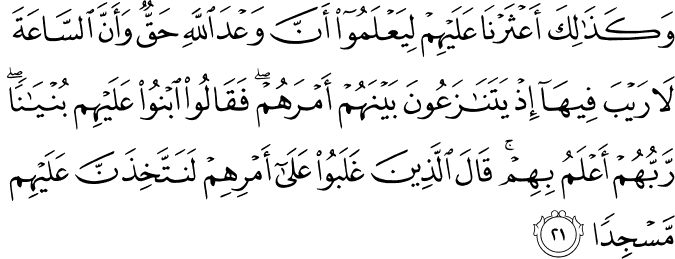
18:21 And that to you, We make known upon them so they would know that the wa'dallaah / promise of Allah is true and that of the saa'ah / direct experience of reality (meeting Allah from a first person perspective) there is no doubt in it when yatanaaza'u / they will pull against one another about their affair and said, "Construct over them a structure. Their Rabb / Lord knows about them." Said those who prevailed (victorious) in the matter, "We will surely establish over them masjidan / a state of submission."
NOTES : This verse reveals how an inner truth, once disclosed, is almost immediately drawn into interpretation and control. What was made known was not for spectacle, but for recognition — so that it becomes clear that the waʿd of Allah is real. The promise here is not postponed hope; it is the certainty that truth reveals itself when the conditions are ripe.
Alongside this is the affirmation of the sāʿah — not merely an event in time, but the direct experience of reality itself. A moment when perception meets truth without mediation, when Allah is not inferred or believed in, but recognised firsthand. About this encounter, there is no doubt — only readiness or resistance.
Yet when such recognition appears, contention follows. They yatanāzaʿūn — pulling against one another — each trying to claim, frame, or define what has been revealed. The affair becomes debated rather than absorbed. One impulse says, “Construct a structure over them.” Preserve the sign by enclosing it. Fix it. Turn it into something stable, distant, and managed.
Another voice interrupts with humility: “Their Rabb knows them best.” A recognition that inner states cannot be captured by outer forms, and that truth does not belong to interpretation.
But those who prevail — those who gain authority over the narrative — choose another route. They decide to establish a masjid over them: a state of submission institutionalised, formalised, externalised. What was inward surrender becomes outward system. What was lived becomes regulated.
The verse does not condemn submission; it exposes a tendency. When inner realisation is not sustained, it is replaced by structure. When direct knowing fades, reverence turns into form. The masjid here symbolises how truth, once recognised inwardly, is often preserved outwardly — not always to deepen awareness, but to manage it.
The verse quietly asks the reader to discern: are you meeting reality directly, or building over the memory of those who did?

18:22 They will say a third, the fourth of them being kalbuhum / their guarding instinct; and they will say fifth, the sixth of them being their guarding instinct - rajman / throwing guesses with the ghaib / hidden nowledge; and they will say seventh, and the eighth of them their guarding instinct. Say, "My Rabb / Lord knows bi'iddatihim / with their count. None knows them (the ghaib) except a few. So do not argue in them except with an obvious argument and do not inquire about them (the ghaib) from anyone."
NOTES : This verse gently exposes a familiar movement of the mind, that is the need to count, define, and categorise what was never meant to be grasped numerically. Once a living sign appears, thought immediately begins measuring it. How many were they? What exactly happened? The mystery is reduced to arithmetic.
They say three, then four with their kalb — their guarding instinct. Then five, then six. Then seven, then eight. The numbers shift, but certainty never arrives. Each claim replaces the last. Nothing is grounded. It is simply rajman — stones thrown into the unseen, guesses cast blindly into what cannot be accessed by speculation.
This is the nature of speaking about the ghayb without direct seeing. The hidden cannot be penetrated by counting. The intellect circles, rearranges, debates — yet never touches essence. The form becomes the distraction.
The instruction redirects attention immediately: your Rabb alone knows their true count. That is, the inner reality of the matter belongs to the One who nurtures it. What is hidden is not meant to be dissected by the surface mind. Only a few perceive beyond form — those who sense the meaning rather than the numbers.
So the guidance is simple and freeing, do not argue. Do not get entangled in debates that add nothing to understanding. If clarification is needed, let it remain obvious and light — just enough to prevent confusion. Do not turn mystery into controversy.
And do not seek answers from others about what can only be known inwardly. The unseen is not resolved through borrowed opinions. It yields only to direct recognition. The verse quietly invites a shift from curiosity about details to intimacy with meaning. The sign is not there to be counted, but to be understood.

18:23 And do not say about anything, "Surely, I will do that ghadan / tomorrow,"
NOTES : This verse gently loosens a subtle knot in the mind, the habit of claiming ownership over what has not yet unfolded. To say, “I will surely do this tomorrow,” seems harmless, yet hidden within it is an assumption: that the future belongs to personal will, that events proceed according to our private authorship.
The word ghadan, tomorrow, points to what has not yet appeared in experience. It lives in the unseen. And the unseen is never fully in the hands of the individual self. It arises from a field far greater than intention alone.
When the mind asserts certainty about tomorrow, it forgets its dependence on the sustaining intelligence of the Rabb. It subtly places itself at the center, as if it were the sole doer. This creates tension, because reality does not obey such claims. Plans shift. Conditions change. Outcomes unfold differently. The strain we feel is not from change itself, but from the illusion of control.
The verse does not discourage action or planning. It softens the posture behind them. Act, intend, prepare, but without the rigidity of “surely.” Leave space for the greater orchestration of life.
There is humility here. A recognition that you participate in unfolding, but do not command it. When this is seen, action becomes lighter. You move sincerely, yet without grasping. In this way, tomorrow is not possessed — insyaAllah, it is received.

18:24 Except if Allah wills. Wadhkur / and embody masculine attributes of your Rabb / Lord (focus, logic, assert, and so on) when nasitat / heedless (when you are absence of the divine masculine qualities) and say, "Perhaps my Rabb / Lord will guide me to what is nearer from this rashadan / sound direction."
NOTES : The verse softens the posture of certainty and returns you to humility. You are told not to bind tomorrow with the claim, “I will surely do.” Because nothing unfolds by isolated will. Every movement arises within a greater field — within the sustaining intelligence of Allah. So the heart remains open, “Except if Allah wills.” This is not hesitation. It is alignment. It is the quiet recognition that you participate in life, but you are not its sole author.
Wa-dhkur rabbaka. When you feel yourself drifting into assumption, reacting mechanically, or losing clarity — return. Gather yourself. Re-establish the masculine qualities of consciousness: focus, discrimination, firmness, deliberate attention. Stand inwardly upright again. To dhikr is to collect scattered awareness and restore order.
Nasīta is heedlessness. The absence of that inner firmness. Attention becomes loose. You are pulled by habits, emotions, and inherited patterns. The directive principle sleeps. So when the masculine axis collapses, you consciously re-embody it. You return to your Rabb — the inner Nurturer who regulates and matures you.
“Perhaps my Rabb will guide me to what is nearer than this in sound direction.” This openness allows guidance to refine you beyond your present understanding. What you intend today may not be the most aligned tomorrow. So you stay teachable, flexible, inwardly listening. The movement of the verse is beautiful and balanced:
- do not claim control
- return to inner firmness
- remain open to correction
In this way, action becomes both strong and surrendered — masculine in clarity, gentle in reliance — aligned with the will of the One who truly guides.

18:25 And they remained in their kahfi / inner refuge for three hundred years (signify three long cycles to attain maturity) and added by nine (for refinement).
NOTES : This verse gently closes the door on any hurried notion of transformation. They did not enter the kahf, the inner refuge, for a brief rest or a passing pause. They remained. The root labithu suggests abiding, lingering, settling deeply into a condition. Not waiting for time to pass, but allowing something within to ripen.
The refuge is not an escape from life. It is a chamber of maturation. A protected interior where noise cannot reach and where consciousness can reorganise itself without interference.
The phrase “three hundred years” need not pull us toward arithmetic. It gestures instead toward magnitude and completeness. Three long cycles — stages of growth — each one sufficient in itself. Layer upon layer of integration. Old patterns dissolving. Perception re-forming. The mind unlearning its habits. The heart stabilising in clarity.
Transformation of this depth cannot be rushed. It asks for seasons, not moments. Then the verse adds: “and they increased by nine.” After maturity, refinement. After structure, polishing. Even when the foundation is firm, subtle adjustments continue. The rough edges soften. Insight becomes embodied. What was understood becomes lived. It is as if the verse is saying, even completion is not the end, there is always a nearer alignment, a finer tuning.
So the numbers describe not duration but depth. Not years on a clock, but degrees of ripening within consciousness. The message is quiet but profound. Inner refuge is not temporary relief. It is a long, patient preparation. Guidance matures slowly, thoroughly, until stability is natural, and then it is refined even further.

18:26 Say, " Allah knows best (the reality of transformation) with what they remained. To Him is the ghaibu / hidden knowledge of the higher consciousness and the lower consciousness. (How perfectly) He sees with it and hears! They have not besides Him any protector, and He shares not hukmihi / His governance with anyone."
NOTES : Here the mind is gently released from its last attachment to counting and measuring. After hearing of their long remaining in the refuge, the tendency is to ask how long, how many, how exactly. But such questions belong only to the surface. Time can be counted; transformation cannot. So attention is quietly redirected, that is only Allah truly knows the reality of what occurred within them.
What is known to Him is not the arithmetic of years, but the depth of their abiding. Not the duration of their suspension, but the unseen maturation that unfolded in silence. From the outside, we measure days and numbers. From within, the Rabb measures ripeness. The slow dissolving of old tendencies, the settling of the heart, the reordering of perception. These movements are invisible to observation, yet fully known to the One who sustains them.
The unseen of both the higher and the lower belongs entirely to Him. The subtlest movements of consciousness and the most grounded events of daily life arise within the same field of awareness. Nothing is hidden, nothing escapes. His seeing and hearing are not sensory acts, but total knowing. Every inner shift, even the faintest, is already encompassed.
From this recognition, reliance naturally withdraws from everything secondary. There is no true protector besides Him. No system, no structure, no external authority can safeguard the soul or guide its unfolding. Protection is not found outside; it is nurtured from within. And the governance of this growth is not shared. The ordering of life flows from a single, undivided intelligence.
So the heart relaxes its need to speculate. There is no need to argue, calculate, or seek certainty from others. The same One who guided them in retreat, preserved them in stillness, and raised them at the right moment is guiding your unfolding as well. What matters is not how long the journey takes, but trusting the One who knows exactly what is being formed within you.

18:27 And atlu / follow through, what has been 'uhiya / inspired to you from kitab / inherent script of your Rabb / Lord. There is no change of His words, and never will you find from other than Him, multahadan / one who gives shelter.
NOTES : Having been guided through withdrawal, stillness, maturation, and the quiet protection of the inner refuge, the movement now turns outward again, but with a different quality. You are not told to search for new answers or gather more opinions. You are simply asked to follow closely what has already been revealed within you.
To atlu is not merely to recite words. It is to walk in their trace. To let the revealed guidance lead your steps. Like following footprints in sand, you place your awareness carefully where truth has already marked the way. This is lived recitation, not sound on the tongue, but alignment in action.
What is revealed is not foreign or imposed. It arises from the kitab of your Rabb — the inherent script, the inner ordering of reality itself. Guidance is not somewhere else. It is already inscribed within the structure of your being. The Rabb who matures you also arranges the path before you. So following revelation is simply cooperating with your own deepest nature.
And there is a deep reassurance here, that is nothing can alter His words. The living principles by which reality unfolds cannot be replaced, edited, or negotiated. Human interpretations shift. Systems rise and fall. Opinions multiply. But truth itself remains untouched. What is real does not bend to preference.
Because of this, there is nowhere else to turn. You will never find refuge apart from Him. No secondary shelter — not identity, not ideology, not belonging, not control — can truly protect the heart. Every alternative refuge eventually collapses, because it is built on what changes. Only the sustaining presence of the Rabb is stable.
So the verse leaves you with a simple posture. Stay close to what has been inwardly revealed. Walk with it. Trust it. There is no safer ground, and no other shelter is needed.

18:28 And stabilise your nafs / soul patiently with those who call upon their Rabb / Lord with the ghadaati / early stage of clarity and the 'ashiyyi / lacking perception wajhahu / its focus to care (for growth), seeking His countenance (admission / acceptance). And let not your eyes drift away from them, desiring adornments of the worldly life, and do not obey qalbahu / whose heart We have left in heedlessness of zikrina / Our embodiment of the divine masculine attributes and who follows his desire (impulses) and whose affair has fallen into disorder.
NOTES : This verse turns from the solitude of the inner refuge to the company you keep once you return to life. After retreat, awakening, and realignment, there is still one subtle danger, that is drifting back into old currents through the pull of the environment around you. So the instruction is simple and deeply practical, stabilise yourself.

18:29 And say, "The truth is from your Rabb / Lord, so whoever wills - let him take security; and whoever wills - let him yakfur / reject." Indeed, We have prepared for the zaalimin / unjust (who displaced truth from its rightful place) naaran / internal conflict (that burn an-nas) whose surrounding will cover them. And if they consider calling for relief, they will be relieved with ma'i / flow of knowledge, like murky oil (deliberately moving / proceeding slowly), burn the wujuha / its focus to care (miss the object of mental growth). Wretched (miserable) is the drink (the direct experience), and evil is the resting place.

18:30 Indeed, those who have trusted (and take security) and do corrections (transformations) - indeed, We will not allow to be lost the reward of any who did well in deeds.

18:31 Those (who did well in deeds) will have jannatu / hidden knowledge (from their Rabb); beneath them rivers (of enlightening knowledge) will flow. They will be adorned therein (state of mind) from zahabin / dispersed thoughts and yalbasuna / will be wrapped (in) thibaban / a cover of khudran / immatured state from supports of intelligence and eloquency, reclining / leaning therein (upon his Rabb). Excellent is the reward, and good is the resting place.

18:32 And present to them an example of rajulain / two independent thought processes (for analysis, reason and rationalization): We granted for one of them jannatain / two gardens of hidden knowledge from life (repeating itself), and We surrounded them (the two of them) with choosing nakhlin / structured and placed between a means to cause them the growth.

18:33 Each of the two jannata / hidden gardens of knowledge produce the two (knowledge) and did not tazlimu / wrong / fall short thereof in anything. And We caused to gush forth within them a river (flow of enlightening knowledge).

18:34 And he had thamarun / an increased intellect, so he said to his companion (thought given birth by his mind) while he was conversing with him, "I am greater than you in wealth (in terms of knowledge) and more honorable contender."

18:35 And he entered his jannah / hidden garden of knowledge while he was unjust to his soul / self. He said, "I do not think that this will perish - ever".

18:36 And I am not azhunnu / certain of the saa'ata / direct experience (meta consciously) will qaa'imah / establish. And if I should be brought back to my Rabb / Lord, I surely will find better from it, munqalaban / one whose knowledge is central to the heart."

18:37 His companion (thought given birth by his mind) said to him while he was conversing with him, "Have you distrusted in He who evolved you from turab / layers of falsehood (in knowledge) and then from a nutfatin / a seed of knowledge and then proportioned you rajulan / an independent thought process (for analysis, reason and rationalization)?

18:38 But as for me, He is Allah , my Rabb / Lord, and I do not associate with my Rabb / Lord, anyone (with other illusory being).

18:39 And why did you not, when you entered your jannah / hidden garden of knowledge, say, "what Allah willed (has occurred); there is no power except with Allah ? Although you see me less from you in wealth (of knowledge) and children (thoughts that you give birth / produce / breed),

18:40 It may be that my Rabb / Lord will give me (something) better than your jannati / hidden garden of knowledge and will send upon it a calamity from the samaa'i / higher state of consciousness, and will become a smooth, dusty ground,

18:41 Or yusibhu / will become (in a state of) its knowledge thereof ghawran / sunken / cave in (lost) so never you will be able to find it.

18:42 And surrounded with thamarihi / increased intellect, so he began turning it inside-out altogether over what he anfaqa / self-experienced in it (the reform), while it had collapsed upon 'urushiha / its framework / structure, and said, "Oh, I wish I had not associated with my Rabb / Lord, anyone."

18:43 And there was for him no one to yansuru / help him from other than Allah, nor could he defend himself.

18:44 Here for you, Al-Walayah (the protection, power, authority and kingdom) will be for Allah, the Truth. He is the best for reward and the best for the final end.

18:45 And present to them the example of the living of this duniya / close attachments and relations, like flow of knowledge which We reveal from the samaa'i / higher consciousness, intermingled with it nabaatu / mental development of the ardh / lower consciousness then it in the early stage become hollow (and easily broken) scattered. And Allah is ever, over all things, Perfect in Measurement.

18:46 Al maalu / the wealth of knowledge and al banuuna / the thoughts produced are adornment of the living temptation of the duniya / close attachments. And the perpetual saalihaatu / correction and transformation are better in the nearness of your Rabb / Lord for reward and better for amalan / deeds / experience.

18:47 And (warn of) the moment when We will nusa'iru / pursue the jibal / fixed headed mind and you will see the lower consciousness prominent (apparent), and We will gather them and not leave behind from them anyone.

18:48 And they will be presented before your Rabb / Lord in saffan / alignment (towards mental clarity), surely, "You have certainly come to Us just as We evolved you the first time. But you claimed that We would never make for you maw'idan / a promise."

18:49 And Al Kitab / the inherent script (of the Rabb) will be placed, so you will see al mujrimun / the one who violated the covenant fearful of that within it, and they will say, "Oh, woe to us! What is this Kitab / inner script that leaves nothing small or great except that it has enumerated it?" And they will find what they did present. And your Lord does yazlimu / wrong / injustice to no one.

18:50 And when We said for the malaa'ikah / sovereign inner authority (where authority to interpret is placed within the consciousness field) to asjudu / submit for Adam / who receive education of the unseen,, then they all fasajadu / submitted except iblees / who are intensely wrapped (with despair and broken spirit). He was of the jinn / hidden thought process (where its construct or birth is not from the command of the consciousness field) fasaqa / disobeyed from the command of his Rabb / Lord. Then will you take him (iblees) and zurriyatahu / his off-springs of early developed thoughts, as allies other than Me while they are enemies to you? Wretched it is for the wrongdoers as an exchange.

18:51 (Allah says further to the malaaikah) I called them not to witness the evolution of the higher state of conscousness and the lower state of consciousness nor evolution of their own soul / self and I would not have taken the misguiders as assistants (to you),

18:52 And the moment when (He) shall say: Call on those whom you considered to be My associates. So they shall asserted on them, but they shall not answer them, and We will cause a separation between them.

18:53 And al mujrimun / the one who violated the covenant will see an-nar / the internal conflicts (that burn an-nas) and will be certain that they are to fall therein. And they will not find from it a way elsewhere.

18:54 And we have certainly varied / diversified in this quran (expressions of truth derived from reading the ayaati / signs) for an-nas / the agitated mind from every (kind of) example, but insaan / perceptive intellect (aligned with the truth), most of anything, (as for the agitated mind, they are prone to) jadalan / be in contention,

18:55 And nothing has prevented an-nas / the agitated mind that trusting (and take security) when al huda / the guidance came to them and asking forgiveness from their Rabb / Lord except that there come to them the sunnatun awalin / early practice or that the punishment should come before them.

18:56 And when We send not the mursalin / inner voice (who deliver the message) except mubashirin / one who possess sensible thoughts (that decode the ayaati / signs to understand the truth) and warners, and those who kafaru / reject, yujadilu / wish to be in contention with bathil / falsehood to invalidate with it the haq / truth, have taken My ayaati / signs and that of which they are warned, huzuwa / in disregard / dispute.

18:57 And who is more azlamu / wrong / unjust than one who zukkira / has embodied (the masculine attributes) with the ayaati / signs of his Rabb / Lord but turn away from them and forget what his hands (physical deeds) have put forth? Indeed, We have placed over their hearts (pulling of affection) coverings, as though they understand it, and in their ears deafness (not listening). And if you invite them to guidance, they will never be guided, ever.

18:58 And your Rabb / Lord is the Forgiving, possessor of Rahmah / abstract system of education. If He were to impose blame upon them for what they earned, He would have hastened for them the punishment. Rather, for them is a promise from which they will never find an escape.

18:59 And those al quraa / the configuration of inner realisation - We destroyed them when they zaalamu / are unjust (displaced truth from its rightful place), and We made for their destruction, a promise.

18:60 And when Musa / the one who is matured and familiar with the truth, said to his fataahu / thoughts in the prime (the opposite of al quraa / the established thoughts in HQ 18:59), I will not quit until I reach majma'a / assembling point of both oceans of knowledge (from mental and Ladunni as mentioned in HQ 18:65) or I will continue being hukuban / kept back (without knowledge),

18:61 Then when they both reached majma'a / assembling point between both of them (the two oceans of knowledge), both of them overlook hutahuma / knowledge that swim around (enticing both of them), so it took its path in the ocean (of knowledge) slipping away.

18:62 So when they jaawaza / had processed (in their mind the hidden knowledge), (Musa) said to fataahu / thoughts in the prime, "Bring us ghada'a / early stage of clarity. We have certainly laqi / measured from safari /state of absence (zero / blank mind) to determine in this (spiritual journey), nasaban / a final reflection."

18:63 He said, "Did you see when we retired to the foundation (thought) ? Indeed, I forgot al huta / knowledge that swim around (enticing both of them). And none made me overlook it except the shaytan / act arises from state of despair - that I should mention it. And it took its course into the ocean of knowledge amazingly".

18:64 He said, that is what we were seeking. So they both returned on their qasasan / traceable steps of the evolution.

18:65 So both of them wajada / found / attained (after Allah brought it into existence) a servant from Our servants. We gave him rahmah / abstract system of education from our nearness and We taught him ladunna / directly from Our knowledge (not mediated by the conditioned mind).

18:66 Musa (the one who is matured and familiar with the truth) said to him (ladunna / in the presence / khidr of your Rabb), "May I follow you on that you teach me from your pure knowing of right guidance?"

18:67 He said, "Indeed, with me you will never be able to have patience.

18:68 And how can you have patience for what you do not encompass with it, khubran / (any) knowledge (of it) ?

18:69 (Musa) said, "You will find me, if Allah wills, patient and I will not disobey your order."

18:70 (Khidr / the presence of your Rabb) said, "Then if you follow me, then do not ask me about anything (the mind must be silent) until I uhditha / have expressed what has been unveiled (of what Allah has decoded the meaning) to you from it zikran / embodiment (of the divine masculine attributes)."

18:71 So both of them (Musa and khidr / in the presence of Rabb) thalaka / set out to be separated, until when they had embarked in the safiinati / dissolution, tore it open. (Musa) said, "Have you torn it open to drown its ahla / those who are acquainted ? You have certainly done a im'ran / grievous thing ."

18:72 (Khidr) said, "Did I not say indeed with me, you would never be able to have patience?"

18:73 ( Musa ) said: "Call me not to account with what I forgot, and not suspect me of bad conduct from usran / (raising) difficulty of my affair."

18:74 Then they both (Musa and khidr / in the presence of Rabb) thalaka / set out to be separated, until when laqiya / measure determining a lustful excitement, so he killed him. (Musa) said, "Have you killed a zakiyyatan / pure nafsan / soul / psyche for other than nafsin / a soul / psyche? You have certainly done a thing, nakran / misjudged."

18:75 (Khidr) said, "Did I not say indeed with me, you would never be able to have patience?"

18:76 (Musa) said, "If I should ask you about a thing after this, then do not keep me (intellect aligned to the truth) as a companion. Verily, you have delivered from ladunni / intuition (the presence) of your Rabb, 'udhran / an excuse (exempted from blame)."

18:77 Then they both (Musa and khidr / in the presence of Rabb) thalaka / set out to be separated, until when they came to those ahla / integrated qaryah / configuration of inner realisation, they asked those acquainted for nourishment, but they refused to provide. And they found therein a wall (their fortification) about to collapse (the wall that protects), so he restored it. (Musa) said, "If you wished, you could have taken for it a reward."

18:78 He said, this is a separation between me and between you, I will inform you with interpretation (news of the ghaib) on what you were not able (to have) patience on it.

18:79 As for the safinatu / dissolution, fakanat / then took place for masaakin / needy of knowledge ya'maluna / experiencing in the ocean of knowledge. Then (when the dissolution) aradtu / shifting to and fro that cause a'ibaha / imperfection in it and there was after them malikun / a faculty of authority who yakhudzu / might gain every safinatin / dissolution, forcefully.

18:80 And as for the ghulaamu / excited by lust, abawaahu / his fatherly support of masculine thoughts and emotions were mukminain / those two who trust (and take security with the Rabb), so we feared (disapprove) that he should come upon both of them (by his undutiful conduct and bringing evil upon them) that yurhiqahuma / make excessive thughyaanan / falsehood activities and rejection.

18:81 So aradna / we shifted that their Rabb / Lord should substitute for them a better from him in purity and nearer to ruhman / the abstract system of education.

18:82 And as for the wall (fortification that is about to collapse), so it was (belonging) to ghulamain / those two who are excited by lust, those two who are not guided in Al Madina / the state of deen (conscious obedience) and beneath it a treasure (pure knowing) for both of them, and both their fatherly support (logical mind and emotion) correct / transform, so your Rabb / Lord willed that they both reach their maturity / strength (in the understanding), and they both take out their treasure, rahmah / abstract system of education from your Rabb / Lord and I do not do it from my own accord. That is interpretation (of) what you were not able (to have) patience on it.

18:83 And they ask you about Dhul Qarnain / the possessor of combined systems of education (mentation and ladunni). Say, I will pursue (study) on you from it, zikran / an awareness.

18:84 Surely makanna / We empower to him in al ardh / the lower consciousness and bestow him (the knowledge) from all kinds of sababan / cause / motive.

18:85 So he concentrates / investigates a cause / motive.

18:86 Until when he balagha / reaches maturity / strength (in understanding from) maghriba / early darkness (to) the shamsi / illumination and he perceives / finds her taghrubu / remote in perception of hami'atin / dirty thought and he finds near that a qauman / group of thoughts. We say, O dhul qarnain / possessor of combined systems of education (by mentation and ladunni) either that you can give them retribution / punishment and you can take that, whatever in them pleasing.

18:87 He says, whoever zalama / does wrong / does unjust then soon we will give him retribution / punishment then he will be returned to his Rabb / Lord, and He will give a difficult retribution.

18:88 And as for whoever trust ( the combined systems of education) and do correction / reform, so for him a good / pleasant reward and soon We inform him from our command (with) ease.

18:89 Then he concentrate on another cause / motive.

18:90 Until when he balagha / reaches maturity / strength (in understanding) mathligha / increase (in clarity) the illumination and he finds it that it's rising upon a qaum / group of thoughts for whom we don't make from other than it, sitran / a cover up.

18:91 Thus and surely, khodna / We encompass (knowledge) with what khubran / knowledge near him.

18:92 Then he concentrates on another cause / motive.

18:93 Until when he reached balagha / maturity / strength (in knowledge) between the saddain / two sayings in the right direction (from two systems of education), he finds qauman / a group of thoughts from who can hardly understand, qaulan / a saying.

18:94 They said, O dhul qarnain / possessor of combined systems of education (mentation and ladunni) surely yakjuj / adding other information to reality and makjuj / state of having distorted reality, mufsidu / the ones who are corrupt in Al Ardh / lower consciousness then shall we make for you kharjan / a way out upon that between us and between them, saddan / a saying (towards the right direction)?

18:95 He said what established me in it that my Rabb / Lord is better, then assist me with strength, I will make between you and between them, radman / a barrier.

18:96 Give me zubara / cognitive intelligence (mental abilities to acquire, process, understand, store and retrieve information) of the hadeed / law of the limits until when sawaa / brought balance between the sadafayn / two opposing boundaries, he said unfukhu / inflate (to fill in) until when it makes naran / conflict within oneself, (so when the conflict come) say, give me (so that) I pour down over it qitran / stability bit by bit.

18:97 So they ( Yakjuj and Makjuj) are not abled to overcome nor to incline for it.

18:98 (Dhul-Qarnain) said, "This is a rahmah / an abstract system of education from my Rabb / Lord; so when the promise of my Rabb / Lord comes, and He will make demolish it (yakjuj and makjuj), and ever is the promise of my Rabb / Lord true."

18:99 And We will leave some of them that moment (those) in a state of commotion (conflicting) in others, and nufikha / inflated in badness, and We will gather them, altogether.

18:100 And We will present jahannam / state of stagnation that moment to al kafirin / rejecters / those who cover (the truth), 'ardhan / a display / obvious -

18:101 Those whose a'yunuhum / sights had been within a cover (by the state of stagnation) about awareness, and they were not able to hear.

18:102 Do (you) then think those who kafaru / reject / cover (the truth) that they can take My servants from other than Me as wali / guardian / allies? Indeed, We have prepared jahannam / state of stagnation for the kafirin / rejecters / those who cover (the truth) as a settled place (they will be occupied in).

18:103 Say, "Shall we (mukmin) inform you of the greatest losers as to a'malan / experience / deeds ?

18:104 They are those whose effort is lost in hayaati duniya / temptations of close attachments and relations, while they think that they are doing well in work."

18:105 Those are the ones who kafaru / reject / cover (the truth) with ayaati / signs of their Rabb / Lord and in (their) meeting Him, so their deeds have become worthless; and We will not assign to them on the yawmal qiyamah / moment of standing upright (in consciousness) any importance.

18:106 That is their reward - Jahannam / state of stagnation - for what they rejected / denied / covered (the truth) and they took My signs and My rusuli / inner voices (that deliver the messages) huzuwa / in disregard / contempt / not mindful.

18:107 Indeed, those who have trusted (and took security) and do solehaati / corrections / transformations - they will have the jannah / hidden gardens of firdaus / abundant / plentiful knowledge as a lodging,

18:108 Wherein they abide eternally. They will not desire about it, a change.

18:109 Say, if the ocean of knowledge midadan / expanded / stretched for the words / speech (lafzun) of my Rabb / Lord, the ocean of knowledge would be exhausted before the words / speech (lafzun) of my Lord exhausted, even if We brought the like of it as supplement.

18:110 Say, "I am only a bashar / sensible thought (to awaken awareness) like you, to whom has been inspired that your ilaah / object of devotion is a single irreducible ilaah / reality of being. So whosoever would hope for the meeting with his Rabb / Lord - let him do corrective / reformative deeds and do not associate with ibadah / service of his Rabb / Lord, anyone."


No comments:
Post a Comment