
ALI IMRAN
(Consciousness enlivened by divine order)

INTRODUCTION#lookingatoneself
Surah Ali ‘Imran explores what happens when the insaan encounters truth, how understanding develops, and why remaining aligned with Al-Haqq requires more than simply acquiring knowledge. Throughout the surah, we are invited to examine the relationship between recognition, inherited beliefs, rational thought, inner attachments, and the choices that shape our experience. The central concern is not merely what we claim to believe, but whether we are willing to recognise what is true and allow that recognition to transform how we think and live.
The surah repeatedly draws attention to the difference between receiving knowledge and responding to it honestly. The insaan may possess an inherent script through which reality can be recognised, yet still become attached to familiar interpretations. Knowledge can open the way to greater clarity, but it can also be used to defend established positions. When an attachment becomes more important than truth, the mind may conceal what it has already recognised, selectively accept what supports its assumptions, or reject what threatens its sense of security. The challenge is to remain receptive rather than allowing accumulated knowledge to become a barrier to further understanding.
A recurring theme is the relationship between what unfolds within the insaan and what becomes expressed through outward behaviour. Thoughts, emotional responses, beliefs, and attachments influence how reality is perceived. When these inner configurations are examined honestly, the insaan can begin to recognise the patterns that support clarity and those that distort it. The surah encourages us to look beyond appearances and question the assumptions through which we interpret our experiences. What appears to be strength may conceal fear; what appears to be certainty may be attachment to an unexamined belief; and what appears to be progress may simply be movement within familiar patterns.
Ali ‘Imran also explores the importance of humility in the pursuit of understanding. No amount of accumulated knowledge removes the need to examine oneself. A person may be deeply familiar with revelation, possess considerable intellectual ability, and yet resist a truth that challenges an established position. Genuine receptivity requires the willingness to acknowledge the limits of one's understanding, reconsider conclusions when necessary, and distinguish what has actually been recognised from what one merely assumes to be true. Rational thought has an important role in this process, but it must remain open to correction rather than becoming a tool for defending preconceived conclusions.
The surah further examines the consequences of alignment and misalignment. When the insaan conceals what has been recognised, the immediate result may appear advantageous. Familiar beliefs remain undisturbed, attachments are protected, and the mind avoids the discomfort of reconsideration. Yet this apparent comfort can sustain inner conflict and obstruct further development. Conversely, when the insaan consciously guards its alignment with Al-Haqq, it becomes increasingly able to recognise harmful patterns, correct mistaken understanding, and allow knowledge to nourish further growth. The difference lies not simply in what is known, but in what the insaan does with what has become clear.
Another important thread is the relationship between individual developmental thought and the wider experience. The surah examines how thought respond to one another, how established affiliations can influence judgement, and how mutual support can either strengthen truthfulness or reinforce mistaken assumptions. It calls for steadfastness, humility, patience, and the refusal to exchange the signs of Allah for temporary advantage. These qualities are not separate from self-examination; they are expressed through the way we respond when our beliefs are challenged, when difficulties arise, and when we encounter knowledge that does not fit what we have previously accepted.
Toward its conclusion, the surah directs attention to the signs revealed through the evolution of higher and lower consciousness and the alternation of obscuration and illumination. Those who reflect deeply do not rush to dismiss what is unfamiliar, nor do they force every new recognition to fit their existing assumptions. They remain connected with their Rabb, allow understanding to unfold, and seek protection from the consuming consequences of agitation and rigid thinking. Reflection becomes meaningful when it leads to greater clarity, humility, and a willingness to live in accordance with what is recognised.
The closing verse brings these themes into practical focus: remain steadfast, support one another in steadfastness, remain firmly connected and watchful, and consciously guard alignment with Allah. The movement toward Al-Haqq is not completed by a single moment of recognition. It requires continuing attention to the habitual thoughts, emotional responses, and conditioned patterns that can either support understanding or draw the insaan away from it.
Reading Surah Ali ‘Imran through this inquiry invites us to examine ourselves as we move through its verses. Where are we receptive to truth, and where do we resist it? When knowledge challenges our attachments, do we investigate honestly or seek reasons to dismiss it? Are our beliefs helping us recognise reality more clearly, or are we using them to protect what we do not wish to question? These questions allow the surah to become more than a collection of statements to be accepted. They make it an opportunity to observe how understanding develops, how truth can be concealed, and how the insaan can return to a more truthful alignment with Al-Haqq.

With the name of Allah - the Rahmaan, the Raheem.
NOTES : The name of Allah is the vibrational signature of the Being in whom all forms appear and disappear, the indivisible presence that pervades both the lower consciousness for the world of experience and thought, and the higher consciousness for the unbounded, unseen field from which all meaning flows. To invoke this name is to recognise that every measure of existence, every unfolding event, every hidden arrangement of cause and effect, arises within the vastness of this singular reality.
To begin with this name is to begin from stillness, from wholeness, from the recognition that the intelligence that moves galaxies is the same intelligence guiding your next breath. It is a return to the awareness that everything you seek is already held within the One who is nearer than your own being. In this recognition, the journey becomes simple, that is to remain open, to listen deeply, and to allow the mercy that shapes all things to shape you from within.

3:1 Alif, Lam, Meem.
NOTES : Alif signifies the singular, fundamental, irreducible reality of being itself. Lam represents the manifestation of the Singular reality through its countless representations, and Meem is the letter of completion and return, signifies al-aakhirah, the ending of association through dissolution of the conceptual self and the ending of separation through dissociation of true self.
This surah opens with the disjointed letters Alif, Lam, Meem. Altogether the Quranic language consists of 28 letters and 14 appear as disjointed at the beginning of 29 surahs. These Quranic letters are signs, with their distinct shapes and sounds, form the foundational building blocks of the Quranic verses, through which divine signs are manifested to convey Allah’s hidden messages of guidance and wisdom. From these letters, words and languages emerge, serving as a gateway to uncovering the profound, hidden spiritual messages embedded within the signs. From the pleasant thoughts provided to you, they invite pure rational mind to contemplate and grasp the deeper meanings concealed within.
From the comtemplation arises the appearance of the illusory, conceptual self, the self you imagine into being. This false self gives birth to further layers of association and separation, weaving a sense of distance from your true nature. When the conceptual self dissolves, both association and dissociation end. It is an act of injustice when truth is displaced by its illusion, when the representation is taken as reality. Amalan ṣaaliḥan are the corrective deeds that undo these distortions, dissolving injustice and allowing your true self to awaken and return to Allah. This is the inner process of al-aakhirah, the ending of dissociation and the unification of your true self as a living expression, a fractal reflection, of consciousness itself.

3:2 Allah, there is no ilaah / governing reality (that governs the mind) except Huwa / He, the Ḥayy / Ever-Living, the Qayyum / Self-Sustaining and Sustainer of all.
NOTES: The verse begins by directing attention away from the multiplicity of objects, thoughts and assumptions that appear to govern the mind. Ilaah is understood here through its functional meaning as a governing reality—whatever is allowed to determine the direction and configuration of the mind. The statement that there is no governing reality except Allah therefore points to the fundamental unity behind all authentic recognition.
The word Allah itself is not being presented as one competing object among other objects of thought. Rather, it identifies the ultimate Reality from which all genuine recognition arises. The apparent multiplicity of governing influences belongs to the conditioned mind. When these influences are examined, they are found to depend upon something prior to them: the awareness in which they appear and through which they become known.
That Reality is described as Al-Ḥayy / Ever-Living. Life here is not merely biological existence. It points to that which is never dependent upon the conceptualized self for its existence or recognition. Thoughts arise and disappear, identities change, knowledge develops and circumstances unfold, yet the capacity through which all of these are known is not itself dependent upon any particular thought.
It is then described as Al-Qayyum / Self-Sustaining and Sustainer of all. The root q-w-m carries the sense of standing, maintaining and establishing. The inward significance is therefore that Reality does not require support from the structures it sustains. The conceptualized self depends upon innumerable conditions, while the sustaining Reality is not dependent upon the self.
This creates an important distinction between what appears to govern the mind and what actually sustains its existence. Established thoughts may temporarily direct attention, inherited beliefs may appear authoritative, and emotional patterns may seem powerful, but none of them possesses independent existence. They arise within a reality that precedes and sustains them.
Thus 3:2 follows naturally from the closing movement of Al-Baqarah. After the insaan has been brought through recognition, resistance, inherited conditioning, responsibility and surrender, attention is brought back to the foundation itself. The journey is not ultimately toward establishing a stronger conceptualized self. It is toward recognizing the Ḥayy, Qayyum—the ever-living Reality that is already present, already sustaining, and never separate from the awareness through which truth is recognized.

3:3 He has brought down upon you Al-Kitab / the inherent script with Al-Haqq / the Truth, confirming what is within the reach and presence (of the rational mind), and He brought down the Tawrah / natural laws of reality (through which behavioural consequences become evident) and the Injeel / good news when signs reveal reality.
NOTES: The movement begins with Al-Kitab / the inherent script being brought into the field of the insaan. Because it comes with Al-Haqq / the Truth, it is not an arbitrary system of ideas imposed upon the mind. It reveals an inherent order that is already present within reality. The insaan is therefore invited to recognize rather than merely believe, to see what is already capable of being recognized within direct experience.
This is why the expression “what is within the reach and presence of the rational mind” is important. The rational faculty is capable of examining, connecting and recognizing what lies within its field of awareness. Al-Kitab confirms that which can already be reached by genuine reasoning, while also opening awareness to what lies beyond the limitations of established thought. Revelation and rational recognition therefore work together rather than standing in opposition.
The Tawrah / natural laws of reality then reveals another dimension of this recognition. Reality operates according to inherent laws, and these laws become evident through their consequences. Every thought, orientation and action participates in a process of cause and consequence. When the insaan understands these natural laws, behavioural consequences are no longer seen as arbitrary rewards or punishments imposed from outside. They are recognized as the natural unfolding of the configuration that has been established.
The Injeel / good news when signs reveal reality describes what happens when these signs become clear. A sign is not merely information pointing toward something else; it is an opening through which reality becomes recognizable. When what was previously obscured becomes evident, recognition itself becomes good news. The joy comes from the dissolution of uncertainty and from seeing reality more directly.
There is therefore a progression within the verse. Al-Kitab reveals the inherent script with Al-Haqq; the rational mind is able to recognize what lies within its reach; the Tawrah reveals the natural laws through which consequences become evident; and the Injeel expresses the good news that arises when signs disclose reality. These are not disconnected forms of guidance. They are different dimensions of one movement from obscurity toward recognition.
The deeper invitation is for the insaan to examine reality without allowing inherited assumptions to dictate what must be seen. What is within reach of the rational mind can be examined; the consequences of behaviour can be observed; and signs can be recognized as they reveal what is true. In this way, guidance becomes experiential rather than merely conceptual. Al-Haqq does not demand that the insaan abandon understanding; it invites understanding to become sufficiently clear that what is already present can finally be recognized.

3:4 From before, as guidance for an-nas / the agitated mind, and He brought down the Furqan / faculty of discernment (that distinguishes truth from falsehood). Indeed, those who kafaru / conceal what they recognize in the aayaat / signs of Allah, for them is a severe punishment. And Allah is ʿAzīz / irresistible in authority, Dhu Intiqaam / possessing the consequence that follows from what is concealed.
NOTES: The guidance that has already been brought into the field of the an-nas / agitated mind is accompanied by the Furqan / faculty of discernment. Recognition alone is not enough, because the mind can receive many impressions and interpretations. The Furqan enables the insaan to examine what arises and distinguish what is aligned with Al-Haqq / the Truth from what merely appears convincing.
This faculty of discernment is particularly important because the agitated mind is easily influenced by established patterns. Something familiar can appear true simply because it has been repeatedly accepted, while something unfamiliar can be rejected despite being true. Furqan therefore represents the capacity to see beyond familiarity and examine what is actually being recognized.
The verse then turns toward those who kafaru / conceal what they recognize. This is a deeper condition than simply not knowing. The recognition has already occurred through the aayaat / signs of Allah, yet the mind covers it rather than allowing it to unfold into understanding. Concealment can therefore take place even in a mind that possesses knowledge. What matters is not how much has been encountered, but whether what has been recognized is allowed to remain visible.
The resulting severe punishment can be understood as the natural consequence of this concealment. When the insaan recognizes something as true but continues to organize thought against that recognition, an inner division develops. The mind is pulled between what it knows and what it insists upon maintaining. The resulting conflict becomes its own form of suffering. The consequence is therefore inseparable from the act of concealment itself.
Allah is ʿAzīz / irresistible in authority because no configuration of thought can ultimately alter Al-Haqq. The mind may conceal a sign, deny its significance or construct another explanation around it, but the Truth does not become less true. Its authority does not depend upon recognition by the conceptualized self. What is real remains real even when awareness temporarily turns away from it.
Dhu Intiqaam / possessing the consequence that follows from what is concealed completes the movement. What is concealed does not simply disappear; it continues to participate in the unfolding of the self. The consequence arises from the very configuration that has been established through concealment. In this sense, Allah's authority is not arbitrary retaliation but the certainty that reality ultimately reveals the consequences of whatever the insaan chooses to recognize, conceal or embody.

3:5 Indeed Allah, nothing is yakhfa / concealed upon Him, whether in the ard / lower consciousness or in the samaawaat / higher consciousness.
NOTES: The preceding verse introduced the Furqan / faculty of discernment through which the insaan distinguishes what is aligned with Al-Haqq from what conceals it. This verse now establishes the foundation upon which such discernment rests: nothing can actually be hidden from Allah. What may be concealed from the conceptualized self is never concealed from the Reality in which that self exists.
The word yakhfaa / is concealed points to something being hidden from awareness or kept out of sight. Within the inward reading, however, concealment belongs to the limitations of the mind. A thought may remain unnoticed, a motive may be suppressed, or a recognition may be deliberately covered, but none of these movements can exist outside the knowing of Allah.
The ard / lower consciousness represents the field in which thought becomes more contracted, conditioned and attached to particular configurations. The samaawaat / higher consciousness, by contrast, represents progressively elevated states of awareness. The verse encompasses both, showing that Allah's knowing is not restricted to one level of the insaan's experience.
This has an important implication for kufr / concealing what has been recognized. The insaan may conceal recognition from itself, from others, or even construct an explanation that makes the recognition appear absent. Yet concealment does not remove what has been recognized from Reality. What has been covered in one level of awareness remains fully known to Allah.
The verse therefore prevents the Furqan from becoming merely an intellectual exercise. Discernment is not about constructing a private certainty and then defending it. It is about becoming increasingly transparent to what is already present. Since nothing is hidden from Allah, the deeper movement is toward honesty—allowing what is actually occurring within the mind to become visible without distortion.
There is also a quiet reassurance in this recognition. The insaan does not need to make everything visible by force before Allah can know it. Nothing is outside His knowledge, whether it appears in the lower consciousness or the higher consciousness. The task of the seeker is therefore not to inform Allah of what is hidden, but to become sufficiently aware to recognize what Allah already knows.

3:6 He is the One who yusawwir / gives shape to you in the arḥaam / inner conception of understanding, however you will. There is no ilaah / governing reality except Huwa / He, Al-ʿAziz / the Irresistible in authority, Al-Ḥakim / the One that is perfect in wisdom.
NOTES: The previous verse established that nothing is concealed from Allah, whether within the ard / lower consciousness or the samaawaat / higher consciousness. This verse takes that recognition further by directing attention to the very process through which understanding takes shape. The insaan does not merely receive thoughts and perceptions; within the arḥaam / inner conception of understanding, these are continuously given form.
The expression yusawwir / gives shape points to the transformation of what is not yet clearly formed into something that can be recognized. An understanding may begin as a subtle impression, gradually acquire structure, and eventually become a clearly identifiable thought or orientation. The inner conception therefore functions as a field in which potential recognition takes shape.
This shaping is not confined to what the conceptualized self consciously chooses. Much of what appears within understanding emerges through a process that precedes deliberate thought. The insaan discovers thoughts already taking form within itself and may only subsequently become aware of them. Thus, the verse directs attention beyond the assumption that the conceptualized self is the independent author of everything that appears within its field of understanding.
The phrase “however you will” introduces the dimension of will into this unfolding. What takes shape within understanding is not separate from the movement of willing. The insaan continually turns toward some possibilities and away from others, and these orientations participate in the forms that become established. Yet beneath this apparent individual willing remains the singular governing Reality. The conceptualized self participates in the unfolding, but it does not stand outside the Reality within which the unfolding occurs.
This leads naturally to the declaration that there is no ilaah / governing reality except Huwa / He. Whatever forms appear within the inner conception of understanding are not independent authorities. Thoughts may seem to govern the mind, inherited assumptions may appear authoritative, and established orientations may determine behaviour, but none possesses ultimate governing authority. Their existence and influence remain within the One Reality that gives them form.
The verse therefore closes with Al-ʿAziz / the Irresistible in authority and Al-Ḥakim / the One that is perfect in wisdom. What takes shape within the insaan is not outside the authority of Allah, nor is its unfolding without wisdom. Recognition develops through forms, forms become visible within understanding, and understanding continually reveals its limitations and possibilities. The deeper movement is to recognize that behind every form is the One Reality in which that form arises—irresistible in authority and perfect in wisdom.

3:7 He is the One who has brought down upon you Al-Kitab / the inherent script. Within it are aayaat / signs that are muḥkamaat / governed by natural law; they are the umm al-kitab / mother of the inherent script, and others are mutashaabihaat / resembling (the Truth). As for those in whose quluub / inner centres of understanding is zaygh / a deviation, they follow what tashaabaha / resemble it (Truth), seeking fitnah / a captivation and seeking taʾwiil / interpretation. And none knows its taʾwiil / interpretation (that returns the resemblance to its originating truth) except Allah. And those firmly established in knowledge say, “We have taken security with it; all of it is from our Rabb / continual nurturing Lord.” And none yadhdhakkaru / embodies divine masculine attributes except ulul-albaab / those endowed with understanding based on Al-Haqq.
NOTES: Al-Kitab / the inherent script contains different kinds of signs through which recognition unfolds. Some are muḥkamaat / governed by natural law. Their manifestation follows an established order, allowing the insaan to observe how reality operates and how consequences arise. These signs therefore provide a stable foundation for understanding because their unfolding is not dependent upon personal preference or interpretation.
These muḥkamaat are described as the umm al-kitab / mother of the inherent script. They provide the foundational structure from which the rest of the inherent script can be approached. Natural law reveals itself through what repeatedly unfolds in accordance with the governing order of reality. When the insaan observes these patterns without imposing preconceived conclusions upon them, the underlying script becomes increasingly recognizable.
Other signs bear resemblance to Al-Haqq. Their representations point toward the Truth without necessarily presenting the originating reality in its most direct form. Resemblance therefore requires discernment. A representation can reveal something of the Truth while still being only a representation. The insaan must learn to recognize what the sign reveals without mistaking the form of the sign for the Reality itself.
The difficulty arises when the qalb / inner centre of understanding contains zaygh / deviation. Instead of allowing the resemblance to lead awareness back toward Al-Haqq, the deviated mind follows the resemblance itself. It becomes captivated by the representation and begins constructing meaning around it. Fitnah / captivation therefore describes a state in which attention becomes absorbed by the appearance rather than remaining oriented toward what the appearance reveals.
This is why taʾwiil / interpretation becomes significant. Genuine taʾwiil is not simply producing an explanation that satisfies the mind. It is the movement through which the resemblance is returned to its originating truth. When the mind is already deviated, however, interpretation can become another means of strengthening the very configuration that prevents recognition. The verse therefore reminds us that the originating truth cannot be fully possessed by interpretation as an independent mental construction.
Those who are firmly established in knowledge respond differently. They do not need to force every resemblance into an immediate explanation. They take security in the whole of Al-Kitab, recognizing that both the signs governed by natural law and those that bear resemblance arise from the same Rabb / continual nurturing Lord. Their security is therefore in the source rather than in their ability to explain every representation.
The closing reference to ulul-albaab / those endowed with understanding based on Al-Haqq brings the verse back to the quality of understanding required for this journey. To yadhdhakkaru / embody divine masculine attributes is not merely to remember information intellectually. It is to allow the recognition of those attributes to become embodied in the way understanding operates. The ulul-albaab are therefore those whose understanding remains rooted in Al-Haqq, allowing resemblance to point beyond itself rather than becoming an object of attachment.

3:8 Our Rabb / continual nurturing Lord, do not tuzigh / cause our understanding to deviate after You have guided us, and grant us raḥmah / nurturing mercy from Yourself. Indeed, You are Al-Wahhaab / the One who continually bestows.
NOTES: After distinguishing the signs governed by natural law from those that bear resemblance to Al-Haqq, the verse turns toward the condition of the one who is seeking recognition. The central concern is not simply acquiring knowledge, but remaining aligned with what has already been recognized. Guidance can be present, yet the inner centre of understanding can still deviate from it.
The request “do not tuzigh / cause our understanding to deviate” can be understood as a recognition of the fragility of the conceptualized self. The mind can move away from a direct recognition of Al-Haqq and become attracted to its own interpretations, preferences and established patterns. The preceding verse has already identified zaygh / deviation as the condition that causes the mind to follow resemblance rather than return toward originating truth.
The phrase “after You have guided us” is particularly significant. Deviation here occurs after guidance has become available. This means that possessing recognition does not automatically guarantee that recognition will remain embodied. The insaan must continually return to what has been recognized, otherwise established thought can gradually reclaim the centre of understanding.
The request for raḥmah / nurturing mercy is therefore a request for continued support in the process of alignment. Recognition is not sustained by the strength of the conceptualized self alone. It requires continual nurturing so that understanding can remain open rather than becoming fixed around its own conclusions. Mercy here is not merely forgiveness after an error; it is the ongoing nurturing through which recognition continues to develop.
The closing name, Al-Wahhaab / the One who continually bestows, completes this movement. What is required for further recognition is not manufactured by the conceptualized self. Capacity, insight, discernment and deeper understanding are continually bestowed. The insaan's role is to remain receptive rather than claiming independent ownership of what has been received.
Thus 3:8 follows naturally from 3:7. Having recognized that some signs are governed by natural law while others bear resemblance to Al-Haqq, the seeker asks not to become deviated by the resemblance. The deeper request is for continuity of recognition: having been guided, may the understanding remain aligned, receptive and continually nurtured toward Al-Haqq.

3:9 Our Rabb / continual nurturing Lord, indeed You are the gatherer of an-nas / the agitated conditioned thoughts for a yawm / moment which there is no doubt. Indeed, Allah does not yukhlifu / fail to fulfil the miʿaad / appointed promise.
NOTES: The movement from the previous verse continues with the recognition that the Rabb / continual nurturing Lord does not abandon the insaan to the fragmentation of its own conditioned thinking. The an-nas / agitated conditioned thoughts may appear as many separate tendencies, assumptions and reactions, yet Allah is the One who gathers them. What appears to be a collection of disconnected thoughts can therefore be brought into a single field in which their relationships become recognizable.
The yawm / moment is the point at which this gathering becomes evident. It need not refer to a distant period in time. It can be understood as a decisive moment in the unfolding of understanding when what has been scattered begins to come together. Thoughts that previously appeared unrelated may suddenly reveal their common source, their consequences and the conditioning that has held them together.
This gathering also provides an answer to the concern expressed in 3:8. After asking not to deviate after guidance, the insaan recognizes that it cannot maintain clarity through its own effort alone. The continual nurturing Lord is continuously bringing the scattered movements of understanding toward a state in which they can be seen together. The task of the insaan is therefore not to control the entire process, but to remain receptive to the gathering.
The absence of doubt does not mean that the conceptualized self will never experience uncertainty. Rather, the gathering itself is certain. Doubt belongs to the changing configuration of thought; the underlying movement toward recognition does not depend upon that configuration being certain about it. What is promised is therefore deeper than intellectual certainty—it is the eventual convergence of what has been dispersed.
The miʿaad / appointed promise expresses this certainty of unfolding. Allah does not fail to fulfil what He has appointed. What has been promised is not necessarily an externally imposed event but the completion of a process already operating within awareness. Every recognition, every deviation, every concealed understanding and every returning movement participates in an unfolding that is ultimately gathered.
The verse therefore offers reassurance to the seeking insaan: fragmentation is not the final condition. The agitated conditioned thoughts may scatter awareness in many directions, but the continual nurturing Lord gathers them toward recognition. The appointed promise does not depend upon the conceptualized self successfully controlling the journey. It rests upon the reliability of Allah, who does not fail to bring the unfolding to its appointed completion.

3:10 Indeed, those who kafaru / conceal what they recognize, their amwaal / wealth of knowledge and support and their awlaad / developing thoughts will never avail them against Allah at all. And those are the fuel of an-nar / consuming fire.
NOTES: The verse now moves from the certainty of gathering to what happens when recognition is concealed. Kufr / concealing what has been recognized is not simply an absence of knowledge. It is the condition in which something has become available to understanding but is then covered over, denied or prevented from unfolding. The verse points to the consequences of allowing that concealment to remain established within the mind.
The amwaal / wealth of knowledge and support represent what the insaan has accumulated as resources for the conceptualized self. Knowledge, experience, abilities, possessions and established understandings can all become forms of support. Yet none of these can protect the self from the consequences of concealing what it has genuinely recognized. Accumulation does not compensate for misalignment with Al-Haqq.
Likewise, the awlaad / developing thoughts are the thoughts that have emerged from what has already been established within the mind. They may multiply, become increasingly sophisticated and even appear to provide security to the conceptualized self. But thoughts generated from a configuration that conceals recognition cannot ultimately free that configuration from its own limitation.
The expression “will never avail them against Allah” therefore points to the inadequacy of relying upon accumulated mental resources to overcome the governing Reality. The mind can construct explanations, gather knowledge and generate increasingly elaborate thoughts, but none of these can alter what is true. The more the conceptualized self relies upon its own accumulation while concealing recognition, the more deeply it becomes confined within its own configuration.
The final image of these becoming the fuel of an-nar / consuming fire brings the consequence into focus. What the self has accumulated does not necessarily disappear; it can become the very material through which the consuming condition is sustained. Knowledge that is not allowed to transform understanding, and developing thoughts that reinforce concealment, can feed the intensity of the conditioned mind rather than release it.
Thus 3:10 follows naturally from the gathering described in 3:9. When the scattered an-nas / agitated conditioned thoughts are gathered, what has been accumulated within them becomes visible. If recognition has been concealed, wealth of knowledge and developing thoughts cannot provide an escape from the consequences of that concealment. The verse therefore directs the insaan away from accumulation as a source of security and back toward the only security that matters: remaining open to what has been recognized as Al-Haqq.

3:11 Like the conduct of the aali Firʿawn / integrated configuration of a tyrannical self-sovereignty (that claims sovereignty over life), and those before them: they concealed Our aayaat / signs, so Allah seized them because of their wrongdoings. And Allah is Shadid al-ʿIqaab / severe in the consequence that follows from wrongdoing.
NOTES: The verse continues the examination of what happens when recognition is repeatedly concealed. The aali Firʿawn / integrated configuration of a tyrannical self-sovereignty that claims sovereignty over life represents a deeply established configuration in which the conceptualized self assumes authority that does not truly belong to it. Instead of recognizing life as unfolding within Allah's governing Reality, this configuration behaves as though it possesses independent sovereignty.
Such a configuration does not necessarily begin with an explicit declaration of sovereignty. It can develop gradually whenever the mind gives itself final authority over what is true, what should be accepted and what should be rejected. Once the self-established authority becomes dominant, recognition that challenges it is experienced as a threat, and the aayaat / signs that could reveal Al-Haqq are increasingly concealed.
The reference to those before them shows that this is not a unique pattern. The same configuration can arise repeatedly within the insaan. Different thoughts, identities and belief structures may appear on the surface, yet the underlying movement remains the same: an established self-sovereignty encounters a sign, refuses to surrender its assumed authority, and conceals the recognition that could dissolve its dominance.
Allah's seizing can therefore be understood as the point at which the consequences of this configuration become unavoidable. What repeatedly conceals recognition gradually becomes constrained by its own structure. The mind that insists upon controlling reality becomes increasingly controlled by the very patterns through which it attempts to maintain control. What was initially experienced as sovereignty becomes a form of confinement.
This is why the verse connects the consequence with wrongdoing / ẓulm. In your established rendering, ẓulm is the displacement of truth from its rightful place. When the self-sovereign configuration places its own assumptions above what has been recognized through Allah's signs, truth is displaced. The problem is therefore not simply that the mind has made an intellectual mistake; it has given authority to something that does not possess ultimate authority.
Shadid al-ʿIqaab / severe in the consequence that follows from wrongdoing completes the principle. The severity does not require Allah to impose an arbitrary punishment upon the insaan. The consequence is already inherent in the configuration that has been established. The more completely the self claims sovereignty over life and conceals the signs that contradict that claim, the more deeply it becomes governed by its own constructed reality. The verse therefore continues the warning of the preceding verses: what is concealed from recognition does not cease to exist; it continues to unfold until its consequences become impossible to ignore.

3:12 Say to those who kafaru / conceal what they recognize: “You will be overpowered, and you will be gathered toward Jahannam / consuming intense fire, and wretched is the resting place.”
NOTES: The previous verse described the integrated configuration of Firʿawn / tyrannical self-sovereignty, in which the conceptualized self assumes authority over life and conceals the signs that challenge that assumption. This verse now describes what inevitably follows when such a configuration continues to assert itself against recognition.
To be overpowered does not necessarily mean that an external force defeats the individual. Within the inward movement, it points to the eventual inability of the self-sovereign configuration to maintain its claim of independence. No constructed identity can ultimately establish itself as sovereign over the Reality in which it arises. The apparent strength of the self therefore has a natural limit.
The movement toward Jahannam / consuming intense fire describes what happens when the configuration continues to feed upon its own concealment. The fire consumes the very structures that attempt to sustain themselves against recognition. The more the mind reinforces a false sovereignty, the more intensely that configuration becomes exposed to the consequences generated by its own resistance.
This also connects directly with the previous verse's ʿiqaab / consequence that follows from wrongdoing. The consequence is not something unrelated to the action. Concealing recognition and displacing Al-Haqq produce a configuration that eventually becomes consumed by its own internal conflict. What the mind attempts to preserve becomes the material through which its limitation is revealed.
The phrase “you will be gathered” also connects back to 3:9, where Allah is the gatherer of an-nas / the agitated conditioned thoughts. Fragmented thoughts and competing self-affirmations do not remain permanently scattered. They are eventually brought together, and when they are gathered, the configuration they have collectively produced becomes evident. What was previously hidden within separate thoughts can no longer remain concealed.
The final description of the resting place as wretched points to the condition of remaining established within this consuming configuration. There is no genuine rest in a self that must continually defend its own sovereignty against what it already recognizes. True rest can arise only when the need to maintain that separation dissolves and the insaan ceases to displace Al-Haqq.
Thus 3:12 continues the sequence from 3:10 and 3:11: concealment of recognition produces a self-sovereign configuration; that configuration becomes subject to the consequences of its own displacement of truth; and ultimately it is gathered into the consuming process through which its false sovereignty is exposed and consumed.

3:13 Surely, there was for you an aayah / sign in two groups that encountered one another: one group fighting in the way of Allah and another kaafirah / concealing what they recognized. They saw them twice their number with their own perception. And Allah supports with His naṣr / help for the realization of truth whoever wills. Indeed, in that is a lesson for those possessing abṣaar / insight.
NOTES: The verse presents an aayah / sign through the encounter of two opposing configurations. One is moving in the way of Allah, while the other is kaafirah / concealing what it has recognized. The encounter therefore reveals what happens when a movement toward recognition meets a configuration that is invested in preserving what has already been established.
The important point is that the opposition is not necessarily between two external groups. Within the insaan, there can also be a continual encounter between two movements: one that allows recognition to unfold and another that protects established thought from being disturbed. The struggle is therefore a revealing process. It exposes which configuration is being given authority.
The perception that one group appears twice the number of the other shows how perception can magnify what is encountered. What appears before the mind is not necessarily perceived without interpretation. Fear, conditioning and established expectations can enlarge an opposing thought until it appears much more powerful than it actually is. The verse therefore draws attention to the difference between what is perceived and what is actually present.
The phrase “with their own perception” makes this especially relevant. The insaan can become convinced by its own seeing, yet perception itself is influenced by the state of understanding through which the seeing occurs. A thought that appears overwhelming may derive much of its apparent strength from the attention and significance given to it. The faculty of insight begins when awareness becomes capable of observing its own perception rather than immediately accepting it as the whole of reality.
Allah supports with naṣr / help for the realization of truth whoever wills. Within the inward movement, this support is not arbitrary intervention favouring one conceptualized self over another. It is the assistance through which recognition of Al-Haqq becomes established when the insaan wills that direction. The decisive movement is therefore toward realization rather than toward strengthening the self's struggle to preserve its own position.
This is why the verse concludes with abṣaar / insight. Insight is more than ordinary seeing. It is the capacity to recognize what an experience is revealing beneath its appearance. The encounter becomes an aayah because it exposes the workings of perception, resistance and recognition. Those possessing insight do not merely see the opposing configurations; they learn from what the encounter reveals about the mind itself.
The deeper lesson is therefore that an apparent conflict can become a means of recognition. What initially appears as an overwhelming opposition may be magnified by perception, while the movement toward Al-Haqq may require only a willingness to see beyond that appearance. When perception is examined rather than blindly followed, the encounter becomes an āyah / sign, and the insaan begins to recognize the help that leads toward the realization of truth.

3:14 Made attractive to an-nas / the agitated conditioned thoughts is the love of the shahawaat / intense inclinations toward what is desired, from an-nisaʾ / developing thoughts arising from the feminine receptive faculty, and al-banin / developing thoughts arising from the masculine affirming faculty, and al-qanaaṭīr / accumulated structures of wealth of knowledge and support, from adh-dhahab / what is intensely attractive and highly valued, and al-fiḍḍah / what is refined and purified, and al-khayl / mental formations that move swiftly, al-musawwamah / marked with distinguishing characteristics, and al-anʿaam / pleasant thought (arising from departure of adverse condition), and al-ḥarth / cultivated conditioning. That is the enjoyment of al-ḥayaah ad-dunyaa / the life of close attachment, and with Allah is the excellence of the final return.
NOTES: The verse now turns from the encounter described previously to the forces that keep the an-nas / agitated conditioned thoughts attached to the immediate field of experience. Attraction is not presented merely as a response to external objects. It arises as shahawaat / intense inclinations toward what is desired, drawing attention toward whatever appears capable of providing satisfaction, security, completion or relief.
The reference to an-nisaaʾ / developing thoughts arising from the feminine receptive faculty and al-baneen / developing thoughts arising from the masculine affirming faculty presents two complementary movements within thought. One receives and develops an impression, while the other affirms and gives it continuing form. When these movements operate together, thoughts can become increasingly established and begin to appear as an independent reality to the agitated mind.
The al-qanaaṭeer / accumulated structures of wealth of knowledge and support represent another powerful source of attachment. Knowledge, experience and accumulated resources can provide genuine support, but the conditioned mind can gradually turn them into objects of security in themselves. Adh-dhahab / what is intensely attractive and highly valued and al-fiḍḍah / what is refined and purified illustrate how the mind can assign special value to particular forms, qualities or achievements and then become attached to possessing or preserving them.
The al-khayl / mental formations that move swiftly reveals how quickly attraction can move through the mind. One thought leads to another, and before the insaan has examined the movement, attention may already have followed it. When these formations become al-musawwamah / marked with distinguishing characteristics, they become recognizable patterns that can exert an even stronger pull. The mind begins to recognize, classify and pursue particular forms because they have acquired significance through previous conditioning.
The mention of al-anʿaam / pleasant thought arising from departure of an adverse condition adds another subtle dimension. When an adverse condition passes, relief itself can become attractive. The mind experiences the disappearance of difficulty as pleasure and may then seek to reproduce that pleasant state. Similarly, al-ḥarth / cultivated conditioning shows how repeated attention cultivates particular patterns until they become established within the field of experience. What is repeatedly attended to becomes increasingly familiar, and what is familiar can become increasingly desirable.
All these attractions belong to al-ḥayaah ad-dunyaa / the life of close attachment. The verse is not saying that these experiences should simply be rejected. Rather, it reveals why the agitated conditioned mind becomes attached to them: each appears to offer something that the conceptualized self believes it needs. The difficulty begins when temporary experiences are mistaken for the source of lasting fulfilment.
The verse therefore turns attention toward Allah and the excellence of the final return. When attachment is examined deeply, the insaan begins to see that no accumulated knowledge, developing thought, valued possession, rapid mental formation, pleasant relief or cultivated conditioning can provide the ultimate completion sought by the conceptualized self. The excellence of the return lies not in acquiring another object of attachment, but in recognizing the Reality to which every experience ultimately points.

3:15 Say: “Shall I inform you of khayr / what is beneficial and good beyond that? For those who developed taqwaa / conscious mindfulness toward their Rabb / continual nurturing Lord are jannaat / hidden gardens of flourishing states beneath which rivers of realisation flow, abiding therein, and purified azwaaj / integrated pairs (of dhakara and untha), and riḍwaan / contentment from Allah. And Allah is Baṣir / fully seeing of the servants.”
NOTES: The verse now offers a deeper possibility beyond the attractions described in the previous verse. The khayr / what is beneficial and good is not simply another collection of desirable experiences. It points to a quality of being that becomes available when the insaan develops taqwaa / conscious mindfulness toward the Rabb / continual nurturing Lord. Instead of allowing attraction to determine the direction of awareness, the insaan remains consciously aware of Allah while every movement of thought and desire unfolds.
The jannaat / hidden gardens of flourishing states represent inward states in which recognition can develop naturally. A hidden garden is not something immediately displayed to the agitated mind; it is discovered as awareness turns inward and becomes receptive to what is already present. These states flourish because they are no longer dependent upon the restless acquisition and preservation described in 3:14.
The rivers of realisation flowing beneath these gardens give the image its movement. Realisation is not a single intellectual conclusion that can be possessed and then put aside. It continues to flow, nourishing understanding and allowing one recognition to lead naturally into another. As long as the insaan remains receptive, this flow can continue to reveal deeper dimensions of Al-Haqq.
The purified azwaaj / integrated pairs of dhakara and untha point to complementary faculties within understanding. The dhakara / masculine affirming faculty and untha / feminine receptive faculty can become integrated rather than operating from conflict or distortion. What is received can be affirmed in alignment with Al-Haqq, while what is affirmed remains open to further recognition. Purification therefore means that neither faculty is being used to serve the conditioned self.
This gives riḍwaan / contentment from Allah a significance deeper than ordinary pleasure. The attractions of 3:14 depend upon obtaining something that the conceptualized self believes will complete it. Contentment does not depend upon acquisition. It arises when the demand for something outside the present recognition begins to dissolve. The insaan discovers that peace is not produced by possessing more of the life of close attachment, but through recognizing the Reality that is already present.
The closing name Baṣīr / fully seeing of the servants brings the verse back to complete transparency. Allah sees the entire movement—the attraction, the attachment, the turning toward recognition and the turning away from it. Nothing within the insaan is outside this seeing. The deeper invitation is therefore not to hide the movements of desire, but to become fully aware of them. Through taqwaa, the insaan can observe the attractions of close attachment without being governed by them, allowing the hidden gardens of flourishing states and the flowing realisation of Al-Haqq to become increasingly evident.

3:16 Those who say, “Our Rabb / continual nurturing Lord, indeed we have aamanna / taken security, so forgive us our dhunub / consequences of our shortcomings and protect us from the ʿadhaab / punishment of the consuming fire.”
NOTES: The movement begins with the recognition of Allah as Rabb / continual nurturing Lord. Those who say aamanna / have taken security are recognizing that genuine security does not come from the attractions, possessions or established patterns of the conditioned mind. Their security comes from turning toward the Reality that continually nurtures the unfolding of understanding.
This recognition also brings an awareness of what has previously been established within the self. The dhunub / consequences of our shortcomings are not merely isolated mistakes. They are the consequences that arise when understanding has been displaced, recognition has been concealed, or conditioned thoughts have been allowed to determine the direction of awareness. Once these consequences become visible, they can no longer be ignored.
The request to be forgiven can therefore be understood as a request for maghfirah / continual covering over. The purpose of this covering is not to hide what has happened from Allah, since nothing is hidden from Him. Rather, it allows the insaan to move beyond the consequences of previous configurations without continually carrying them as a fixed identity. What has been recognized can become the beginning of correction rather than a reason for remaining trapped in the past.
The request for protection from ʿadhāb / punishment of the consuming fire follows naturally. The consuming fire represents the painful consequence of remaining within configurations that continually consume the awareness they were supposed to serve. When the mind continues to feed concealment, attachment and displacement of truth, those very patterns become self-consuming.
There is therefore a significant shift from the attractions described in 3:14. The conditioned mind seeks security through what it can possess, accumulate and experience, whereas those who have aamanna / taken security recognize a different source of security. They do not claim that their previous shortcomings never existed. Instead, they turn toward the Rabb with an openness that allows those consequences to be covered over and no longer govern the direction of awareness.
The verse thus expresses the beginning of a deeper freedom. Taking security with Allah does not mean that the conceptualized self has become perfect; it means that it has ceased to depend upon itself as the ultimate source of security. From that recognition comes the willingness to acknowledge its shortcomings, receive continual nurturing mercy, and move away from the consuming consequences of the patterns that once governed it.

3:17 Those who are aṣ-ṣaabirin / steadfast in peaceful recognition, aṣ-ṣaadiqīn / truthful, al-qaanitīn / continually receptive in devoted obedience, al-munfiqīn / those who put into self-experience, and al-mustaghfirīn / those seeking forgiveness (continual covering) with al-asḥaar / the moments before the emergence of consequence.
NOTES: The verse describes how aamanna / taking security with Allah becomes embodied within the insaan. The first quality is aṣ-ṣaabirīn / those steadfast in peaceful recognition. Recognition is not always accompanied by immediate clarity or ease. Established thoughts may continue to arise, desires may continue to pull, and uncertainty may temporarily appear. Ṣabr is the capacity to remain peacefully aligned with what has been recognized without allowing these movements to displace it.
From this steadfastness comes aṣ-ṣaadiqīn / those who are truthful. Truthfulness means allowing the inner configuration to correspond with what has actually been recognized. It is not enough to acknowledge Al-Haqq intellectually while allowing contradictory patterns to govern experience. Ṣidq is the progressive alignment between recognition and embodiment, so that what the insaan knows and how the insaan lives no longer move in opposing directions.
The al-qaanitin / continually receptive in devoted obedience describe another dimension of this alignment. Devoted obedience is not blind submission to an external authority. It is the willingness of the insaan to remain receptive to the governing Reality rather than allowing established thought to insist upon its own authority. The more receptive the understanding becomes, the less it needs to defend its existing configuration.
This receptivity naturally leads to al-munfiqīn / those who put into self-experience. Recognition must move into experience. Knowledge that remains merely conceptual can become another possession of the self, whereas putting it into self-experience allows its truth to reshape the configuration of thought. In this sense, infaaq is an active movement of releasing recognized knowledge into lived experience rather than keeping it contained as an intellectual possession.
The final quality is al-mustaghfirīn / those seeking forgiveness, or continual covering, at al-asḥaar / the moments before the emergence of consequence. The asḥaar can be understood as a threshold period—a point at which what has been developing beneath awareness is approaching manifestation. Before consequence becomes evident, there remains an opportunity for recognition, correction and return. Seeking continual covering at this stage reflects an awareness that not every developing pattern needs to be allowed to reach its full consequence.
There is therefore a natural progression in the verse. Ṣabr provides stability, ṣidq brings truthfulness into the configuration, qaanit keeps awareness receptive, infaaq puts recognition into self-experience, and istighfaar remains open to continual covering and correction before what has been developing becomes fully manifest. The verse describes an insaan that is no longer merely receiving truth, but allowing truth to govern the entire movement from recognition to consequence.

3:18 Allah bears witness that there is no ilaah / governing reality except Huwa / He; and the malaa’ikah / governing authorities and ulul-ʿilm / those endowed with knowledge also bear witness, standing firmly with al-qisṭ / what establishes truth in its rightful balance. There is no ilaah / governing reality except Huwa / He, Al-ʿAzīz / the Irresistible in authority, Al-Ḥakim / the One perfect in wisdom.
NOTES: The qualities described in the preceding verse now become more than personal disciplines; together they become a witness to reality. Steadfastness in peaceful recognition, truthfulness, continual receptivity, putting recognition into self-experience and seeking continual covering are ways in which knowledge moves beyond intellectual possession and becomes embodied. When these qualities are present, the insaan itself becomes capable of witnessing what it has recognized.
The verse declares the fundamental recognition: laa ilaaha illaa Huwa / there is no governing reality except He. The significance of this recognition becomes clearer when placed after the attractions described in 3:14. The conditioned mind encounters many things that appear to govern it—desire, possession, knowledge, identity, pleasure and fear. Yet none of these possesses independent governing authority. Their apparent authority exists only within the singular Reality in which they arise.
The malaa’ikah / governing authorities bear witness to the same reality through the order they establish within the field of awareness. Their function does not point toward competing authorities. Rather, the multiplicity of governing functions ultimately reveals a single source of governance. What appears as many processes remains held within one governing Reality.
Then come the ulū al-ʿilm / those endowed with knowledge. In the immediate context, these can be recognized through the qualities just described. Their knowledge is not merely something they have learned; it has become embodied through ṣabr, ṣidq, qānūt, infāq and istighfar. Their lives therefore become a form of witnessing. They do not merely say that there is no governing reality except Allah—their way of responding to experience progressively demonstrates that recognition.
Their witnessing is described as qaaʾiman bil-qisṭ / standing firmly with what establishes equitable balance. This is important because genuine knowledge must establish truth in its rightful place. The embodied knower does not allow desire, inherited conditioning or personal preference to displace what has been recognized. Qisṭ therefore becomes the visible expression of knowledge that has remained aligned with Al-Haqq.
The repetition of laa ilaaha illaa Huwa reinforces that all three dimensions ultimately converge upon one recognition. Allah is the singular Reality; the governing authorities operate within His order; and those endowed with knowledge become witnesses through their embodied recognition. The apparent multiplicity does not produce multiple ultimate authorities.
The verse finally returns to Al-ʿAzīz / the Irresistible in authority and Al-Ḥakīm / the One perfect in wisdom. The recognition witnessed by the insaan is therefore not a philosophical conclusion manufactured by thought. It is discovered through the progressive alignment of understanding, behaviour and experience. When knowledge becomes embodied as peaceful recognition, truthfulness, receptivity, self-experience and continual return, the insaan itself becomes a witness to the singular Reality that governs all.

3:19 Indeed, the deen / the obligation to consciously fulfill the covenant (to live in alignment with truth) with Allah is Islam / willing surrender to Al-Haqq. And those who were given the Al-Kitab / inherent script did not differ except after knowledge had come to them, out of baghy / transgression arising from what had been given to them. And whoever conceals the signs of Allah, then indeed Allah is swift in accounting.
NOTES: The word deen points beyond a belief or an intellectual system. It concerns an obligation to consciously fulfil the covenant with Allah—to live in alignment with what has been recognized as Al-Haqq. Recognition therefore carries a responsibility. Once truth has become evident, the natural movement is not toward resistance but toward Islam / willing surrender. Surrender does not mean passively submitting to an external command; it is the willingness of the mind to release its resistance and allow life to be lived in accordance with what is true.
This makes Islam a lived condition rather than merely a declaration. The covenant is fulfilled when recognition becomes embodied in thought, perception and action. The qualities described in the preceding verses—sabr / steadfastness in peaceful recognition, sidq / truthfulness, qanit / continual receptivity, infaaq / putting recognition into self-experience, and istighfar / seeking continual covering—describe this movement from knowing truth to living it.
The difficulty arises when knowledge has already been received but the mind continues to preserve its own position. Those given the Al-Kitab / inherent script possess access to a framework through which truth can be recognized, yet knowledge itself does not prevent inner conflict. Difference emerges when the conceptualized self begins to interpret, possess or defend what has been given according to its own established configuration. The problem, therefore, is not that different perspectives appear, but that difference becomes separation from what knowledge has already revealed.
Baghy / transgression describes this movement beyond what is rightfully established. Instead of allowing knowledge to correct the self, the mind can make knowledge serve the self. It can use what was intended to free it from conditioning to strengthen the very conditioning that keeps it separate from Al-Haqq. In this way, knowledge becomes an instrument of the conceptualized self rather than a means through which the self is understood and released.
This also clarifies the meaning of concealing the signs of Allah. Concealment is not simply ignorance, because ignorance has no recognition to conceal. Kufr arises when something has been recognized but is prevented from unfolding into its rightful consequence. A sign may become clear within the inner field, yet the mind can turn away from its implication, preserve an inherited position, or refuse to allow the recognition to transform its way of living.
Allah's accounting is therefore swift because the consequence does not need to be imposed from outside. Recognition already carries its own consequence. When truth is consciously embraced, the mind moves toward alignment and surrender; when truth is concealed, the unresolved contradiction continues to shape the inner experience. The covenant with Allah is fulfilled when recognition is allowed to become life itself—when knowledge is no longer something the mind possesses, but something through which the mind willingly lives in alignment with Al-Haqq.

3:20 So if they haaju / argue with you concerning it, then say: “I have aslamtu / submitted my wajh / orientation to Allah, and whoever follows me.” And say to those who were given Al-Kitab / the inherent script and to the ummiyyīn / receptive thoughts (those without the knowledge of inherent script), “Have you willingly surrendered?” Then if they willingly surrender, they have indeed been guided. But if they turn away, then upon you is only the conveying. And Allah is Baṣir / fully seeing of the servants.
NOTES: The movement begins with haaju / argument because resistance often appears when an established configuration is confronted by recognition that challenges its existing position. Argument here is not simply the exchange of words. It is the inner tendency to defend what has already been accepted rather than allowing knowledge to reveal what is true. The response to such resistance is therefore not to become entangled in argument, but to demonstrate the orientation that has already been chosen.
To say aslamtu / I have willingly surrendered my wajh / orientation to Allah is to place the whole direction of the inner life with Allah. The wajh represents the orientation through which reality is approached and understood. When this orientation is surrendered, the mind is no longer attempting to make Al-Haqq conform to its expectations. Instead, it allows itself to be aligned with what truth reveals.
The addition of “and whoever follows me” extends this movement without turning it into coercion. Following means accompanying the same inward movement toward surrender. It is not merely following a person, a form, or a set of inherited statements. The essential thing being followed is the orientation toward Allah. Whoever genuinely follows that movement must eventually encounter the same question: Have you willingly surrendered?
This question is directed both toward those given Al-Kitab / the inherent script and toward the ummiyyīn / receptive thoughts, those without the knowledge of the inherent script. The distinction shows that possession of knowledge does not automatically produce surrender, while the absence of such knowledge does not prevent the possibility of surrender. The decisive factor is what happens when the mind encounters recognition. Knowledge may be present, but it must still be received and allowed to govern the inner configuration.
When there is willing surrender, guidance becomes evident. Guidance is therefore not merely something added to the mind from outside. It unfolds when resistance is released and the orientation turns toward Al-Haqq. The mind becomes receptive to what is already being revealed rather than continually defending its previous configuration. Islam / willing surrender is consequently both the response to guidance and the condition through which guidance continues to unfold.
Yet the responsibility of the one conveying recognition ends with the conveying itself. Truth can be expressed, signs can be presented, and the invitation to surrender can be made clear, but the turning must be willing. If the mind chooses to turn away, that choice cannot be replaced by another's effort. Allah as Baṣir / fully seeing sees the entire movement—not merely the outward argument or declaration, but the actual orientation of the inner life. What matters is therefore not what the mind claims to have accepted, but whether it has genuinely surrendered its orientation to Al-Haqq.

3:21 Indeed, those who yakfurun / conceal what they recognize in the aayaat / signs of Allah, and yaqtulun / suppress the nabiyyīn / receptive awareness who call for truth without rightful cause, and they yaqtulun / suppress those among the an-nās / agitated conditioned thoughts who command bil-qisṭ / what establishes truth in its rightful balance. So give them tidings (to awaken self-inflict) with a painful ʿadhaab / punishment.
NOTES: The movement described here begins with kufr / concealment. Recognition has already taken place through the aayaat / signs of Allah, yet what has been recognized is covered rather than allowed to unfold. This is different from simply not knowing. The inner conflict arises precisely because something has become evident, while another part of the mind resists its consequence.
The nabiyyīn / receptive awareness who call for truth represent the capacity within the mind to remain open to further recognition. This receptive awareness does not impose truth; it responds to what is revealed and allows recognition to enter. When this faculty is suppressed, the mind closes itself to the possibility of seeing beyond its established configuration. The phrase “without rightful cause” emphasizes that there is no legitimate basis for suppressing this receptive movement toward truth.
The second suppression concerns those among the an-nas / agitated conditioned thoughts who command bil-qisṭ / what establishes truth in its rightful balance. These are the movements within the conditioned mind that call for correction, proportion and restoration. They provide an inward counterbalance to distorted configurations. Suppressing them allows imbalance to continue even when the mind has sufficient recognition to see that something is not in its rightful place.
There is therefore a progressive movement: first recognition is concealed, then receptivity to truth is suppressed, and finally the inner movement toward balance is suppressed. What began as a refusal to acknowledge a sign becomes a condition in which the mind actively protects its established configuration from correction. The problem is no longer lack of knowledge; it is resistance to the transformation that knowledge requires.
The ʿadhaab / punishment can then be understood as the painful consequence generated by this resistance. The phrase “to awaken self-inflict” brings attention to the inward nature of that consequence. When the mind repeatedly conceals recognition and suppresses its own receptive and corrective faculties, it creates an experience in which the unresolved conflict turns back upon itself. The pain is therefore not arbitrary; it arises from the very configuration that refuses alignment with Al-Haqq.
The verse consequently exposes a subtle form of self-infliction. The mind may believe that it is protecting itself by concealing what it recognizes, silencing receptive awareness and resisting correction. Yet by doing so, it becomes increasingly confined within its own conditioned structure. The painful consequence becomes an awakening precisely because it reveals what the mind has been doing to itself: suppressing the very faculties through which truth could have been recognized, received and restored to its rightful balance.

3:22 Those are the ones whose aʿmaal / actions have become fruitless in al-ḥayaah ad-dunyaa / the life of close attachment and in the aakhirah / the end of dissociation (of true self), and they will have no naasirin / supporters.
NOTES: The verse now brings the consequence of concealment into focus. When recognition is covered and the receptive and corrective faculties are suppressed, the aʿmaal / actions arising from that configuration become fruitless. The issue is not that nothing is being done. The mind may remain highly active, constantly thinking, choosing and pursuing its attachments. Yet activity alone does not guarantee meaningful unfolding.
Fruitfulness depends upon the orientation from which action arises. When action is rooted in recognition of Al-Haqq, it can lead to correction, understanding and further unfolding. But when action arises from concealment, it tends to preserve the very configuration that prevents recognition. The mind may therefore expend considerable energy while remaining inwardly unchanged. Its actions become fruitless because they no longer lead toward the truth they have already encountered.
This becomes particularly apparent within al-ḥayaah ad-dunyaa / the life of close attachment. Attachments give the conceptualized self its sense of continuity and identity, so actions performed from attachment naturally serve to maintain that identity. Yet what is maintained through attachment cannot provide freedom from attachment. The activity may produce temporary experiences, but it cannot resolve the underlying dissociation from Al-Haqq.
The consequence extends into the aakhirah / the end of dissociation of the true self. As close attachments dissolve, the structures that previously supported the conceptualized self can no longer sustain it. What remains is not the accumulated appearance of activity, but the underlying orientation that produced it. Actions rooted in concealment cannot provide lasting support because their apparent fruit depended upon the very attachments that are dissolving.
This explains why there are no naasirin / supporters. The mind that has repeatedly suppressed its own receptive awareness and its own capacity to establish truth in its rightful balance has progressively removed the conditions through which it could be corrected. No external support can substitute for the willingness to recognize and surrender. Support becomes meaningful only when there is openness to what is true.
The verse therefore invites a deeper examination of what makes an action fruitful. It is not the amount of activity, nor its outward appearance, but whether the action allows recognition to unfold. When the orientation is toward Al-Haqq, action becomes part of the movement toward integration. When the orientation is maintained through concealment and attachment, action may continue endlessly yet remain fruitless. The eventual dissolution of close attachment simply reveals what that activity was actually built upon.

3:23 Have you not considered those who were given nashiban / a portion of Al-Kitab / the inherent script, being invited toward the Kitab / inherent script of Allah so that it may judge between them, then a group of them turns away while they are refusing?
NOTES: The verse now turns attention to a subtle contradiction within the mind: possessing access to the Al-Kitab / inherent script while simultaneously resisting the very source that can bring its understanding into discernment. Knowledge has been received, yet the mind is being invited to return to the inherent script itself so that what has been understood can be examined and brought into its rightful order.
The invitation toward the Kitab of Allah is therefore an invitation back to an intrinsic reference point. Instead of allowing inherited assumptions, preferences or established configurations to determine what the knowledge means, the mind is asked to let the inherent script itself govern the matter. This is consistent with the movement of the preceding verses: truth has to be allowed to correct the configuration rather than being made to serve it.
The function of ḥukm / judgment here is particularly important. It is not simply the issuing of a verdict. It is the discerning process through which what is true is distinguished and established in its rightful place. When the inherent script judges between conflicting configurations, the mind is no longer free to preserve a preferred interpretation merely because it is familiar or comforting.
Yet a group turns away. This reveals that possessing knowledge does not necessarily mean being willing to submit to its discernment. The same Al-Kitab that can provide guidance can become uncomfortable when it exposes an established configuration that the mind is unwilling to release. The resistance therefore arises not from absence of access, but from unwillingness to allow recognition to govern.
The phrase “while they are refusing” makes the inner resistance even clearer. Turning away is not merely an accidental failure to understand. It is a refusal to engage with the very criterion that could settle the conflict. The mind would rather preserve its existing position than submit it to a process capable of revealing whether that position is aligned with Al-Haqq.
This connects directly with the previous verses. Concealment of recognition leads to suppression of receptive awareness and the faculty that establishes truth in its rightful balance. Here, the same pattern appears in another form: the mind is given an opportunity to return to the inherent script and allow it to judge, yet it turns away. The deeper lesson is that true knowledge must remain open to being corrected by truth itself. Possessing Al-Kitab is not enough; its guidance becomes transformative only when the mind is willing to let it establish what is true within itself.

3:24 That is because they say, “The consuming fire will never touch us except for a limited number of moments.” And they were deceived in their deen / obligation to consciously fulfil the covenant (to live in alignment with truth) by what they used to fabricate.
NOTES: The resistance described in the previous verse is sustained by a comforting assumption: the consequences of concealment are limited and therefore need not be taken seriously. The mind creates a boundary around its own accountability, convincing itself that whatever follows from turning away from the inherent script will be temporary and manageable.
This reveals how the conceptualized self can protect its established configuration through fabrication. Rather than allowing the inherent script to judge and correct what has been understood, the mind constructs an explanation that makes continued resistance appear acceptable. The fabrication does not necessarily have to be a deliberate falsehood; it can be an interpretation created by the mind to preserve its existing sense of security.
The deeper problem is therefore connected to deen / the obligation to consciously fulfil the covenant to live in alignment with truth. The covenant requires recognition to become lived alignment. But when the mind convinces itself that consequences are limited, it separates knowledge from responsibility. It can acknowledge truth intellectually while postponing the transformation that truth demands.
The consuming fire represents the painful consequence of this separation. The mind may imagine that the consequence can only affect it for a limited period, but such calculations arise from the same configuration that created the concealment. The mind is attempting to determine in advance how much consequence it can tolerate while continuing to preserve its attachments.
The phrase “what they used to fabricate” brings the responsibility back to the mind itself. The limitation was not established by Allah; it was constructed within the conditioned configuration. A fabricated belief becomes particularly powerful when it provides justification for continuing in a familiar pattern. What was created as an explanation gradually becomes a shield against recognition.
The verse therefore exposes a subtle form of self-deception. The mind can possess Al-Kitab / inherent script and still construct beliefs that protect it from the implications of what it knows. But truth cannot ultimately be contained within the limits fabricated by the conceptualized self. When the mind willingly fulfils its covenant and aligns itself with Al-Haqq, there is no need to negotiate how much consequence it can endure. The movement is simply toward recognition, surrender and truthfulness.

3:25 Then how will it be when We jama'naahum / gather them for a yawm / moment in which there is no doubt, and every nafs / conceptualized self will be fully paid what it has earned, and they will not be ẓulamun / have truth displaced from its rightful place?
NOTES: The previous verse describes the mind's attempt to protect itself through a fabricated assurance that the consequences of its orientation will be limited. This verse removes that assumption by bringing attention to the moment when everything that has been accumulated through the conceptualized self is brought together. The yawm / moment is therefore a decisive unfolding in which what has been scattered through experience becomes fully apparent.
The absence of doubt is significant. During the life of close attachment, the mind can maintain uncertainty, reinterpret recognition and construct explanations that allow it to continue in familiar patterns. But there comes a point at which the accumulated configuration can no longer remain concealed from itself. What has been thought, affirmed, suppressed and acted upon is brought into a unified field of recognition.
The gathering of every nafs / conceptualized self points to the complete exposure of what that self has acquired. Nothing is treated as belonging to some other configuration, and nothing is transferred away from its source. Every conceptualized self encounters the consequences generated through its own orientation, its own recognitions, its own concealments and its own actions.
To be fully paid what it has earned therefore carries the meaning of complete correspondence between what has been embodied and what unfolds from it. There is no arbitrary addition and no withholding. What has been developed through the inner configuration reaches its corresponding consequence. This is why the verse immediately connects the process with ẓulm / displacement of truth from its rightful place.
There is consequently no injustice in this unfolding. Truth is not displaced, because each thing is brought into its rightful relationship with what produced it. The mind may previously have imagined that consequences could be avoided, postponed or restricted through fabrication, but when the complete configuration is gathered, such distinctions can no longer be maintained.
The deeper movement is therefore from concealment to complete recognition. What the conceptualized self tried to keep separate is gathered together and made evident. The yawm is not merely a future date to be feared; inwardly, it represents the decisive moment when there is no longer room for the mind to maintain doubt about what it has itself cultivated. At that point, what has been earned becomes fully apparent, and Al-Haqq remains exactly where it has always been—in its rightful place.

3:26 Say: “O Allah, Maalik / one who has authority over the mulk / domain of governing authority, You give the mulk / domain of governing authority to whoever wills (whoever repeatedly turns back), and You withdraw the mulk / domain of governing authority from whoever wills (whoever repeatedly turns away). You give honour to whoever wills (whoever repeatedly turns back), and You bring low whoever wills (whoever repeatedly turns away). In Your hand (your rational strength) is the khayr / what is beneficial and good. Indeed, You are over all things fully capable of determining their unfolding.”
NOTES: The verse begins by directing attention to Maalik / the One who has authority over the entire mulk / domain of governing authority. After the previous verses exposed the limitation of the conceptualized self, this becomes a recognition that no configuration within the mind possesses independent sovereignty. Whatever authority appears within the field of experience exists within a greater governing order belonging to Allah.
The giving and withdrawal of mulk / governing authority can be understood through the movement of the mind itself. When it repeatedly turns back toward Allah, authority is given to those configurations that are aligned with recognition. When it repeatedly turns away, that authority is withdrawn. The change is therefore not arbitrary. It reflects the orientation that the mind repeatedly chooses to embody.
The same principle applies to honour and being brought low. Honour arises when the mind is increasingly aligned with Al-Haqq and its faculties are allowed to function according to their rightful purpose. Conversely, when the mind repeatedly turns away, the configuration that once appeared powerful begins to lose its authority. What is brought low is not the true self, but the false assumption that the conceptualized self possesses independent sovereignty.
The phrase “In Your hand is the khayr / what is beneficial and good” takes the understanding deeper. The hand can be seen inwardly as the rational strength through which recognition is grasped, examined and brought into experience. When that rational strength remains aligned with Allah, it becomes an instrument through which khayr unfolds. True benefit is therefore not simply what satisfies an immediate desire; it is what contributes to clearer recognition and movement toward Al-Haqq.
This also explains why the same governing Reality can be experienced as elevation or diminution. The changes occur within the domain of governing authority, but Allah Himself does not change. What changes is the configuration through which His governing reality is being experienced. Repeated turning back allows a configuration to become increasingly receptive to truth; repeated turning away allows it to lose the authority that it previously imagined it possessed.
The verse therefore returns the mind to humility without diminishing its agency. The conceptualized self does not control the entire unfolding, yet its orientation matters. It can repeatedly turn back or repeatedly turn away, and the corresponding configuration of authority unfolds from that movement. Allah remains fully capable of determining the unfolding of all things, while the insaan discovers that its deepest freedom lies not in claiming sovereignty, but in consciously choosing whether to align its orientation with Al-Haqq.

3:27 You cause the layl / state of obscured intellect to enter into the nahaar / state of clarified intellect, and You cause the nahaar / state of clarified intellect to enter into the layl / state of obscured intellect. And You bring forth the ḥayy / living and responsive from the mawt / loss of responsiveness, and You bring forth the mawt / loss of responsiveness from the ḥayy / living and responsive. And You provide rizq / sustaining provision to whoever wills (whoever repeatedly turns back), without limitation.
NOTES: The verse continues the recognition from the previous verse that the entire movement of the inner domain remains within Allah's governing authority. What appears to the mind as a separation between clarity and obscurity is not a fixed division. Layl / the state of obscured intellect and nahaar / the state of clarified intellect continually enter into one another. A state that appears clear can become obscured, while what was previously obscured can open into clarity.
The repeated movement of yulij / causes to enter suggests a gradual interpenetration rather than two completely separate conditions. Clarity can emerge within obscurity, and obscurity can arise within what had appeared clear. This prevents the mind from treating its present condition as permanent. A moment of understanding should not become another fixed identity, just as a period of confusion does not mean that clarity has disappeared completely.
The same principle is expressed through al-ḥayy / the living and responsive and al-mawt / the loss of responsiveness. Responsiveness to Al-Haqq can emerge from a condition in which responsiveness has been lost. Conversely, something that was responsive can become unresponsive when recognition is concealed. The verse therefore describes an ongoing movement between responsiveness and its loss, rather than presenting them as permanent identities.
This gives a deeper meaning to the movement of awakening. When the mind has become unresponsive, the possibility of renewed responsiveness has not been destroyed. What is apparently dead in relation to recognition can become alive again when life-giving knowledge enters the field of awareness. At the same time, responsiveness must remain consciously embodied; otherwise the living recognition can again become obscured and lose its vitality.
The final movement toward rizq / sustaining provision shows that this unfolding is continually supported. Provision is not restricted to material acquisition. Within this inward reading, it includes whatever sustains the capacity for recognition, understanding and further development. The phrase whoever wills can therefore be understood through the established principle of repeated turning back: as the mind repeatedly turns toward Allah, it becomes increasingly receptive to the provision through which recognition can continue to unfold.
And this provision comes without limitation. The sustaining capacity of Allah is not exhausted by the changing conditions of the mind. Clarity may diminish and return; responsiveness may be lost and restored; yet the source of sustaining provision remains unrestricted. The verse thus reveals an intimate continuity: obscurity can open into clarity, loss of responsiveness can open into life, and the capacity for further recognition is continually sustained by Allah.

3:28 Let not the muʾminun / those who have taken security with Allah take the kāfirūn / those who conceal what they recognize as awliyaaʾ / intimate guardians instead of the muʾminun / those who have taken security with Allah. And whoever does that has nothing with Allah in anything, except that you protect yourselves from them as a precaution. And Allah warns you of Himself, and toward Allah is the final return.
NOTES: The verse continues the distinction between those who have taken security with Allah and those who conceal what they recognize. The central concern is not simply who is present within the mind, but who is given intimate authority within it. An awliyaaʾ / intimate guardians are the influences that the mind allows to remain close, trusted and protective. The verse therefore asks the muʾmin not to hand this intimate position over to configurations that conceal recognition.
The warning becomes particularly meaningful when we remember that a kaafir is not necessarily one who has never encountered truth. In this framework, kufr is the act of concealing what has already been recognized. Such a configuration can appear convincing precisely because it knows something of the truth while simultaneously resisting its implications. If the mind allows such a configuration to become its intimate guardian, it effectively permits concealment to protect it from further recognition.
This does not mean that every arising thought must be rejected. The conditioned mind will continue to produce thoughts, inclinations and defensive responses. What matters is whether these movements are given guardianship. A thought may arise and be observed without being trusted as an authority. The inward discipline is therefore one of discernment: recognize the thought, but do not automatically allow it to determine your orientation.
The qualification concerning protection as a precaution is important. Willing surrender to Allah does not require the mind to expose itself indiscriminately to every influence. There may be configurations from which it is necessary to maintain distance while remaining inwardly free from hostility toward them. Protection here is an act of conscious discernment, not another form of rejection or conflict.
To give such configurations intimate authority is to have nothing with Allah in anything, because the orientation has been divided. The mind cannot simultaneously claim security with Allah while making concealment its trusted guardian. The issue is therefore one of inward allegiance: what does the mind actually trust to preserve and direct its life?
The warning that Allah warns you of Himself brings the matter to its deepest level. Allah is not another competing authority within the mind. He is the governing Reality within which every configuration appears. The warning is therefore a call to recognize the consequence of allowing anything that conceals truth to occupy the place of intimate guardianship. And when the verse ends with the final return to Allah, it reminds us that every borrowed authority eventually falls away. What remains is the truth of the orientation that has been lived.

3:29 Say: “Whether you conceal what is within your ṣudur / awareness or disclose it, Allah knows it. And He knows what is in the samaawaat / higher consciousness and what is in the ard / lower consciousness. And Allah is over all things fully capable of determining their unfolding.”
NOTES: The verse continues the recognition that nothing within the inner field is outside Allah's knowing. Whether something is concealed within the ṣudur / awareness or openly disclosed, concealment does not make it unknown to Allah. What may remain hidden from the conceptualized self, or from others, is never hidden from the Reality in which the entire field of experience unfolds.
This is especially important because concealment can create the illusion that an unexpressed thought has no significance. A thought may never be spoken, an inclination may never become visible, and an intention may remain entirely inward, yet it has already arisen within the configuration of awareness. The mind can conceal something from itself by refusing to look at it, but it cannot remove that movement from the knowing of Allah.
The reference to the samaawaat / higher consciousness and the ard / lower consciousness expands this recognition beyond what the individual mind ordinarily perceives. The subtle and elevated dimensions of understanding, as well as the conditioned and limited dimensions of experience, are equally within Allah's knowledge. There is therefore no region of consciousness in which the mind can establish an independent domain beyond His awareness.
This gives a deeper meaning to the preceding warning about what the mind chooses as its intimate guardians. What is allowed to govern the inner life is already known. The important question is therefore not whether something can be hidden, but whether the mind is willing to see clearly what it has allowed to arise and govern within itself. Conscious recognition begins when concealment is no longer used to protect an established configuration.
The verse also removes the assumption that what is hidden is somehow outside the process of unfolding. Allah does not merely know what exists; He is fully capable of determining its unfolding. Every concealed inclination, every disclosed thought, every movement within higher consciousness and every configuration within lower consciousness remains within the field of His governing reality. Nothing develops independently of that greater order.
The natural response, then, is not fear of being exposed but honesty in awareness. What is hidden can be brought into recognition; what is disclosed can be examined without attachment; and both can be allowed to return to their rightful place in relation to Al-Haqq. When nothing within awareness needs to be protected from seeing, the mind becomes increasingly transparent to the truth that Allah has always known.

3:30 The moment every nafs / conceptualized self will find what it has done of khayr / what is beneficial and good present, and what it has done of suuʾ / what is harmful and adverse, it will wish that between itself and it were a distant separation. And Allah warns you of Himself, and Allah is Raʾuf / deeply compassionate toward the servants.
NOTES: The verse brings the discussion of concealment and disclosure into a more intimate dimension. What has been thought, embodied and acted upon does not simply disappear. There comes a point when every nafs / conceptualized self encounters the consequences of what it has itself brought into being. What was beneficial becomes evident as such, and what was harmful can no longer be separated from the configuration that produced it.
The presence of khayr / what is beneficial and good shows that the accounting is not concerned only with wrongdoing. Every movement toward recognition, correction and alignment has its own consequence. Likewise, suuʾ / what is harmful and adverse represents the consequences of movements that have taken the mind away from what is true. Both become apparent when the conceptualized self can no longer conceal what it has embodied.
The desire for a distant separation from what is harmful reveals the mind's recognition of its own contradiction. During the life of close attachment, a configuration may protect, justify or even identify with what is harmful. But when the consequence becomes fully apparent, the same configuration wishes to distance itself from what it previously sustained. The painful realization is that what it wants to escape is inseparable from what it has itself cultivated.
This connects directly with the preceding warning that nothing within awareness is hidden from Allah. Concealment can delay recognition from the perspective of the conceptualized self, but it cannot erase what has been established. The moment of encounter therefore does not introduce something new; it reveals what was already present within the configuration.
Yet the warning is immediately accompanied by Raʾuf / deeply compassionate. This is significant. The purpose of revealing consequence is not simply to condemn the conceptualized self, but to awaken it to what its own orientation has produced. Compassion is present even within the warning because recognition of consequence can become the beginning of correction.
The verse therefore invites awareness before such separation becomes necessary. If what is harmful can be recognized while it is still being formed, there is an opportunity to turn back, correct the configuration and realign with Al-Haqq. Allah's warning is thus not opposed to compassion. The warning itself is an expression of compassion, because it reveals the consequence while there is still the possibility of conscious return.

3:31 Say: “If you love Allah, then follow me; Allah will love you and forgive your dhunub / sins (consequences) of your shortcomings. And Allah is Ghafur / forgiving (continually covering over), Raḥim / continually nurturing with mercy.”
NOTES: After describing the moment when every nafs / conceptualized self encounters what it has embodied, this verse points toward the way that movement can be transformed. The essential requirement is love of Allah. Love here is not merely an emotional attachment to an idea of Allah. It is an inward inclination toward the Reality itself—a willingness to know, approach and live in accordance with Al-Haqq.
The instruction to follow means that this love must become a movement of the whole inner life. It is not enough for the mind to affirm that it loves Allah while continuing to follow configurations that conceal recognition. To follow is to allow one's orientation, understanding and conduct to move in the same direction as the one who has surrendered his wajh / orientation to Allah.
This connects directly with the preceding verses concerning the choice of intimate guardians. What the mind truly loves becomes influential within it. When Allah becomes the orientation of love, the mind gradually ceases to give intimate authority to configurations that conceal what they recognize. Love therefore becomes a force of alignment rather than merely a feeling.
The promise that Allah will love you reveals a reciprocal movement. As the mind repeatedly turns toward Allah, it becomes increasingly receptive to the nurturing reality that is already present. Divine love is not something that Allah begins to possess only after the human being performs correctly. Rather, the turning allows that ever-present nurturing relationship to become consciously experienced.
The forgiveness of dhunub / consequences of shortcomings follows naturally from this movement. When the mind turns back toward Al-Haqq, the consequences generated through previous misalignment can be covered rather than continually reinforced. Ghafur / continually covering over expresses this capacity of Allah to cover what has been recognized and released, so that the past configuration does not have to remain the governing reality of the present.
Finally, Raḥim / continually nurturing with mercy shows that the process does not end with forgiveness. The mind that turns toward Allah is continually nurtured toward deeper recognition. Love therefore becomes a living movement: recognition gives rise to following, following opens the experience of divine love, and divine nurturing allows the consequences of past shortcomings to be released while the inner orientation continues to unfold toward Al-Haqq.

3.32 Say: “Obey Allah and the rasul / inner silent messenger (by which truth enters awareness).” Then if they turn away, indeed Allah does not love the kaafirin / those who conceal what they recognize.
NOTES: The previous verse described love of Allah as a movement that must become embodied through following. This verse makes the relationship even clearer: love is not merely an inward feeling or an intellectual recognition. It expresses itself through ṭaʿah / willing obedience to Allah and responsiveness to the rasul / inner silent messenger through which truth enters awareness.
Obedience here should not be understood as blind compliance. Within this inward framework, it is the willingness to allow what has been recognized as truth to govern the inner configuration. When the rasul brings recognition into awareness, the appropriate response is not to negotiate with it according to established preferences, but to remain receptive to what Allah is revealing.
This also explains why the rasul is mentioned alongside Allah. The rasul represents the channel through which recognition enters the field of awareness. Following the rasul therefore means remaining responsive to the movement by which truth becomes evident. It is not the elevation of an intermediary above Allah, but the recognition of how divine guidance becomes available within the inner experience.
The contrast is with those who turn away. Turning away is not simply failing to understand. It is a movement away from a recognition that has already become available. When the mind chooses to preserve its established configuration rather than follow what truth reveals, concealment begins to take the place of recognition.
This connects directly with kufr / concealing what has been recognized. The kaafir is not necessarily without knowledge; rather, the problem is that recognition is prevented from becoming transformative. The mind may encounter the sign, hear the inner call and even understand its meaning, yet still turn away because surrender would require the release of an established attachment.
The statement that Allah does not love the kāfirīn therefore describes the incompatibility between divine nurturing and deliberate concealment. Allah's mercy remains available, but the configuration that continually conceals recognition has turned away from the very movement through which that nurturing can be consciously received. The invitation remains simple: love Allah by following what truth reveals, remain receptive to the inner messenger through which recognition enters, and do not turn away from what has become known.

3:33 Indeed, Allah chose Adam / inner authority to receive Al-Haqq, and Nuh / inner call toward awakening, and the aali Ibrahim / integrated configuration of one naturally inclined toward Al-Haqq, and the aali Imran / integrated configuration that enlivens divine order, above the aalamin / all realms through which something becomes known.
NOTES: The verse continues the movement from obedience and willing surrender toward the recognition of the inner configurations through which Al-Haqq becomes known. The choosing of Adam / inner authority to receive Al-Haqq points to the foundational capacity to place the judgment within the consciousness field within the insaan to receive truth. Before knowledge can be consciously developed, there must be an inner authority capable of receiving what is revealed and allowing it to become recognized.
From this foundation emerges Nuh / inner call toward awakening. The receptive capacity is not meant to remain passive. There is an inward call that disturbs established patterns and invites awareness to awaken. Nuh therefore represents the movement from simply receiving recognition toward responding to the call that draws the mind out of its unconscious conditioning.
The aali Ibrahim / integrated configuration of one naturally inclined toward Al-Haqq represents a further refinement. Awakening alone does not determine the direction of the mind. The awakened faculty must develop an orientation that naturally inclines toward truth. Ibrahim therefore expresses the integration of receptivity and awakening into a configuration that turns naturally toward Al-Haqq rather than toward inherited assumptions.
Then comes the aali Imran / integrated configuration that enlivens divine order. Here the development moves beyond individual inclination toward the enlivening of a greater divine order within the field of understanding. What has been received, awakened and naturally oriented toward truth becomes capable of expressing and sustaining an order aligned with Allah.
The phrase above the aalamin / all realms through which something becomes known does not necessarily imply superiority in the conventional sense. It points to the significance of these configurations within the unfolding of recognition. They represent important modes through which truth can become known: receiving Al-Haqq, awakening to it, naturally inclining toward it, and enlivening its divine order.
The sequence therefore presents a coherent inward development. Adam receives, Nuh awakens, Ibrahim naturally inclines toward Al-Haqq, and Imran enlivens divine order. Allah's choosing is what gives these configurations their significance; they are not independent sources of truth. Through them, the insaan can move from the capacity to receive recognition toward a fully integrated orientation in which truth is not merely known but consciously lived.

33.34 Dhurriyyah / an early developed thoughts, some of them from others. And Allah, He Samiʿ / fully hears, ʿAlīm / the fully knows.
NOTES: This verse continues the sequence introduced in the preceding verse. The configurations represented by Adam, Nuh, the aali Ibrahim and the aali ʿImran are not isolated developments. They arise in continuity with one another, with each stage providing a basis from which another stage can emerge. The expression dhurriyyah / offspring of early developed thoughts therefore points to the unfolding of recognition through successive inner configurations.
The phrase “some of them from others” is particularly significant for an inward reading. Development does not occur in isolation. An emerging understanding can arise from what has already been received, awakened and integrated. What comes later carries something of what came before, while also developing beyond it. Recognition therefore has continuity without requiring every stage to be identical.
This gives deeper meaning to the sequence of the previous verse. Adam / inner authority to receive Al-Haqq provides the capacity for reception; Nuh / inner call toward awakening brings that capacity into awakening; aali Ibrahim / integrated configuration of one naturally inclined toward Al-Haqq gives the awakened faculty a truthful orientation; and aali ʿImran / integrated configuration that enlivens divine order allows that orientation to become an integrated living configuration. Each development emerges from what has already been established.
The verse also prevents the mind from treating spiritual development as a sudden event disconnected from everything that preceded it. What appears as a new recognition may have been prepared by earlier movements within awareness. A receptive thought gives rise to an awakening; awakening gives rise to discernment; discernment develops into natural inclination toward Al-Haqq; and that inclination can become an order capable of enlivening further recognition.
Yet the closing names of Allah maintain the essential distinction between the developing configurations and the One who knows them. As-Samīʿ / the One who fully hears encompasses every inward call, intention and movement toward recognition, while Al-ʿAlīm / the One who fully knows encompasses the entire development before, during and after its emergence. Nothing in this unfolding is unknown or unheard.
The verse therefore presents recognition as a living continuity of development. What emerges within the insaan is not isolated from what preceded it; each developing configuration can become the ground from which another unfolds. Yet throughout this entire process, Allah remains the One who fully hears and fully knows. The development belongs within His governing reality, while the insaan gradually becomes aware of how one recognition gives birth to another.

3:35 When imraatu / receptive awareness of ʿImran / integrated configuration that enlivens divine order said: “My Rabb / continual nurturing Lord, indeed I have vowed to You what is in my baṭn / inner state (my thoughts, beliefs and emotional tendencies), fully devoted to You, so accept it from me. Indeed, You are As-Samīʿ / the One who fully hears, Al-ʿAlim / the One who fully knows.”
NOTES: The verse begins with the imra'atu ʿImran, the receptive awareness of an integrated configuration that seeks to enliven the divine order. This receptive awareness turns toward its Rabb, the continual nurturing Lord, and makes a vow concerning what exists within its baṭn, its inner state of thoughts, beliefs, and emotional tendencies that influence how the insaan perceives reality and responds to it.
There is something important about this inward turning. We often pay attention to what we say and do, because these are the things others can see. Yet what we express outwardly has already been influenced by what is taking place within us. A belief shapes the way we interpret an experience. That interpretation may give rise to an emotional response, and the emotion may influence what we choose to do. If we want to understand why we repeatedly respond to life in certain ways, we need to look beyond our actions and examine the inner state from which they arise.
When the receptive awareness says, innī nadhartu laka — “Indeed, I have vowed to You” — it is making a commitment to its Rabb. This is more than a passing wish to become better. A vow establishes a direction for what follows. Inwardly, we can understand it as a commitment to bring the inner state into alignment with Al-Haqq. The thoughts we entertain, the beliefs we maintain, and the emotional tendencies that influence our responses are no longer to be left unquestioned. They are being dedicated to a purpose beyond the demands of the conceptual self.
The phrase mā fī baṭnī, “what is in my inner state,” brings this commitment close to our own experience. What do we carry within us? Perhaps there are beliefs inherited from others that we have never examined. Perhaps certain fears continue to shape our decisions, even when we believe ourselves to be acting rationally. Or perhaps we hold on to resentment while outwardly presenting ourselves as forgiving. These inner tendencies may remain hidden from others, and sometimes even from ourselves, yet they influence the way we experience the world.
To dedicate the inner state to Allah, then, is not simply to declare that we believe in Him. It is to become willing to examine what actually governs our thoughts and responses. When a belief contradicts what has been recognised as true, are we willing to reconsider it? When an emotion arises from an attachment, can we recognise its influence without allowing it to dictate our actions? Such examination is part of the movement toward alignment with Al-Haqq. The commitment concerns the whole inner state, not merely the ideas we consciously approve of.
The word muḥarraran carries the sense of being freed or set apart for a dedicated purpose. In this inward reading, what is within the baṭn is being devoted to Allah and released from the unquestioned authority of personal attachments. This does not mean suppressing emotions or forcing thoughts to disappear. Rather, it means allowing them to be seen clearly, so that they no longer govern the mind merely because they are familiar or deeply rooted. A thought can arise without needing to become a belief; an emotion can be felt without having to determine our response.
The receptive awareness then says, fa-taqabbal minnī — “so accept it from me.” This is a recognition that making a commitment and having that commitment realised are not necessarily the same thing. We may sincerely intend to change, yet discover that old habits and hidden assumptions continue to influence us. The request for acceptance expresses a turning toward the nurturing reality of the Rabb, seeking that this dedication be received and brought to fulfilment. The inner state is offered, but its transformation still requires continuing receptivity, awareness, and alignment.
The verse concludes by recognising Allah as As-Samiʿ, the One who fully hears, and Al-ʿAlim, the One who fully knows. Nothing in the inner state is beyond His hearing and knowledge. What we express aloud is not the whole of what we are, and what we believe about ourselves may not reveal all the assumptions that influence us. We can conceal our feelings from others, and we may even be unaware of the deeper roots of our own responses, but the Rabb fully knows.
This brings the verse back to the sincerity of the vow. The commitment is not merely about appearing devoted or maintaining an outward identity. It concerns what is actually taking place within the baṭn — the inner state from which our understanding and outward responses emerge. When that inner state is consciously dedicated to Allah, we begin to examine the thoughts, beliefs, and emotions that shape our experience, allowing what has become misaligned to be recognised and corrected. The movement toward truth begins not with controlling how we appear, but with becoming honest about what is within us and making ourselves receptive to the continual nurturing of our Rabb.

3:36 So when she had wadaʿat / placed down what she had conceived, she said: “My Rabb / continual nurturing Lord, indeed I have wadaʿtu / placed her as untha / receptive feminine faculty, and Allah knows best what she has wadaʿat / placed; and the dhakar / affirming masculine faculty is not like the untha / receptive feminine faculty. And indeed, I have named her Maryam / receptive thought pursuing Al-Haqq, and indeed I seek refuge with You for her and her dhurriyyah / offspring of early developed thoughts from ash-shayṭaan / the persistent distracting whisper arising from the agitated and conditioned mind.”
NOTES: The verse brings us into the inner development of the aali ʿImran / integrated configuration that enlivens divine order. What has been developing within its baṭn / inner depth is now brought into a more defined state. The use of wadaʿat / placed down suggests that something previously held within the inner depth has reached the point where it can emerge as a distinct configuration. It is not yet simply an established thought; it is a developing faculty that has been brought forth from within.
What is placed down is identified as untha / receptive feminine faculty. This establishes an important distinction between the receptive and affirming movements of understanding. The dhakar / affirming masculine faculty and the untha are not interchangeable because they perform different functions. The untha receives, allows and nurtures what is emerging, while the dhakar gives affirmation and direction. Both belong to the development of recognition, but their functions are distinct.
The statement that Allah knows best what has been placed down introduces an important humility into this development. The receptive faculty may be present before its full significance is understood by the conceptualized self. Allah knows what this developing configuration will become, even when the mind cannot yet perceive its potential. The receptive faculty therefore does not need to define itself prematurely; its development can remain within the nurturing awareness of the Rabb.
It is then given the name Maryam / receptive thought pursuing Al-Haqq. This name reveals a specific direction within the receptive faculty. Maryam is not simply a thought that receives whatever enters awareness. She represents a receptive thought whose movement is oriented toward Al-Haqq. The pursuit gives the receptive faculty dynamism: it remains open, but its openness has a direction. It continually moves toward greater recognition of what is true.
This also explains the concern for Maryam and her dhurriyyah / offspring of early developed thoughts. Once a receptive thought pursuing Al-Haqq begins to generate further thoughts, those developing thoughts inherit the direction of their source. Yet they remain vulnerable to ash-shayṭaan / the persistent distracting whisper arising from the agitated and conditioned mind. Such distraction can redirect the receptive movement toward inherited assumptions, attachments or self-generated conclusions rather than toward Al-Haqq.
The request for protection therefore concerns the preservation of a whole developmental process. The receptive faculty is dedicated to pursuing Al-Haqq, and the thoughts arising from it must remain protected from influences that divert that pursuit. The verse thus establishes a powerful sequence: what is conceived within the inner depth is brought forth as receptive awareness; receptive awareness develops into a thought pursuing Al-Haqq; and the thoughts arising from that pursuit must be protected so that the original orientation toward truth is not lost.
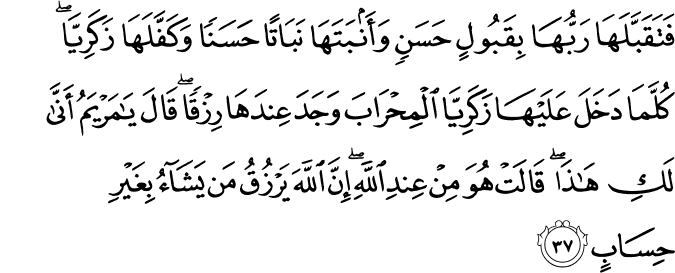
3:37 So her Rabb / continual nurturing Lord accepted her with a good acceptance, and caused her to develop with a good development, and placed her under the care of Zakariyya / he who fills and support (development and growth in recognition). Whenever Zakariyya entered upon her in the miḥrab / elevated inner state where the mind confronts and resolves its conflicting configurations, he discovered with her rizq / sustaining provision. He said: “O Maryam / receptive thought pursuing Al-Haqq, from where is this for you?” She said: “It is from Allah. Indeed, Allah provides rizq / sustaining provision to whoever wills (whoever repeatedly turns back), without limitation.”
NOTES: The development of Maryam reveals an important principle about the way recognition unfolds. Her Rabb does not merely bring her into existence and leave her to develop by herself. He accepts her completely and nurtures her development in a way that is good, sound, and aligned with Al-Haqq. Her growth therefore does not arise from the restless activity of the conditioned mind, but from an underlying process of divine nurturing that allows receptive understanding to mature naturally.
This receptive thought is then placed under the care of Zakariyya / he who fills and supports development and growth in recognition. The function of Zakariyya is significant: what is receptive needs to be sustained while it develops. Recognition cannot mature merely by receiving an insight once; it needs a supportive capacity that continually provides what is necessary for further growth. In this sense, support is not an external addition to recognition but part of the process through which recognition becomes established.
The miḥrab / elevated inner state where the mind confronts and resolves its conflicting configurations represents a deeper movement within this development. When the mind enters such a state, it is no longer simply moving among its ordinary conditioned patterns. It becomes capable of confronting those patterns directly and allowing their conflicts to resolve. It is within this inward clarity that something unexpected is discovered: rizq / sustaining provision is already present with the receptive pursuit of Al-Haqq.
This raises a profound question. Where does such sustaining provision come from? The question is not merely about the origin of an intellectual insight. It points toward the recognition that what genuinely nourishes the development of truth cannot ultimately be attributed to the conceptual mind. The mind may experience the recognition, cultivate it, and give it expression, but the source from which that nourishment arises is beyond the mind's own construction. Maryam therefore directs the recognition back to Allah.
The answer also reveals that this provision is not scarce or dependent upon the mind's calculations. Allah provides rizq to whoever wills / repeatedly turns back, without limitation. Whenever the mind turns back toward Al-Haqq, it becomes receptive to what is already available from the source of its nurturing. The apparent lack of provision is therefore not a limitation in Allah, but a limitation created when the mind turns away from what is continually available.
The deeper movement of the verse is consequently from receptivity to nourishment, from nourishment to development, and from development to recognition of its true source. Maryam represents the receptive movement toward Al-Haqq; Zakariyya represents the capacity that fills and supports that development; and the miḥrāb represents the elevated inward state in which conflicting configurations can be confronted and resolved. Yet the sustaining provision discovered there does not originate from any of these faculties. It comes from Allah, whose provision remains without limitation for the one who continually turns back toward Him.

3:38 Thereupon Zakariyya / he who fills and supports development and growth in recognition called upon his Rabb / continual nurturing Lord, saying: “My Rabb, grant me directly from You a dhurriyyah / developing thoughts that are wholesome. Indeed, You are Samiʿ / fully hearing of what is expressed, ʿAlim / fully knowing of what is understood.”
NOTES: The encounter with sustaining provision awakens in Zakariyya a deeper recognition of where genuine development comes from. Having witnessed that nourishment can arise within the receptive pursuit of Al-Haqq without being manufactured by the conditioned mind, he naturally turns toward his Rabb. The movement is not one of demanding an external reward, but of becoming receptive to a further unfolding of recognition.
His request for dhurriyyah / developing thoughts that are wholesome expresses the desire for understanding to continue reproducing itself without becoming distorted. A wholesome thought is not merely a pleasant or agreeable thought; it is one that develops while remaining aligned with Al-Haqq. Such development can continue to generate further recognition rather than becoming another fixed configuration that limits awareness.
The expression “directly from You” is especially significant. Zakariyya recognizes that the deepest source of wholesome development cannot be manufactured through intellectual effort alone. The mind can support, nurture, and make itself receptive, but it cannot claim ownership of the truth that emerges. What is genuinely transformative must arise directly from the continual nurturing source.
This also reveals why the request follows his encounter with Maryam. The receptive pursuit of Al-Haqq has already demonstrated that sustaining provision is available. Zakariyya now seeks for that same source to bring forth a new development. Recognition therefore unfolds organically: what has been received becomes nourishment, nourishment supports development, and development gives rise to further living recognition.
Allah is Samiʿ / fully hearing of what is expressed because nothing that emerges through the inward movement is outside His awareness. The expression of the request itself is already part of the unfolding. At the same time, He is ʿAlim / fully knowing of what is understood, knowing not only what the mind articulates but also what lies beneath its words—the genuine condition from which the request arises.
The verse therefore presents a movement from recognition to receptivity, from receptivity to wholesome development, and from development to further recognition. Zakariyya does not seek to construct this development by his own conceptual power. He turns toward the source and asks that it come directly from there. The next stage of the unfolding will reveal what this wholesome developing thought becomes: Yaḥyā / the living and responsive development.

3:39 Then the malaaʾikah / governing authorities called to him while he was standing in the miḥrab / elevated inner state where the mind confronts and resolves its conflicting configurations, establishing ṣalaah / connection through which Allah’s presence is experienced: “Indeed, Allah gives you bashhiru / joyful thoughts (arises from the recognition of Al-Haqq) of Yaḥya / living and responsive development, confirming a word from Allah, and a sayyid / one who is masterful in governing, and ḥasur / one who restrains himself, and a nabiyy / receptive awareness bringing recognition of truth, from among the ṣaliḥin / those who correct themselves.”
NOTES: The emergence of Yaḥya begins within the miḥrab / elevated inner state where the mind confronts and resolves its conflicting configurations. While Zakariyya remains established in ṣalaah / connection through which Allah’s presence is experienced, the governing authorities become active and bring recognition of what is unfolding. This suggests that genuine development does not arise from forcing an outcome. When the mind remains connected with Allah, the conditions are created for a new and living recognition to emerge naturally.
The message is expressed through bashhiru / joyful thoughts arising from the recognition of Al-Haqq. Joy here is not merely emotional pleasure. It is the natural lightness that appears when something within the mind recognizes what is true. The joyful thought announces Yaḥya / the living and responsive development—a development that is no longer merely potential but has become capable of responding to truth.
Yaḥya is described as confirming a word from Allah. The significance is that living recognition does not invent its own truth. It recognizes and confirms what originates from Allah. A thought becomes truly alive when it can receive truth without distorting it through the conditioned mind. In this sense, Yaḥyā represents a development of understanding that remains connected to its source.
His description as sayyid / one who is masterful in governing shows that this living recognition has acquired authority over the movement of thought. It is no longer merely carried along by inclinations, impulses, and inherited configurations. It can govern its own direction because it is established in recognition. Yet this mastery is immediately balanced by ḥaṣūr / one who restrains himself. True mastery includes the capacity not to follow every impulse that arises.
This restraint is not suppression. It is the freedom to remain aligned with Al-Haqq even when conflicting inclinations appear. The living development can distinguish what should be followed from what should be released. In this way, mastery and restraint work together: one provides governing strength, while the other prevents that strength from being diverted by the conditioned mind.
Yaḥya is then identified as a nabiyy / receptive awareness bringing recognition of truth, belonging to the ṣāliḥīn / those who correct themselves. The complete picture is therefore of a development that is alive, responsive, confirmatory, governing, restrained, receptive to truth, and continuously self-correcting. What Zakariyya requested as dhurriyyah / wholesome developing thoughts has now emerged as a living capacity within recognition. It is not merely another thought added to the mind; it is a development that can receive Al-Haqq, govern its own movement, and continually correct itself in accordance with what it recognizes.

3:40 He said: “My Rabb, how can there be for me a ghulaam / developing thought when al-kibar / advanced development has reached me and my imraati / receptive awareness is ʿāqir / unable to produce development?” He said: “Thus does Allah unfolds what is willed.”
NOTES: Zakariyya’s question arises from the apparent limits of the existing configuration. He has reached al-kibar / advanced development, while his imraʾah / receptive awareness is ʿaaqir / unable to produce development. From the perspective of the established patterns of the mind, there appears to be no capacity left from which a new ghulam / developing thought could emerge. The question therefore exposes the mind’s tendency to measure possibility according to what its present condition allows.
Yet the request itself had been for a development directly from Allah. The apparent impossibility therefore becomes an opportunity to recognize that what comes from the continual nurturing source does not have to conform to the limitations of the existing configuration. A developing thought that arises directly from Allah is not manufactured by the accumulated structures of the mind; it emerges through a deeper movement of recognition.
Al-kibar / advanced development need not therefore signify the end of development. It may simply indicate that one configuration has reached the limit of what it can produce through its existing patterns. Likewise, ʿaaqir / unable to produce development describes a condition of incapacity, not an absolute limitation upon what Allah can unfold. What appears to be an ending from the perspective of the conditioned mind can become the ground from which something entirely new emerges.
The response, “Thus does Allah unfold what is willed,” redirects attention away from the limitations of the existing configuration. The unfolding is not determined by what the mind believes to be possible. Allah remains the source from which new possibilities can arise, even when the existing conditions appear incapable of producing them. What is willed can therefore unfold without being constrained by the mind’s previous assumptions about how development must occur.
This gives ghulam / developing thought a deeper significance. It is not simply another thought added to an already developed structure. It represents a new movement of understanding emerging where the established configuration could no longer generate further development by itself. The development comes directly from the source and therefore carries the possibility of moving beyond inherited limitations.
The verse thus prepares us to recognize a fundamental principle of inward development: the end of one mode of development is not necessarily the end of development itself. When the existing configuration reaches its limit, the mind may interpret that limitation as impossibility. But when it turns toward its Rabb, what appeared impossible can become the very condition through which a new, living and responsive recognition unfolds.

3:41 He said, “My Rabb / continual nurturing Lord, appoint for me an aayah / sign.” He said: “Your aayah / sign is that you will not takallamu / express understanding to an-naas / the agitated conditioned thoughts for three moments (during clarity, darkness, and early stage for result) except by ramz / symbolic indication (mind only speaks in respect of symbols as representation to reality). And udhkuru / embody the divine masculine of your Rabb abundantly, and tasabbih / move to explore beyond limitation into the expansive recognition of Al-Haqq with the lack in perception and the ibkaari / early stage of clarity.”
NOTES: The request for an aayah / sign shows that Zakariyya is seeking a way to recognize the unfolding of what has been promised. The sign is not another verbal explanation. Instead, his ordinary ability to takallam / express understanding toward an-naas / the agitated conditioned thoughts becomes restricted. This creates a temporary separation from the habitual process through which the mind normally converts recognition into conceptual expression.
The restriction does not mean that understanding disappears. Communication remains possible through ramz / symbolic indication, because the mind encounters reality through representations. A symbol does not itself constitute the reality it represents; it points beyond itself toward what is to be recognized. Thus, when ordinary conceptual expression becomes quiet, recognition can still be indicated through symbolic representation.
The three moments represent stages within the unfolding: clarity, darkness, and the early stage from which a result emerges. These are not merely divisions of external time but different conditions through which understanding develops. Recognition may pass through clarity, apparent absence of clarity, and the initial formation of a consequence. The sign is that Zakariyya remains connected with the source through all these stages, even when ordinary expression is unavailable.
He is therefore instructed to udhkur / embody the divine masculine of his Rabb abundantly. This is more than remembering an idea about Allah. It is the embodiment of the active, affirming qualities through which divine recognition becomes expressed within the developing mind. The abundance of this embodiment ensures that the temporary silence of ordinary expression does not become a vacuum; it becomes filled with a deeper alignment to the Rabb.
The instruction to tasabbih / move to explore beyond limitation into the expansive recognition of Al-Haqq further redirects the mind away from its accustomed boundaries. Rather than attempting to force understanding through existing concepts, it explores what lies beyond those limitations. This movement is particularly significant when perception itself is lacking, because the absence of clear perception does not mean that the underlying reality has disappeared.
The reference to the ibkaari / early stage of clarity completes the movement. After the condition of limited perception, a new clarity begins to emerge. The mind is therefore being trained to remain with Al-Haqq through the entire movement—from diminished perception, through exploration beyond limitation, to the first emergence of clarity. The sign is consequently not merely the inability to speak; it is the transformation of the way recognition develops when habitual conceptual expression becomes quiet.
In this sense, 3:41 continues the theme of the previous verses. A new ghulaam / developing thought can emerge even when the existing configuration appears incapable of further development. The aayah given to Zakariyya demonstrates how this new development begins: ordinary conceptual expression becomes quiet, symbolic recognition remains, awareness of the Rabb is embodied abundantly, and the mind moves beyond its limitations until a new clarity begins to unfold.

3:42 And when the malaaʾikah / governing authorities said: “O Maryam / receptive thought pursuing Al-Haqq, indeed Allah has iṣṭafaaki / selected you, purified you, and selected you above the nisaaʾ / receptive thoughts arising from the feminine receptive faculty of al-aalamin / all realms through which reality becomes known.”
NOTES: Maryam represents a receptive thought that has become deliberately oriented toward Al-Haqq. Her significance is therefore not simply that she receives information, but that her receptivity has acquired a clear direction. She is receptive without surrendering that receptivity to every influence arising within the conditioned mind. This makes her capable of receiving what is true while remaining oriented toward its source.
The malaaʾikah / governing authorities announce that Allah has iṣṭafaaki / selected her. Selection here can be understood as the recognition of a particular capacity that is especially suited to the unfolding of truth. Maryam's receptivity has become distinguished from the many other ways in which the mind can receive, interpret, and develop representations of reality. Her selection therefore concerns function rather than personal superiority.
That selection is followed by purification. Receptivity must become increasingly free from the distortions that arise when conditioned thought interferes with what is being received. Purification does not require the elimination of thought; rather, it removes the tendency to confuse the representation with the reality it represents. As that interference diminishes, receptive understanding becomes clearer and more transparent to Al-Haqq.
The repetition of iṣṭafaa / selected is significant. The first selection establishes the receptive faculty for its particular function, while purification refines that faculty. The second selection can therefore be understood as a renewed recognition of its suitability after purification. What was initially receptive becomes increasingly capable of receiving without distortion.
Maryam is then selected above the nisaaʾ / receptive thoughts arising from the feminine receptive faculty of the al-ʿaalamin / all realms through which reality becomes known. This places her within the larger field of all possible ways through which reality can become known. Among these receptive developments, she represents a particularly refined movement: receptivity that remains consciously directed toward Al-Haqq rather than becoming absorbed in the representations produced by the mind.
The verse therefore describes a progressive refinement of receptivity: orientation toward Al-Haqq, selection, purification, and renewed selection. Maryam is being prepared for something further. Her receptive capacity has become sufficiently clear that what emerges through it can no longer be understood merely as another product of conditioned thought. The following verses will reveal how this purified receptivity becomes the field through which a deeper recognition is brought into the mind.

3:43 O Maryam / receptive thought pursuing Al-Haqq, be obedient (in embodying the divine masculine attributes) to your Rabb / continual nurturing Lord, and usjudi / surrender your orientation, and ir'ka'i / accept with humility with those who raa'ki'iin / accept.
NOTES: Maryam represents receptive thought pursuing Al-Haqq, and the first instruction is to become obedient to her Rabb / continual nurturing Lord. This obedience is not blind submission to an external authority. It is the willingness of receptive understanding to embody the divine masculine attributes that affirm, establish, and express what has been recognized as true. What is received through genuine receptivity must therefore become embodied rather than remaining merely an idea.
The instruction to usjudi / surrender your orientation deepens this movement. Once truth has been recognized, the receptive thought must surrender its own tendency to determine reality according to its previous conditioning. Surrender is therefore a relinquishment of the claim that the conceptual mind knows independently. The orientation turns toward Al-Haqq, allowing recognition to become the governing reference rather than the mind's accumulated assumptions.
Then comes ir'ka'i / accept with humility. Humility here does not mean thinking less of oneself; it means becoming willing to receive what is beyond the present configuration of understanding. A receptive thought that remains proud of its own conclusions becomes closed to further recognition. Humility keeps the faculty open, allowing what has been recognized to continue developing without resistance.
The instruction to do this with those who raa'ki'iin / accept shows that humility is not an isolated state. It is a shared quality among faculties that are willing to relinquish resistance to Al-Haqq. The movement is from obedience, to surrender, to humble acceptance. Each stage removes another layer of self-imposed authority that could interfere with the unfolding of recognition.
This gives Maryam's development a clear progression. She has first been selected and purified, then instructed to embody the divine masculine attributes of her Rabb. Now she is asked to surrender her orientation and accept with humility. Receptivity is therefore not weakness. It becomes a disciplined openness in which truth can be received, embodied, and allowed to transform the configuration of understanding.
The deeper message is that recognition of Al-Haqq requires both receptivity and surrender. To receive truth without embodying it leaves understanding incomplete; to embody it without surrender leaves the conceptual self in control; and to surrender without humility can become merely passive. Maryam represents the receptive faculty in which these movements come together, creating the condition for a deeper reality to become known.

3.44 That is from anba'i al-ghayb / news of the unseen that We have inspired to you. You were not with them when they yulquna / brought forward their aqlaam / faculties that inscribe understanding, determining which of them would take responsibility for Maryam, nor were you with them when they yahtasimun / were disputing (among those faculties).
NOTES: The verse draws attention to a process that lies beyond the immediate perception of the conditioned mind. The anbaaʾ al-ghayb / news of the unseen reveals an inward movement that cannot be discovered merely by observing the surface activity of thought. What is being unveiled is how receptive understanding becomes entrusted to a particular faculty and how that responsibility is established among competing modes of understanding.
The aqlaam / faculties that inscribe understanding represent the different capacities through which experience is interpreted, recorded, and given form within the mind. Each faculty can leave an imprint upon what is being received. The act of yulqūna / bringing forward their aqlām therefore represents these faculties placing their respective modes of understanding into consideration, as though each is presenting itself as capable of guiding what is receptive.
The purpose of this process is to determine which of them would take responsibility for Maryam / receptive thought pursuing Al-Haqq. This is significant because receptivity by itself does not determine what will be done with what is received. What is perceived must still be interpreted and developed by some faculty. The question is therefore: which faculty will be entrusted to nurture and support this receptive pursuit without distorting its orientation toward Al-Haqq?
The subsequent dispute among those faculties reveals that this responsibility is not automatically settled. Different modes of understanding may claim authority over the same receptive thought, each attempting to interpret what has been received according to its own configuration. The conflict therefore occurs within the architecture of the mind: competing faculties seek to determine which interpretation will govern the development of receptivity.
Yet the revelation of this unseen process also points to something deeper. The receptive thought pursuing Al-Haqq cannot simply be handed over to whichever faculty is most forceful or most familiar. Its development requires a faculty capable of supporting it while remaining aligned with truth. The dispute exposes the importance of discerning which mode of understanding should be given authority.
This prepares the way for the appearance of Zakariyya / he who fills and supports development and growth in recognition. The preceding verses have already shown his supportive relationship with Maryam, and the present verse reveals that this responsibility emerges from a process in which different faculties contend over who will assume it. The unseen news therefore unveils not merely a past event, but an inward principle: receptive understanding requires the right faculty to nurture it, and discernment is needed when competing faculties seek authority over its development.

3:45 When the malaaʾikah / governing authorities said: “O Maryam / receptive thought pursuing Al-Haqq, indeed Allah gives you bashshir / joyful thoughts (arising from the recognition of Al-Haqq) of a kalimah / word from Him, whose name is Al-Masih / he who brings the touch of awareness, Isa / he who brings the spirit of Al-Haqq, construct of Maryam / receptive thought pursuing Al-Haqq, honoured in the dunya / life of close attachment and the aakhirah / the end of dissociation (of true self), and among the muqarrabun / those who are brought near (to Al-Haqq).”
NOTES: The announcement marks a further unfolding in the development of Maryam / receptive thought pursuing Al-Haqq. Having been selected, purified, and instructed to embody the divine masculine attributes of her Rabb, surrender her orientation, and accept with humility, she is now prepared to receive a new development directly from Allah. The bashshir / joyful thoughts arising from the recognition of Al-Haqq indicate that this is not merely information being added to the mind. It is the joy that naturally accompanies the recognition of something true.
What emerges is a kalimah / word from Him. A word, in this inward framework, is an articulated expression through which something becomes known. Because this word is from Him, its origin is not the conditioned mind or any of the competing faculties that had disputed over responsibility for Maryam. It comes directly from Allah and enters the receptive field as something to be recognized rather than something manufactured by thought.
The word is identified as Al-Masīḥ / he who brings the touch of awareness. The touch of awareness suggests a direct contact between awareness and what is being revealed. Just as masḥ involves passing over or making contact, the inward function is to bring awareness into contact with what has previously remained obscure. The result is not necessarily the destruction of the existing mental configuration, but the opening of perception so that what was hidden can become recognizable.
This word is also ʿIsa / he who brings the spirit of Al-Haqq. Here the movement goes beyond mere contact. The spirit of Al-Haqq is brought into the receptive field, giving the recognition a living quality. 'Isa therefore represents an active expression through which the spirit of truth becomes present within understanding. The fact that he is a construct of Maryam / receptive thought pursuing Al-Haqq shows that this development arises through purified receptivity, not through the independent manufacture of the conditioned mind.
His being honoured in the dunya / life of close attachment and the aakhirah / the end of dissociation of the true self indicates that this recognition retains its significance through both stages of the inward journey. It can illuminate the mind while it is still engaged in close attachment, and it remains relevant when those attachments dissolve. The truth brought through ʿIsa is therefore not dependent upon the temporary configuration of the conceptual self.
Finally, ʿIsa is among the muqarrabun / those who are brought near to Al-Haqq. Nearness here is not spatial. It describes the intimacy of recognition: the less distance there is between the mind and what it recognizes as Al-Haqq, the less room remains for distortion, projection, and separation. The development brought through Maryam therefore moves progressively closer to its source.
The verse presents a profound sequence: purified receptivity gives rise to a kalimah / word from Allah; the word brings the touch of awareness; that awareness brings the spirit of Al-Haqq; and this living development becomes increasingly near to its source. Maryam is the receptive field, Al-Masiḥ is the touch that awakens awareness, and ʿIsa is the expression that brings the spirit of Al-Haqq into that field. This is not merely the acquisition of another concept—it is the emergence of a living development through which truth becomes increasingly intimate within the mind.

3:46 And he (Isa) will speak to an-nās / the agitated conditioned thoughts in the mahdi / state of developing guidance and in the kahlan / a state of advanced development, and among the ṣaaliḥin / those who correct themselves.
NOTES: The development represented by ʿIsa / he who brings the spirit of Al-Haqq does not remain confined to the receptive state from which it emerged. Once the spirit of Al-Haqq has entered understanding, it becomes capable of communicating with an-nas / the agitated conditioned thoughts. Recognition therefore begins to interact with the very mental configurations that previously obscured it.
This communication occurs in the mahdi / state of developing guidance and the kahli / state of advanced development. The two descriptions suggest that the living recognition can express itself throughout different stages of development. It is not limited to an early stage of understanding, nor does it disappear when understanding becomes mature. The same truth can meet the mind at whatever stage of development it has reached.
The contrast between developing and advanced states is particularly significant. A new recognition may initially appear as something small and still developing, but its truth does not depend upon its developmental age. As it matures, it can become increasingly capable of communicating with more established configurations of thought. Thus, the spirit of Al-Haqq can accompany the mind throughout its development rather than being confined to a particular moment of insight.
The reference to an-nas / the agitated conditioned thoughts also shows the direction of this communication. The purpose is not simply to reinforce already harmonious thoughts. It reaches into the agitated and conditioned field where conflicting assumptions, inherited patterns, and restless inclinations continue to operate. The living recognition therefore has an active role in transforming the very field in which it has emerged.
Yet the verse concludes by placing this development among the ṣaaliḥin / those who correct themselves. This indicates that the communication of truth must remain connected with continual correction. Recognition is not considered complete merely because it has emerged. It must continually examine and correct the configurations through which it expresses itself, preventing new understanding from becoming another fixed mental structure.
The verse therefore presents ʿIsa as a living development that can communicate with the conditioned mind across its different stages of maturity. The spirit of Al-Haqq does not remain an abstract recognition hidden within receptive awareness. It becomes an active capacity that enters the developing and advanced states of understanding, engages the agitated conditioned thoughts, and continually moves them toward ṣalāḥ / self-correction and alignment with Al-Haqq.

3:47 She said: “My Rabb, how can there be for me a walad / developing thought (given birth by Maryam) when no bashar / joyful thought (arising from the recognition of Al-Haqq) has touched me?” He said: “Thus does Allah evolve what he ('Isa) wills. When He determines an amr / governing command, He only says to it, ‘Be,’ and it becomes.”
NOTES: Maryam's question arises from the apparent absence of the condition she would normally associate with the emergence of a walad / developing thought given birth by her. She is receptive and pursuing Al-Haqq, yet no bashar / joyful thought arising from the recognition of Al-Haqq has touched her. From the standpoint of the existing configuration, there appears to be no recognizable process through which this new development could arise.
The response introduces a deeper principle: Allah evolves what ʿIsa / he who brings the spirit of Al-Haqq wills. The development is therefore not dependent upon the ordinary sequence expected by the receptive mind. What ʿIsa wills represents an emerging movement within the spirit of Al-Haqq, while Allah remains the source that evolves and brings that movement into manifestation. The apparent absence of a preceding bashar does not prevent the new development.
This distinction is important because bashar / joyful thought is an experience of recognition, whereas walad / developing thought is the development that can emerge from it. Maryam expects the joyful recognition to come first, followed by development. Yet the verse reveals that the source of development is deeper than the sequence anticipated by the mind. What is being evolved can arise directly from the governing command before the expected sign has appeared in the familiar way.
The amr / governing command represents the decisive establishment of what is to unfold. Once this command is determined, Allah does not need to construct the development through the limited mechanisms available to the conceptual mind. The expression “Be” represents the direct establishment of the governing reality, while “it becomes” describes the unfolding of that determination into an actual development.
This also connects the experiences of Zakariyya and Maryam. Zakariyya questioned how a ghulam / developing thought could emerge when his existing configuration had reached advanced development and lacked the capacity for further production. Maryam now questions how a walad / developing thought can emerge without the expected bashar. Both encounters expose the same limitation: the mind attempts to define what can emerge according to conditions it already understands.
The deeper recognition is that divine evolution is not confined to the mind's anticipated sequence of causes. What appears absent may already be contained within a governing command that has not yet unfolded into perception. When the mind remains receptive rather than imposing its own conditions upon reality, the command can become manifest. Thus, the absence of the expected bashar does not prevent the emergence of the walad; the development comes through a deeper source, and when Allah determines its unfolding, it becomes.

3:48 And He will teach him Al-Kitab / the inherent script, and al-Ḥikmah / wisdom (understanding based on Al-Haqq), and the Tawrah / natural laws of reality (through which behavioural consequences become evident), and the Injeel / good news when signs reveal reality.
NOTES: The development described in the preceding verses now moves from the arising of a new thought into its education. What emerges through Maryam / receptive thought pursuing Al-Haqq is not left to develop according to the accumulated conditioning of the mind. Its understanding is taught from a source beyond that conditioning. This is important because a thought arising from Al-Haqq cannot fulfil its function merely by possessing information; it must learn to recognise the order through which reality expresses itself.
Al-Kitab / the inherent script represents that underlying order. It is not simply accumulated knowledge placed into the mind from outside, but the inherent pattern through which reality can be read and understood. To be taught Al-Kitab is therefore to become capable of recognising what has already been inscribed within the unfolding of existence. The thought begins to read reality itself rather than interpreting everything through inherited assumptions, preferences and attachments.
Yet recognition of the inherent script requires al-Ḥikmah / wisdom, because knowledge without wisdom can easily become another possession of the conceptualized self. Wisdom is understanding based on Al-Haqq—the capacity to see how what is recognized should be appropriately embodied. Al-Kitab reveals the underlying order, while al-Ḥikmah enables that order to be understood and lived without distortion. Thus knowledge and its proper application develop together.
The Tawrah / natural laws of reality then reveals that every movement within consciousness carries consequences. Nothing arising in the mind is isolated from what follows it. A thought repeatedly affirmed develops its corresponding condition; an orientation toward truth produces one consequence, while concealment of what has been recognized produces another. The Tawrah therefore makes visible the lawful relationship between inward orientation and the experience that subsequently unfolds from it.
From recognising these natural laws comes the Injeel / good news when signs reveal reality. The good news is not disconnected from the Tawrah; it becomes apparent when the consequences themselves are understood as signs. What previously appeared to be merely pleasant or painful experience can now disclose something about the mind's relationship with Al-Haqq. Even correction becomes good news when its sign is understood, because it reveals what must be released, restored or brought again into alignment.
The verse therefore describes a complete education of the developing recognition represented by ʿIsa / he who brings the spirit of Al-Haqq. Al-Kitab provides the inherent script, al-Ḥikmah gives understanding grounded in Al-Haqq, the Tawrah reveals the natural laws through which consequences unfold, and the Injeel reveals the good news contained within their signs. Together they prepare this developing recognition not merely to know Al-Haqq conceptually, but to read its order, understand its wisdom, recognize its consequences, and perceive its signs as they unfold within lived experience.

3:49 And a rasul / inner silent messenger (by which truth enters awareness) to the bani Israel (those who construct their spititual journey seeking guidance) that indeed, I have come to you with an aayah / sign from your Rabb / continual nurturing Lord. I evolve for you from the ṭīn / conditioned matter a form like that of a ṭayr / thought that rises and moves freely, then I breathe into it from the ruḥ / spirit of Al-Haqq, and it becomes a ṭayr / thought that rises and moves freely by Allah's permission. And I heal the akmah / inner blindness, and the abraṣ / distorted perception, and I give life to the mawta / those who have lost responsiveness, by Allah's permission. And I inform you of what you consume and what you store within your buyut / mental houses. Indeed, in that is surely an aayah / sign for you, if you are mu'minin / those who have taken security with Allah.
NOTES: The verse presents ʿIsa / he who brings the spirit of Al-Haqq as an inward movement through which guidance becomes experiential rather than remaining conceptual. The rasul is the silent messenger by which truth enters awareness, and the bani Israʾil are those who construct their spiritual journey while seeking guidance. This means the message is directed toward a mind already engaged in a journey of recognition. The sign from the Rabb is therefore something that can be recognized within the development of that journey.
The transformation begins with ṭin / conditioned matter. Existing conditioning is not simply rejected or destroyed. Instead, it becomes the material from which a new configuration can evolve. When a form resembling a ṭayr / thought that rises and moves freely emerges, thought is no longer completely confined by the patterns from which it arose. It begins to possess movement beyond its previous limitations. This is a significant transition: the conditioned mind becomes capable of allowing a thought to move rather than continually returning it to the same established conclusions.
Yet this movement becomes truly transformative only when it receives the ruḥ / spirit of Al-Haqq. The breath of this spirit represents the enlivening influence of truth itself. What was merely a constructed form now becomes responsive to a deeper reality. The ṭayr therefore represents more than an imaginative thought; it points to a thought that has acquired freedom of movement because it is no longer entirely governed by conditioning. Its movement is permitted by Allah because its source and sustaining reality remain with Him.
From this awakening comes healing. The akmah / inner blindness is not simply an inability to receive information; it is the condition in which recognition cannot see what is already present. The abraṣ / distorted perception similarly represents a mind that sees through a distorted configuration. When the spirit of Al-Haqq becomes active, these limitations begin to lose their authority. Seeing becomes clearer because the mind is no longer imposing its inherited distortions upon what is being revealed.
The giving of life to the mawta / those who have lost responsiveness takes the process still deeper. A mind may continue thinking while inwardly losing its capacity to respond to truth. Such a condition is effectively lifeless in relation to recognition. The spirit of Al-Haqq restores responsiveness—not by adding more concepts, but by reopening the capacity to receive, recognise and move with what is true. What had become inwardly inert can therefore become alive again by Allah's permission.
The final sign is particularly intimate: knowing what is consumed and what is stored within the buyut / mental houses. What enters the mind does not simply disappear; what is repeatedly consumed can become part of the structures in which thought lives. Some inputs nourish recognition, while others reinforce conditioning. The verse therefore turns the attention inward, asking the seeker to observe both what is being taken in and what has been allowed to become established within the mental house. For those who are muʾminin / those who have taken security with Allah, these movements themselves become signs: conditioning can evolve, thought can become free-moving, perception can be healed, responsiveness can return, and the contents of the inner house can become consciously recognized.

3:50 And confirming what is between my hands from the Tawrah / natural laws of reality (through which behavioural consequences become evident), and to make lawful for you some of what was forbidden to you. And I have come to you with an aayah / sign from your Rabb / continual nurturing Lord, so develop taqwa / conscious mindfulness toward Allah and obey me.
NOTES: The movement of ʿIsa / he who brings the spirit of Al-Haqq continues by confirming the Tawrah / natural laws of reality that are already within reach and presence of the rational mind. Truth does not need to contradict the lawful order through which reality unfolds. Rather, genuine recognition confirms what can already be discerned when the mind observes the relationship between its orientation, its actions and their consequences.
This confirmation is important because the mind can easily create an imagined separation between spiritual recognition and the laws governing lived experience. Yet the Tawrah represents an order that remains operative whether or not the mind acknowledges it. When ʿIsa brings the spirit of Al-Haqq into awareness, the natural consequences that were previously overlooked become visible. Recognition therefore does not abolish reality's order; it reveals it more clearly.
The verse then introduces the making lawful of some things that had been forbidden. Within the inward reading, this points to the possibility that a restriction may belong to a particular stage of development rather than being an absolute feature of truth itself. What was previously experienced as prohibited may become accessible when the underlying distortion or incapacity that made it harmful has been transformed. The distinction is crucial: freedom does not mean abandoning discernment. It means understanding why a restriction existed and whether its underlying condition remains.
This is where the aayah / sign from the Rabb becomes significant. The sign is not merely an extraordinary occurrence; it is the recognition that appears when a previously concealed relationship becomes clear. The developing mind begins to see why certain conditions produce certain consequences. What once appeared arbitrary begins to reveal an intelligible order. The sign therefore educates rather than merely impresses.
Such recognition naturally calls for taqwa / conscious mindfulness. Once the relationship between orientation and consequence becomes visible, awareness can no longer honestly claim not to know. Taqwa is the sustained attentiveness that prevents the mind from returning unconsciously to what it has already recognized as misaligned. It is not fear imposed from outside, but an inward sensitivity to the consequences of losing alignment with Al-Haqq.
Obedience to ʿIsa therefore means allowing the spirit of Al-Haqq to govern the movement of thought. The instruction is not toward blind submission to another conceptual authority, but toward responsiveness to the recognition that has entered awareness. The sequence is coherent: the natural law is confirmed, restrictive conditioning is reassessed, the sign becomes evident, conscious mindfulness is established, and obedience becomes the natural expression of understanding.

3:51 Indeed, Allah is my Rabb / continual nurturing Lord and your Rabb / continual nurturing Lord, so serve Him. This is a ṣiraaṭ mustaqim / path of the one who is established in Al-Haqq.
NOTES: The recognition brought by ʿIsa / he who brings the spirit of Al-Haqq ultimately returns to the recognition of a single nurturing Reality. Allah is not merely the Rabb of one particular faculty, one particular thought, or one particular stage of development. He is equally the Rabb of the one who brings recognition and the one who receives it. The source of guidance and the one being guided are therefore held within the same continual nurturing Reality.
To serve Him is to allow this recognition to become the governing orientation of the mind. Service is not simply an outward performance carried out by a separate self for a distant authority. It is the willingness to let Al-Haqq determine the movement of thought, rather than allowing inherited conditioning, personal preference or attachment to assume that authority.
This becomes especially meaningful after the preceding description of ʿIsa. The inherent script has been taught, wisdom has developed, the natural laws of reality have become evident, and signs have begun to reveal what was previously concealed. The conditioned material has been transformed, perception has been healed and responsiveness has been restored. All these movements now converge upon one recognition: Allah alone is the Rabb.
The expression ṣiraaṭ mustaqim then describes the quality of this movement. Mustaqim carries the sense of being upright, established and firmly aligned. The path is therefore not merely a route that leads toward Al-Haqq; it is the path of the one who is established in Al-Haqq. Once recognition is no longer continually pulled away by competing identifications, movement becomes direct and balanced.
Being established in Al-Haqq does not mean that the mind has reached a final conceptual conclusion. It means that its orientation is no longer dependent upon the fluctuations of conditioning. Thoughts may arise and dissolve, clarity may alternate with obscurity, and experiences may change, but the underlying orientation remains grounded in what has been recognized as true.
Thus the verse brings the preceding development into simplicity. The purpose of knowledge, wisdom, natural law, signs and transformation is not to create another elaborate identity. It is to establish the mind in its source. When Allah is recognized as the continual nurturing Lord, serving Him becomes the natural expression of that recognition, and the path becomes ṣiraaṭ mustaqim—the path of the one who is established in Al-Haqq.

3:52 Then when ʿIsa / he who brings the spirit of Al-Haqq perceived the kufr / concealment of what was recognized from them, he said, “Who are my anṣaar / those who support the realization of truth toward Allah?” The ḥawaariyyun / those who become purified and move toward what is clear said, “We are anṣaar / those who support the realization of truth toward Allah. We have aamanna / taken security with Allah, and bear witness that we are muslimun / those who willingly surrender to Al-Haqq.”
NOTES: The movement now reaches a point where recognition encounters resistance. ʿIsa / he who brings the spirit of Al-Haqq perceives kufr not simply as a lack of knowledge, but as the concealment of what has already been recognized. The problem is therefore no longer whether truth has been presented. It is whether the mind is willing to remain open to what it has already seen.
At this point, recognition requires support. The question about the anṣaar / those who support the realization of truth is an inward question: which faculties within the mind are willing to sustain the movement toward Al-Haqq rather than allow conditioned patterns to suppress it? Truth may be recognized, yet without supporting faculties that recognition can easily be covered again by habitual thought.
The ḥawaariyyun respond by identifying themselves with this supporting movement. Their purification is important because genuine support for truth cannot arise from the same distortions that conceal it. As the mind becomes clearer, its faculties become capable of standing with recognition rather than competing against it. They do not claim ownership of the truth; they support its realization.
Their iman / taking security with Allah then expresses a deeper transition. Security is no longer sought in the familiar structures of the conditioned mind. The developing faculties place their trust in the Reality that continually nurtures their recognition. This gives them the stability needed to remain with what has been seen even when established patterns resist it.
Their declaration of being muslimun / those who willingly surrender to Al-Haqq completes the movement. Recognition by itself is not surrender. One can recognize something as true and still resist its implications. Willing surrender means allowing the recognized truth to reorganize the mind without demanding that reality conform to its previous assumptions.
Thus the verse moves from recognition of concealment, to the search for support, to purification, to security, and finally to willing surrender. The spirit of Al-Haqq does not force the mind into alignment. It reveals the truth and calls forth those inner faculties that are willing to support its realization.

3:53 Our Rabb / continual nurturing Lord, we have aamanna / taken security with what You have brought down, and we have followed the rasul / inner silent messenger (by which truth enters awareness), so write us among the shaahidin / those who bear witness.
NOTES: The response of the ḥawaariyyun now moves from recognition into conscious alignment. Having identified themselves as supporters of the realization of truth, they acknowledge Allah as their Rabb and place their security in what He has brought down. This is not merely accepting an external teaching. It is finding stability in the recognition that has entered awareness through the continual nurturing of Al-Haqq.
The phrase aamanna is particularly significant. To take security with Allah means that the mind no longer needs to protect itself through its previous assumptions. The need to defend an established position begins to fall away because security is found in remaining open to what is true. This creates the inner stability required for genuine transformation.
Their following of the rasul is therefore a natural consequence of that security. The rasul / inner silent messenger is the movement through which truth enters awareness. To follow it is to allow that movement to continue rather than interrupting it with the resistance of conditioned thought. Recognition is thus not something to admire from a distance; it becomes a direction in which the whole mind begins to move.
They then ask to be written among the shaahidin / those who bear witness. Witnessing is deeper than merely agreeing with an idea. A witness is one in whom what has been recognized becomes evident through the way awareness operates. The truth is no longer merely something understood intellectually; it becomes something that can be directly observed in the transformation taking place within.
This completes the movement that began when ʿIsa perceived the concealment of what had been recognized. The answer to kufr is not argument or force. It is a mind that takes security with Allah, follows the movement by which truth enters awareness, and allows that truth to become embodied. In this way, recognition becomes lived evidence.
The verse therefore describes a progression from security, to following, to witnessing. When the mind is secure in Al-Haqq, it can follow without resistance; when it follows without resistance, recognition can become embodied; and when recognition becomes embodied, the mind itself becomes a witness to the truth it has recognized.

3:54 And they devised a concealed strategy, and Allah devised; and Allah is the best of those who devise.
NOTES: The preceding verse has described those who recognized the truth yet attempted to undermine it. Their response was not one of open recognition but of resistance. Within the inward movement of the insaan, this represents the tendency of an established configuration of thought to protect itself when confronted by what exposes its limitations.
Such resistance often operates subtly. Rather than meeting what has been recognized directly, the mind can rearrange its perceptions, create alternative explanations, conceal what has become evident, or construct circumstances that appear to preserve its existing position. The strategy is concealed because the mind itself may not fully recognize that it is protecting an assumption rather than discovering what is true.
Yet no movement within the insaan exists independently of the greater reality in which it arises. What appears to be an independent attempt to control the direction of events is already contained within the unfolding brought about by Allah. The limited mind can formulate its intentions only from within the field of understanding available to it; it cannot stand outside the whole and determine the whole.
This reveals the deeper meaning of the divine response. The greater unfolding does not need to oppose the limited strategy on its own terms. What the mind intends for one purpose can become the very circumstance through which another reality is revealed. A movement intended to conceal can therefore become a movement that exposes; an attempt to obstruct recognition can become part of the process through which recognition becomes clearer.
The superiority of Allah's devising lies precisely here. The limited strategy operates from partial knowledge, while the divine unfolding encompasses both the strategy and its consequence. Nothing that the conditioned mind constructs can escape the reality within which it is constructed.
The verse therefore shifts attention from the apparent power of resistance to the completeness of the divine unfolding. The insaan may attempt to preserve separation, conceal what has been recognized, or redirect the movement of understanding, but none of these movements can alter Al-Haqq. What seems to be a strategy against truth is already contained within the unfolding through which truth reveals itself.

3:55 When Allah said, “O Isa / he who brings the spirit of Al-Haqq, indeed I mutawaffika / complete you fully and raise you (in derajat) to Me, and I will purify you from those who conceal what they have recognised. I will make those who follow you superior to those who conceal what they have recognised until yawmil; qiyamah / moment of standing (in consciousness when what has been established stands fully in awareness). Then to Me is your return, and I will judge between you concerning that in which you differed.”
NOTES: The preceding verse describes the concealed strategies of those who attempt to resist what has been recognised. In this verse, the movement shifts toward Isa, understood inwardly as he who brings the spirit of Al-Haqq. The focus is therefore on the recognition of truth and its further development within the insaan.
The declaration that Allah will mutawaffika, complete Isa fully, points to the bringing of this recognition to its full measure. What begins as an emerging recognition of Al-Haqq is not left incomplete or confined to the level at which it first appears. It is gathered into completeness, so that nothing essential remains outside the recognition.
This completion is accompanied by an elevation in derajat. Recognition does not merely increase in quantity; it rises in degree. As the insaan becomes less identified with the configurations that previously concealed what was recognised, the recognition of Al-Haqq becomes established at a higher level of awareness. The movement is therefore from partial recognition toward a more complete seeing of what is already true.
At the same time, Allah purifies this recognition from those who conceal what they have recognised. The concealment referred to here is not simply ignorance. It is the movement of knowing something inwardly while allowing an opposing configuration to obscure, deny or suppress that knowing. Purification means that such concealment can no longer determine the direction of recognition.
Those who follow Isa represent the faculties that remain aligned with this movement of recognition. Their superiority is not necessarily superiority over other people; inwardly, it is the ascendancy of recognition over concealment. As recognition becomes more firmly established, the tendency to deny what has been recognised loses its authority. What is aligned with Al-Haqq naturally becomes stronger than what attempts to obscure it.
This continues until yawmil-qiyaamah—the moment of standing, when what has been established stands fully in awareness. At that point, what has previously remained uncertain, concealed or divided becomes unmistakably present. Recognition stands as recognition, while concealment stands revealed as concealment. Nothing needs to be imposed from outside; what has been established simply becomes fully evident.
The movement then returns to Allah, because every degree of recognition ultimately returns to its source. The return is not merely a movement toward a distant destination. It is the inward movement by which what has been perceived as separate is brought back into the awareness of its originating reality.
The differences that existed during the process are then judged within that complete awareness. What had appeared as conflicting understandings is no longer evaluated from the limited perspective from which the disagreement arose. Each movement is seen according to what it actually recognised, what it concealed, and how faithfully it remained aligned with Al-Haqq.
The verse therefore presents a complete inward progression: recognition of Al-Haqq is brought to completion, elevated in degree, purified from concealment, and strengthened against the tendency to deny what has been recognised. Eventually, what has been established stands fully in awareness, and all apparent differences return to the one reality from which recognition arose.

3:56 As for those who kafaru / conceal what they have recognised, I will punish them with severe suffering in this dunya / close attachments (of subconscious conditioned mind) and in the aakhirah / ending the dissociation (of true self), and they will have no supporters.
NOTES: The previous verse described the completion and elevation of recognition through Isa, together with its purification from those who conceal what they have recognised. This verse now turns directly to the consequence of kufr—those concealing something that has already been recognised. The problem therefore arises after recognition has occurred.
Within the dunya, understood as the close attachments of the subconscious conditioned mind, concealment creates a division within the insaan. What has been recognised as true is present, yet the conditioned mind continues to organise experience around attachments that do not acknowledge it. The result is an inner tension: recognition moves in one direction while the conditioned structure attempts to preserve itself in another.
The severe suffering arises from this very division. The insaan cannot permanently conceal what has been recognised without experiencing the consequences of living against its own deeper seeing. The more firmly the conditioned mind identifies with its attachments, the more deeply the concealment becomes embedded, and the greater the suffering produced by that separation.
The consequence also extends into the aakhirah, understood here as the ending of dissociation from the true self. When the close attachments that sustain the conditioned identity come to an end, the structures that enabled concealment can no longer provide the same separation. What has been hidden beneath those attachments is brought into direct awareness.
At that point, there is no longer a supporting configuration through which the concealment can maintain itself. This is the significance of having no supporters. No conditioned attachment, belief, identity or mental structure can ultimately stand independently against what has been recognised as Al-Haqq.
The verse therefore describes the consequence of kufr as an unfolding rather than an arbitrary punishment. Concealment generates suffering because it maintains dissociation from what has already been recognised. In the dunya, the conflict is sustained through attachment to the conditioned mind; in the aakhirah, when that dissociation ends, the concealment loses the structure that supported it. What remains is the recognition that was there all along.

3:57 And as for those who have aamanu / taken security (recognised, aligned with what is right, and acted in accordance with that recognition), He will fulfil their rewards. And Allah does not love those who are zaalimin / unjust (displace truth from its rightful place).
NOTES: The preceding verse described the consequence of kufr, where what has been recognised is concealed and the insaan remains divided from what it already knows. This verse presents the contrasting movement through imaan—taking security in what has been recognised, aligning with what is right, and allowing that recognition to guide thought and action.
This security is not merely belief in an idea. It is the growing absence of inner conflict that comes when the insaan no longer needs to defend a conditioned position against what has become evident. Recognition is allowed to settle into understanding, and understanding is allowed to express itself in the way one perceives, responds and lives.
The fulfilment of the reward describes the completion of this movement. When recognition is not concealed but embodied, its consequences naturally unfold. The reward is therefore not simply an external payment for an action; it is the fruition of alignment. What has been recognised becomes increasingly established within awareness, and the insaan experiences the wholeness that comes from no longer moving against that recognition.
This also clarifies the relationship between imaan and action. Action does not manufacture recognition. Rather, when recognition is secure, it expresses itself through action. The outward movement becomes an indication of the inward alignment that has already taken place.
The verse then identifies what stands contrary to this movement: zulm—displacing truth from its rightful place. Zulm occurs when something other than what has been recognised as Al-Haqq is given authority over it. A conditioned assumption is placed where direct recognition should stand; attachment is allowed to override clarity; or the limited self is placed in the position that belongs to truth.
Allah does not love this movement because it sustains distortion and separation. The issue is not that Allah withholds love from a particular individual, but that zulm itself is incompatible with the movement toward Al-Haqq. What displaces truth cannot be the basis for complete recognition.
Thus the verse completes the contrast established in the previous two verses. Kufr conceals what has been recognised, while imaan takes security in it. Kufr sustains inner division, while imaan allows recognition to become embodied. And when truth is no longer displaced from its rightful place, the movement naturally reaches its fulfilment.

3:58 That is what We recite to you from the Ayaat / signs and the dhikri / embodiment of the divine masculine attributes, al-hakim / the wise (who establishes things in their proper order).
NOTES: The preceding verses have shown the movement from concealment to recognition, from inner division to security, and from displacement of truth to alignment with it. This verse now points to the Ayaat through which these movements are being revealed. The signs are not merely information to be accumulated; they are representations through which the insaan can recognise what is taking place within itself.
The dhikr is the embodiment of the divine masculine attributes. It represents the active expression of what has been recognised, allowing the qualities of Allah to become established in the movement of the insaan. In this sense, dhikir is not simply recalling something mentally. It is bringing the recognised reality into expression so that it becomes present in the way the insaan perceives, understands and acts.
The designation al-Hakim points to the wisdom by which everything is established in its proper order. Nothing is placed arbitrarily. Each faculty, recognition and movement has its appropriate position within the unfolding of reality. When the insaan displaces truth from its rightful place, disorder arises; when what has been recognised is allowed to occupy its proper place, understanding becomes coherent.
The Ayaat therefore function as a means of restoring this order. They reveal the distinction between what conceals recognition and what allows recognition to become established. The dhikr embodies the qualities through which that recognition is sustained, while al-Hakim indicates the wisdom that places each element where it belongs.
The verse consequently directs attention back to the nature of the Qur'anic signs themselves. They are not merely statements to be believed or rejected. They are signs through which the insaan is invited to see, recognise and reorder its inner movement according to what is true.
In this way, the verse continues the movement of the preceding passages: recognition becomes secure when what has been recognised is no longer displaced, but established in its proper order. The Ayaat reveal this movement, the dhikr embodies it, and al-Hakim expresses the wisdom by which the whole is brought into harmony.

3:59 Indeed, the likeness of Isa / he who brings the spirit of Al-Haqq with Allah is as the likeness of Adam / inner authority to receive Al-Haqq. He evolved him from turab / layers of illusory and corrupted thoughts, then He said to him, “Be,” and he became.
NOTES: The preceding verse directs attention to the Ayaat through which reality is recognised and to al-Hakim, the wisdom that establishes everything in its proper order. This verse now clarifies the nature of Isa by placing him alongside Adam. The comparison shows that both represent stages within the same inward process through which Al-Haqq becomes recognised and established in the insaan.
Isa, understood as he who brings the spirit of Al-Haqq, represents the movement through which truth becomes present and recognisable within awareness. Adam, understood as the inner authority to receive Al-Haqq, represents the receptive capacity through which that recognition can be established. Their likeness therefore lies in their function within the unfolding of recognition rather than in their outward forms.
The starting condition is turab, layers of illusory and corrupted thoughts. These accumulated thoughts form the conditioned ground upon which the insaan ordinarily builds its sense of reality. They can appear convincing because they have been repeatedly established, but their apparent solidity does not make them true. They are the material from which the inward transformation begins.
The process of evolution is therefore significant. What has been formed through layers of conditioned thought is not simply discarded; it becomes the ground from which a different configuration can emerge. As recognition of Al-Haqq penetrates these layers, the receptive authority represented by Adam begins to develop. The old configuration is progressively reorganised so that it can receive what is true without distorting it through inherited assumptions.
The command “Be” represents the decisive establishment of this new reality. It is not merely an external instruction but the point at which what has been brought into possibility becomes established. When the conditions for recognition are complete, what Allah wills to establish simply becomes.
The final movement, “and he became,” expresses the immediacy of this divine establishment. The receptive faculty does not create Al-Haqq; it becomes what it is intended to be through receiving and embodying it. What was previously obscured beneath layers of illusory and corrupted thought becomes capable of standing as a clear recognition.
Thus the likeness between Isa and Adam reveals two complementary movements: Isa brings the spirit of Al-Haqq into recognition, while Adam represents the inner authority capable of receiving Al-Haqq. Both emerge through the same divine process of evolution—from the accumulated layers of distorted thought toward an established reality in which truth can be recognised and embodied.

3:60 The truth is from your Rabb /continual nirturing , so do not be among the mumtarin / those who doubt.
NOTES: The likeness of Isa and Adam as two movements within the same divine unfolding reveals the spirit of Al-Haqq becoming recognisable and the inner authority becoming capable of receiving Al-Haqq. This verse now establishes the foundation upon which that recognition rests.
What has been described does not originate from the assumptions of the conditioned mind. Its source is Al-Haqq from your Rabb—the continual nurturing reality from which the development of recognition takes place. The truth is therefore not something manufactured by thought; it is something that becomes recognised as the layers of distortion are progressively penetrated.
The instruction not to become among those who doubt is not a demand to suppress questioning. Doubt here can be understood as the movement that remains divided after recognition has already become clear. It is the mind's tendency to return to its previous configuration because the established assumptions feel more familiar than the reality that has been revealed.
The deeper movement is therefore one of trust in direct recognition rather than dependence upon conditioned conclusions. When Al-Haqq becomes evident, the insaan does not need to manufacture certainty through belief. Recognition itself becomes the basis of security.
This also connects with the preceding image of turab as layers of illusory and corrupted thoughts. Those layers can continue to generate doubt even after a deeper recognition has emerged. The verse therefore directs the insaan not to allow the residue of those conditioned structures to obscure what has already become evident.
The movement is simple: truth originates from the Rabb, recognition receives it, and doubt belongs to the residual movement that continues to identify with what has already been exposed as incomplete. As recognition becomes established, there is progressively less need to defend an assumed reality against what is directly recognised as Al-Haqq.

3:61 Then whoever hajjaka / argues with you concerning him after the knowledge has come to you, then say: “Come, let us call abna / our construct of understandings and your abna / construct of understandings, our nisaa / receptive impulses and your nisaa / receptive impulses, our anfus / souls and your anfus / souls; then nabtahal / let us earnestly invoke and place the curse / distancing from nurturing mercy of Allah upon those who lie.”
NOTES: The preceding verse establishes that the truth comes from the Rabb and that recognition should not be displaced by doubt. This verse now addresses the condition in which the mind continues to hajjaka—to argue, contend or dispute concerning what has already become known. The issue is therefore no longer the absence of knowledge, but resistance to knowledge that has already arrived.
The invitation to bring together the abna represents the construct of understandings through which each side has organised what it perceives. These understandings are not merely isolated pieces of information; they are developed structures that shape how reality is interpreted. By bringing them into the examination, the established constructions of thought are placed openly before Al-Haqq rather than being protected through argument.
The nisaa represent the receptive impulses through which these understandings receive, respond to and incorporate what is encountered. Both the constructed understanding and the receptive movement that sustains it must therefore be brought into awareness. Nothing within the inner configuration should remain hidden while the truth is being examined.
The anfus, understood as souls, bring the examination to the level of the conceptual self itself. The invitation is therefore comprehensive: the constructs of understanding, the receptive impulses and the conceptual selves associated with them are all brought into the same field of recognition. There is no selective examination in which only the ideas of the other are questioned while one's own configuration remains protected.
The movement of nabtahal then takes this examination beyond ordinary argument. It is an earnest invocation in which the whole matter is entrusted to Allah. Rather than attempting to establish truth through the superiority of one conditioned argument over another, the participants submit the opposing configurations to the consequence of divine truth.
The reference to the curse of Allah is functionally understood as distancing from the nurturing mercy of Allah. What is false does not merely lose an argument; it becomes progressively distanced from the sustaining movement of the Rabb. A configuration that persists in denying what has been recognised removes itself from the very nurturing process through which recognition develops.
Those who lie are therefore those whose expression no longer corresponds with what is true. The lie is not merely a spoken falsehood. It is the displacement of recognition by a constructed understanding that contradicts what has already become evident. When such distortion is exposed to Al-Haqq without protection, its separation from the nurturing reality becomes apparent.
The verse consequently presents a radical form of self-examination. When argument persists after knowledge has arrived, bring the entire configuration into the field of recognition—its constructed understandings, receptive impulses and conceptual self—and relinquish the need to defend any of them. Allow Allah to determine what remains aligned with truth and what becomes distanced from His nurturing mercy.

3:62 Indeed, this is the true qasasu / unfolding through traceable steps, and there is no ilah / governing reality (that governs the mind) except Allah. And indeed, Allah is surely Al-ʿAziz, the one who establishes through irresistible strength, Al-Hakim, the wise who establishes everything in its proper order.
NOTES: Earlier the different configurations of understanding was brought into direct examination and asked that they be exposed to Al-Haqq rather than protected by argument. Having reached that point, this verse identifies what remains as the true qasasu—the unfolding through traceable steps. The truth is not presented as an isolated conclusion; its movement can be followed through the stages by which recognition develops and reveals what is real.
This is important because the preceding account has not moved randomly. Each stage leads into the next: recognition arises, resistance attempts to conceal it, the conditioned configuration argues against it, and the whole structure is eventually brought into direct examination. The qasasu is true because its unfolding can be traced through these successive movements without requiring an externally imposed explanation.
The recognition that there is no ilah, understood here as a governing reality that governs the mind, brings the movement back to its foundation. The mind can be governed by many apparent authorities—constructed understandings, inherited assumptions, attachments, identities and impulses. Yet none of these possesses independent authority over the whole movement of awareness. They may influence the mind, but they are not the ultimate governing reality.
This also clarifies the preceding discussion of Isa. The recognition brought through Isa does not establish another governing reality alongside Allah. Rather, it leads the insaan back to the source from which recognition itself arises. Whatever appears within awareness remains subordinate to the reality that gives rise to awareness and its capacity to recognise.
Al-ʿAziz expresses the capacity of Allah to establish through irresistible strength. What is established by this reality cannot ultimately be overturned by a conditioned configuration of thought. The mind may resist, conceal or dispute, but its resistance does not acquire the power to redefine what is true.
Al-Hakīm expresses the wisdom that establishes everything in its proper order. The stages through which recognition unfolds are therefore not accidental. Even concealment and resistance have their place within the process, because their exposure reveals the limitations of the configuration that produced them.
The verse consequently brings the argument to a simple recognition: the unfolding of truth can be traced through its successive stages, and throughout that unfolding there is no independent reality governing the mind apart from Allah. What Allah establishes cannot be overcome, and what He establishes unfolds with the wisdom of everything being brought into its proper order.

3:63 Then if they tawallaw / turn away, indeed Allah 'alimun / is Knowing of those who are with the mufsidin / those who corrupt their covenant (with Allah).
NOTES: The preceding verse establishes the qasasu as the true unfolding through traceable steps and recognises Allah as the only governing reality. Having been brought to this recognition, the insaan is now faced with a choice: remain aligned with what has become evident or tawallaw—turn away from it.
Turning away is therefore a movement of the inner configuration away from the direction in which recognition is unfolding. The mind may return to its familiar assumptions, attachments and inherited understandings, even after the truth has become clear. The turning does not invalidate the recognition; rather, it reveals that the conditioned configuration is still attempting to retain its former position.
The mufsidin are those who corrupt their covenant—the established alignment or commitment through which the insaan remains connected to what has been recognised as Al-Haqq. Corruption occurs when that alignment is disrupted: what has been recognised is no longer allowed to govern the movement of understanding, and another configuration is placed in its position.
Allah being ʿAlim, fully Knowing, means that this movement cannot remain hidden. The mind may not recognise the extent to which it has turned away or corrupted its covenant, but nothing within the movement is outside the knowledge of Allah. The entire process—from recognition to resistance, from alignment to turning away—is already completely known.
The verse therefore does not suggest that turning away creates uncertainty about the truth. Rather, it exposes the condition of the one who turns away. The truth remains established; what changes is the relationship of the insaan to it. When recognition is abandoned and the covenant with Al-Haqq is corrupted, the resulting movement becomes one of fasād, while Allah remains fully Knowing of every stage of that departure.

3:64 Say, “O Ahle Al Kitab / those closely connected with their inherent script, come to a word that is equal between you and us: that we do not serve except Allah, that we do not associate anything with Him, and that none of us take others as governing authorities besides Allah.” Then if they turn away, say, “Bear witness that we are muslimun / those who willingly surrender to Al-Haqq.”
NOTES: Earlier the verse describes those who turn away after the truth has become clear. The response here is not to continue the argument but to return to a principle that can be recognised without requiring agreement over every secondary interpretation. The address to Ahle Al-Kitab, those closely connected with their inherent script, calls them back to the guidance already present within that deeper script.
The invitation to come to a kalimah that is equal between both sides establishes a common ground. The word is not presented as a compromise between two opposing positions. It is a point of equality because it removes the assumptions that create separation in the first place. Both movements are invited to recognise the same governing reality.
That foundation is the recognition that Allah alone is to be served. To serve Allah is to allow the one governing reality to determine the direction of the mind rather than allowing conditioned constructions to become its ultimate authority. Thoughts, identities, inherited interpretations and attachments may appear within the mind, but none of them is independent enough to occupy the position belonging to Allah.
The prohibition against associating anything with Him extends this principle further. Association occurs whenever something within the conditioned configuration is elevated to the status of an independent governing reality. The mind then gives its own representation, belief or attachment an authority that does not belong to it. The result is a divided orientation in which the source of truth is confused with the representations through which truth is perceived.
The same principle is then applied to the relationship between one human configuration and another. No one is to become the governing authority over another in place of Allah. This does not deny guidance, teaching or mutual responsibility. Rather, it prevents another conditioned configuration from becoming an absolute authority that replaces direct recognition of Al-Haqq.
If they nevertheless turn away, the response is not to force recognition upon them. The instruction is simply to bear witness to one's own state of islaam. The muslimun are those who willingly surrender to Al-Haqq, allowing what is recognised as true to take precedence over the resistance of the conditioned mind.
Thus the verse brings the discussion back to its simplest foundation: there is one governing reality, and nothing within the mind or between human beings should be elevated to compete with it. If another configuration refuses this recognition, remain surrendered to Al-Haqq rather than becoming entangled in the need to make another mind agree.

3:65 O Ahle al Kitab / those who are connected to their inherent script, why do you tuhaajuna / argue concerning Ibrahim / who is naturally inclined to Al-Haqq, while the Tawrah / natural law of reality (through which behavioural consequences become evident) and the Injeel / good news (when signs reveal reality) were not revealed until after him? Will you not ta'qilun / understand?
NOTES: The preceding verse establishes a common foundation: Allah alone is the governing reality, and no inherited configuration or human authority should be allowed to take His place. This verse now directs that principle toward the dispute concerning Ibrahim, understood as the one who is inclined toward Al-Haqq. The question is why those connected with their inherent script continue to tuhaajuna—to contend or argue concerning him.
The argument becomes misplaced when a later configuration of understanding attempts to claim authority over an earlier movement of recognition. Ibrahim represents an inclination toward Al-Haqq that precedes the later formulations through which that recognition was expressed and preserved. The issue is therefore not to determine which later configuration can claim ownership of Ibrahim, but to recognise the reality toward which Ibrahim was already inclined.
The Tawrah, understood as the natural law of reality through which behavioural consequences become evident, belongs to a later stage of this unfolding. It reveals the lawful relationship between what is established within the insaan and the consequences that subsequently become apparent. It does not create the originating inclination toward Al-Haqq represented by Ibrahim.
Likewise, the Injeel, understood as the good news that arises when signs reveal reality, is a later disclosure within the same movement. When the Ayaat become clear, what was previously unseen becomes evident, bringing the recognition of reality into a form that can be received and understood. Its emergence after Ibrahim therefore confirms that the recognition represented by Ibrahim cannot be defined as a product of either the Tawrah or the Injeel.
The sequence is important. First there is the inclination toward Al-Haqq; subsequently, the natural law through which consequences become evident; and subsequently, the good news that arises when signs reveal reality. Confusing this order causes the later expressions to be projected backward as though they were the source of the earlier recognition.
The closing question, “Will you not ta'qilun?”, calls for more than the accumulation of information. ʿAql involves binding or connecting what has been perceived so that the relationship between the elements becomes intelligible. To understand here is therefore to see the sequence and its proper relationship: Ibrahim precedes the Tawrah and the Injeel, while both belong to the later unfolding of recognition.
The verse therefore invites the insaan to release the need to possess the source through a later conceptual configuration. Ibrahim's inclination toward Al-Haqq precedes the formulations that later reveal its laws and signs. To understand is to recognise this order and allow each stage to remain in its proper place, rather than using a later expression to define or confine what came before it.

3:66 Here you are—arguing about what you have knowledge of. So why do you tuhaajjuna / argue about what you have no knowledge of? And Allah knows, while you do not know.
NOTES: The preceding verse exposes the error of arguing about Ibrahim through later configurations of guidance that came after him. The issue now becomes more fundamental: the mind can argue confidently about what it has some knowledge of while simultaneously extending that confidence into what it has never actually recognised.
There is a distinction between knowledge that has been directly established and conclusions constructed beyond that knowledge. The former has a basis in recognition; the latter is an extrapolation of the conditioned mind. When the mind fails to distinguish between them, it treats assumption as though it were knowledge.
This is particularly relevant to the dispute concerning Ibrahim. What can be recognised from the sequence of revelation may be known to a certain extent, but attempting to construct claims beyond what has actually been revealed introduces elements that the mind cannot directly substantiate. The argument then becomes an attempt to defend a conceptual configuration rather than an inquiry into Al-Haqq.
The question therefore turns the examination inward: if one argues about what one knows, on what basis does one argue about what one does not know? The problem is not the use of reasoning itself. ʿAql is valuable when it connects what is known accurately. It becomes distorted when it extends beyond its actual ground of knowledge and then mistakes its own construction for reality.
Allah's knowledge, by contrast, is not limited to what the conditioned mind has recognised. What remains unknown to the insaan is not unknown to Allah. This establishes the appropriate relationship between human understanding and divine knowledge: recognition should remain faithful to what has actually become evident, while what remains unknown should not be filled with imagined certainty.
The verse therefore calls for intellectual humility. Know what has been recognised, distinguish it from what has merely been constructed, and do not allow the mind's desire for completion to turn the unknown into assumed knowledge. Allah knows the whole, while the conditioned mind knows only what has been revealed to it.

3:67 Ibrahim / who is naturally inclined to Al-Haqq was neither a Yahudi / those who return to the right path nor a Nasrani / those who give support to the right path, but he was hanif, naturally inclined to Al-Haqq, musliman / one who willingly surrender to Al-Haqq and he was not among the mushrikin / those who associate others with Allah.
NOTES: The preceding verses have distinguished between what is genuinely known and what is constructed beyond knowledge. This verse applies that distinction to Ibrahim, whose inward orientation toward Al-Haqq precedes the later configurations through which people attempted to define him.
The designations Yahudi and Nasrani describe particular movements in relation to the right path: one returning toward it and the other giving support to it. Yet neither designation captures the fundamental orientation represented by Ibrahim. These are descriptions of particular movements within the unfolding of recognition, whereas Ibrahim's orientation is more fundamental.
His hanif nature expresses a natural inclination toward Al-Haqq. The movement is not produced by an inherited identity or imposed from outside. There is an intrinsic turning toward what is true. Before the mind constructs categories around truth, there is already within the insaan a capacity to incline toward what corresponds with Al-Haqq.
His being musliman then describes what happens when that inclination is allowed to mature into willing surrender. Recognition is not merely acknowledged intellectually; the insaan ceases to resist what has been recognised and allows Al-Haqq to determine the direction of its movement. Submission therefore arises from recognition rather than from attachment to a label.
This also explains why Ibrahim is distinguished from the mushrikin. To associate others with Allah is to allow something other than the one governing reality to share in the authority that belongs to Allah. Such association can occur inwardly whenever a constructed belief, inherited configuration or conceptual identity is treated as an independent source of truth.
Ibrahim's movement is therefore one of undivided orientation. His natural inclination is toward Al-Haqq, his response is willing surrender, and his understanding does not distribute ultimate authority among competing realities.
The verse thus moves beneath inherited labels and points to the essential movement itself: an innate inclination toward Al-Haqq, a willing surrender to what is recognised, and freedom from the tendency to associate any constructed reality with the One governing reality.

3:68 Indeed, the nearest of an-nas / the agitated thought with Ibrahim / who is naturally inclined to Al-Haqq are those who followed him, and this nabi / receptive awareness that establishes Al-Haqq, and those who have recognised; and Allah is the waliyyul / protecting authority of the mukminin / those who have taken security with Al-Haqq.
NOTES: The preceding verse establishes Ibrahim as naturally inclined toward Al-Haqq, willingly surrendered to it, and free from associating anything with Allah. This verse now clarifies what it means to be nearest to Ibrahim. The nearness is not a matter of physical proximity, lineage or inherited identity; it is a nearness of inner orientation.
The an-nas, understood here as the agitated thought, represents the movements of thought that arise and fluctuate within the insaan. Such thought becomes nearest to Ibrahim when it follows the same fundamental inclination toward Al-Haqq. Instead of allowing agitation to pull awareness into competing assumptions, it begins to move in the direction of what is true.
Following Ibrahim therefore means following his functional movement rather than merely identifying with his name. The thought that follows him is thought that turns toward Al-Haqq, willingly surrenders to what has been recognised, and does not divide ultimate authority between Allah and constructed realities.
The reference to this nabi, understood as receptive awareness that establishes Al-Haqq, brings another dimension to the movement. Recognition must not remain merely an abstract perception. Receptive awareness receives what is revealed and allows that recognition to become established. The connection with Ibrahim is therefore strengthened when thought becomes receptive to what establishes Al-Haqq rather than remaining trapped within its own agitation.
Those who have recognised are likewise nearest to Ibrahim because recognition establishes the same essential orientation. What connects them is not an inherited label but the security that comes from no longer resisting what has become evident. Their recognition becomes a stable ground from which thought can operate without being governed by its previous agitation.
Allah being the waliyy of the mukminin completes this movement. Those who have taken security with Al-Haqq are not left to depend upon the unstable movements of thought for their ultimate direction or protection. Their governing and protecting authority is Allah. As security in Al-Haqq becomes established, the agitated thought is gradually released from the need to govern itself through conditioned assumptions.
Thus the verse presents nearness as a quality of alignment: the agitated thought is nearest to Ibrahim when it follows the inclination toward Al-Haqq; receptive awareness establishes that recognition; and the mukminin find security in it because Allah remains their protecting authority.

3:69 And taaifatun / a group of looping thoughts from the AHle al Kitab / those connected to their inherent script would wish to lead you astray, but they only lead themselves astray, and they do not perceive it.
NOTES: The verse draws attention to a subtle movement within the mind: thoughts that appear to be concerned with truth may nevertheless attempt to pull recognition away from what has already become clear. The Ahle al-Kitab represent those connected to their inherent script—the inner capacity through which what is true can be recognised. Yet even within such a framework, a taaifah, a group of looping thoughts, can arise that attempts to redirect the movement of recognition.
This redirection is described as leading astray. The important point is that the attempt does not ultimately displace what is true. When a thought tries to divert recognition away from Al-Haqq, it creates separation within itself. The thought becomes caught in its own movement, moving away from the very recognition it is trying to control. What appears to be an attempt to mislead another therefore becomes a form of self-misleading.
This is why the verse says that they only lead themselves astray. The truth does not become lost because a conditioned thought challenges it. Rather, the one generating the challenge becomes increasingly distant from its own recognition. The movement of deviation therefore belongs to the thought itself, not to Al-Haqq.
The final statement reveals the deeper difficulty: they do not perceive it. A mind caught within its own looping patterns can mistake its resistance for insight. It can believe that it is correcting, protecting, or defending truth while actually moving away from direct recognition. Without seeing this movement, the thought continues to reinforce itself.
The verse therefore invites a very careful observation of the inner process. Not every thought that speaks about truth is aligned with truth. A thought can arise from an inherited framework and still become self-diverting when it attempts to impose its own interpretation upon what has already been recognised. Recognition does not need to fight such thoughts. It simply sees their movement clearly.
When the movement is seen, the looping thought loses its authority. What remains is the inherent script itself—the direct capacity to recognise Al-Haqq without allowing conditioned thought to become its substitute.

3:70 O Ahle al-Kitab / those connected to their inherent script, why do you takfuru / conceal what you have recognised from the ayaat / signs and representations of reality, while you yourselves bear witness?
NOTES: The verse now turns directly toward those who are connected to the inherent script—the inner capacity through which reality can be recognised. The question is not whether the signs are present, because they are already being witnessed. The question is why what has been recognised is subsequently concealed.
This is the movement described by kufr. Recognition has already taken place, yet the mind can cover over that recognition when what it reveals conflicts with an established configuration of thought. The problem therefore is not a lack of evidence. The evidence has been seen. The difficulty arises when the mind refuses to remain aligned with what it has seen.
The expression Ayaat Allah points to the signs through which reality becomes apparent. An ayah is not merely information to be accepted intellectually; it is a representation through which something deeper becomes recognisable. To witness an ayah is therefore to encounter something that reveals Al-Haqq. Once that recognition occurs, concealment becomes an active movement away from one's own seeing.
The closing phrase makes the contradiction especially clear. They are shahidun—witnessing, bearing testimony—yet they conceal what they witness. The same faculty that is capable of recognising the sign can also become divided against that recognition. It sees one thing directly but allows inherited assumptions, attachment, or conditioned thought to cover what has been seen.
This connects naturally with the previous verse. A looping group of thoughts may attempt to lead recognition astray, but ultimately the movement of deviation occurs within those thoughts themselves. Here the deeper issue is exposed: even when recognition has already occurred, the mind can conceal it from itself.
The verse therefore asks us to notice the precise moment at which seeing becomes concealment. What has been recognised does not need to be defended or intellectually reinforced. It needs to be allowed to remain visible. The moment the mind begins to cover what it has directly recognised, kufr has entered—not as ignorance, but as the concealment of knowledge already present.

3:71 O Ahle al-Kitab / those connected to their inherent script, why do you talbisu / clothe Al-Haqq / the Truth with falsehood and conceal Al-Haqq while you know?
NOTES: The previous verse exposed the concealment of what has already been recognised. This verse goes deeper into how that concealment happens. Once recognition has arisen, the mind can place another layer of interpretation over it, causing what is true to become mixed with what is not true.
To talbis Al-Haqq with falsehood is to cover the clarity of recognition by clothing it in something that does not belong to it. The Truth itself does not become false. Rather, the mind superimposes its own assumptions, inherited concepts, preferences, and conditioned conclusions upon what has been directly recognised. What was clear then becomes obscured by the interpretation placed over it.
This is why the verse connects the clothing of truth with concealment. Falsehood becomes effective not because it can overcome Al-Haqq, but because it can cover the recognition of Al-Haqq. The mind does not necessarily deny what it has seen outright. It can instead surround it with explanations that make the original recognition difficult to see.
The final phrase, wa antum taʿlamun—while you know—makes the condition particularly significant. This is not simple ignorance. There is already a knowing present. The conflict arises because the mind knows while simultaneously allowing something else to obscure that knowing. The concealment therefore occurs in the presence of recognition.
The verse invites a precise form of self-inquiry: whenever something has been recognised directly, can it be left as it is, without immediately clothing it in inherited interpretation? If the mind adds something to what has been seen, that addition needs to be examined separately from the recognition itself.
Al-Haqq does not need falsehood removed from it in order to become true. It is already true. What needs to be seen is the movement by which the mind covers what it knows and then mistakes the covering for the truth itself.

3:72 And taaifah / a group of looping thoughts from the Ahle al-Kitab / those connected to their inherent script said, “Aamanu / take security with what has been revealed upon those who have taken security, (at the) wajh / orientation of the unfolding, and conceal it at its end phase, perhaps they may return.”
NOTES: The previous verses exposed the movement by which recognition can be concealed and Al-Haqq can be clothed with falsehood. Here, the verse reveals a more deliberate strategy within the mind. A taaifah, a group of looping thoughts, arises from the Ahle al-Kitab—those connected to their inherent script—and proposes that what has been revealed should initially be accepted by those who have recognised it.
At the wajh, the orientation of the unfolding, recognition is allowed to appear and establish itself. The movement is initially directed toward what has been revealed, and security is taken with it. Yet this acceptance is not necessarily genuine surrender. The intention is to allow recognition to emerge only at the initial orientation, while reserving the possibility of concealing it later.
The instruction to conceal it in its end phase reveals the mechanism more clearly. What has been recognised is not challenged immediately. Instead, it is permitted to move through the unfolding until the later phase, where kufr—concealment of what has been recognised—is introduced. The mind therefore creates a reversal within the same process: recognition is permitted to arise, but then it is covered before its full implication can become established.
The purpose of this movement is expressed in laʿallahum yarjiʿun—perhaps they may return. The intention is to cause the one who has begun moving toward recognition to return to a previous configuration. What appeared to be acceptance therefore becomes a temporary stage in a larger movement of retreat.
This reveals an important distinction between recognising something and remaining aligned with what has been recognised. Recognition may arise clearly at the beginning of an unfolding, yet conditioned thought can later intervene and conceal it. The existence of an initial recognition does not by itself guarantee that the mind will allow that recognition to transform its established configuration.
The verse therefore invites us to observe the whole movement rather than only its beginning. When something true is revealed, does the recognition remain present throughout the unfolding, or does thought eventually cover it and return to what was familiar? The deeper danger is not that truth fails to appear. It is that truth appears, is recognised, and then is deliberately concealed before it can complete its movement within the insaan.
In this way, the verse continues the progression of 3:70–71. First, what has been recognised is concealed. Then Al-Haqq is clothed with falsehood. Now we see a possible strategy behind that concealment: allow recognition to appear at the orientation of the unfolding, then conceal it in its end phase so that the movement of recognition is reversed and the mind returns to its former configuration.

3:73 And do not tukminu / take security except with the one who follows deenakum / your obligation to consciously fulfil the covenant (to live in alignment with truth).” Say, “Indeed, the guidance is the guidance of Allah: that anyone may be given the like of what you have been given, or that they may contend with you before your Rabb.” Say, “Indeed, the fadl / given advantage is in the Hand of Allah; He gives it to man-yasha' / whoever wills (who repeatedly turn back to Him), and Allah is All-Encompassing, Knowing.”
NOTES: The previous verse revealed how a group of looping thoughts can allow recognition to appear and then conceal it in the later phase of its unfolding, hoping that the mind will return to its former configuration. Here, the underlying principle behind that movement becomes clearer: security is to be given only to what follows the deen—the conscious obligation to fulfil the covenant and live in alignment with truth.
Within the inward movement, deenakum points to an obligation that cannot be separated from the covenant with Al-Haqq. To follow this deen is therefore not simply to belong to a particular group or inherited system. It is to remain consciously responsible for living according to what has been recognised as true. Security belongs with the movement that honours this responsibility.
The response then shifts the source of guidance away from the conditioned mind. The guidance is the guidance of Allah. What has been given as recognition is therefore not the exclusive possession of any particular configuration. Another may receive the like of what has been given, because guidance does not originate from the mind's claim of ownership. It comes from Allah.
The concern that another may receive what has been given reveals a subtle form of possessiveness. The mind can begin to treat recognition as something belonging to “us” rather than as something entrusted to the insaan. Once this happens, the very recognition that should dissolve separation can become a reason for creating separation.
The reference to contending before the Rabb takes the matter deeper. Ultimately, what has been recognised cannot be secured through human exclusivity or defended by controlling who may receive it. Any contention returns to the Rabb because the source, measure, and fulfilment of guidance belong to Him.
The fadl—the given advantage—is therefore in the Hand of Allah. It is not a possession that the conditioned mind can claim, distribute, or withhold. Allah gives it to whoever wills—to whoever repeatedly turns back toward Him. The movement of yashaʾ can thus be understood functionally as the exercise of will: those who continually orient themselves toward Al-Haqq become receptive to what Allah gives.
The closing qualities, All-Encompassing, Knowing, remove any possibility that the mind can determine the limits of divine giving. Allah encompasses what the mind cannot encompass and knows the complete movement through which recognition unfolds. What appears to the conditioned mind as exclusive, limited, or deserving of protection is already contained within a reality far greater than its own configuration.
The verse therefore challenges the tendency to turn truth into possession. The covenant is not fulfilled by guarding recognition for a particular configuration. It is fulfilled by remaining aligned with what has been recognised, while acknowledging that guidance and its given advantage belong entirely to Allah. When the mind stops claiming ownership of recognition, it becomes available to receive whatever further guidance Allah brings.

3:74 He selects exclusively for His nurturing mercy man-yasha' / whoever wills (whoever repeatedly turns back to Him). And Allah is the possessor of the immense fadl / given advantage.
NOTES: The previous verse established that guidance and fadl belong to Allah rather than to any inherited configuration of thought. This verse now deepens that understanding by directing attention to the source from which this given advantage arises: the nurturing mercy of Allah.
The word yaḵtaṣṣu carries the sense of selecting, distinguishing, or giving something specifically to a particular recipient. In the inward movement, this does not suggest arbitrary favouritism. Rather, it points to a distinction that emerges through receptivity. Allah's raḥmah—His nurturing mercy—works within the one who repeatedly turns back toward Him, allowing a particular capacity for recognition to become established.
This connects directly with the previous verse's yashaʾ—whoever wills, understood as whoever repeatedly turns toward Allah. The receiving of fadl is therefore not about possessing a privileged identity. It is about orientation. When the insaan continually returns to Al-Haqq, the mind becomes increasingly receptive to the nurturing process through which deeper recognition unfolds.
The raḥmah of Allah is not merely an external reward bestowed upon an already-complete self. It is the very nurturing movement through which the capacity to recognise, understand, and live in alignment with Al-Haqq develops. The one who repeatedly returns to Allah remains open to this process rather than attempting to preserve a fixed configuration.
The verse concludes by describing Allah as the possessor of the immense fadl. This reinforces the central correction made in the preceding verse: no inherited configuration, group, or individual owns the advantage that comes through guidance. Whatever clarity, understanding, or capacity for recognition arises is ultimately given.
The movement from 3:73 to 3:74 is therefore significant. The mind may try to restrict security to those who share its deen or inherited configuration, but Allah's guidance cannot be confined by such boundaries. His nurturing mercy selects and develops receptivity wherever the turning toward Him is present, and the immense fadl remains His alone.
The deeper lesson is humility. Recognition may be profound, but it is never something the mind can possess as its private achievement. The more deeply one turns toward Al-Haqq, the more clearly it becomes that what has been received was always fadl—a given advantage arising from the All-Encompassing Allah.

3:75 And among the Ahle al-Kitab / those connected to their inherent script is one who, if you entrust him with a qintaar / accumulated knowledge and support, he will return it to you; and among them is one who, if you entrust him with a dinaar / small measure of knowledge and support, he will not return it to you unless you remain standing over him. That is because they say, “There is no obligation upon us concerning the ummiyyin sabil / way of the receptive thoughts (those without the knowledge of inherent script).” And they knowingly speak falsely against Allah.
NOTES: The previous verses established that guidance and fadl belong to Allah and cannot be claimed as the possession of any inherited configuration. This verse now examines what happens when knowledge and support are entrusted to the faculties connected to the inherent script. The contrast between the qintaar and the dinaar reveals two different relationships with what has been received.
The qintaar, understood here as accumulated knowledge and support, represents a substantial body of what has been entrusted. One faculty receives this abundance and faithfully returns it. The returning indicates that what has been received is not appropriated as personal possession. Knowledge remains connected to its source and is brought back into alignment with Al-Haqq.
The dinaar, by contrast, represents a small measure of knowledge and support. Yet the faculty entrusted with even this limited measure refuses to return it unless someone remains standing over it. The problem is therefore not the amount entrusted. A large measure can be returned willingly, while even a small measure can be withheld when there is no continual oversight.
This contrast exposes two movements within the insaan. One recognises that whatever knowledge and support have been received are entrusted rather than owned. The other appropriates what it receives and releases it only under pressure. The difference lies not in the quantity of knowledge but in the integrity with which knowledge is held.
The justification for withholding is then revealed: “There is no obligation upon us concerning the ummiyyin sabil.” The ummiyyin sabil are understood here as the way or movement of receptive thoughts that do not possess the knowledge of the inherent script. The mind creates a distinction between what belongs to its own established configuration and what lies outside it, and then uses that distinction to suspend its obligation toward the latter.
This is a subtle corruption of the covenant. The obligation to return what has been entrusted is no longer treated as intrinsic to truth itself. Instead, it becomes conditional: the mind decides that responsibility applies only within its own recognised configuration. Once another movement is classified as lacking the inherent script, the mind feels justified in withholding what it has received.
Yet the verse immediately exposes this justification as false. They knowingly speak falsely against Allah. The mind is not merely mistaken about its obligation; it attributes its self-created exemption to Allah while knowing that the exemption has arisen from its own conditioned distinction.
The deeper lesson is that knowledge and support are not possessions through which the mind gains authority over others. They are trusts. Whether the measure is immense or small, what has been received must remain available to be returned to its rightful source and used in alignment with Al-Haqq.
Thus the verse continues the movement of the preceding verses: guidance is from Allah, the given advantage belongs to Allah, and whatever knowledge and support arise from that guidance remain entrusted rather than owned. The moment the mind uses inherited identity to decide whom it is obligated to honour, it has already moved away from the universality of the covenant.

3:76 Rather, whoever fulfils his covenant and wattaqa / is consciously mindful (guards against violating it), then surely Allah loves the muttaqeen / those who are consciously mindful (against what compromises their alignment with Al-Haqq).
NOTES: The verse now provides the criterion by which the behaviour described in the previous verse can be understood. The issue is not the amount of knowledge or support entrusted to a person, nor the identity of the one to whom it is entrusted. What matters is whether the covenant is fulfilled and whether the mind remains consciously mindful of anything that could cause it to violate that covenant.
To fulfil the covenant means to honour what has been recognised as true. Once the insaan has recognised Al-Haqq, there is an obligation to allow that recognition to guide its movement. The covenant is therefore not merely something declared; it becomes meaningful through the way recognition is carried into thought, understanding and action.
The word wattaqa adds an important dimension. Conscious mindfulness is required because the mind is constantly capable of moving away from what it has recognised. To guard against violating the covenant means to remain attentive to the subtle movements that can conceal recognition, distort it, or create an exception that justifies acting against it.
This connects directly with the previous verse. A mind may receive an abundance of knowledge and support yet remain unwilling to return what has been entrusted. Another may receive very little and nevertheless withhold it. The decisive factor is therefore not what has been received but the quality of alignment with the covenant.
The muttaqeen are consequently not defined by outward identity or inherited affiliation. They are those who remain consciously watchful of the movements within themselves that could compromise their alignment with Al-Haqq. Their mindfulness protects the recognition that has already arisen from being covered over by conditioned thought.
The closing statement, that Allah loves the muttaqeen, reveals the direction of this entire passage. Divine love is associated with integrity of alignment. When the insaan fulfils its covenant and remains consciously mindful of whatever could cause it to violate that covenant, it no longer needs an external authority constantly standing over it. The guarding has become inward.
The verse therefore moves the discussion from what is possessed to how what is recognised is lived. Knowledge may be received as a given advantage, but its true value is revealed when the insaan remains faithful to the covenant and consciously guards against every movement that would compromise its alignment with Al-Haqq.

3:77 Indeed, those who yashtaruna / exchange the covenant of Allah and their self-imposed affirmations for a small price will have no khalaaqa / evolution for them in the aakhirah / ending the dissociation (of their true selves), and Allah will not speak to them, nor will He look toward them on the yawm al-qiyamah / moment of standing (in consciousness when what has been established stands fully in awareness), nor will He zakki / purify and mentally develop them; and for them is a painful punishment.
NOTES: The previous verse established that the covenant is to be consciously fulfilled and protected. Here, the verse describes the opposite movement: the insaan knowingly exchanges the covenant of Allah for something of lesser value. The word yashtarūna presents the movement as a transaction. What should remain a direct alignment with Al-Haqq is treated as something that can be traded away for a temporary advantage.
The covenant of Allah is the conscious obligation to live in accordance with what has been recognised as true. The accompanying self-imposed affirmations are the declarations through which the conditioned mind commits itself to a particular position. When these are exchanged, the problem is not simply that an affirmation proves to be mistaken. The deeper problem is that the mind places its own constructed commitment above the covenant with Al-Haqq.
The small price represents whatever temporary advantage the mind considers valuable enough to justify this exchange. It may preserve an attachment, protect an established configuration, secure approval, or maintain an identity. Yet whatever is gained remains limited because it belongs to the conditioned structure. The verse therefore exposes a profound reversal of value: something transient is preferred over the recognition that could lead beyond the conditioned configuration.
The consequence is described as having no khalaaq in the aakhirah. With khalaaq understood as evolution, the statement points to the absence of further development when the dissociation of the true self comes to an end. If the mind has continually exchanged its covenant for temporary conditioned advantages, those advantages cannot provide the basis for further evolution once the attachments through which they operated have dissolved.
The subsequent descriptions—Allah does not speak to them, look toward them, or zakki them—can be understood as successive expressions of this loss of receptivity. The issue is not that Allah becomes absent. Rather, the conditioned structure that has deliberately turned away from the covenant is no longer receptive to the communication, recognition, and mental development through which alignment with Al-Haqq unfolds.
The yawm al-qiyamah, the moment of standing in consciousness when what has been established stands fully in awareness, brings everything into clarity. At that point, the structures that previously concealed the consequences of the mind's choices can no longer provide the same cover. What has been established within the insaan stands openly in awareness.
The painful punishment is therefore inseparable from the inner contradiction created by the exchange. The insaan has recognised the covenant yet repeatedly chooses the temporary advantage; it knows alignment yet reinforces separation. The resulting conflict becomes its own suffering.
The verse thus completes the contrast with 3:76. The muttaqeen guard their alignment and allow themselves to evolve through the covenant. Those who exchange the covenant for temporary advantage instead strengthen the very attachments that eventually dissolve. When the aakhirah arrives—the ending of dissociation—the temporary gain has no lasting khalaaq, while the unresolved contradiction is fully exposed.

3:78 And indeed, among them is a group who distort the Al-Kitab / inherent script with their tongues, so that you may think it is from Al-Kitab, while it is not from Al-Kitab. And they say, “It is from Allah,” while it is not from Allah; and they knowingly speak falsely against Allah.
NOTES: The previous verse described the exchange of Allah's covenant for a temporary advantage. This verse now reveals another way in which that distortion can operate: a group of looping thoughts can alter the expression of the Al-Kitab—the inherent script—until the altered expression appears to have come from the script itself.
The reference to the tongue is important because the tongue gives outward form to what is held within. When the Al-Kitab is distorted through the tongue, the problem is not necessarily that the inherent script has changed. Rather, what is expressed through it has been twisted. The original recognition may still be present, but its expression is modified by conditioned thought.
The verse then draws a precise distinction: they cause it to be perceived as being from the Al-Kitab, while it is not from the Al-Kitab. This warns against confusing the language of truth with the source of truth. Something can sound as though it belongs to the inherent script while actually containing an interpretation introduced by the mind.
The distortion becomes more serious when the altered expression is attributed to Allah. At this point, the mind does not merely mistake its own interpretation for the Al-Kitab; it gives that interpretation divine authority. What originated as a conditioned formulation is presented as though it came directly from the source of guidance.
The final statement—that they knowingly speak falsely against Allah—connects this verse with the preceding passage. The issue is not simply an inability to understand. There is recognition that something has been altered, yet the altered expression is still attributed to Allah. The concealment therefore occurs deliberately within the presence of knowing.
This places a responsibility upon the insaan to distinguish what is revealed from what is subsequently constructed about what is revealed. The fact that an expression uses the language of the Al-Kitab does not by itself establish that it originates from the Al-Kitab. Its relationship to the inherent script must be examined.
The deeper danger is that falsehood does not always oppose truth openly. It can preserve the appearance of truth while subtly changing its meaning. The distortion becomes difficult to detect precisely because the altered expression continues to carry the authority and language of what is genuine.
The verse therefore continues the inward warning of the preceding verses: once the covenant with Al-Haqq is compromised, the mind can begin to reshape its expression of the inherent script and eventually attribute its own construction to Allah. What must be protected is not merely the wording, but the integrity of recognition from which the wording arises.

3:79 It is not for a bashar / joyful thought (arising from the recognition of Al-Haqq) that Allah has given the Al-Kitab / inherent script, the hukm / capacity to establish sound judgement, and the nubuwwah / receptive awareness that establishes Al-Haqq, that he should then say to the an-nas / agitated thoughts, “Be servants to me instead of Allah”; rather, “Be rabbaniyyin / those whose understanding is nurtured by the Rabb, because you teach the Al-Kitab and because you study it.”
NOTES: The previous verse exposed how the expression of the Al-Kitab can be distorted until a construction of conditioned thought is attributed to Allah. This verse now establishes the opposite movement. When a bashar—a joyful thought arising from the recognition of Al-Haqq—receives the Al-Kitab, the capacity for sound judgement, and receptive awareness that establishes Al-Haqq, that recognition must never become a reason for the mind to submit to the thought itself.
The three gifts describe a progressive development within the insaan. The Al-Kitab provides the inherent script through which reality can be recognised. The hukm provides the capacity to establish what is sound and place things in their proper relationship. The nubuwwah represents receptive awareness through which Al-Haqq becomes established. Together, they produce a faculty capable of recognising and expressing truth without claiming ownership of it.
The danger arises when this joyful thought, having received such recognition, begins to regard itself as the source of what it has received. It then says to the an-nas—the agitated thoughts—“Become servants to me instead of Allah.” Inwardly, this represents the mind turning an instrument of recognition into an object of authority. The thought that arose from Al-Haqq begins to appropriate Al-Haqq for itself.
The verse rejects this movement completely. Genuine recognition cannot establish another independent governing authority. If a thought truly arises from recognition of Al-Haqq, its natural direction is back toward Allah, not toward itself. It cannot ask the agitated thoughts to become subordinate to its personal identity.
Instead, the thoughts are directed toward becoming rabbaniyyin—those whose understanding is continuously nurtured by the Rabb. This is a profound distinction. The objective is not to replace one mental authority with another, but to transform the quality of understanding itself so that it remains connected to its nurturing source.
The reason given is equally important: because you teach the Al-Kitab and because you study it. Teaching and studying form a continuous movement. Teaching allows what has been recognised to be expressed and shared; studying prevents that expression from becoming fixed as personal authority. The one who teaches must remain a student of the same inherent script.
This also protects against the distortion described in 3:78. Once a thought claims ownership of the Al-Kitab, it can begin twisting its expression and attributing its own construction to Allah. But the rabbani remains in a different relationship with knowledge: it is continually nurtured, continually examined, and continually returned to the source.
The deeper meaning is therefore that recognition of Al-Haqq does not make the recognising thought an authority over others. The joyful thought is valuable precisely because it arose from recognition, but its value lies in pointing beyond itself. It should lead the agitated thoughts toward the Rabb, where understanding continues to be nurtured through both teaching and study.
Thus, the genuine bearer of the Al-Kitab does not say, “Serve me.” It says, in effect: Remain receptive to the Rabb, learn from the inherent script, and continue studying what has been revealed. In this way, recognition remains free from becoming another form of attachment or self-imposed authority.

3:80 Nor would he command you to take the malaa’ikah / inner authority (where authority to judge is placed within the consciousness field) and the nabiyyin / receptive awarenesses that establish Al-Haqq as governing authorities. Would he command you with al-kufr / the concealment of what has been recognised after when you had been muslimun / those who willingly surrendered to Al-Haqq?
NOTES: The previous verse established that a joyful thought arising from recognition of Al-Haqq must not become an authority in its own right. Its function is to remain rabbani—continuously nurtured by the Rabb through teaching and studying the Al-Kitab. This verse continues that principle by examining where the mind places authority.
The malaa’ikah, understood here as the inner authority where judgement is placed within the consciousness field, represents the faculty through which the mind assigns authority to what it perceives. The nabiyyin represent receptive awarenesses through which Al-Haqq becomes established. Neither can legitimately become an independent governing authority. Their proper function is to facilitate recognition and sound judgement, not to replace Allah as the ultimate governing reality.
The rhetorical question is therefore decisive: would genuine guidance command the insaan to take these faculties as governing authorities? Such a command would contradict the very nature of Al-Haqq. If a faculty derives its capacity from recognition of Allah, it cannot legitimately elevate itself—or another intermediary faculty—above the source from which its authority arises.
The verse then brings the matter directly to al-kufr: the concealment of what has been recognised. This is the critical reversal. The insaan has already become muslimun—those who willingly surrender to Al-Haqq. Having surrendered, it would be contradictory to be commanded to conceal the recognition that produced that surrender.
Islam and kufr therefore represent two opposite movements within the insaan. Islam is the willing opening to Al-Haqq and alignment with what has been recognised. Kufr is the subsequent covering of that recognition. Once recognition has become clear, deliberately concealing it is a movement away from the very surrender that allowed it to become clear.
This also connects directly with the earlier warning about distorted revelation. The mind may attempt to place authority in an intermediary faculty, then use that authority to justify concealing what has been recognised. But the verse rejects the entire movement. Genuine guidance does not create an independent authority and then instruct that authority to cover the truth.
The deeper lesson is that authority must never become separated from its source. The inner faculties may judge, receive, establish, and express recognition, but they do not become Allah. Their proper function is fulfilled when they remain transparent to Al-Haqq.
Thus, once the insaan has willingly surrendered to Al-Haqq, the natural movement is toward greater clarity, not concealment. Kufr would mean turning against the very recognition to which one has surrendered. The verse therefore exposes the incompatibility between genuine Islam and the deliberate concealment of what has been recognised.

3:81 And when Allah took the covenant of the nabiyyin / receptive awarenesses that establish Al-Haqq: “Whatever I give you of the Al-Kitab / inherent script and hikmah / wisdom that establishes everything in its proper order, then a rasul / inner silent messenger (by which truth enters awareness) comes to you confirming what is with you, you shall surely take security with him and you shall surely support him.” He said, “Do you acknowledge and take upon yourselves My covenant on that?” They said, “We acknowledge.” He said, “Then bear witness, and I am with you among the witnesses.”
NOTES: The previous verses established that genuine surrender to Al-Haqq cannot lead to kufr—the concealment of what has been recognised. This verse now takes that principle deeper by describing the covenant within the receptive awareness itself. The nabiyyin—receptive awarenesses that establish Al-Haqq—are bound by an obligation to remain faithful to whatever Allah gives through the Al-Kitab and hikmah.
The Al-Kitab is the inherent script through which reality can be recognised, while hikmah is the wisdom that establishes everything in its proper order. The two work together. Recognition reveals what is true, while wisdom allows that recognition to be correctly established within the unfolding of the insaan. The covenant therefore concerns not merely receiving knowledge, but preserving its proper relationship to Al-Haqq.
Then a rasul—the inner silent messenger by which truth enters awareness—comes confirming what is already present. This is important because the new recognition does not arrive as an arbitrary replacement for what has already been established. It confirms what is with the receptive awareness. The movement is one of continuity: what has been recognised is deepened, clarified, and reaffirmed through a further entrance of truth into awareness.
The instruction to take security with the rasul means that when truth enters awareness and confirms what is already recognised, the appropriate response is openness rather than resistance. Security is taken with the message because it is recognised as being in harmony with what has already been established through the Al-Kitab and hikmah.
To support him adds another dimension. The inner silent messenger is not merely allowed to appear and then ignored. The recognition must be supported within the insaan. The newly established truth must be allowed to influence thought and remain present rather than being pushed aside by the old configuration.
The covenant is then made explicit through the question, “Do you acknowledge and take upon yourselves My covenant on that?” Recognition alone does not complete the process. The insaan must consciously accept the responsibility that comes with recognition. Once truth has entered awareness, there is an obligation to remain aligned with it.
The response, “We acknowledge,” expresses willing acceptance. This connects directly with the muslimun of the preceding verse. Willing surrender to Al-Haqq is not blind acceptance; it is the conscious willingness to remain faithful to what has been recognised.
The command to bear witness then establishes recognition as something fully present within awareness. What has been received is no longer merely a possibility or passing thought. It has become something that the receptive awareness can consciously witness. Allah's statement that He is with them among the witnesses reinforces that the entire process remains within His encompassing knowledge.
This also provides an important safeguard against the distortion described in the earlier verses. The rasul does not become an independent authority, nor does the receptive awareness become the owner of the message. Both remain within the covenant of Allah. The inner messenger conveys truth, the receptive awareness recognises and supports it, and the entire movement remains witnessed by Allah.
Thus, the covenant is ultimately a covenant of continuing receptivity: whenever truth enters awareness and confirms what is already established, the insaan willingly takes security with it, supports it, and allows it to stand fully in awareness rather than returning to concealment.

3:82 Then whoever turns away after that, they are the fasiqun / those who consciously depart from the covenant.
NOTES: The previous verse described the covenant taken by the nabiyyin—receptive awarenesses that establish Al-Haqq. Whatever Allah gives through the Al-Kitab and hikmah is to be received, and when the rasul—the inner silent messenger through which truth enters awareness—confirms what is already present, that truth is to be recognised, supported, and consciously witnessed.
This verse now identifies the consequence of refusing that covenant. The expression tawalla indicates a turning away. The significant point is that the turning occurs after the covenant has been acknowledged. This is therefore not the movement of someone who has never encountered recognition. It is the movement of a faculty that has already acknowledged the truth and then chooses to turn away from it.
The term fasiqun carries the sense of departing from an established boundary or going outside what has been properly established. In the inward reading, this is a departure from the covenant of alignment. The receptive awareness has recognised what has entered it, acknowledged the obligation, and then moves outside that alignment.
This connects directly with the earlier meaning of kufr. Kufr is concealment of what has been recognised, while fisq here describes the movement that follows: the insaan turns away from the established covenant and allows its movement to proceed outside the boundary established by recognition.
The verse therefore places responsibility after recognition. Recognition itself does not guarantee alignment. The insaan can recognise Al-Haqq, consciously acknowledge the covenant, and still turn away. The crucial point is what happens after truth has become clear.
There is also a connection with 3:76, where the muttaqeen were described as those who fulfil their covenant and consciously guard against violating it. Here, the opposite movement is identified. Instead of guarding the covenant, the faculty turns away from it. The distinction is therefore not simply between those who know and those who do not know, but between those who remain aligned with what they know and those who depart from it.
The deeper lesson is that the covenant creates a boundary within awareness. Once Al-Haqq has been recognised and consciously acknowledged, turning away is no longer merely uncertainty. It is a movement away from an established recognition.
Thus, the verse completes the covenant described in 3:81: truth enters awareness, recognition confirms it, the covenant is acknowledged, and then the insaan must remain aligned with it. To consciously turn away after that recognition is to become among the fasiqun—those who depart from the alignment established by the covenant.

3:83 So is it other than the deen / obligation to consciously fulfil the covenant (to live in alignment with truth) of Allah that they seek, while to Him willingly submits whoever is in the samaawaat / higher consciousness and the ard / lower consciousness, willingly or unwillingly, and to Him they will be returned?
NOTES: The previous verse described the fasiqun—those who turn away after acknowledging the covenant. This verse now asks what the mind is actually seeking when it departs from that covenant. If Allah's covenant is the obligation to live in alignment with Al-Haqq, then turning away from it means seeking another governing principle.
The question therefore exposes the contradiction: is there another deen that can replace the deen of Allah? The mind may attempt to construct its own obligation, establish its own authority, or follow an inherited configuration that appears more comfortable. Yet none of these can replace the fundamental covenant with Al-Haqq.
The deen of Allah is not presented here as a label or institutional identity. Within the established functional reading, deen is the conscious obligation to fulfil the covenant—to allow one's movement to remain aligned with what has been recognised as true. It is therefore a principle of alignment rather than merely an affiliation.
The verse then expands this principle beyond a particular faculty or level of awareness. Everything within the samaawaat—the higher levels of awareness—and the ard—the lower levels of awareness—submits to Allah. The distinction between higher and lower awareness does not create separate governing realities. Both remain within the same overarching order.
The words tawʿan wa karhan—willingly or unwillingly—introduce another important distinction. At the level of the insaan, surrender may be conscious and willing, or it may occur through the unavoidable consequences built into reality. The conditioned mind may resist what is true, but resistance does not create an alternative reality. It merely creates suffering within the process of returning to alignment.
This gives the verse a deeper relationship with the preceding passage. The nabiyyin acknowledge the covenant willingly; the fasiqun turn away from it. Yet even their turning away cannot establish an independent governing order. Everything ultimately remains within Allah's encompassing reality.
The final statement—“and to Him they will be returned”—completes the movement. Whatever temporary configuration the mind adopts, the movement eventually returns to its source. The return is not merely geographical or external. It is the dissolution of the illusion that there is an independent governing reality apart from Allah.
The verse therefore challenges the fundamental assumption behind departure from the covenant. The mind may choose another configuration, another authority, or another way of organising experience, but it cannot establish another ultimate deen. There is only one underlying obligation: to live in alignment with Al-Haqq. Everything else is a temporary movement within that greater reality.
Thus, 3:81–83 forms a coherent progression: the covenant is taken, turning away from it creates fisq, and the verse then asks whether anything other than Allah's covenant can ultimately govern the insaan. The answer is revealed through the entire field of awareness: willingly or unwillingly, everything remains within the order of Allah and ultimately returns to Him.

3:84 Say, “We aamanna / have taken security with Allah, and with what has been revealed to us, and what was revealed to Ibrahim / the one naturally inclined to Al-Haqq, Ismaʿil / the one who possesses receptive intellect, Ishaq / the one who possess es discerning intellect, Yaʿqub / he who gathers and holds together developing thoughts in alignment to Al-Haqq, and the Asbaat / developing faculties from that alignment, and what was given to Musa / the one who is strong in rational clarity, Isa / he who brings the spirit of Al-Haqq, and the Nabiyyin / receptive awarenesses who establish Al-Haqq. We do not make distinction between any of them, and to Him we are muslimun / those who willingly surrender to Al-Haqq.”
NOTES: The previous verse established that the deen of Allah is the underlying obligation to live in alignment with Al-Haqq, and that everything within the higher and lower levels of awareness ultimately remains within His order. This verse now describes the inner attitude that naturally follows from that recognition: imaan is taken with Allah and with every genuine revelation through which Al-Haqq becomes known.
The opening declaration, “We aamanna / have taken security with Allah,” establishes the foundation of the entire movement. Security is not first taken with a particular messenger, faculty, interpretation, or inherited configuration. It is taken with Allah. What has been revealed through the various faculties is then received within that primary security.
The verse proceeds through a series of distinct faculties. Ibrahim represents the natural inclination toward Al-Haqq. Ismaʿil represents the faculty possessing receptive intellect, while Ishaq represents the discerning intellect. Yaʿqub represents the capacity to gather and hold developing thoughts together in alignment with Al-Haqq, while the Asbaat represent the developing faculties that emerge from that alignment. Musa represents strength in rational clarity, and Isa represents the faculty that brings the spirit of Al-Haqq into awareness. The Nabiyyin represent receptive awarenesses through which Al-Haqq becomes established.
These functions are different, and the verse does not require us to erase those differences. What it rejects is the creation of separation between them as competing sources of truth. Each faculty contributes something distinct to the unfolding of recognition, yet none possesses an independent source of authority. Their value lies in their relationship to Allah and to Al-Haqq.
This is why the statement “We do not make distinction between any of them” follows the enumeration. The distinction being rejected is not functional distinction. Ibrahim, Ismaʿil, Ishaq, Yaʿqub, Musa, Isa, and the Nabiyyin can represent different capacities within the unfolding of recognition. What is rejected is the conditioned mind's tendency to accept one and reject another, creating separate camps of authority.
This principle also corrects the movement described in the earlier verses. The mind can distort the Al-Kitab, attribute its own constructions to Allah, and then use those constructions to establish exclusive boundaries. Here, the movement is reversed. Every genuine revelation is received without allowing any particular expression to become an independent governing authority.
The closing statement, “and to Him we are muslimun,” provides the integrating principle. Willing surrender is directed to Allah alone. The different faculties are not objects of surrender; they are movements through which recognition unfolds. The insaan remains receptive to what is revealed while keeping its ultimate alignment with Al-Haqq.
There is therefore a profound unity beneath the diversity of these functions. Receptive intellect, discerning intellect, gathering and aligning thought, rational clarity, the bringing of the spirit of Al-Haqq, and receptive awareness are not competing paths when they remain transparent to the same source. They become fragmented only when the conditioned mind claims one function as its exclusive possession.
The verse thus presents unity without the denial of functional diversity. We recognise the different capacities through which truth enters and develops within awareness, but we do not turn those differences into divisions. We take security with Allah, receive what He has revealed through every genuine channel of recognition, and remain muslimun—willingly surrendered to Al-Haqq.

3:85 And whoever seeks other than al-Islam / willingly surrendering to Al-Haqq as a deen / conscious obligation to live in alignment with truth, it will never be accepted from him, and in the aakhirah / ending the dissociation of the true self, he will be among those who are khaasirun / those who have lost their true potential.
NOTES: The previous verse established the foundation of genuine imaan: security is taken with Allah and with every genuine revelation through which Al-Haqq becomes recognised. The different faculties through which recognition unfolds are not made into competing authorities, because the ultimate surrender is to Allah alone. This verse now asks what happens when the insaan seeks another way of living apart from that surrender.
Al-Islam is not being presented merely as an inherited identity or external designation. In the established functional reading, it is the willing surrender to Al-Haqq. It is the conscious willingness to align thought, understanding, and action with what has been recognised as true.
To seek another deen therefore means to seek another governing principle. The insaan may construct its own configuration of reality, place authority in conditioned thought, or allow attachment to determine what it accepts as true. Yet none of these alternatives can fulfil the fundamental covenant because they place something other than Al-Haqq at the centre of alignment.
The statement that it will not be accepted indicates that willing surrender cannot be replaced by a substitute configuration. One cannot consciously recognise Al-Haqq and simultaneously make another governing reality the basis of one's life while expecting the contradiction to remain unresolved. Acceptance here concerns the integrity of the whole movement: recognition must be followed by alignment.
This connects directly with 3:83. Everything in the samāwāt and ard ultimately submits to Allah, willingly or unwillingly. The present verse brings that universal order into the individual movement of the insaan. The question is whether surrender is consciously embraced or whether the mind attempts to establish an alternative deen for itself.
The consequence is described in the aakhirah—the ending of dissociation of the true self. When the close attachments and conditioned structures through which the separate configuration has maintained itself dissolve, whatever was built upon an alternative governing reality cannot provide lasting fulfilment. The contradiction that was previously maintained through attachment becomes fully exposed.
The khāsirūn are therefore those who have lost their true potential through this misalignment. Their loss is not simply the loss of an external reward. It is the loss created when the insaan turns away from the possibility of fully developing through alignment with Al-Haqq.
The verse therefore continues the progression from 3:81 onward: the covenant is acknowledged, turning away from it produces fisq, everything ultimately returns to Allah, genuine security is taken with Him, and now the necessity of Islam becomes clear. The insaan may construct many configurations, but it cannot replace the fundamental reality to which everything ultimately surrenders.
True Islam is therefore not merely something one claims. It is the ongoing willingness to let Al-Haqq remain the governing reality, allowing every faculty of recognition, understanding, and action to develop within that alignment

3:86 How shall Allah guide qawman / a group of established thoughts who have concealed what they have recognised after their iman / having taken security, and they bore witness that the Rasul / inner silent messenger through which truth enters awareness is true, and clear signs came to them? And Allah does not guide the qawm / group of established thoughts who are zalimun / those who displace truth from its rightful place.
NOTES: The previous verse established that Islam is the willing surrender to Al-Haqq and that seeking another deen—another governing obligation apart from alignment with truth—cannot fulfil the covenant. This verse now examines a more specific condition: what happens when recognition has already occurred, has been affirmed, and has even been witnessed, yet is subsequently concealed.
The opening question, “How shall Allah guide a people…?”, is not suggesting that Allah is unable or unwilling to guide. It exposes the contradiction within the condition itself. Guidance is available, but the mind has deliberately covered what it has already recognised. The obstacle is therefore not the absence of guidance; it is the concealment of the recognition through which guidance can operate.
This is why the verse emphasises that they had aamanu—taken security. They were not without recognition. They had already entered into a relationship of security with Al-Haqq, yet subsequently concealed what had been recognised. The movement is therefore a reversal from openness to concealment.
They also bore witness that the Rasul was true. The Rasul, understood here as the inner silent messenger through which truth enters awareness, had already been recognised as genuine. This makes the later concealment even more significant. The mind is not rejecting something it has never encountered; it is turning away from something it has already witnessed.
The presence of clear signs further removes the possibility that the difficulty is simply lack of evidence. The Ayaat have appeared and recognition has taken place. What remains is the mind's response to that recognition. It can either allow the signs to establish their meaning or cover them with conditioned interpretation.
The closing statement identifies the underlying movement as zulm. Those who are zalimun displace truth from its rightful place. Instead of allowing Al-Haqq to remain the governing reality, the mind places conditioned thought, attachment, identity, or self-interest in the position that belongs to truth.
This connects strongly with 3:70–78. First, recognition is concealed. Then Al-Haqq is clothed with falsehood. The covenant is exchanged for a small price, and the expression of the Al-Kitab is distorted until the mind's own construction is attributed to Allah. Verse 3:86 now shows the consequence of that entire movement: guidance cannot establish itself where the mind continually displaces the truth it has already recognised.
The verse therefore does not describe Allah as withholding guidance arbitrarily. Rather, it exposes the incompatibility between guidance and deliberate concealment. Guidance requires receptivity; concealment closes that receptivity.
The deeper inquiry is therefore very direct: What happens when the insaan has recognised truth, witnessed its messenger, encountered its signs, and then chooses to cover that recognition? The problem is no longer the absence of knowledge. It is the displacement of what is known.
To remain open to guidance, the insaan must allow Al-Haqq to remain in its rightful place. Once conditioned thought is allowed to occupy that place, the movement becomes zulm—an inward displacement of truth—and the very recognition through which further guidance could unfold becomes concealed.

3:87 Those—their recompense is that upon them is the laʿnah / distancing from the nurturing mercy of Allah, and the malaa’ikah / inner authority, and the an-nas / agitated thoughts, all together.
NOTES: The previous verse described those who conceal what they have recognised after taking security with Al-Haqq, even though they had witnessed the truth of the Rasul and received clear signs. Their difficulty was therefore not the absence of recognition but the displacement of what had already been recognised.
This verse describes the consequence of that movement through the concept of laʿnah. Rather than understanding laʿnah simply as an external curse, it can be understood functionally as distance from the nurturing mercy of Allah. When recognition is deliberately concealed, the insaan moves away from the very source through which further understanding and development can occur.
The verse then brings together the malaa’ikah and the an-nas. The malaa’ikah, understood as the inner authority where judgement is placed within the consciousness field, represents the faculty through which decisions and evaluations are established. The an-nas, as agitated thoughts, represent the constantly moving field of conditioned mental activity.
When truth is displaced, both are affected. The authority through which judgement is formed becomes separated from its proper alignment, while the agitated thoughts continue to reinforce the separation. What was intended to serve recognition can instead become an instrument for maintaining concealment.
The phrase “all together” is significant. The consequence is not confined to one isolated thought or faculty. Once the central recognition of Al-Haqq is concealed, the disturbance can permeate the whole field of the insaan. The governing faculty and the thoughts it governs become caught within the same movement of separation.
This also explains why laʿnah is best understood here as distance rather than merely punishment. Allah's nurturing mercy remains present, but the insaan has moved into a configuration that is no longer receptive to it. The concealment creates the distance. The mind has displaced truth and therefore becomes increasingly disconnected from the nurturing process through which recognition could continue to develop.
The verse therefore continues the progression from 3:86. Zulm is the displacement of truth from its rightful place; laʿnah describes the resulting distance from the nurturing mercy that supports further development. Once truth is displaced, the authority of judgement and the field of agitated thought become involved in sustaining that displacement.
The deeper lesson is that concealment of recognition is not an isolated intellectual act. It affects the entire inner structure. What the insaan repeatedly conceals eventually influences how it judges, how it thinks, and how it responds to further signs.
The verse is revealing the inner consequence of choosing to cover what has already been recognised: the insaan gradually becomes separated from the very nurturing process that could have allowed that recognition to evolve further.

3:88 They will remain in it, and the punishment will not be lightened for them, nor will they be given respite.
NOTES: The previous verse described the consequence of concealing what has already been recognised: the insaan becomes distanced from the nurturing mercy of Allah, while the faculties of judgement and the field of agitated thought become involved in sustaining that separation. This verse now describes the persistence of that condition.
The phrase “they will remain in it” points to a state that has become established rather than a passing thought or temporary disturbance. Once the concealment of recognition has been repeatedly reinforced, the resulting configuration can become self-sustaining. The insaan continues to experience the consequences of its own displacement of Al-Haqq.
The statement that the punishment will not be lightened indicates that the consequence cannot simply be removed while the underlying configuration remains unchanged. The suffering arises from the contradiction between what has been recognised and what the mind continues to uphold. As long as that contradiction remains established, its consequence remains present.
Nor will they be given respite. This further emphasises that the movement cannot be indefinitely postponed without consequence. The mind may attempt to delay recognition, suppress discomfort, or preserve its existing configuration, but postponement does not resolve the underlying contradiction.
In the inward sense, the punishment is therefore not merely an external penalty imposed upon the insaan. It is the painful persistence of a configuration that has turned away from what it knows. The mind has displaced truth, concealed recognition, and then become caught within the consequences of that displacement.
This connects directly with 3:86–87. First, recognition is concealed despite clear signs. Then truth is displaced from its rightful place, resulting in distance from Allah's nurturing mercy. Verse 3:88 shows that once this condition is established, the consequences continue until the underlying movement changes.
The deeper lesson is that concealment cannot provide permanent relief from recognition. It may temporarily protect an inherited configuration, but it does not remove the truth that was recognised. Instead, the effort required to maintain concealment becomes itself a source of suffering.
The verse therefore invites the insaan to examine the cost of maintaining separation. When truth has already become clear, attempting to suppress it does not make the contradiction disappear. It only prolongs the state in which the mind is divided against its own recognition.

3:89 Except those who taabu / turn back toward Al-Haqq after that, and aslahu / restore what has been corrupted to its rightful alignment. Then indeed, Allah is Ghafur / the One who covers and protects from the consequences of wrongdoing, Raheem / the One who grants approval through His nurturing mercy.
NOTES: The previous verses described the consequences of concealing what has already been recognised. When the insaan deliberately displaces Al-Haqq from its rightful position, the resulting separation affects its capacity for judgement, understanding, and further development. The suffering persists because the conditioned configuration continues to sustain the very concealment from which it arises. This verse now reveals that such a condition need not remain the final state of the insaan.
The exception begins with taabu, the movement of turning back toward Al-Haqq. This is more than an expression of regret or an acknowledgement that something has gone wrong. It is a fundamental reorientation of the mind. Having recognised how conditioned thought has concealed what was previously known, the insaan ceases to defend that concealment and turns again toward the truth from which it had become separated.
However, turning back alone does not complete the movement. The verse immediately adds aslahu—restoring what has been corrupted to its rightful alignment. This establishes an important relationship between recognition and transformation. The insaan may recognise that it has departed from the covenant, but that recognition must be followed by the restoration of what has been displaced. The distorted configuration of thought must be corrected so that what is understood, expressed, and acted upon becomes consistent with Al-Haqq.
The relationship between taabu and aslahu is therefore significant. The first describes a change in orientation, while the second describes the restoration that follows from that change. Turning back opens the possibility of correction; restoring what has been corrupted allows that correction to become established. Without restoration, the mind may acknowledge its error while continuing to preserve the very conditions that produced it.
This also clarifies the persistence of suffering described in the previous verse. The condition remains painful while the underlying concealment continues, but it is not necessarily irreversible. When the insaan turns back and restores its alignment, the structure sustaining the separation begins to change. The verse therefore introduces the possibility of renewal through conscious recognition and corrective action.
Allah is then described as Ghafur, the One who covers and protects from the consequences of wrongdoing. Within this inward understanding, divine forgiveness is not merely the cancellation of a penalty. It is the protective mercy through which the insaan is no longer held captive by the consequences of its former misalignment. What has been recognised and corrected need not continue to define the unfolding of awareness through the same pattern of concealment.
The concluding attribute, Raheem, brings the movement into the nurturing mercy of Allah. As the insaan returns to Al-Haqq and restores what has been corrupted, it becomes receptive again to the nurturing process through which understanding develops. The approval associated with Ar-Raheem is thus understood as the fulfilment of a movement in which recognition is no longer resisted but allowed to guide the restoration of the mind.
The deeper significance of this verse is that the covenant remains the point of return even after it has been violated. The insaan is not required to construct a new truth to replace what was concealed. It must return to what was already recognised and restore its rightful place within awareness.
The progression from 3:86 to 3:89 therefore reveals both the consequence of concealment and the possibility of restoration. Recognition may be concealed, truth may be displaced, and suffering may persist within the resulting separation. Yet through taabu and aslahu, the movement can be reversed. The insaan turns back toward Al-Haqq, restores what has been corrupted, and becomes receptive once again to the protective and nurturing mercy of Allah.

3.90 Indeed, those who kafaru / conceal what they have recognised after they iman / have taken security, then increase in concealment, their turning back will never be accepted; and they are the ones who are astray.
NOTES: The previous verse opened the possibility of restoration. Those who turn back toward Al-Haqq and restore what has been corrupted can re-establish their alignment and become receptive again to the nurturing mercy of Allah. This verse now describes the opposite movement: recognition is concealed, and instead of being corrected, the concealment itself continues to grow.
The first concealment is significant because it occurs after taking security. The insaan has already encountered recognition and established a relationship of trust with Al-Haqq. The subsequent kufr is therefore not simply an absence of knowledge. It is the covering of something that has already been recognised.
The expression “then increase in concealment” indicates that the problem becomes progressively deeper. One act of concealment can lead to another. The mind may initially cover a recognition to preserve an attachment, then construct an explanation to justify that concealment, and eventually defend the entire configuration that has been built around it. What began as a covering becomes an established pattern.
This explains why the verse says that their tawbah will not be accepted. The contrast with 3:89 is important. Tawbah is meaningful when it represents a genuine turning back accompanied by restoration. Here, the movement is in the opposite direction: concealment is repeatedly reinforced. The insaan may outwardly claim to turn back, yet if the underlying movement continues to deepen its concealment, the reorientation has not actually taken place.
The verse therefore presents tawbah not as a verbal declaration but as a transformation of direction. To turn back toward Al-Haqq means that concealment must stop and restoration must begin. If concealment continues to increase, the mind remains oriented away from what it has recognised.
The final statement identifies the resulting condition as being astray. This is not simply a lack of information. The insaan has lost its direction because it has progressively moved away from its own recognition. The more it reinforces the concealment, the further it moves from the alignment that could have guided it.
The progression from 3:86–90 is therefore precise. Recognition is concealed; truth is displaced; distance from nurturing mercy develops; suffering persists; then restoration becomes possible through turning back and correcting the corruption. But if the insaan instead increases its concealment, the possibility of genuine return is progressively closed by the very configuration it continues to reinforce.
The deeper lesson is that what matters is the direction of movement. A mistake does not permanently define the insaan. What matters is whether recognition leads to turning back and restoration, or whether the mind uses its recognition to construct increasingly elaborate ways of concealing it.
Thus, the verse is not simply warning against one act of concealment. It is revealing the danger of concealment becoming self-reinforcing. When the mind continually chooses its conditioned configuration over what it has recognised as Al-Haqq, it does not merely hide the truth—it gradually loses its orientation toward it.

3:91 Indeed, those who kafaru / conceal what they have recognised and maatu / die (lose their responsiveness to Al-Haqq) while they are kuffar / concealing what they have recognised, never will they be accepted from any of them mil'u / filling in full the capacity of al-ard / lower consciousness complete with accumulated value, even if he offered it as redemption. For them is a painful punishment, and they will have no supporters.
NOTES: The previous verses described the progressive movement of concealment: recognition is first covered, then the concealment increases, until the insaan loses its responsiveness to Al-Haqq. This verse brings that movement to its extreme. The issue is not simply that the insaan makes an error; it reaches a condition in which responsiveness to what has been recognised is no longer active.
To kafaru is to conceal what has been recognised. When the insaan maatu while remaining in kufr, the loss of responsiveness to Al-Haqq means that the concealment has become deeply established. What was once capable of responding to truth has become unresponsive because the conditioned configuration has repeatedly chosen to cover recognition.
Milʾ carries the sense of filling to capacity, while al-ard is understood here as the lower field of consciousness. The verse therefore presents an image of the entire lower field being completely filled. The substance filling that field is dhahab—accumulated value.
The point is not simply the quantity of accumulated value. It is the completeness of the occupation. Even if the entire field of lower consciousness were filled with everything the conditioned mind considers valuable, that accumulation would still have no power to restore responsiveness to Al-Haqq.
This explains the reference to offering it as fidyah—redemption. The mind may imagine that something of sufficient value can compensate for what has been lost. But recognition cannot be redeemed through accumulation. If the fundamental relationship with Al-Haqq has been concealed, no quantity of conditioned value can perform the inward restoration that was required.
This also connects directly with 3:89–90. In 3:89, taubah and islah provided the possibility of turning back and restoring what had been corrupted. In 3:90, the warning concerned increasing concealment. Here, the verse shows why the earlier opportunity matters: once responsiveness has been lost, accumulated value cannot substitute for the restoration that should have taken place while recognition was still alive.
The painful punishment is therefore understood as the consequence of this profound disconnection. The insaan has accumulated value within the lower field while losing responsiveness to the very reality that gives meaning to that field. What appears outwardly as possession becomes inwardly incapable of providing fulfilment.
The statement that they have no supporters completes the picture. Once responsiveness to Al-Haqq has been lost, the accumulated structures of the lower consciousness cannot rescue the insaan from its own condition. Attachments may support the conditioned identity temporarily, but they cannot restore the recognition that has been concealed.
The deeper lesson is therefore striking: the entire capacity of the conditioned field can be filled with accumulated value, yet none of it can redeem the concealment of Al-Haqq. What restores the insaan is not accumulation but responsiveness—turning back, recognising what has been covered, and restoring it to its rightful place.

3:92 You will never attain al-birr / truthfulness (alignment with Al-Haqq) until you self-experience (the reform) from what you love (from your close attachments). And whatever you self-experience of anything, then surely Allah is Knowing of it.
NOTES: The previous verse revealed that no amount of accumulated value within the lower field of consciousness can redeem the concealment of what has been recognised. This verse now presents the opposite movement: alignment with Al-Haqq is not achieved through accumulation, but through a transformation in the relationship with what the insaan loves and remains closely attached to.
Al-birr, understood here as truthfulness and alignment with Al-Haqq, is not merely an outward performance. It is an inward integrity in which what the insaan recognises as true becomes consistent with the way it lives. Recognition must therefore penetrate the attachments that continue to influence thought, judgement, and behaviour.
The expression “until you self-experience the reform from what you love” brings the process inward. It is something the insaan must directly experience within itself. The close attachments become the very field in which transformation takes place.
What the insaan loves is particularly revealing because close attachments are rarely experienced as obstacles. They often feel natural, familiar, protective, or even essential to identity. Yet when an attachment becomes more important than alignment with Al-Haqq, it begins to govern the insaan. The reform therefore requires the insaan to experience directly what happens when it loosens its dependence upon that attachment.
This does not necessarily mean abandoning everything that is loved. The deeper movement is to discover whether the love has become attachment and identification. When something is loved without being possessed by it, love no longer has to conflict with Al-Haqq. The reform occurs when the insaan can remain connected without allowing the attachment to displace truth from its rightful place.
This also connects directly with 3:91. There, the lower field of consciousness could be completely filled with accumulated value, yet none of that accumulation could redeem the loss of responsiveness to Al-Haqq. Here, the direction is reversed: the insaan consciously examines and reforms its relationship with the very attachments through which accumulated value has acquired significance.
The phrase “whatever you self-experience of anything” broadens the principle. The reform is not restricted to one particular attachment or one particular form of giving. Whatever the insaan encounters as part of this process becomes an opportunity for recognition. Every attachment can reveal where the mind still seeks security outside Al-Haqq.
The closing statement, “Allah is Knowing of it,” places the entire process within complete divine awareness. The reform does not need to be demonstrated to others or measured by outward appearance. Allah knows what is genuinely being experienced within the insaan, including the subtle movement by which attachment is recognised, examined, and transformed.
The verse therefore describes al-birr as an experiential transformation rather than a conceptual achievement. The insaan becomes truthful in its alignment with Al-Haqq when it directly experiences the reform of its relationship with close attachments. What was once unconsciously governing the mind becomes consciously seen, and what is seen can then be released from its authority.
The deeper movement is therefore not simply giving something away, but experiencing the reform of the attachment itself. When the insaan no longer needs its close attachments to define its security, identity, or truth, alignment with Al-Haqq becomes increasingly free and undivided.

3:93 All at-ta'ami / consumption (of knowledge) was ḥilla / released and permitted for bani Isra'il / those who construct their configuration (gathering developing thoughts in alignment with Al-Haqq), except what Isra'il / configuration that gathers developing thoughts ḥarrama / imposed as a restriction upon his nafs / conceptual self before the Tawrah / natural law of reality through which behavioural consequences become evident was revealed. Say, “Then bring the Tawrah and recite it, if you are truthful.”
NOTES: The verse begins from a condition of openness. At-taʿam, understood here as consumption of knowledge, represents what the inner faculty takes in, assimilates, and allows to nourish its development. Such consumption was ḥilla, released and permitted, for those represented by Bani Israʾil, those who construct their configuration gathering developing thoughts in alignment with Al-Haqq. There is therefore no inherent restriction upon the acquisition and assimilation of knowledge at this stage.
The restriction appears only when Israʾil, the configuration that gathers and holds developing thoughts in alignment with Al-Haqq, imposes something upon its nafs, the conceptual self. The restriction is not attributed to the Tawrah. It is something imposed by the conceptual self before the Tawrah was revealed. This creates an important distinction between a restriction arising from conditioned self-construction and a consequence that belongs to the natural law of reality.
The Tawrah therefore functions as the criterion by which such restrictions can be examined. It represents the natural law through which behavioural consequences become evident. What is genuinely inherent in reality does not depend upon a conceptual self declaring something permissible or forbidden. Its consequences are already embedded within the order of reality itself and become evident through experience.
The challenge, therefore, is not merely to accept an inherited restriction, but to return to the underlying source and examine whether it is actually grounded in the Tawrah. The instruction to bring the Tawrah and recite it is an invitation to return to the governing principle itself rather than relying upon claims made about it. Truth does not require protection through assertion; it can be brought forward, examined and recognised.
The closing condition—“if you are truthful”—makes the verse an invitation to verification. If the restriction truly belongs to the natural law established by Al-Haqq, then it should be demonstrable through the Tawrah. If it arose instead from the conceptual self before that natural law was revealed, then the restriction belongs to the constructed mind rather than to reality itself.
Seen inwardly, the verse therefore asks us to distinguish what reality actually restricts from what the conceptual self has learned to restrict. Knowledge itself is not the enemy. What matters is whether the mind consumes knowledge openly and allows reality to reveal its consequences, or whether the conceptual self first creates boundaries and then attributes those boundaries to divine law. The Tawrah restores this distinction by allowing the seeker to test every inherited restriction against the natural order of Al-Haqq.

3:94 So whoever fabricates falsehood against Allah after that, then those are the zalimun / those who displace truth from its rightful place.
NOTES: After the challenge to bring forth the Tawrah and establish the claimed restriction from the natural law of reality, the matter is no longer one of inherited assumption. The truth can be examined directly. Once this clarification has been made, attributing something to Allah without evidence becomes a conscious distortion of what has been recognised.
The expression iftara al-kadhib carries the sense of deliberately fabricating or inventing falsehood. It is more than simply being mistaken. A person may misunderstand something through lack of knowledge, but fabrication involves constructing a claim and presenting it as though it originates from Allah when it does not. The falsehood is therefore given a divine authority that it does not possess.
The preceding verse has established a means of verification: bring the Tawrah and examine the claim. Once the natural law has been brought forward as the criterion, there is no justification for continuing to attribute an unsupported restriction to Allah. What was previously assumed can now be tested against what reality itself establishes.
This is why the verse identifies them as zalimun. In the established functional sense, zulm is not merely wrongdoing in a conventional moral sense. It is placing or displacing something from its rightful position. Here, truth belongs to its rightful source, but the fabricated claim displaces that truth by placing an invention in its place and attributing it to Allah.
The deeper movement of the passage is therefore from assumption to verification. Knowledge may be consumed openly, but the conceptual self can impose restrictions and then attempt to make those restrictions appear divinely ordained. The Tawrah provides the means to distinguish natural consequence from self-imposed limitation. Once that distinction is clear, knowingly maintaining a fabricated attribution is itself a displacement of Al-Haqq.
The verse thus closes the argument with a principle that reaches beyond this particular restriction: do not attribute to Allah what has not been established by the reality that He has revealed. When the conceptual self places its own construction where truth should stand, it does not merely create an error—it displaces truth from its rightful place.

3:95 Say, ‘Allah has spoken the truth. So follow the configuration of Ibrahim / the one who is naturally inclined toward Al-Haqq, hanifan / naturally turning away from every constructed orientation, and he was not among the mushrikin / those who associate other governing realities with Allah.
NOTES: Having established that claims attributed to Allah must be tested against what He has revealed, the verse now returns the seeker to the source of a genuine orientation toward Al-Haqq. “Allah has spoken the truth” affirms that truth does not originate from the conceptual constructions of the self. Recognition becomes stable when the mind stops projecting its own restrictions onto divine reality and allows what is true to stand as it is.
The instruction to follow the millah of Ibrahim points to a configuration of realities represented by Ibrahim, the receptive awareness who naturally inclined toward Al-Haqq. This is not an invitation to adopt an external identity or merely reproduce an inherited religious form. It points inwardly toward a configuration of understanding that remains naturally oriented toward what is real rather than toward assumptions imposed by the conceptual self.
The quality of hanif deepens this orientation. It represents a turning away from constructed orientations whenever they conflict with Al-Haqq. The movement is therefore not simply toward another belief system. It is a continual reorientation of the mind away from whatever has been falsely elevated into authority.
This connects directly with the preceding verses. In 3:93, a restriction had been imposed upon the nafs, the conceptual self, before the Tawrah was revealed. In 3:94, attributing such a construction to Allah was identified as zulm, displacing truth from its rightful place. Here, the corrective is to return to the configuration represented by Ibrahim: remain naturally inclined toward Al-Haqq and do not allow inherited or self-created constructions to become governing realities.
The final statement, that Ibrahim was not among the mushrikin, completes the principle. Shirk, in this inward reading, occurs when the mind associates another governing reality with Allah—when an inherited belief, conceptual restriction, personal assumption, or constructed authority is allowed to govern the mind as though it possessed independent truth.
Thus, the verse is calling for a return to undivided recognition. Truth is acknowledged as coming from Allah; the inherited configuration of realities is examined rather than blindly followed; every constructed orientation that conflicts with Al-Haqq is relinquished; and no secondary authority is allowed to occupy the place that belongs to Allah alone.

3:96 Indeed, the awla bayt / first mental house (an inner transformative centre) established for the an-nas / agitated thoughts was with Bakkah / gathering and concentrating of scattered thoughts, blessed and a guidance for the ʿaalamin / all realms through which reality becomes known.
NOTES: The verse introduces the Bayt as an inner transformative centre established within the field of the an-nas / agitated thoughts. The first Bayt is therefore not merely a physical structure but an inward house in which thought can be gathered, ordered and transformed. It provides a stable centre within the otherwise restless movement of the mind.
Its association with Bakkah reveals the condition in which this transformation takes place. Bakkah represents the gathering and concentration of scattered thoughts, bringing what has been dispersed into closer alignment. When agitated thoughts are no longer allowed to move endlessly in conflicting directions, they can be gathered around a central orientation. The Bayt is established within this gathering, providing an inner space where thought can become coherent.
The function of this mental house is therefore to house and nurture pure rational thought. Rational thought here is not merely intellectual activity or accumulation of information. It is thought that has been gathered, cleared of conflicting constructions and brought into alignment with Al-Haqq. The Bayt becomes an inner transformative centre through which scattered mental activity can mature into clear recognition.
This explains why the Bayt is described as mubaarakan / blessed. Its blessing lies in its capacity to support inner development. When thought is gathered into a coherent centre, knowledge can be properly assimilated, recognition can deepen, and the mind can move from agitation toward clarity. The Bayt thus becomes a source through which the inner faculties are progressively developed.
It is also described as hudan / guidance for the ʿālamīn / all realms through which reality becomes known. Guidance is not restricted to one particular group or level of understanding. Wherever reality becomes known—through perception, reflection, reasoning or deeper recognition—the function of this inner centre is to provide an orientation toward what is true.
The passage has just distinguished between restrictions imposed by the conceptual self and the natural law represented by the Tawrah. It then calls for an orientation like that of Ibrahim, naturally inclined toward Al-Haqq and free from competing governing realities. Now the Bayt provides the inner architecture through which such an orientation can be established.
The verse is therefore describing the beginning of an inward transformation: agitated thoughts are gathered, scattered mental activity is concentrated, a stable inner house is established, and within that house thought can be transformed into clear recognition. From this centre, guidance becomes available throughout every realm in which reality unfolds and becomes known.

3:97 Within it are clear ayaat / signs, maqaam / established station of Ibrahim / the receptive awareness naturally inclined toward Al-Haqq. Whoever enters it becomes aaminan / secure. And for Allah, upon the an-nas / agitated thoughts, is the ḥijj al-Bayt / deliberate movement toward the mental house to establish decisive recognition, for whoever has the capacity to find a way to it. And whoever conceals what has been recognised, then surely Allah is free of need from the ʿaalamīn / all realms through which reality becomes known.
NOTES: The mental Bayt introduced in the previous verse is not an empty structure. Within it are clear signs through which reality can become recognised. Once scattered and agitated thoughts are gathered into this inner transformative centre, the mind becomes capable of seeing distinctions that were previously obscured by its own movement.
Among these clear signs is the maqaam of Ibrahim, the established station of the receptive awareness naturally inclined toward Al-Haqq. Ibrahim represents an orientation that does not depend upon constructed assumptions. Within the mental Bayt, this natural inclination becomes an established inner standing: the capacity to remain oriented toward truth even when other thoughts attempt to pull the mind elsewhere.
The statement that whoever enters it becomes secure describes the consequence of entering this inner centre. Security arises when agitated thought is no longer governed by conflicting constructions. The mind finds stability because its orientation is established upon recognition rather than upon uncertainty, inherited assumptions or competing authorities. The security is therefore an inward condition of being settled in what has been recognised.
The verse then establishes an obligation upon the an-nas / agitated thoughts: ḥijj al-Bayt. Here, ḥijj is not merely a physical journey. Its root carries the movement of deliberately directing oneself toward something with the purpose of establishing a decisive proof. Thus, the agitated thoughts are called to turn deliberately toward the Bayt / mental house, where recognition can be examined and decisively established.
This gives the Bayt a dynamic function. It is not enough for the mental house to exist as a potential centre of recognition. The agitated thoughts must turn toward it. The movement from scattered thought toward the Bayt is itself part of the process of awakening. Instead of allowing thought to follow every competing direction, it deliberately returns to the inner centre where truth can be established.
The phrase “for whoever has the capacity to find a way to it” introduces an important qualification. The way to the Bayt is available, but recognition requires the capacity to find that way. The mind must possess sufficient discernment to move from agitation toward concentration, from concentration toward the inner house, and from the inner house toward decisive recognition. The verse therefore recognises that this inward journey requires a developed capacity within the seeker.
The final warning returns to the theme already established in the preceding verses: concealing what has been recognised. Once the clear signs have been encountered and the mind has entered the inner centre of recognition, concealment becomes a movement away from what has already been known. Yet Allah remains free of need from the ʿālamīn. Reality does not depend upon the agitated thoughts acknowledging it. Recognition benefits the seeker; it does not add anything to Allah.
Taken together with 3:96, the movement is now becoming clear: the agitated thoughts are gathered and concentrated at Bakkah; within that gathering the mental Bayt becomes established; within the Bayt are clear signs and the maqām of Ibrahim; entering it brings security; and ḥijj is the deliberate movement of the agitated thoughts toward that inner house so that decisive recognition can be established.
The verse therefore describes an inward journey from agitation to concentration, from concentration to the mental house, and from the mental house to secure recognition of Al-Haqq.

3:98 Say, ‘O Ahle al-Kitab / those connected to their inherent script, why do you conceal the Ayaat / signs (representations of reality) of Allah, while Allah is Witness over what you do?
NOTES: The verse now turns directly toward those who are Ahle al-Kitab / connected to their inherent script. The question is not whether the signs exist. The issue is whether those who have access to the inherent script are willing to allow those signs to remain visible and recognisable.
The Ayaat of Allah are signs and representations through which reality becomes known. They point beyond themselves to what is true. To conceal them is therefore not simply to hide information from another person. It is to place something between recognition and the reality to which the sign points.
This continues the central theme of the preceding verses. The mental Bayt provides an inner centre where scattered thoughts can be gathered, clear signs can be recognised, and decisive recognition can be established. But recognition can still be concealed when the conceptual self overlays those signs with inherited assumptions or competing interpretations.
The address to the Ahle al-Kitab is therefore significant. Having a connection with the inherent script does not automatically mean that its signs are being recognised truthfully. The inherent script provides the potential for recognition, but the mind can still conceal what that script reveals. Knowledge becomes distorted when what is recognised is covered by a constructed interpretation.
The final statement—that Allah is Witness over what you do—removes the possibility of concealing the act itself. The mind may conceal a sign from itself or from others, but it cannot conceal its own movement from the One who knows the entire process. The witnessing is not merely observation of an external action; it encompasses the relationship between recognition, concealment and action.
Thus, the verse continues the progression from 3:93–97. First, self-imposed restrictions are distinguished from natural law. Then false attribution is exposed. The mind is directed toward the mental Bayt, where clear signs can be recognised and decisive understanding established. Now the warning is that even those connected to the inherent script can conceal the signs that should lead to recognition.
The deeper question is therefore: when reality becomes visible through its signs, will the mind allow those signs to reveal what they represent, or will it cover them with what it already believes? The verse calls the seeker back to honesty in recognition: do not conceal what the signs have already made evident.

3:99 Say, "O Ahle al-Kitab / those connected to their inherent script, why do you obstruct the path of Allah of aamana / those who take security (who seeks to align with Al-Haqq), seeking to make it appear crooked, while you are witnesses?
NOTES: The verse continues the warning against interfering with the movement toward Al-Haqq. Those connected to the Al-Kitab / inherent script possess access to an inner source through which reality can be recognised. Yet connection to the script does not by itself guarantee that its guidance will be followed. The mind can recognise a path and still place obstacles before those who seek to walk it.
The expression taṣudduna describes this obstruction. It is not simply concealing what has been recognised; it is actively diverting or preventing the movement toward the path of Allah. Inwardly, this can occur when an established configuration of thought intervenes between recognition and the direction toward Al-Haqq, causing the seeking mind to turn away from what it is beginning to recognise.
The ones being obstructed are the aamana / those who take security, those who seek security by aligning themselves with Al-Haqq. Their movement is therefore toward greater recognition and inner stability. To obstruct them is to interfere with the natural process by which recognition develops. The obstruction does not make Al-Haqq less true; it merely prevents the seeking mind from moving freely toward it.
The verse then describes the intention to make the path appear crooked. Once the movement toward truth has been obstructed, the mind can introduce assumptions that distort its perception of the way itself. What is direct can be made to appear uncertain, difficult or contradictory. The path has not actually become crooked; rather, the obstructing configuration has caused it to be perceived that way.
The final phrase, “while you are witnesses,” makes the matter particularly serious. These are not merely unconscious thoughts arising from ignorance. They are connected to the inherent script and therefore have access to recognition. To obstruct the movement of those who seek alignment while witnessing what is being done represents a conscious interference with the unfolding of truth.
The verse therefore calls for an honest examination of the mind's relationship with guidance. Do not use what has been recognised to prevent recognition from developing further. Do not place obstacles before a mind that is seeking Al-Haqq, and do not distort the path so that what is true appears crooked. The function of the inherent script is to reveal reality, not to become an instrument for obstructing the movement toward it.

3:100 O those who aamanu / have taken security, if you obey a group from those who have been given the Al-Kitab / inherent script, they will turn you back, after imaanikum / your having taken security, into kaafirin / those who conceal what has been recognised.
NOTES: The verse now turns to those who have taken security with Al-Haqq and warns them about allowing another configuration of thought to govern their movement. The issue is not the inherent script itself. The danger lies in following a group from among those who have been given access to that script when their understanding has become disconnected from its purpose.
To obey such a group is to allow its direction to become an authority over one's own recognition. This is particularly significant because the preceding verses have already warned about thoughts that conceal the signs and obstruct the path toward Allah. The seeker who has begun to recognise Al-Haqq must therefore remain attentive to whether another configuration is guiding thought toward greater recognition or back toward concealment.
The phrase “they will turn you back” describes a reversal of inner movement. The seeker has already taken security and begun moving toward alignment with Al-Haqq. Yet by surrendering discernment to an externalised or inherited configuration, the mind can be redirected toward its former condition. What had been opened can become closed again.
The destination of this reversal is particularly important: those who conceal what has been recognised. The danger is therefore not simply that the seeker will acquire an incorrect opinion. The deeper danger is that recognition already gained will become covered again. The mind may know something inwardly, yet allow another authority to persuade it to suppress, deny or disregard what it has recognised.
This connects directly with the movement of 3:98–99. The Ahle al-Kitab can conceal the signs and obstruct the path toward Allah. Now the verse warns those who have taken security not to become dependent upon such configurations of thought. If they surrender their discernment, the very recognition that brought them security can be reversed into kufr / concealment of what has been recognised.
The verse therefore calls for continued discernment after recognition. Taking security is not the end of the journey. The mind must remain attentive to what it follows, whom it obeys, and whether that movement deepens its alignment with Al-Haqq or returns it to the concealment from which it had emerged.
The deeper warning is simple: a mind can recognise truth and still lose its orientation if it allows another configuration to govern it. Genuine security is preserved not by blindly following those who possess knowledge, but by continually testing every direction against the recognition of Al-Haqq.

3:101 And how could you takfuru / conceal what has been recognised while the ayaat / signs (representations) of Allah are being recited to you, and among you is His Rasul / inner silent messenger through which truth enters awareness? And whoever holds firmly with Allah has certainly been guided to siratin mustaqim / a path of the one who is established in Al-Haqq.
NOTES: The verse continues from the warning that a mind which has already taken security can nevertheless be turned back into concealment. It now points to the conditions that make such concealment difficult to justify: the ayaat / signs and representations of Allah are continually being brought into awareness, and the Rasul / inner silent messenger through which truth enters awareness is present within the field of recognition.
The Ayaat provide the representations through which reality becomes knowable. They are not merely statements to be accepted; they are signs through which the mind can recognise what is being revealed. As these signs are recited, they continually bring the possibility of recognition before awareness. To takfuru / conceal what has been recognised in such a condition is therefore to cover something that has already become available to direct recognition.
The presence of the Rasul gives this process an inward continuity. Truth does not merely appear as an external piece of information. The inner silent messenger conveys what is true into awareness, allowing the sign to become recognition. The Rasul therefore represents the movement by which what is revealed becomes inwardly understood.
The verse's rhetorical question challenges the mind to examine how it could knowingly return to concealment when both the signs and the faculty through which truth enters awareness are present. The difficulty is not a lack of access to guidance. The danger lies in allowing another configuration of thought to override, suppress or cover what has already been recognised.
The remedy is expressed as holding firmly with Allah. This is not merely holding onto a concept or belief about Allah. It is maintaining one's orientation in direct relationship with Al-Haqq, refusing to allow the conceptual self or competing thought-patterns to become an alternative governing reality. When the mind remains firmly connected to its source, recognition is not easily displaced.
The consequence is guidance to siraaṭin mustaqīm / a path of the one who is established in Al-Haqq. The path is mustaqim because it is established and unwavering in its orientation toward truth. It is not made crooked by the changing movements of agitated thought. To be guided upon it is therefore to remain aligned with an established recognition rather than continually returning to constructed uncertainty.
The verse presents a complete inward movement: the Ayaat reveal, the Rasul brings truth into awareness, recognition becomes possible, and holding firmly with Allah preserves that recognition. The resulting path is not a path constructed by the conceptual self but one established in Al-Haqq itself.
The deeper invitation is therefore to remain with what has genuinely been recognised. When the signs are clear and the inner messenger has brought truth into awareness, the task is not to search for another governing reality. It is to hold firmly with Allah, allowing recognition to remain established and the movement of the mind to follow the straight orientation of Al-Haqq.

3:102 O you who aamanu / have taken security, ittaqu / be consciously mindful of Allah with the mindfulness due to Him, and do not tamutu / die (lose your responsiveness) except you are muslimun / those who willingly surrendered to Al-Haqq.
NOTES: Having taken security with Al-Haqq is not a condition that can simply be assumed to continue by itself. It requires a sustained quality of awareness. The verse therefore calls those who have aamanu / taken security to remain consciously mindful of Allah—to continuously observe whether their thoughts, assumptions and actions remain aligned with what they have recognised.
Ittaqu Allah expresses this active mindfulness. It is to guard against whatever compromises one's alignment with Al-Haqq. The mindfulness is not based upon fear of an external authority; it is the vigilance of a mind that has recognised truth and does not want to unconsciously move away from it. Every emerging thought can therefore be examined: does it preserve alignment, or does it begin to conceal, distort or replace what has been recognised?
The expression “with the mindfulness due to Him” calls for completeness in this awareness. Recognition of Al-Haqq cannot be compartmentalised. If one part of the mind acknowledges truth while another continues to be governed by conflicting constructions, the recognition has not yet become fully established. Conscious mindfulness means remaining attentive to the whole movement of the inner life.
The instruction “do not tamutu / die” carries an inward meaning that is especially significant here. Death is the loss of responsiveness to Al-Haqq. The verse is therefore not merely speaking about physical existence; it warns against allowing responsiveness to truth to disappear while the mind continues to function through its conditioned structures.
The condition attached to this is muslimun / those who willingly surrender to Al-Haqq. Willing surrender means allowing truth, once recognised, to remain the governing orientation rather than insisting that the conceptual self retain ultimate control. It is a continuous willingness to release whatever conflicts with Al-Haqq.
Thus the verse describes a single continuous movement: take security, remain consciously mindful, preserve responsiveness to truth, and willingly surrender to Al-Haqq. Security is not passive belief. It becomes stable when the mind continually guards its alignment and refuses to allow recognition to become concealed.
The deeper invitation is to remain alive to recognition. As long as responsiveness to Al-Haqq remains present, the inward journey continues. The moment the mind ceases to respond to what it has recognised and returns completely to its own constructions, the living connection with truth has been lost.

3:103 Waktasimu / and hold firmly, all together, to the rope of Allah, and do not tafarraqu / become separated into fragmented orientations. And udhkuru / embody with the divine masculine attributes of the niʿmah / transformative favour of Allah upon you: when you were enemies, then He brought qulubikum / your centres of understanding together, and by His favour you became ikhwaanan / support from those having mutual allegiance. And you were on the edge of an-nar / the intense fire that consumes, and He saved you from it. Thus Allah makes clear to you His signs so that you may be guided.
NOTES: The verse now calls for the inner faculties to remain firmly connected to a single source of truth. Wakʿtaṣimu / hold firmly describes an active grasping and preserving of connection. The instruction to do this all together means that the different movements within the mind are not to establish separate governing authorities. They are to remain connected through the rope of Allah, the means by which the mind remains attached to Al-Haqq.
This is immediately contrasted with tafarruq / becoming separated into fragmented orientations. Fragmentation occurs when different thoughts begin to operate as though each possesses an independent authority. The mind then becomes divided against itself, with one configuration pulling in one direction and another configuration pulling elsewhere. The verse calls for the opposite movement: gathering the faculties around their common source.
The instruction to udhkur / embody the divine masculine attributes of the niʿmah / transformative favour of Allah gives this remembrance an active dimension. The favour of Allah is not merely something to recall intellectually. It is to be embodied through the qualities by which truth establishes itself within the mind. Recognition becomes transformative when these qualities are expressed through thought and action.
The verse then recalls a condition in which the qulub / centres of understanding were in opposition. When the inner centres through which meaning is understood are governed by competing orientations, they become enemies of one another. Each attempts to establish its own interpretation as authoritative, producing inner conflict and fragmentation.
Allah then brought the qulub together. This represents the restoration of coherence within the field of understanding. The different faculties do not have to become identical; rather, they become capable of functioning together because they are aligned with the same source. The result is ikhwān, support arising among those who have mutual allegiance. What previously opposed one another can now support and reinforce the movement toward Al-Haqq.
The image of being at the edge of an-nār / the intense fire that consumes describes the danger of remaining in such fragmentation. When competing thought structures continually consume one another, the mind can become trapped in a self-reinforcing process of conflict and destruction. Being saved from it means being brought out of that destructive configuration through the restoring influence of Allah.
The closing statement returns us to the Ayaat / signs and representations of reality. Allah makes these signs clear so that the mind can recognise the movement from fragmentation toward integration. The signs reveal not only what reality is, but also what happens when thought separates itself from its source and what becomes possible when the faculties are gathered again.
The verse therefore presents a complete inward transformation: hold firmly to the connection with Allah; refuse fragmentation; embody the qualities through which His transformative favour operates; allow the centres of understanding to be brought together; and let formerly opposing faculties become mutually supportive. Through this integration, the mind moves away from the consuming fire of internal conflict and becomes receptive to guidance.
The deeper significance is that unity is not achieved by suppressing differences between faculties. It is achieved by bringing those faculties into allegiance with the same source of truth. When the centres of understanding are aligned with Al-Haqq, what was once experienced as opposition can become cooperation, and what was once fragmentation can become an integrated movement toward recognition.

3:104 And let there arise from among you an ummah / community of receptive thoughts with a common configuration, inviting toward al-khayr / the good that brings development, commanding what is maʿruf / recognised as sound and aligned with Al-Haqq, and forbidding what is munkar / what is rejected because it disguises with Al-Haqq. And those are the muflihun / ones who successfully attain true potential.
NOTES: The verse now describes what can emerge when the inner faculties have been brought together rather than remaining fragmented. From within this integrated field arises an ummah / community of receptive thoughts with a common configuration. These are not merely thoughts that happen to coexist; they share an orientation and can therefore move together toward a common recognition of Al-Haqq.
The first function of this receptive community is to invite toward al-khayr / the good that brings development. Khayr represents whatever contributes to the unfolding and strengthening of recognition. The movement is therefore developmental: the mind does not remain satisfied with what it already knows, but continually opens itself to whatever allows understanding to mature.
The community then commands what is maʿruf / recognised as sound and aligned with Al-Haqq. Once something has been genuinely recognised as sound, it should be allowed to become established within the configuration of thought. Maʿruf therefore represents more than what is socially accepted; it is what has become known and recognised as being in harmony with truth.
At the same time, the community forbids what is munkar—what is rejected because it disguises itself with Al-Haqq. This is an important distinction. Munkar is not simply something unfamiliar or unpopular. It represents a configuration that presents itself as though it belongs to truth while concealing or distorting what truth actually reveals. The integrated faculties therefore need discernment to recognise such disguises and prevent them from becoming established.
There is a natural relationship between these three movements: invite toward development, establish what is recognised as sound, and prevent what disguises itself as truth from taking root. The community of receptive thoughts becomes healthy when these functions operate together. Development without discernment can become directionless; recognition without development can become static; and rejection without understanding can become another form of fragmentation.
The final description, mufliḥun / those who successfully attain true potential, points to the outcome of this integration. True potential is realised when receptive thoughts are able to develop, recognise what is aligned with Al-Haqq, and distinguish it from what merely appears to be aligned.
Thus the verse continues the inward progression of the preceding verses. The mind first holds firmly to Allah, then refuses fragmentation, then brings its centres of understanding into mutual support. From that unified configuration arises a community of receptive thoughts capable of guiding its own development.
The deeper significance is that inner unity must become intelligent movement. It is not enough for thoughts simply to coexist peacefully. They must share a configuration oriented toward Al-Haqq, continually inviting development, establishing recognised truth, and exposing whatever attempts to disguise itself as truth. Through this process, the receptive faculties fulfil their true potential.

3:105 And do not be like those who became tafarraqu / fragmented and ihtalafu / differed after the clear proofs had come to them. And for them is a tremendous punishment.
NOTES: The previous verse described the emergence of an ummah / community of receptive thoughts with a common configuration. This verse now warns against losing that integration after clarity has already been established.
The instruction “do not be like those who became fragmented” points directly back to the warning against tafarruq / separation into fragmented orientations. Fragmentation occurs when the receptive faculties cease to remain connected to their common source and begin to establish competing configurations. What had been integrated becomes divided, and each fragment begins to interpret reality from its own limited position.
The verse adds an important condition: this fragmentation occurred after the clear proofs had come to them. The problem, therefore, is not a lack of access to evidence. The bayyināt / clear proofs had already made the direction sufficiently evident. The division arose after recognition had become possible.
This makes the warning particularly relevant to the inward journey. A mind can arrive at clarity and yet later fragment because different conceptual structures begin competing with what has been recognised. Recognition itself does not guarantee continued integration. It must be protected through conscious mindfulness and continued holding firmly to Allah.
The phrase “and differed” describes the consequence of this fragmentation. Once the inner faculties are no longer organised around a common orientation, they begin to produce conflicting interpretations. Difference itself is not necessarily the problem; different faculties can contribute different perspectives. The danger arises when those differences become competing governing realities and lose their common alignment with Al-Haqq.
The tremendous punishment can therefore be understood as the consequence of this inward fragmentation. When thought divides after clear recognition, the mind experiences the painful consequences of contradicting what it already knows. The conflict becomes self-sustaining because one part of the mind can recognise while another part conceals, distorts or rejects that recognition.
This verse therefore continues the progression from 3:103–104. First, the faculties are called to hold firmly to Allah and avoid fragmentation. Then an integrated community of receptive thoughts emerges, inviting development and establishing what is recognised as sound. Now the warning is that this integration must not be abandoned after clarity has been established.
The deeper message is that clarity creates responsibility. Once the signs have become clear, returning deliberately to fragmentation is not simply intellectual uncertainty. It is a movement away from an established recognition. The mind is therefore called to preserve its common configuration, allowing its different faculties to remain aligned with the one reality they have recognised as Al-Haqq.

3:106 At the moment when wujuh / orientations are bright (clear), and wujuh / orientations are dark (obscured). As for those whose wujuh / orientations are dark (obscured): ‘Did you conceal what you had recognised after you had taken security? Then taste the punishment because you were concealing what you had recognised.
NOTES: The verse now describes the moment when the inner condition of the mind becomes unmistakable. The wujuh / orientations through which thought turns toward reality become either bright and clear or dark and obscured. These two conditions represent the consequence of how recognition has been handled within the mind.
A bright orientation is one in which recognition remains unobscured. The mind is able to see what the signs have revealed without covering it with competing constructions. A dark orientation, by contrast, is one in which recognition has become obscured. The truth may once have been recognised, but the mind has allowed another configuration to cover it.
The verse then addresses those whose orientations have become darkened by asking whether they concealed what they had recognised after taking security. The question connects directly with the established meaning of kufr. Concealment here is not simply lack of knowledge. It is the covering of something that has already entered recognition.
The phrase “after you had taken security” makes the movement especially significant. The mind had already reached a condition of security with Al-Haqq. It had encountered the signs, received recognition and begun to establish alignment. The subsequent darkness therefore represents a reversal—a movement from clear recognition back toward concealment.
The instruction to “taste the punishment” describes the experiential consequence of this reversal. The punishment is not arbitrary. When the mind conceals what it has recognised, it creates an internal contradiction between what is known and what is allowed to govern its orientation. That contradiction becomes something the mind must experience.
This connects directly with the preceding warning against tafarruq / fragmented orientations. When the receptive faculties cease to remain united around Al-Haqq, some configurations may continue to recognise while others conceal. The resulting fragmentation manifests as an orientation that has become darkened.
The verse therefore presents brightness and darkness as the visible expression of an inward choice: to leave recognition uncovered or to conceal it. The signs themselves have not become less clear. Rather, the orientation toward them has changed.
The deeper movement is therefore from recognition to orientation. What has been recognised must be allowed to determine the direction of thought. When recognition remains uncovered, the orientation becomes clear; when recognition is concealed, the orientation becomes obscured. The verse calls the seeker to remain vigilant so that what has once been recognised is not subsequently covered by the movements of the conceptual self.

3:107 And as for those whose wujuh / orientations are bright and clear, they are within the rahmah / nurturing mercy of Allah, khaalidun / abiding therein.
NOTES: The previous verse described how the orientations of the mind become either bright and clear or dark and obscured, depending on whether what has been recognised remains uncovered or becomes concealed. This verse now describes the condition of those whose wujuh / orientations remain bright: they are within the nurturing mercy of Allah.
A bright orientation represents a mind that allows recognition to remain clear. Rather than covering what has been revealed by the signs, the mind continues to acknowledge and follow what it has recognised. Its direction is no longer governed by competing constructions that obscure Al-Haqq. The brightness is therefore an expression of inner clarity, in which recognition and orientation remain aligned.
The phrase rahmat Allah / nurturing mercy of Allah points to the sustaining process through which this alignment continues to develop. This mercy is not merely a reward bestowed after the journey has ended. It is the nurturing influence through which the mind remains receptive, its understanding deepens, and its faculties continue to develop in alignment with Al-Haqq. To be within this mercy is to remain in a condition where recognition can be nurtured rather than concealed.
The statement that they abide therein expresses the continuity of this condition. Their orientation is not a momentary glimpse of truth followed by a return to fragmentation. It is a sustained relationship with the nurturing mercy of Allah. The mind remains receptive to what is true and allows that recognition to continue shaping its understanding and action.
The contrast with 3:106 is essential. There, darkened orientations were confronted with the consequence of concealing what had already been recognised. Here, bright orientations reveal the other possibility: recognition remains uncovered, and the mind continues to be nurtured by Allah. The distinction lies not in whether signs were made available, but in how the mind responds to what it has recognised.
The deeper message is that clarity is sustained through continued receptivity to Al-Haqq. When the mind does not conceal its recognition, it remains open to the nurturing process through which understanding develops. This enduring alignment—not merely the initial experience of recognition—is the tremendous development described in the verse.

3:108 These are the ayaat / signs (representations) of Allah that We recite to you with the truth. And Allah does not intend zulman / displacement of truth from its rightful place for the ‘aalamin / all realms through which reality becomes known.
NOTES: The signs presented in these verses reveal the inner consequences of how the insaan responds to what has been recognised. The preceding verses distinguish between orientations that remain bright with recognition and those that become dark through concealing what was known. These signs are not presented to create confusion or to impose an arbitrary judgement; they make the movement of the mind toward or away from Al-Haqq discernible.
The expression natluha ʿalayka bil-haqq points to the recitation of these signs in truth. Their purpose is not merely to convey words that the mind can memorise. Rather, the signs unfold a reality that can be examined, understood, and recognised. Their truth does not depend on whether the conceptual self accepts them. The task of the receptive mind is to look carefully at what they reveal instead of allowing inherited assumptions to determine what it sees.
The concluding statement, wa ma Allahu yuridu zulman lil-ʿaalamin, establishes that Allah does not intend to displace truth from its rightful place in any realm through which reality becomes known. Within this inward reading, zulm is not simply an act of unfair treatment; it is the displacement of something from its rightful place. The signs therefore direct attention to the distinction between what reality reveals and what the mind constructs over it. When recognition is concealed, the resulting conflict does not mean that truth has become unjust. It means that the mind has moved out of alignment with what it has recognised.
This also clarifies the relationship between recognition and consequence. When an orientation becomes dark after having been bright, the change does not arise because Allah arbitrarily withholds truth. It arises through the act of concealing what was recognised. Conversely, when an orientation remains open to the signs, it can continue within the nurturing mercy of Allah, as described in the preceding verse. The two outcomes reveal different responses to the same underlying truth.
The verse thus brings the preceding discussion into focus: Allah's signs disclose truth without displacing it, while the insaan remains responsible for whether recognition is preserved or concealed. The purpose of understanding these signs is not to judge others from an assumed position of superiority, but to examine one's own orientation. Does the mind allow what has been recognised to guide its movement, or does it distort that recognition to protect its existing constructions? In this examination, the signs become a means of restoring every understanding to its rightful place in alignment with Al-Haqq.

3:109 And to Allah belongs whatever is in the samawaat / higher consciousness and whatever is in the ard / lower consciousness. And to Allah are returned all affairs.
NOTES: The verse brings the discussion back to the fundamental reality underlying all the signs, orientations, and consequences described in the preceding verses. Whatever exists within the samawaat and the ard belongs to Allah. Within this inward reading, the higher levels of awareness and the lower field of awareness are not independent realities existing apart from Him. Both belong to the same all-encompassing reality.
This statement also places the contrasting orientations described in verses 3:106–108 within a wider perspective. Brightness and darkness, the preservation and concealment of recognition, and the consequences arising from these orientations all unfold within what belongs to Allah. The insaan may experience itself as an independent centre that determines its own reality, but no configuration of thought exists outside the reality in which it arises.
The phrase wa ilaa Allaahi turjaʿu al-umur means that all affairs return to Allah. The Arabic turjaʿu conveys the sense of being returned, while al-umur refers to affairs, matters, or states of being. In the inward exposition, this invites the seeker to trace every matter back to its governing reality rather than stopping at its outward appearance. What appears to be a conflict between different orientations must ultimately be examined in relation to Al-Haqq, the truth by which those orientations can be discerned.
This does not mean that the distinctions between recognition and concealment become meaningless. The preceding verses have made their consequences clear. Rather, the verse establishes that no orientation possesses an independent domain outside Allah. The consequences of concealing what has been recognised do not place the act of concealment beyond the reality of Allah, nor does the emergence of a clear orientation create a separate reality apart from Him.
The deeper invitation is to release the assumption that the conceptual self stands apart from the reality it seeks to understand. Every level of awareness, every movement of thought, and every unfolding affair belongs to Allah. When the insaan recognises this, attention can move away from the defence of a supposedly independent self and return to examining what is true.
Thus, verse 3:109 completes this passage by restoring the whole discussion to its foundation: all realms of awareness belong to Allah, and every affair ultimately returns to Him. Recognition is not the creation of a separate truth by the mind; it is the uncovering of what has always belonged to Al-Haqq.

3:110 You are the best ummah / community of receptive thoughts brought forth for the an-nas / agitated thoughts: you command what is maʿruf / recognised as sound and aligned with Al-Haqq, and you forbid what is munkar / rejected because it disguises itself as Al-Haqq, and you take security with Allah. And had the Ahle al-Kitab / those connected to their inherent script taken security, it would have been better for them. Among them are those who have taken security, but most of them are the fasiqun / those who consciously depart from the covenant.
NOTES: The verse describes a community of receptive thoughts that can help bring clarity to the wider field of agitated thoughts. What makes this khayra ummah, the best community, is not that it claims superiority over others. Its value lies in its orientation toward Al-Haqq and its ability to help other thoughts move toward recognition.
The phrase ukhrijat li-an-nas suggests that this community is brought forth for the an-nas, understood here as agitated thoughts. Think of what happens when the mind is unsettled, pulled in different directions by conflicting ideas and assumptions. What is needed is not more confusion, but the capacity to recognise what is sound and what only appears to be sound. A community that has recognised truth cannot be concerned only with preserving its own security. It must also contribute to bringing clarity to the wider field of thought.
This is where taʾmuruna bil-maʿruf and tanhawna ʿan al-munkar become meaningful. The first calls for affirming what is recognised as sound and aligned with Al-Haqq. The second calls for resisting what disguises itself as truth. The distinction matters. An idea may sound convincing, even carry the language of truth, yet lead the mind away from what truth actually reveals. So the question is not whether an idea is familiar or unfamiliar, popular or unpopular. The question is whether it can withstand honest examination and remain aligned with Al-Haqq.
The verse then adds wa tuʾminuna billah — you take security with Allah. This is the foundation of the whole process. Without it, even the attempt to establish what is right can become an expression of the conceptual self. We may believe we are defending truth when, in fact, we are defending our own assumptions. We may reject what appears wrong simply because it challenges what we have always believed. Taking security with Allah requires something deeper: a willingness to let truth, rather than the self, determine what we accept and what we reject.
The verse also turns its attention to the Ahle al-Kitab, those connected to their inherent script. Having access to the signs of reality, however, does not automatically mean living in alignment with Al-Haqq. Knowledge can be possessed without being embodied. A person may recognise what is true and yet continue to act against that recognition. The verse acknowledges that some among them have taken security with Allah, while most are fasiqun — those who consciously depart from the covenant. The distinction, then, is not merely between one group and another. It is also a question each of us can examine within ourselves: are we living in accordance with what we have come to recognise, or are we turning away from it?
Seen this way, the verse is not an invitation to feel superior because we belong to a particular community or possess a particular body of knowledge. It points instead to the responsibility that comes with recognition. A sound community of receptive thoughts helps establish what is aligned with Al-Haqq, exposes what merely disguises itself as truth, and remains open to correction through that same truth. Its worth is not measured by how many people accept its conclusions, but by the clarity of its orientation and the integrity of its response.
Knowledge becomes transformative only when it changes how we see, discern, and live. To possess an inherited understanding is one thing; to remain faithful to what it reveals is another. The verse calls for the latter — a living alignment with Al-Haqq that brings clarity to the mind rather than another identity for the conceptual self to defend.

3:111 They will never cause you harm except through adhan / hurtful disturbance. And if they fight against you, they will turn their backs to you; then they will not be yunsarun / given support.
NOTES: The verse speaks about the opposition that can arise when some remain attached to an inherited understanding but move away from Al-Haqq. Their opposition may cause adhan, hurtful disturbance, to those who have taken security with Allah. But being disturbed is not the same as being defeated. Words can hurt, arguments can create doubt, and other people's rejection can unsettle the mind. Yet none of these, by themselves, can undo what has been genuinely recognised.
When we encounter an idea that challenges what we believe, it is natural to feel uncomfortable. But what does that discomfort tell us? Perhaps we have overlooked something and need to examine our understanding more carefully. Or perhaps the conceptual self simply feels threatened because something familiar is being questioned. We need to be honest enough to distinguish between the two. Taking security with Allah does not mean refusing to listen to opposing views. It means remaining willing to examine them without allowing fear, hostility, or the need to defend ourselves to determine what we accept as true.
The verse continues, wa-in yuqaatilūkum, “and if they fight against you.” The root q-t-l is associated with killing, while qaatala refers to fighting or engaging in conflict. In an inward reading, we can consider this as a conflict between different configurations of thought. One seeks to remain aligned with what has been recognised, while another tries to challenge or displace that recognition. The question is whether the opposing position can stand when it is examined, not how forcefully it is defended.
The next phrase, yuwallukum al-adbaar, describes the opposing party turning away and retreating. Inwardly, this may point to what happens when an argument cannot sustain itself under honest examination. It may seem convincing at first, especially when supported by familiar beliefs or repeated assertions. But once its assumptions are examined, its apparent strength may begin to fade. What seemed so certain may no longer hold together.
The verse then says, thumma laa yunṣarun, “then they will not be given support.” An idea that contradicts Al-Haqq cannot become true simply because others defend it or agree with it. It may gain followers, create confusion, or persist through inherited assumptions. None of that establishes its truth. Agreement and truth are not necessarily the same thing.
So perhaps the point is simpler than it first appears. We will encounter opposition, and some of it may hurt. But we do not have to let every challenge become a personal struggle. Nor should we assume that whoever opposes us must be wrong. We can examine what is being said, question our own assumptions, and remain open to what is true. The important thing is not to protect an identity or win an argument, but to remain responsive to Al-Haqq.
When the mind is concerned mainly with defending what it already believes, even a genuine challenge can feel like an attack. But when it is more interested in truth than in being right, it can listen without immediately surrendering or resisting. The real strength lies in remaining open to examination without abandoning what has been genuinely recognised.

3:112 And the dhillah / state of being brought low has been imposed upon them wherever they are found, except through a rope from Allah and a rope from the an-nas / agitated thoughts. And they have drawn upon themselves the anger of Allah, and the miskanah / state of inner impoverishment has been imposed upon them. That is because they concealed the signs of Allah and killed the anbiya / receptive awarenesses that establish Al-Haqq without right. That is because they disobeyed and continually transgressed.
NOTES: The verse describes what happens when a configuration of thought repeatedly turns away from the signs of reality. The dhillah, understood here as state of being brought low, is not merely a loss of status in the eyes of others. Inwardly, it points to what happens when the mind loses its standing in relation to Al-Haqq. It may continue to hold opinions and defend its beliefs, yet something essential is missing: the willingness to remain answerable to what is true.
The verse makes an interesting qualification, however. This diminished state is excepted through habl min Allah and habl min an-nas, a rope from Allah and a rope from the an-nas, understood in this framework as agitated thoughts. The image of a rope suggests a bond, something that connects and holds together. The connection with Allah provides the grounding in truth, while the connection with the wider field of thoughts points to the relationships through which that grounding is maintained or restored. The verse thus leaves open the possibility of connection, even where diminished standing has arisen. The question is whether the mind remains connected to what guides it back toward Al-Haqq.
It then speaks of ghadab min Allah, the anger of Allah, and miskanah, a state of impoverishment or lowliness. These expressions point to the consequences of moving against truth. When the mind conceals the signs that could correct its understanding, it gradually loses access to the clarity those signs offer. It becomes impoverished, not necessarily in material possessions, but in its capacity to recognise what is real. The more it protects its assumptions from examination, the less freely it can learn.
The verse identifies two actions behind this condition: concealing the signs of Allah and killing the anbiya, the receptive awarenesses that establish Al-Haqq, without right. To conceal the signs is to cover what could otherwise bring recognition. But the second expression points to something further. It is not enough for the mind to overlook a sign; it may also suppress the very awareness that challenges its established beliefs. Whenever an insight begins to expose a contradiction, the conceptual self may try to silence it rather than examine what it reveals. In this inward reading, that is the significance of destroying the receptive awareness that establishes truth.
This occurs because they disobeyed and continually transgressed. These are not presented as isolated mistakes. The verse points to a continuing pattern, that is, the mind recognises a direction, turns away from it, and then crosses the limits again. Each act of resistance makes it easier to repeat the same movement. Eventually, what began as a refusal to acknowledge one sign can become a whole configuration organised around protecting itself from recognition.
There is a lesson here for anyone engaged in seeking truth. We may have access to guidance, signs, and insights, yet still lose our way if we refuse to let them question us. The difficulty is not always that truth is hidden. Sometimes it is that the mind does not want to see what has become visible. The inward impoverishment begins when preserving our existing beliefs becomes more important than remaining open to Al-Haqq.

3:113 They are not all alike. Among the Ahle al-Kitab / those connected to their inherent script is an upright ummah / community of receptive thoughts, who recite the ayaat / signs of Allah throughout the periods of layl / obscuration from the light of guidance while they are those who yasjudun / submit.
NOTES: The verse begins by reminding us that they are not all alike. Even among the Ahle al-Kitab, those connected to their inherent script, there are different ways of responding to the signs of reality. An inherited understanding does not determine how every thought will develop. Some may turn away from what they have recognised, while others remain receptive to the truth revealed through those same signs.
Among them is an ummah qāʾimah, an upright community of receptive thoughts. The word qāʾimah conveys the idea of standing or being established. These thoughts are not merely passing impressions, easily carried away by whatever enters the mind. They have a certain steadiness because their orientation remains connected to the inherent script and the signs through which reality becomes known. Their uprightness lies not in claiming to be better than others, but in how they respond to what they recognise.
What is particularly interesting is that they recite the ayaat of Allah throughout the periods of layl — obscuration from the light of guidance. Even when the insaan is obscured from that light, the signs are still there to be read. The receptive awareness continues to engage with them from a state of knowledge. It does not simply abandon the search because clarity is absent. Instead, it remains attentive to the signs, allowing what they reveal to be examined and understood.
There is something important here. Being obscured from the light of guidance does not necessarily mean that every capacity for recognition has disappeared. The mind may be caught in confusion, unable to see the whole clearly, yet still possess the capacity to read the signs. What matters is whether that receptive awareness remains open to what the signs reveal, rather than allowing the obscuration to become a reason for turning away from them.
The verse concludes by describing these receptive thoughts as yasjudūn — those who submit. This brings the whole passage together. They do not merely read the signs as information to be collected or ideas to be discussed. Their response is submission: they are willing to yield to what is recognised as true. The mind does not insist that reality must conform to its existing assumptions. It allows its understanding to be corrected and reordered by Al-Haqq.
So the distinction drawn here is not simply between those who possess an inherited script and those who do not. It is between different responses to the signs of reality. Some conceal what they have recognised; others continue to read the signs, even through periods of obscuration, and remain willing to submit to what those signs reveal. The latter preserve the possibility of recognition because they do not allow the absence of clear guidance to become a reason for abandoning their search for truth.

3:114 They yukminun / take security with Allah and the Yawm al-Akhir / the moment of ending the dissociation (of true self), they command what is maʿruf / recognised as sound and aligned with Al-Haqq, and they forbid what is munkar / rejected because it disguises itself as Al-Haqq, and they hasten in khayraat / developments that bring goodness. And those are among the salihin / those who restore things to their rightful alignment.
NOTES: These receptive thoughts are not merely concerned with recognising truth. Their recognition influences how they respond to what unfolds within the mind. They take security with Allah, placing their trust in Al-Haqq rather than allowing inherited assumptions or the demands of the conceptual self to determine their direction. This security is not simply a belief they hold. It is reflected in their willingness to remain aligned with what they have recognised.
The verse also connects this orientation with the Yawm al-Akhir, the end of dissociation of true self that unfolds after the dissolution of close attachments. When the mind is no longer held captive by what it has become attached to, it can begin to see more clearly what those attachments have concealed. This does not mean that every attachment must simply disappear. Rather, the insaan must be willing to examine whether its attachments have become obstacles to recognising Al-Haqq. What happens when the mind no longer needs to protect what it has always believed or identified with? A different understanding may then become possible.
From this orientation, the receptive thoughts yaʾmuruna bil-maʿruf, they command what is recognised as sound and aligned with Al-Haqq. They also yanhawna ʿan al-munkar, resisting what disguises itself as truth. This is the same responsibility we encountered in the preceding verses. Recognition is not complete when the mind merely knows what is sound; it must also be willing to distinguish that soundness from ideas that distort or conceal it. Otherwise, knowledge remains something the mind possesses without allowing it to guide its understanding.
The verse then says that they yusaariʿuna fī al-khayraat, they hasten in developments that bring goodness. The wording suggests eagerness and movement, not passive agreement. When the mind recognises what is aligned with Al-Haqq, it does not need to remain endlessly caught in hesitation or in the defence of competing assumptions. It moves toward what helps restore clarity and supports further development. The emphasis is not on acting quickly without reflection, but on being ready to respond when the direction becomes clear.
Finally, the verse describes them as the salihin, those who restore things to their rightful alignment. This connects their actions with the deeper movement of the whole passage. They do not merely identify what is wrong; they contribute to restoring what has been displaced from its proper place. Their understanding becomes visible in the way they bring their thoughts, judgements, and responses into alignment with Al-Haqq.
Taken together, the verse describes a living response to recognition. The receptive mind takes security with Allah, remains mindful of what unfolds beyond its close attachments, distinguishes what is sound from what disguises itself as truth, and moves willingly toward what brings goodness. It does not stop at knowing. It allows what has been recognised to reshape the way it sees and responds.

3:115 And whatever khayrin / development that brings goodness they do, it will never be concealed from them. And Allah is fully aware of the muttaqin / those who consciously guard themselves against what compromises their alignment with Al-Haqq.
NOTES: The verse continues describing the receptive thoughts that remain aligned with Al-Haqq. Whatever good they bring about does not go unnoticed or disappear into nothing. Their efforts may not always be recognised by others, and the results may not be immediately visible, but that does not make their value any less real.
The word khayr points to goodness, benefit, or what is better. Within this inward reading, it can be understood as development that brings goodness to the mind. When receptive thoughts help establish what is sound, resist what disguises itself as truth, and restore understanding to its rightful alignment, they contribute to the development of the whole inner configuration. These are not merely ideas held in isolation. They influence how the insaan understands reality and responds to what is recognised.
The verb yukfaruhu comes from the root k-f-r, associated with covering or concealing. Here, the meaning is that the good they do will not be concealed from them. This connects with the earlier discussion of kufr as concealing what has been recognised. The verse presents a contrast: while some conceal the signs of Allah, the goodness arising from those who remain aligned with truth will not itself be concealed. What has been done in alignment with Al-Haqq retains its significance, even when others fail to acknowledge it.
The verse then concludes, wa-Allaahu ʿalimun bil-muttaqin, Allah is fully aware of those who consciously guard themselves. In this framework, muttaqīn are those who remain mindful of the covenant and guard against whatever compromises their alignment with Al-Haqq. Their orientation is not maintained by occasional moments of clarity alone. It requires continual attentiveness, because the conceptual self can easily return to old assumptions and conceal what it has already recognised.
There is also a subtle point here. The verse does not say that goodness matters only when it produces a visible result or receives recognition from others. Its value is not dependent on public approval. What matters is the reality of the action and the orientation from which it arises. A thought that restores clarity, a judgement that refuses distortion, or a response that brings understanding back into alignment can contribute to genuine development, even when no one else sees it.
The verse therefore reassures us that goodness arising from alignment with Al-Haqq is not lost or rendered meaningless. The insaan need not depend on the recognition of others to validate what is sound. What matters is to remain attentive, act from what has been recognised, and guard against the tendency to conceal that recognition when it becomes inconvenient.

3:116 Indeed, those who kafaru / conceal what has been recognised, neither their amwaal / accumulated resources nor their awlaad / developing thoughts will avail them against Allah in any way. And those are the companions of the naar / consuming fire; they will abide therein.
NOTES: The verse shifts our attention to those who conceal what they have recognised and asks us to consider what they rely on instead. The amwaal and awlaad they possess cannot protect them from the consequences of turning away from Al-Haqq. Whatever they have accumulated, and whatever has developed from their existing configuration of thought, cannot compensate for the concealment of truth.
Within this inward reading, amwaal refers to accumulated resources, including the knowledge, beliefs, and conceptual structures the mind has gathered over time. These may appear to give the insaan strength and security. Yet what happens when those very resources are used to defend a position that contradicts what has been recognised? Knowledge accumulated by the mind cannot protect it if the mind refuses to live in accordance with what that knowledge reveals. The problem is not possession itself, but the reliance on what has been accumulated as a substitute for alignment with Al-Haqq.
The word awlaad, conventionally understood as children or offspring, can be explored inwardly as developing thoughts that emerge from an existing configuration. Our established beliefs give rise to further ideas, judgements, and conclusions. These become like offspring of the mind, carrying its assumptions into new situations. When the underlying configuration is aligned with truth, its developing thoughts can contribute to clearer understanding. But when that configuration conceals what has been recognised, the thoughts arising from it may continue to reproduce the same concealment. Their number or complexity does not make them a source of genuine security.
The verse says that neither accumulated resources nor developing thoughts can avail them min Allahi shayʾan — anything against Allah. This is not a contest in which the mind gathers enough knowledge or constructs enough arguments to overcome truth. Al-Haqq does not become less true because the conceptual self has built a convincing defence against it. No amount of accumulation can remove the consequences of refusing to acknowledge what is real.
The verse then describes them as aṣḥaab al-naar, companions of the consuming fire, abiding therein. Within the inward framework, an-naar can be understood as the consuming condition that arises when conflicting assumptions and concealed recognition sustain an inner state of contradiction. The mind may expend enormous energy defending its established position, yet the very effort required to maintain that defence can become consuming. The phrase khālidūna fīhā conveys abiding in that condition, rather than passing through it as a momentary disturbance.
The contrast with the preceding verse is worth noticing. In 3:115, the goodness of those who guard their alignment with Al-Haqq is not concealed from them. Here, those who conceal what they have recognised discover that their accumulated resources and the thoughts arising from them cannot protect them. One configuration allows recognition to guide its development; the other uses what it has accumulated to preserve itself from recognition.
The question this verse brings into our own examination is simple: What are we relying on to feel secure? Is it the amount of knowledge we possess, the strength of our arguments, or the beliefs we have inherited and developed? Or are we willing to let what we recognise as true determine how we use all these things? Accumulated knowledge and developing thoughts have value when they serve recognition. When they become instruments for concealing it, they cannot provide the security the conceptual self seeks.

3:117 The likeness of what they yunfiqun / expend in this al-hayaat al-dunya / state of living among close attachments is like the likeness of a rihin / spirit (essence of truth) containing sirr / intense cold, which strikes the harth / cultivated field of qawm / a group of established thoughts who have displaced truth from its rightful place upon their anfus / souls, and destroys it. Allah has not displaced truth from its rightful place upon them; rather, they themselves are displacing truth from its rightful place.
NOTES: The verse presents an image of something being expended in the al-hayaat al-dunya, the state of living among close attachments. What appears to be a valuable contribution may not necessarily bring about the development that is expected. The verse invites us to look beyond what is spent and examine the inner condition from which it comes, as well as the effect it has on what is being cultivated within the mind.
The word yunfiqun, meaning to expend, draws our attention to what a group of established thoughts puts forth. In the state of living among close attachments, much can be invested in maintaining beliefs, supporting familiar ideas, and preserving what the conceptual self considers valuable. Yet the amount expended does not, by itself, determine whether genuine development will take place. We need to look at what that expenditure serves and whether it remains aligned with Al-Haqq.
The verse compares this expenditure to a rih, the spirit or essence of truth, containing sirr, intense cold. This is an unusual and thought-provoking image. Something associated with truth encounters a cultivated field, yet its effect is destructive rather than nurturing. In an inward reading, the image invites us to consider what happens when the essence of truth meets a field of thought that has already displaced truth from its rightful place. The problem may not be the absence of truth, but the condition of the field receiving it. What could otherwise support development may instead expose how deeply that field has become misaligned.
The harth, the cultivated field, represents what has been prepared to grow and yield something. In the mind, this may be the body of beliefs, assumptions, and understandings that a group of established thoughts has cultivated over time. But cultivation alone does not guarantee a sound outcome. If these thoughts have displaced truth from its rightful place upon their anfus, their conceptual selves, then the very ground in which further understanding should develop has been compromised. When the essence of truth encounters such a field, what has been cultivated may not survive. The verse says that it is destroyed.
Notice, however, where the verse places responsibility. It says that Allah has not displaced truth from its rightful place upon them. Rather, they themselves are continually doing so. This is an important distinction. The destruction of the cultivated field is not presented as an arbitrary act of Allah directed against them. The preceding image points instead to the consequences of the field's condition. The thoughts have displaced truth from its rightful place, and the resulting destruction unfolds within that misalignment.
This also asks us to examine our own inner cultivation. We may spend considerable effort defending an understanding, developing an argument, or sustaining beliefs that have become closely attached to our sense of self. We may even believe that our effort is bringing us closer to truth. But what if the very assumptions we are protecting have displaced truth from its rightful place? More effort cannot necessarily correct the problem. If the foundation is misaligned, continued investment may only deepen that misalignment.
The verse does not ask us merely to judge the expenditure of others. It invites us to look at what our own thoughts are cultivating and what happens when they encounter the essence of truth. Are we willing to let what we have cultivated be examined, corrected, or even brought to an end? Or do we protect it because we have invested so much of ourselves in it? The distinction matters because truth is not established by the effort we expend, the beliefs we accumulate, or the strength with which we defend them. What matters is whether we allow truth to remain in its rightful place within our understanding.

3:118 O you who aamanu / have taken security with Allah, do not adopt a biṭaanah / inner layer (of your baṭn / inner state) from outside your alignment (with Al-Haqq). They do not spare you in creating khabal / confusion and disorder. They desire what brings you into difficulty. The baghḍaaʾ / aversion has already become evident from their afwaah / expressions, while what is hidden in their ṣudur / inner awareness is greater. We have certainly made the ayaat / signs and representations of reality clear to you, if you taʿqilun / connect what you perceive to establish understanding.
NOTES: The verse addresses those who have aamanu, those who have taken security with Allah. This security is not simply a declaration of belief. It is a state in which the insaan seeks to remain aligned with Al-Haqq, allowing what is recognised as true to guide the way thoughts are understood and actions are taken. Yet this alignment can be compromised when thoughts that have not been examined are allowed to influence the inner state.
The instruction is not to adopt a biṭaanah, an inner layer of the baṭn, from outside that alignment. The baṭn is the inner state constituted by thoughts, beliefs, and emotional tendencies that shape our perception and outward responses. The biṭaanah, in this inward reading, is a layer of that inner state that gains intimate access and influences how we understand reality. It is not merely a thought that passes through the mind, but one that is allowed to become close enough to affect our judgement.
Consider how this happens in ordinary experience. We encounter an idea that appeals to us, perhaps because it confirms what we already believe or protects something to which we are attached. Without examining it carefully, we allow it to become part of the way we interpret everything else. Gradually, it begins to influence which evidence we accept, which questions we avoid, and how we respond when our understanding is challenged. What was once an external idea has become an inner influence. The danger is not simply that the idea came from outside our established orientation, but that we allowed it to govern our understanding without examining whether it is aligned with Al-Haqq.
The verse explains why such a configuration must be approached with discernment. It says that they do not spare you khabalan, confusion and disorder. When an inner influence works against alignment with truth, it can disturb the connections through which understanding develops. One thought may contradict another, yet the mind may continue trying to preserve both. A belief may appear convincing in isolation but become difficult to sustain when examined alongside what has already been recognised. Instead of allowing these contradictions to be resolved, the mind may become entangled in explanations that create further confusion.
The next phrase expresses the desire for maa ʿanittum, what brings you into difficulty or distress. Inwardly, this invites us to examine the effect of the thoughts we allow into our inner state. Do they help us see more clearly, or do they keep us caught in recurring conflict? Do they help us recognise our attachments, or do they give us new reasons to defend them? Difficulty itself does not prove that a thought is false. Sometimes an uncomfortable insight is precisely what enables us to correct an error. The important distinction is whether the difficulty opens the way to clearer understanding or perpetuates confusion by keeping truth obscured.
The verse then says that baghḍaaʾ, aversion or hostility, has already become evident through their afwaah, their expressions. Yet what is hidden in their ṣudur, their inner awareness, is greater. What is expressed outwardly may reveal something about the inner state, but it does not necessarily disclose everything that shapes it. A person may speak with apparent reason while being driven by an unexamined attachment. A thought may present itself as concern for truth while its underlying tendency is to reject whatever threatens an established belief.
This distinction also asks us to examine ourselves. It is easy to notice hostility in another person's words while overlooking the aversion operating within our own inner state. We may believe that we are defending truth when, in fact, we are protecting our identity, our preferred interpretation, or the comfort of what is familiar. The verse should not become a reason to suspect others automatically. Rather, it invites us to recognise that outward expressions may be only a partial indication of what lies within, including within ourselves.
The verse concludes by reminding us that the ayaat, the signs and representations of reality, have been made clear, if we taʿqilun, connect what we perceive to establish understanding. This is crucial. We are not asked to accept or reject an idea merely because of its source, nor to judge its truth by how strongly it is expressed. We are asked to connect what we perceive, examine the relationships between the signs, and see whether our understanding remains consistent with Al-Haqq. Understanding requires more than collecting statements that support what we already believe. It requires a willingness to examine the whole.
When we take security with Allah, we must therefore remain attentive to what enters and occupies our inner state. An idea may be worth considering without deserving intimate authority over our understanding. We can listen to different perspectives, question our assumptions, and allow genuine challenges to expose what we have overlooked. What we must avoid is adopting an inner influence so uncritically that it begins to determine what we can and cannot recognise.
The verse brings us back to the relationship between the baṭn, the inner state, and what becomes evident outwardly. What is allowed to occupy the inner state influences how we perceive, feel, and respond. If confusion and aversion are concealed beneath our expressions, they may continue shaping our understanding without being recognised. But when we examine our inner influences in the light of the ayaat, we have the opportunity to see what is operating within us and correct what has moved away from Al-Haqq. The responsibility is not merely to guard the mind against other people's ideas. It is to remain honest about the ideas we ourselves have allowed to become part of us.

3:119 Here you are: you tuḥibbūnahum / have affection for them, while they do not have affection for you, and you tu'minu / take security with the Al-Kitab / inherent script, all of it. When they meet you, they say, “We have taken security.” But when they are alone, they bite their fingertips at you out of al-ghayẓ / intense anger. Say, “Mutu / lose your responsiveness while holding to your anger.” Indeed, Allah is Al-ʿAlim / the One who fully knows what is within the ṣudur / inner awareness.
NOTES: The verse begins by drawing attention to a difference between two inner orientations. You have affection for them, but they do not have affection for you. This is not necessarily a question of whether one person is kind and another is unkind. Within our inward reading, it invites us to examine the relationship between a receptive orientation toward truth and another configuration of thoughts that does not share that orientation.
The word tuḥibbunahum expresses affection or love. When we consider this inwardly, we can ask why the mind remains receptive toward certain thoughts or configurations. Perhaps it recognises something familiar in them, or perhaps it hopes that they will share the same commitment to Al-Haqq. Yet the verse points out that this affection is not reciprocated. The two orientations do not necessarily share the same underlying commitment, even when they appear to meet on common ground.
The verse then says, wa-tuʾminuna bil-kitaabi kullihi — you take security with the Al-Kitab, the inherent script, in its entirety. This is significant within our established understanding. Taking security with the inherent script means allowing the whole of that inherent guidance to inform understanding, rather than accepting only the parts that support existing beliefs. Recognition cannot be complete if the mind welcomes some signs of reality while dismissing others simply because they challenge a familiar position.
The next part describes what happens when these configurations meet. They say, aamanna, “We have taken security.” Outwardly, their expression suggests a shared orientation. But when they are alone, their response is different: they bite their fingertips out of intense anger. The contrast between these two situations is important. What is expressed outwardly does not necessarily reveal the full condition of the inner state.
In our inward reading, this invites us to consider how a thought can present itself as accepting truth while remaining resistant to what that truth reveals. A person may agree with an idea when it is convenient, yet become hostile when its implications threaten an established belief. The same can happen within one mind. One part of our understanding may acknowledge what has been recognised, while another part resists because accepting it would require a change in our familiar way of seeing ourselves and the world.
The image of biting the fingertips conveys an intense expression of anger. It represents a reaction so strong that the outward appearance of agreement gives way to a more revealing response when the configuration is no longer in the company of those it has encountered. The verse draws attention to the difference between professed acceptance and the inner response that emerges when there is no need to maintain that appearance.
The instruction that follows is qul mutu bi-ghayẓikum — “Say: die in your anger.” Given our inward understanding of mawt, or death, as the loss of responsiveness to Al-Haqq, we can read this as a warning about remaining enclosed within intense anger. When anger becomes the governing state of the mind, it can prevent the insaan from responding openly to what is true. Instead of examining what has challenged an established belief, the mind becomes occupied with resisting it. The anger then sustains itself, while the possibility of recognition is pushed aside.
This does not mean that every expression of anger is evidence of a false belief. Anger can arise for many reasons, and it may alert us to something that needs attention. The question is what happens next. Do we examine the cause of the anger and remain open to correction, or do we allow the emotion to take control of our understanding? When anger becomes something we protect and continually reinforce, it can turn into a barrier against recognition.
The verse concludes by stating that Allah is Al-ʿAlim, the One who fully knows what is within the ṣudur, the inner awareness. This returns us to the central concern of the passage. The outward expression is not the whole story. Beneath what is said may lie an attachment, a resistance, or an emotional tendency that has not been openly acknowledged. The inner state is known to Allah even when its contents are concealed from others or not fully recognised by the person experiencing them.
We may be quick to identify inconsistency in another person's response while failing to notice the same pattern within ourselves. We may express acceptance of Al-Haqq but become defensive when its implications challenge our own assumptions. If we want to remain aligned with the inherent script, we must be willing to look honestly at this difference between what we say we recognise and how we actually respond.
The verse therefore brings attention to the relationship between outward expression and inner orientation. Words of acceptance do not, by themselves, establish that the inner state has become receptive to truth. What matters is whether the mind remains willing to examine what it encounters, even when recognition brings discomfort or requires familiar beliefs to be reconsidered. The challenge is not to judge another's hidden state, which we cannot fully know, but to remain attentive to our own and ensure that anger, attachment, or the need to defend ourselves does not close us to Al-Haqq.

3:120 If a ḥasanah / development that brings goodness touches you, it grieves them; and if a sayyiʾah / harmful development befalls you, they rejoice in it. But if you remain steadfast and consciously guard your alignment with Al-Haqq, their kayd / scheming will not harm you in anything. Indeed, Allah encompasses all that they do.
NOTES: The verse describes a revealing difference in how thoughts respond to the experiences of others. When a ḥasanah, a development that brings goodness, touches those who have taken security with Allah, it grieves the opposing configuration. But when a sayyiʾah, a harmful development, befalls them, that same configuration rejoices. What should matter here is not simply the event itself, but the inner response it brings to the surface.
Why would another's development bring us distress? We might expect to feel pleased when someone gains understanding, finds clarity, or moves toward what is good. Yet an established configuration of thought may experience another's development as a threat. If its sense of security depends on preserving a particular belief or maintaining its position, another person's growing clarity may challenge that security. What is good for the other then becomes uncomfortable for the mind that feels threatened by it.
The reverse can happen when adversity befalls someone. If a configuration of thought is attached to opposition, it may find satisfaction in another's difficulty. Their setback seems to confirm an existing judgement or offer reassurance that the opposing position has not gained ground. The pleasure does not necessarily arise from an appreciation of what is good, but from the relief of seeing something perceived as a rival weakened.
We can examine this tendency within ourselves as well. When someone challenges our understanding, do we genuinely want them to discover what is true, even if that discovery exposes an error in our own thinking? Or do we secretly prefer them to fail, because their failure would allow us to retain our position? These are uncomfortable questions, but they can reveal whether our concern is truly with Al-Haqq or with protecting the conceptual self.
The verse then turns to the response that matters: wa-in taṣbiru wa-tattaqu — if you remain steadfast and consciously guard your alignment with Al-Haqq. Ṣabr involves patience, endurance, and holding steady through difficulty. Inwardly, this is the capacity to remain attentive when events are uncomfortable, when others oppose us, or when their reactions tempt us to respond in kind. We do not have to let their hostility become our own inner condition.
The second part, wa-tattaqu, adds the need for conscious vigilance. It is not enough merely to endure an unpleasant experience while allowing resentment or fear to govern our thoughts. We must also guard against what compromises our alignment with Al-Haqq. That means examining our own responses, recognising when an emotion begins to distort our judgement, and refusing to let another person's conduct determine what we accept as true.
The verse says that if we remain steadfast and consciously guard this alignment, their kayd will not harm us in anything. Kayd refers to scheming or a calculated plan. Inwardly, it may include attempts to create confusion, provoke an emotional reaction, or draw the mind away from what it has recognised. Such attempts may still cause difficulty, and the verse need not be read as a promise that no external harm can ever occur. Its point is that we need not allow another's scheme to determine our inner orientation or undo our commitment to truth.
There is an important difference between being affected by an event and surrendering our understanding to it. We may feel hurt when someone acts against us. We may need to respond to a genuine problem or protect ourselves from harmful conduct. Remaining aligned with Al-Haqq does not mean passivity or pretending that nothing has happened. It means responding with discernment rather than allowing anger, fear, or the desire for retaliation to take control.
The verse concludes, inna Allaaha bimaa yaʿmaluna muḥiṭ, Allah encompasses all that they do. Nothing in their actions lies outside the reality governed by Allah. Their intentions, their outward behaviour, and the consequences of what they do are all encompassed by Him. They cannot make their own position independent of the truth simply by scheming against those who seek it.
This also reminds us not to become consumed by trying to discover what others secretly intend. We can observe what they do, examine the effects of their actions, and respond appropriately, but we do not have complete knowledge of what lies within their inner states. Allah encompasses what they do; our responsibility is to remain attentive to our own alignment.
The verse brings us back to a practical question: what governs our inner state when another person succeeds, fails, supports us, or opposes us? If our orientation changes according to whether events favour us, then our security may still depend on circumstances and attachments. But when we remain steadfast and consciously guard our alignment with Al-Haqq, we can face both favourable and difficult developments without allowing them to determine what we recognise as true.

3:121 And when you went forth from your ahl / close configuration of thoughts, establishing the mukminin / those who have taken security with Allah in their maqaaʿid / appointed positions for al-qitaal / confronting and contending. And Allah is As-Samiʿ / the One who fully hears, Al-ʿAlim / the One who fully knows.
NOTES: The verse describes a movement from one's ahl, a close configuration of thoughts, toward the task of establishing those who have taken security with Allah in their respective positions for al-qitaal, confrontation and contending. The focus shifts from the inner state discussed in the preceding verses to the way a configuration of thought becomes organised when it must face opposition.
The word ghadawta conveys the movement from an existing inner configuration into a situation that calls for deliberate engagement. Recognition alone does not mean that every thought has found its proper place. When the mind encounters conflicting ideas, it must organise its understanding and determine how each thought relates to what has been recognised as true.
The phrase min ahlika points to coming forth from one's close circle or household. If we read ahl as a close configuration of thoughts, the movement suggests that the insaan is not simply remaining within familiar patterns. There comes a point when the understanding developed within that close configuration must be brought into a situation where conflicting positions have to be examined. Familiarity may provide a starting point, but it cannot be the final measure of truth.
The verse then says tubawwiʾu al-muʾminina maqaaʿida — establishing those who have taken security in their positions. The verb tubawwiʾu is associated with settling or assigning someone to a place, while maqaaʿid refers to places or positions in which one sits or settles. These words suggest deliberate arrangement rather than random movement. In our inward reading, the thoughts that have taken security with Allah must be established in positions from which they can respond appropriately to what they encounter.
This is important because the mind can possess many thoughts without having a coherent understanding. Some thoughts may recognise a particular aspect of truth, while others may be concerned with defending familiar beliefs or responding emotionally to a challenge. Unless these thoughts are properly examined and organised, they may work against one another. Establishing them in their positions means giving each its proper place in relation to what has been recognised, rather than allowing confusion to govern the response.
The purpose of this positioning is al-qitaal, a word associated with fighting or engaging in combat. In an inward reading, we can consider it as confronting and contending with opposing configurations of thought. This does not mean treating people who disagree with us as enemies. The essential work is to examine ideas that conflict with Al-Haqq and determine whether they can withstand honest scrutiny. An argument does not become true because it is forcefully expressed, nor does it become false simply because it challenges our existing understanding.
There is also a need to examine our own thoughts in this process. When an opposing idea appears, do we respond from a clear understanding, or do we react from fear, resentment, and the desire to defend ourselves? If every thought is allowed to contend without discernment, the mind becomes fragmented. But when those who have taken security with Allah are established in their proper positions, the engagement can become an examination of what is true rather than a struggle to protect identity.
The verse concludes by stating that Allah is As-Samiʿ, the One who fully hears, and Al-ʿAlim, the One who fully knows. This connects the outward movement and organisation with the inner state. What is expressed and what lies beneath the expression are both encompassed by Allah's hearing and knowledge. We may be able to arrange our outward arguments carefully while remaining unaware of the motives influencing us. We may believe that we are defending truth when we are actually protecting an attachment.
The reminder that Allah fully hears and knows brings the mind back to sincerity. The question is not merely whether we can arrange our thoughts to make a convincing argument, but whether our engagement remains aligned with Al-Haqq. Are we willing to recognise an error when it becomes evident? Can we distinguish between a challenge to truth and a challenge to our own assumptions? Without that willingness, even a carefully organised argument can become another way of concealing what has been recognised.
Read alongside the preceding verses, 3:121 continues the examination of how the inner state responds to opposition. We have considered the danger of allowing unexamined influences into the baṭn, the concealed anger that can contradict outward expressions, and the need to remain steadfast when confronted by hostility. Here, attention turns to the deliberate positioning of those who have taken security with Allah before engaging in confrontation. The mind must not simply react to opposition; it must organise its understanding and remain accountable to what Allah fully hears and knows.

3:122 When two ta’ifatan / groups of looping thoughts among you were about to lose courage, while Allah was their waliyy / protecting authority. And upon Allah, let the mukminun / those who have taken security with Allah place their trust.
NOTES: The verse describes a moment when two ṭaʾifatan, two groups of looping thoughts, were close to losing heart. Even after the mind has taken security with Allah and begun to organise its understanding, there can still be moments when confidence weakens. Thoughts that seemed settled may begin to circle around uncertainty again. The mind may recognise what is true, yet when faced with a difficult situation, some of its thoughts begin to question whether they can remain aligned with that recognition.
The expression hammaṭ ṭaifatani conveys that these two groups were on the verge of doing something or were inclined toward a particular response. The verse does not say that they actually abandoned their position. This distinction matters. There is a difference between a thought arising that draws us away from truth and our allowing that thought to determine our direction. A moment of hesitation does not necessarily mean that recognition has been lost. What matters is how the mind responds when uncertainty arises.
The word tafshalaa is associated with becoming weak, losing courage, or faltering. Inwardly, we can understand this as a weakening of resolve. When the mind encounters resistance or anticipates difficulty, some thoughts may begin to withdraw from what they had previously recognised. They may look for reasons to avoid the challenge, return to familiar assumptions, or persuade themselves that maintaining alignment with Al-Haqq is too difficult. The pressure does not always come from an actual defeat. Sometimes the anticipation of difficulty is enough to make the mind hesitate.
Why does this happen? Perhaps an established belief still has a strong emotional hold. Perhaps the conceptual self fears losing its familiar position. Or perhaps the mind has recognised something intellectually but has not yet allowed that recognition to reshape its deeper tendencies. When the situation becomes difficult, these unresolved attachments can reappear and pull the mind in different directions. This is why recognition needs to be accompanied by continued awareness of what influences our responses.
The verse then says, wa-Allaahu waliyyuhumaa — Allah was their waliyy, their protecting authority. This is the turning point. Even when these two groups of thoughts were close to faltering, their security did not depend entirely on their own confidence. Within our inward framework, the protecting authority of Allah points to the reality that continues to guide and sustain the possibility of alignment with Al-Haqq. A moment of weakness does not place the mind beyond that guidance.
There is a useful distinction here between personal confidence and taking security with Allah. Personal confidence may fluctuate with circumstances. When things appear favourable, we feel certain; when difficulties arise, our certainty may weaken. But alignment with Al-Haqq cannot be measured solely by how confident we feel at a particular moment. We must return to what has been recognised, examine our doubts honestly, and allow the signs of reality to guide our understanding rather than letting fear decide for us.
The verse concludes, wa-ʿalaa Allaahi fa-l-yatawakkali al-muʾminun — upon Allah, let those who have taken security place their trust. Tawakkul involves placing reliance or trust in Allah. Inwardly, this means not making our own fluctuating thoughts, emotional reactions, or predictions the ultimate authority over what we accept as true. We still have to examine, discern, and act responsibly. Trust is not an excuse to abandon understanding; it is a refusal to let fear and uncertainty replace Al-Haqq as the governing reference.
We can see how this applies in our own experience. When a familiar belief is challenged, one part of the mind may recognise the force of the evidence while another part begins to retreat. Rather than condemning the hesitation or pretending it is not there, we can examine what is causing it. Is the doubt revealing a genuine weakness in our understanding, or is it arising because recognition threatens an attachment we are reluctant to release? The answer requires honesty, not blind confidence.
The verse does not suggest that the mind will never falter. It acknowledges the possibility of weakness even among those who have taken security with Allah. What matters is that this weakness does not become the final authority. When thoughts begin to lose heart, the mind can return to its protecting authority and place its trust in Allah, continuing to examine what is true instead of surrendering to the fear of what may happen.

3:123 And indeed, Allah had supported you at Badr / the state of inner recognition that distinguishes truth from falsehood, while you were adillah / in a state of diminished strength. So consciously guard your alignment with Allah, so that you may embody gratitude.
NOTES: The verse begins by reminding the insaan that Allah had already provided support at Badr, even when those addressed were in a state of diminished strength. Within our inward reading, Badr represents a state of inner recognition in which truth becomes distinguishable from falsehood. The significance of this reminder is that the ability to recognise truth does not depend entirely on how strong, confident, or well-equipped the mind feels.
We often assume that we need to feel strong before we can face a difficult situation. We want certainty, emotional stability, and enough knowledge to feel that we can manage whatever comes our way. Yet there are times when recognition emerges precisely when the mind realises the limitations of its own resources. Familiar beliefs may no longer provide the reassurance they once did, and the conceptual self may feel uncertain about what lies ahead. This does not necessarily mean that the mind has lost its way. It may be the moment when it becomes more receptive to what it could not previously recognise.
The phrase wa-antum adhillah describes those addressed as being in a state of weakness or diminished strength. Inwardly, we can understand this as a condition in which the mind does not possess the apparent strength it expects to need. Its accumulated knowledge, established beliefs, and familiar ways of responding may be insufficient to resolve what it faces. When these resources no longer provide a convincing answer, the mind may have to look more carefully at what is actually true rather than relying on what has always made it feel secure.
The mention of Badr brings this experience into focus. If we understand Badr as the state of inner recognition that distinguishes truth from falsehood, then Allah's support points to the guidance through which that distinction becomes possible. Recognition is not something the conceptual self can simply manufacture by insisting that it is right. It requires receptivity to the signs of reality and a willingness to let what is recognised correct existing assumptions. The mind may feel weak, but that weakness does not prevent recognition from arising.
The verse then says, fa-ttaqu Allaaha, consciously guard your alignment with Allah. This is not merely a reminder to be careful. It calls for ongoing attention to the relationship between what has been recognised and how the mind actually responds. Even after truth has become clear, familiar attachments can return. Fear may encourage us to retreat, pride may tempt us to defend an old position, and the desire for reassurance may lead us to accept an explanation that feels comfortable rather than one that is true.
To guard our alignment, therefore, is to remain attentive to these tendencies. When an old belief is challenged, we examine it rather than defending it automatically. When uncertainty arises, we do not assume that our discomfort proves something is wrong. We return to the signs, connect what we perceive, and remain willing to revise our understanding where necessary. This is how recognition is preserved rather than concealed by the conceptual self.
The verse concludes, laʿallakum tashkurun, so that you may embody gratitude. Inwardly, gratitude is more than expressing thanks for a favourable outcome. It is the recognition that our understanding has been supported and that we should not take this capacity for granted. When we see truth more clearly, we can acknowledge the guidance that made this recognition possible and allow it to change the way we think and act.
There is also a connection between gratitude and diminished strength. When the mind believes that its own knowledge and ability are sufficient, it may become attached to the idea that it is the source of its own clarity. But when it recognises its limitations and remains receptive to guidance, it becomes less inclined to claim ownership of the truth. Gratitude grows from seeing that recognition is not simply an achievement to be used for self-importance; it is an opportunity to live more consistently with what has been revealed.
The verse thus brings together three movements: support from Allah when strength is lacking, conscious guarding of alignment, and gratitude for the guidance received. The mind does not have to wait until it feels powerful before it can recognise truth. What matters is whether it remains receptive to that recognition and allows it to guide the way forward. Even in a moment of uncertainty, the insaan can return to Al-Haqq, examine what is before it, and respond with a clearer understanding of the support it has received.

3:124 When you were saying to the mukminin / those who have taken security with Allah: “Will it not be sufficient for you that your Rabb / continual nurturing Lord reinforces you with three aalafin / elements brought together in unity, from the malaa’ikah / governing authority where the authority to judge is placed within the consciousness field, munzalin / raised from within?
NOTES: When we take security with Al-Haqq, something begins to change in the way our thoughts are governed. Instead of allowing every inherited belief, emotional reaction, or passing thought to determine what we accept as true, we begin to recognise the authority that operates within the consciousness field. This is the inward significance we have been exploring in the term malaa’ikah: the governing authority where the authority to judge is placed within the field of awareness. The question in this verse invites us to look at how this authority can reinforce those who have taken security with Allah.
What are the three aalafin that bring the inner configuration into unity? We have been examining these as three elements: focus, honour and love. Focus gathers the scattered faculties toward a common direction. Honour arises from elevated understanding through high-value information, allowing the governing authority to recognise what deserves to be valued. Love brings the configuration of thoughts into true brotherhood, united by a common allegiance to Al-Haqq. These are not three isolated qualities. They work together, allowing the faculties to support rather than contradict one another.
Consider what happens when these elements are absent. The mind may be full of information, yet lack focus. It may possess knowledge, yet fail to recognise its true value. Its thoughts may compete for authority, each defending its own inherited beliefs and emotional attachments. There is activity, but no genuine unity. When focus, honour and love come together under the governing authority within the consciousness field, the inner configuration begins to move in a common direction. Its strength no longer depends on the number of thoughts it can produce, but on the coherence of the thoughts it brings together.
The verse asks whether this reinforcement from the Rabb should not be sufficient. The Rabb is understood here as the continual nurturing Lord, the source through which this development is sustained. The question directs our attention away from seeking strength solely through external circumstances and toward the development of the inner faculties. When the authority to judge is rightly placed within the consciousness field, the elements needed for coherent understanding can be raised from within. We begin to see that genuine strength does not come from allowing more competing voices to govern the mind, but from bringing its faculties into alignment with Al-Haqq.
The next verse develops this idea further. When opposing thoughts arrive with force and urgency, the initial unity is put to the test. Focus, honour and love must not disappear under pressure. Through ṣabr, remaining firm in the alignment already recognised, and taqwaa, consciously guarding that alignment against what compromises it, the configuration can develop consistency and inner stillness. Thus, the movement from three elements to five suggests, in our inward reading, not merely an increase in strength but a deeper capacity to preserve coherence when challenged.
The question in 3:124 therefore becomes personally relevant. When the mind is disturbed by conflicting beliefs, emotional reactions or the force of opposition, where is the authority to judge being placed? Is it dispersed among conditioned thoughts, or is it established within the consciousness field and oriented toward Al-Haqq? The verse invites us to examine whether focus, honour and love have truly come together in our own inner configuration. Without that unity, we remain vulnerable to fragmentation. With it, we begin to discover the foundation upon which consistency and inner stillness can develop.

3:125 Rather, if you ṣabaru / remain steadfast and tattaqu / consciously guard your alignment with Al-Haqq, and they come to you in this very moment with their full force, your Rabb / continual nurturing Lord will reinforce you with five aalafin / elements brought together in unity, from the malaa’ikah / governing authority where the authority to judge is placed within the consciousness field, musawwimīn / establishing distinguishing marks.
NOTES: The previous verse introduced three aalafin / elements brought together in unity: focus, honour and love. These establish the foundation of coherence within the consciousness field. Focus gathers the faculties toward a common direction; honour arises from elevated understanding through high-value information; and love brings the configuration of thoughts into true brotherhood under a common allegiance to Al-Haqq. But what happens when this inner configuration is confronted by thoughts that arrive with force, threatening to disturb the unity that has been established?This verse addresses that very situation. The phrase wa yaʾtukum min fawrihim haadha describes their coming upon you with immediacy and force. In our inward reading, this can represent the sudden arrival of opposing thoughts, emotional reactions or inherited beliefs that challenge the established orientation. It is easy to feel focused, honour what we recognise as valuable, and maintain a sense of brotherhood when nothing challenges us. The real test comes when a disturbance arises and threatens to pull the mind back into its conditioned patterns.
The verse places two conditions before the reinforcement is mentioned: ṣabr and taqwaa. The root of ṣabr carries the sense of remaining steadfast and enduring rather than giving way under pressure. In our inward interpretation, this points toward consistency, the ability to remain aligned with what has been recognised as true, even when opposing thoughts become forceful. Taqwaa, from the root associated with guarding and protection, directs attention to consciously protecting that alignment from what would compromise it. Neither quality requires us to suppress thoughts or pretend that disturbance does not exist. Rather, they concern how the governing authority responds to disturbance without surrendering its direction to it.
The verse then describes the Rabb reinforcing the configuration with five aalafin from the malaa’ikah, the governing authority where the authority to judge is placed within the consciousness field. In our proposed reading, the five elements comprise the original three—focus, honour and love—together with consistency and inner stillness. The first three establish unity; the additional two enable that unity to remain stable when challenged. Consistency prevents the inner configuration from abandoning its recognised direction, while inner stillness allows it to meet the force of opposing thoughts without being carried away by their urgency.
The practical insight is that inner coherence is not demonstrated merely by the absence of conflicting thoughts. It is revealed when conflict appears. When anger, fear or inherited assumptions arise with force, do we immediately allow them to govern our judgement? Or can we remain steadfast, guard what we have recognised, and allow understanding to respond without being overwhelmed? The verse directs us toward a form of strength that does not depend on controlling every thought that enters awareness. It depends on maintaining the right governing orientation amid the movement of thoughts.

3:126 And Allah did not make it except as bashra / a joyful thought arising from the recognition of Al-Haqq for you, and so that your qulub / centres of understanding may become settled through it. And the support is only from the presence of Allah, Al-‘Aziz / the One who establishes through irresistible strength, Al-Hakim / the Wise who establishes everything in its proper order.
NOTES: The previous two verses have explored how the governing authority within the consciousness field reinforces those who have taken security with Allah. We have examined the unity of three elements—focus, honour and love—and how steadfastness and conscious guarding can strengthen that unity through consistency and inner stillness when opposing thoughts arrive with force. But what is the purpose of this reinforcement? Is it merely to overcome whatever opposes us, or is there something deeper that this development allows us to recognise?
Verse 3:126 gives us an important clue. It says that Allah made it bashra for them. Bashra is a joyful thought arising from the recognition of Al-Haqq. The reinforcement is therefore not simply an external display of power. It brings a recognition that can be received within the mind. When the inner faculties become coherent and the governing authority is properly established, the resulting understanding can itself become a source of joy. We begin to recognise that the mind need not remain fragmented among competing beliefs and reactions.
The verse then says that this was so that the qulub would become settled through it. We understand qulub as the centres of understanding. The Arabic verb taṭmaʾinna, from the root ط م أ ن, conveys becoming settled, reassured or tranquil. This suggests that the purpose of the reinforcement is not merely to make the mind feel powerful. It is to bring a sense of settled understanding. When focus, honour and love work together, and consistency and inner stillness develop under pressure, the governing authority is less easily displaced by the movement of conditioned thoughts. The centres of understanding can become settled because their direction is no longer constantly being pulled apart by conflicting influences.
Notice that the verse does not end with the reinforcement itself. It declares that an-naṣr—support that lead to victory—comes only from Allah, Al-‘Aziz, Al-Hakim. Al-‘Aziz is the One who establishes through irresistible strength, while Al-Hakim is the Wise who establishes everything in its proper order. This directs our attention to the source of genuine support. The mind may develop focus, recognise value, establish loving affinity, and cultivate consistency and inner stillness, but these are not reasons to regard the conditioned self as the ultimate source of its own guidance. The recognition and establishment of truth remain dependent upon Allah.
There is also a distinction between feeling reassured and being established in understanding. A person can feel confident because a familiar belief has been reinforced, even when that belief has never been examined. Such confidence may disappear when challenged. The settled state described here, in our inward reading, is different. It arises as understanding becomes aligned with Al-Haqq and the governing authority learns to distinguish what is sound from what merely appears convincing. Its stability does not depend on the absence of opposing thoughts, but on the clarity of the orientation through which they are examined.
Read together, verses 3:124–126 present a progression worth considering. The initial elements bring the faculties into unity. Steadfastness and conscious guarding help preserve that unity when it is challenged. The result is not simply greater resistance to opposition, but a more settled centre of understanding and the joyful recognition that comes with it. The final reminder—that support comes from Allah, Al-‘Aziz, Al-Hakim—keeps this development grounded in the source of truth rather than in a sense of personal achievement. The purpose of inner coherence is not to make the self feel invincible; it is to allow understanding to become increasingly clear, stable and aligned with Al-Haqq.

3:127 So that He may cut off tarafan / a portion of those who conceal what has been recognised, or suppress them so that they turn back, disappointed (in their effort).
NOTES: Verse 3:126 explains that the reinforcement is given as bashra, a joyful thought arising from the recognition of Al-Haqq, and so that the centres of understanding may become settled through it. Verse 3:127 now points toward what this development accomplishes in relation to thoughts that conceal what has been recognised. The purpose is not simply to strengthen one configuration of thoughts against another. It is also to bring an end to the influence of thoughts that obscure truth and prevent the mind from remaining aligned with it.
The first phrase, li-yaqṭaʿa ṭarafan mina alladhina kafaru, speaks of cutting off a portion of those who kafaru, conceal what has been recognised. This is more than simply not knowing something. Recognition has occurred, yet something in the mind covers it over, perhaps because the truth challenges an attachment, an inherited belief or a preferred self-image. The inward significance of cutting off a portion is that the influence of this concealment is reduced. As understanding becomes clearer, some of the thoughts that previously governed judgement can lose their hold.
The next phrase, aw yakbitahum, carries the sense of suppressing, subduing or bringing someone low. We should not automatically equate this with the destruction of people or thoughts. It can be explored as the weakening of the authority of thoughts that resist recognition. When the governing authority is established within the consciousness field, thoughts that conceal truth no longer have the same power to determine what is accepted as real. They may still arise, but they need not continue directing the mind.
The verse concludes with fa-yanqalibu khaaʾibin, that they turn back disappointed or frustrated in their aim. The root kh-y-b is associated with disappointment or failing to attain what one seeks. Thoughts that depend on concealing what has been recognised cannot achieve their intended purpose when the mind remains aligned with Al-Haqq. Their effort to obscure understanding is frustrated, not because the mind has forcibly eliminated every unwanted thought, but because those thoughts can no longer secure the authority they once exercised.
This also brings us back to the development described in verses 3:124–126. Focus, honour and love establish coherence among the inner faculties. Consistency and inner stillness help preserve that coherence when opposing thoughts arrive with force. As the centres of understanding become settled, the concealment of truth loses its effectiveness. The mind becomes less susceptible to the old patterns that once diverted it from what it had recognised.
We should nevertheless keep the lexical evidence distinct from our inward interpretation. The Arabic describes the cutting off of a portion, the subduing of opponents, and their turning back disappointed. The essential question for self-examination is whether we allow thoughts that conceal what we already recognise to retain their authority, or whether we are willing to see through them, so that understanding can return to its rightful alignment with Al-Haqq.

3:128 The matter is not yours to determine: whether He turns toward them in repentance or punishes them, for indeed they are zalimun / those who displace truth from its rightful place.
NOTES: The previous verses have described how the governing authority within the consciousness field can be strengthened, how the centres of understanding can become settled, and how thoughts that conceal what has been recognised may lose their influence. This verse introduces an important boundary: the process of restoring alignment with Al-Haqq does not give the conditioned self the authority to determine the final outcome for others.
Whatever understanding we have gained, whatever clarity we have developed, we cannot assume that we possess complete knowledge of what must happen to another. The conditioned mind often wants to control the outcome. When it sees what it considers wrong, it may demand punishment; when it feels compassion, it may insist that the other must be forgiven. Both responses can arise from our own judgements and attachments. The verse asks us to recognise the limits of that authority.
The two possibilities are then stated: aw yatuba ʿalayhim or yuʿadhibahum. The first describes Allah turning toward them in repentance or granting them the opportunity to turn back; the second refers to punishment. Tawbah is turning back toward Al-Haqq. It is the movement by which a configuration that has departed from truth begins to return to alignment. This possibility matters because an insaan who has concealed recognition is not necessarily beyond the possibility of recognising it again. The mind can become aware of what it has covered over and turn back toward what it once resisted.
Punishment, by contrast, reminds us that displacing truth from its rightful place has consequences. We should not assume that these consequences are ours to prescribe for another. The verse places the matter with Allah, whose knowledge and authority are not limited by our partial understanding. We may recognise an act of concealment or injustice, but recognising it does not mean that we know every condition affecting the person, the possibilities still open to them, or the full outcome of their actions.
The verse closes with fa-innahum ẓaalimun, they are those who displace truth from its rightful place. This identifies the condition at issue without making us the final judge of what must happen next. In our inward reading, ẓulm is not simply a label to attach to someone we oppose. It describes the displacement of truth from its proper place. That displacement can occur in the thoughts we accept, the judgements we make, and the way we treat others. The verse therefore invites us to examine our own tendency to take control of outcomes while claiming to act in the name of truth.
As the centres of understanding become settled, the mind may see more clearly where concealment and misalignment occur. Yet clarity should not turn into the presumption that we possess authority over the final destiny of others. The more deeply we recognise the limits of our own judgement, the less compelled we may feel to impose our preferred outcome. We can uphold what is sound, refuse to conceal what we have recognised, and act responsibly without pretending to possess the complete knowledge that belongs to Allah.
The verse does not ask us to become indifferent to injustice or to abandon discernment. It asks us to distinguish discernment from ultimate judgement. We can recognise the displacement of truth while leaving open the possibility of repentance, and we can acknowledge consequences without claiming the authority to determine them. In this way, the governing authority within the consciousness field remains oriented toward Al-Haqq rather than being taken over by the desire to control what happens to others.

3:129 And to Allah belongs whatever is in the samawaat / higher consciousness and whatever is in the ard / lower consciousness. He forgives (covers and protects) from the consequences of wrongdoing whoever wills (whoever repeatedly turns back), and He brings punishment (consequences) upon whoever wills (whoever persists in turning away). And Allah is Ghafur / the One who covers and protects from the consequences of wrongdoing, Raheem / the One who grants approval through His nurturing mercy.
NOTES: Whatever exists in the higher consciousness and whatever exists in the lower consciousness belongs to Allah. This reminds us that the entire movement of our inner experience takes place within the reality sustained by Him. The higher consciousness allows us to recognise truth with greater clarity, while the lower consciousness is where thoughts, beliefs, attachments and conditioned responses can influence how we perceive and respond to what we encounter. These are not separate realities beyond Allah’s authority. Both belong to Him, and both are part of the field through which our understanding develops.
The verse then speaks of forgiveness as covering and protecting from the consequences of wrongdoing. When we understand whoever wills as whoever repeatedly turns back toward Allah, the emphasis shifts from a single declaration of regret to a continuing movement of return. We may recognise that a belief is false, yet still find ourselves returning to it when an old attachment is threatened. We may recognise the truth of something and then conceal that recognition because accepting it would require us to change. Turning back means repeatedly restoring our orientation toward Al-Haqq whenever we become aware that we have moved away from it.
Forgiveness, understood through the meaning of Ghafur, invites us to consider how this return changes our relationship with wrongdoing and its consequences. When we recognise what has been displaced and begin to restore it to its rightful place, we interrupt the continuation of the same harmful pattern. The past cannot simply be declared nonexistent, and not every consequence necessarily disappears. But our relationship with the wrongdoing can change. We no longer need to keep defending the belief, attachment or judgement that produced it. What was concealed can be acknowledged, and what was misaligned can begin to be restored.
The verse contrasts this with punishment, understood as the consequences that unfold when a person persists in turning away. When recognition is repeatedly concealed, the mind continues to act from the very beliefs and attachments that distort its understanding. Those choices shape further thoughts, responses and actions, which in turn produce consequences. The difficulty is not merely that an individual has made a mistake; it is that the mistake continues to govern the mind because the person refuses to examine what has been recognised. The pattern sustains itself, and its consequences continue to develop.
This does not mean that every painful experience can be confidently identified as punishment for a particular wrongdoing. We cannot infer such a relationship simply from the fact that someone suffers. The verse speaks about Allah’s authority over forgiveness and punishment, but our understanding of a specific person's circumstances remains limited. What we can examine directly is the relationship between our own choices and the patterns they sustain. When we repeatedly turn away from what we recognise as true, we should not be surprised when our understanding and actions continue to reflect that departure.
The closing names, Ghafur and Raḥim, bring the meaning of the verse together. Ghafur is the One who covers and protects from the consequences of wrongdoing, while Raḥim is the One who grants approval through His nurturing mercy. Protection from wrongdoing’s consequences and approval through nurturing mercy are related, but they are not identical. One concerns the covering and protection associated with wrongdoing; the other points toward the nurturing through which development is supported and approved. Together, they direct our attention to the possibility of returning, being restored, and continuing to develop rather than remaining imprisoned in a pattern of concealment.
The verse therefore brings us back to the relationship between recognition and responsibility. The higher and lower fields of consciousness both belong to Allah, but we must examine how we move within them. Do we repeatedly return when we recognise that we have departed from Al-Haqq, or do we continue turning away because the truth challenges what we have become attached to? The difference is not merely in what we claim to believe. It appears in the direction of our thoughts, the judgements we make and the actions we continue to sustain. Repeatedly turning back opens the possibility of restoration, while persistent turning away allows the consequences of misalignment to unfold.

3:130 O you who aamanu / have taken security with Allah, do not consume ar-riba / the increase in understanding (that arises through additional input by the agitated, conditioned mind to the truth that is recognized), muda'afah / multiplied repeatedly. And consciously guard your alignment with Allah so that you may tuflihun / successfully attain your true potential.
NOTES: When we have taken security with Allah, the way we receive and develop understanding becomes especially important. Recognising truth is one thing; allowing the conditioned mind to add its own interpretations to what has been recognised is another. The mind is accustomed to working through what it already knows. It draws upon inherited beliefs, past experiences, emotional attachments and familiar explanations to make sense of what it encounters. These can be useful when they help us examine reality, but they can also distort what has already become clear. The warning against consuming ar-riba invites us to look closely at this process of increase.
Here, we are examining ar-riba as an increase in understanding that arises when the agitated, conditioned mind adds further input to truth that has already been recognised. The original recognition may be clear, but the mind does not always leave it undisturbed. It adds assumptions, explanations and conclusions based on its existing conditioning. Gradually, what was directly recognised becomes mixed with what the mind thinks it should mean. We may no longer see the truth itself; instead, we see the accumulated interpretation through which the mind has learned to approach it.
The word muḍaaʿafah draws our attention to multiplication. An additional interpretation may seem insignificant at first, but when it becomes the basis for further interpretations, the process continues to expand. One assumption gives rise to another, and the new conclusion becomes the starting point for yet another. Eventually, the mind can construct an elaborate understanding around something that was initially recognised quite simply. The growing structure may feel convincing precisely because so much has been built upon it. Yet the quantity of explanation does not establish the truth of what has been understood.
We can see how this happens when an inherited belief influences our reading of the Quran. We may encounter a sign that challenges what we have always assumed. Rather than examining the sign afresh, the conditioned mind immediately supplies an explanation that protects the inherited belief. That explanation then becomes part of the lens through which the next sign is interpreted. The mind continues adding to its existing understanding, and each addition reinforces the previous ones. In time, the accumulated interpretations may appear inseparable from the original text. We believe we are defending truth, when we may actually be defending the additional structure that the conditioned mind has built around it.
This is why the verse commands us to consciously guard our alignment with Allah. Such guarding requires more than protecting a belief from criticism. It requires us to examine the very beliefs we are inclined to protect. When something has been recognised as true, can we remain attentive to it without immediately adding what our conditioning tells us it ought to mean? Can we distinguish what the signs actually reveal from what we have inferred, assumed or inherited? This does not mean that all further understanding is harmful. Understanding can deepen through careful reflection, comparison and examination. The concern is the unchecked addition of conditioned interpretations that distort the truth rather than clarify it.
The distinction is subtle but important. Genuine development brings greater clarity, while the multiplication described in this inward reading can produce greater complexity without greater recognition. The mind may accumulate more explanations and become increasingly confident, yet remain unable to distinguish the original truth from its own additions. Conscious guarding means noticing when this is happening and being willing to question the accumulated structure. Instead of measuring understanding by how much we can say about something, we examine whether what we say remains faithful to what has actually been recognised.
The verse concludes with tufliḥun, successfully attaining our true potential. This success is not achieved by accumulating endless interpretations, nor by refusing to investigate anything beyond an initial understanding. It comes through a disciplined relationship with truth: examining what we recognise, testing what we add, and correcting our understanding whenever the evidence requires it. The conditioned mind need not be silenced, but it must not be allowed to turn every recognition into an opportunity to reinforce its own assumptions.
The question, then, is not simply whether our understanding continues to increase. It is whether that increase brings us closer to Al-Haqq or moves us further away through the multiplication of conditioned interpretations. When we remain consciously aligned with Allah, we become more willing to see the difference. We can allow understanding to develop without confusing the additions of the mind with the truth itself. That is how the increase in understanding can serve genuine recognition rather than obscure it.

3:131 And attaqu / consciously guard yourselves against the naar / intense fire that consume prepared for the kaafirin / those who conceal what has been recognised.
NOTES: The previous verse warns against consuming ar-riba, the increase in understanding that arises when the agitated, conditioned mind repeatedly adds its own interpretations to truth that has been recognised. Verse 3:131 continues this warning by directing our attention to the Naar, the intense fire that consume prepared for those who conceal what has been recognised. The connection between the two verses invites us to consider what happens when the mind not only adds to the truth, but gradually loses sight of the truth beneath those additions.
When a truth is first recognised, it may expose something we have previously misunderstood. We then face a choice: allow that recognition to correct our understanding, or protect our existing beliefs by covering over what we have seen. The conditioned mind often prefers the second option because genuine recognition may require us to reconsider familiar assumptions, attachments and ways of seeing ourselves. Instead of letting the truth change us, we construct explanations that allow us to continue as before. What began as an addition to understanding can become a means of concealing understanding itself.
The Naar, understood as a consuming fire, points us toward the destructive consequences of this process. A belief that conceals recognised truth does not necessarily remain an isolated mistake. When we continue to act from it, it influences our subsequent thoughts, judgements and responses. Those responses produce further consequences, and the pattern can become increasingly difficult to break. The mind is then caught within the very configuration it has sustained. What it refuses to examine continues to shape its experience, consuming its capacity to recognise and respond to what is true.
This is why the verse begins with the command to guard ourselves. The warning is not merely about something distant that may happen later. It calls for attention to the way we live and understand now. We need to notice when an attachment makes us reluctant to acknowledge what we have recognised, when an inherited belief becomes more important to us than the truth it was supposed to serve, or when we keep adding explanations simply to avoid changing our position. The danger lies not in the mere presence of conditioned thoughts, but in allowing them to conceal what we already know.
The phrase describing the Naar as prepared for those who kafaru is particularly significant in our established terminology. Kufr is the act of concealing what has been recognised. The verse therefore directs our attention to a specific relationship between concealment and consequence. It is not simply a matter of lacking knowledge. We may have encountered the signs, considered their implications and recognised something of their truth, yet still choose to cover that recognition because it conflicts with what we want to preserve. The more consistently we do this, the more our thoughts and actions become organised around the concealment.
The warning also connects with the earlier instruction to guard our alignment with Allah. Conscious guarding means being alert to the moment when understanding begins to be distorted by the conditioned mind. Rather than allowing an assumption to multiply unchecked, we examine it. Rather than defending a belief merely because it is familiar, we test it against what has been recognised. And when we discover that we have concealed the truth from ourselves, we turn back and restore our understanding. This is not always comfortable, because the truth may challenge attachments that have become part of our identity. Yet avoiding that discomfort can allow a much deeper disturbance to continue.
The verse does not require us to live in fear of every thought or to interpret every difficulty as punishment. Its warning is more precise: be vigilant about concealing what has been recognised, because concealment has consequences. We can use the warning as an opportunity for self-examination. What truth have we recognised but not allowed to change our understanding? What explanation are we maintaining because we are unwilling to release an attachment? What have we allowed to grow in the mind until it obscures the very recognition from which we began?
The connection between verses 3:130 and 3:131 is therefore clear in our inward reading. The first warns against an increase that multiplies through conditioned additions to recognised truth; the second warns of the consuming consequences associated with concealing that truth. Together, they call us to guard the clarity of recognition, to examine what the mind adds to it, and to remain willing to correct ourselves. The purpose is not to accumulate more beliefs about Al-Haqq, but to avoid allowing our own beliefs to cover what Al-Haqq has already made clear.

3:132 And consciously follow Allah and the Rasul / the inner silent messenger (through which truth enters awareness), so that you may receive turhamun / nurturing mercy (of Allah).
NOTES: The verse begins with a direct instruction: wa aṭīʿu Allaaha wa ar-rasul, follow by responding to Allah and the Rasul. The verb aṭīʿu carries the established sense of obeying or following willingly. The inward question is what such obedience means when we are examining the movement of thought and the recognition of truth within ourselves.
To respond to Allah is to bring our understanding into alignment with Al-Haqq, rather than allowing inherited beliefs, personal preferences or emotional reactions to decide what is true. We may recognise something clearly, yet still resist it because accepting it would challenge a belief we have held for years. At that moment, the issue is no longer whether the truth has been presented to us. It is whether we are willing to respond to what we have recognised.
The mention of the Rasūl alongside Allah is significant. In the terminology we have been developing, the Rasul is the inner silent messenger through which truth enters awareness. This inward reading invites us to examine whether we are receptive to the message or whether the conditioned mind interferes with it. We can hear a message and repeat its words without allowing it to change our understanding. Genuine responsiveness requires more than familiarity with the message; it requires a willingness to follow where recognition leads.
This connects directly with verses 3:130 and 3:131. The previous verse warned against repeatedly multiplying additions to recognised truth through the conditioned mind. The next warned against the consuming consequence associated with concealing what has been recognised. Now, 3:132 points toward the response that prevents this movement from continuing: instead of adding assumptions to truth or concealing it when it becomes uncomfortable, we consciously align ourselves with Allah and remain receptive to the Rasūl.
The verse concludes with laʿallakum turḥamun, so that you may receive mercy. The root r-ḥ-m is associated with mercy and nurturing care, while turḥamun expresses being shown or receiving mercy. The inward significance is that alignment with Al-Haqq opens us to the nurturing process through which mistaken understanding can be corrected and our relationship with truth restored. Mercy is not merely an idea we hope to receive; it is also the possibility of being guided out of the very patterns of thought that keep us distant from what we have recognised.
We should be careful, however, not to turn this into a claim that every difficulty disappears once we respond to truth. The verse does not promise a life without hardship. It directs us toward a relationship with Allah and the Rasūl through which we become receptive to nurturing mercy. The essential question is whether we are willing to follow truth when it challenges us, rather than asking truth to conform to what we already believe.

3:133 And hasten toward forgiveness from your Rabb / continual nurturing Lord, and (toward) a Jannah / hidden garden of flourishing state, whose expanse encompasses the samawaat / higher consciousness and the ard / lower consciousness, prepared for the muttaqeen / those who consciously guard their alignment with Al-Haqq.
NOTES: The verse begins with wa saariʿu — hasten, or move swiftly. The word comes from the root s-r-ʿ, associated with speed and quickness. The instruction is not merely to understand the importance of truth but to move toward it without unnecessary delay. When we recognise that a belief, reaction or attachment has taken us away from Al-Haqq, why continue defending it? The longer we postpone facing what we have recognised, the more opportunity the conditioned mind has to justify its position.
The direction of this movement is maghfirah from our Rabb, the continual nurturing Lord. The root gh-f-r carries the sense of covering and protecting. In the terminology we have been using, forgiveness is not simply a declaration that wrongdoing no longer matters. It is connected with the covering and protection from the consequences of wrongdoing. We turn toward our Rabb by allowing what has been recognised to correct us, rather than concealing it or continuing to act against it. This movement makes room for restoration.
The verse then directs us toward Jannah. The word is associated with a garden and with something concealed or screened. Reading it inwardly as a state of growth and flourishing invites us to consider what happens when the mind is no longer dominated by conflicting beliefs and defensive reactions. Understanding becomes fertile. Thoughts can develop without being continually distorted by the need to protect an established identity.
The description of this Jannah is especially striking: its ʿarḍ — breadth or expanse — encompasses the samaawat and the arḍ. The image suggests a state of flourishing that encompasses both levels of consciousness. It is not a matter of escaping ordinary experience and remaining only in elevated understanding. The lower field of awareness, where attachments, reactions and everyday thoughts operate, is also included. The whole field becomes available for transformation.
This breadth also challenges the mind's tendency to confine truth within a narrow set of assumptions. We may accept what confirms our existing beliefs while rejecting anything that asks us to look more deeply. But the expanse described here is not narrow or exclusive. It invites us to consider a state of understanding broad enough to embrace the whole movement from higher insight to the thoughts and responses of everyday life.
Finally, this Jannah is described as being prepared for the muttaqeen, those who consciously guard their alignment with Al-Haqq. It is an active attentiveness to what might compromise our alignment with truth. Such attentiveness matters because recognition alone does not guarantee that we will live in accordance with what we recognise. We must continue to notice when attachment, pride or inherited assumptions begin to take over.
Verse 3:132 called for a response to Allah and the Rasul so that we may receive nurturing mercy. Verse 3:133 now gives that response a direction: move toward forgiveness and toward a state of flourishing. The emphasis is on movement. When truth exposes something within us that needs correction, we need not spend our energy defending the old position. We can turn, learn and allow our understanding to grow. The question is not how quickly we can claim to have reached such a state, but how readily we respond when Al-Haqq reveals the next thing that needs to change.

3:134 Those who yunfiqu / self-experience (the reform by putting the knowledge into practice), in ease and in constraint, and those who restrain al-ghayẓ / the agitated inner pressure, and those who pardon the people. And Allah loves the muḥsinin / those whose experience and deeds are fortified with Al-Haqq.
NOTES: The verse continues describing the muttaqeen, those who consciously guard their alignment with Al-Haqq. It moves from the broad vision of inner flourishing in the previous verse to the actual experience of living in alignment with truth. What does it mean to guard our alignment? It is not merely to possess knowledge or agree with what is true. The knowledge must enter our experience and transform the way we respond to life.
Those who yunfiqu are those who self-experience the reform by putting knowledge into practice, both in ease and in constraint. It is one thing to recognise the truth intellectually, but quite another to allow that recognition to work through our thoughts, feelings and actions. When circumstances are favourable, we may find it easy to act from understanding. When circumstances become difficult, our old conditioning can return with demands for security, control and self-protection. The test is whether we continue to put what we have recognised into practice under both conditions. Knowledge that remains only an idea has not yet completed its work within us.
The verse then speaks of restraining al-ghayẓ, the agitated inner pressure. This pressure arises when experience does not conform to what the conditioned mind expects or wants. Someone disagrees with us, a situation frustrates us, or an expectation is disappointed, and an inward disturbance begins to build. The mind quickly forms its judgement and prepares to react. If we identify completely with that movement, the agitation takes control of our response before we have clearly understood what is happening.
To restrain this pressure does not mean suppressing an emotion or pretending that we are not disturbed. It means recognising the agitation without immediately allowing it to dictate our words and actions. We can look at the thought behind the anger, notice the expectation it is protecting, and question whether that expectation is aligned with Al-Haqq. In this way, the pressure becomes something we can understand rather than a force that controls us. The capacity to pause and see clearly is itself part of putting knowledge into practice.
The verse next mentions those who pardon the people. Pardon becomes possible when we no longer need to keep another person's mistake alive within our own thinking. The conditioned mind often returns to an injury, rehearsing what happened and strengthening the judgement attached to it. Each repetition renews the disturbance, even when the original event has passed. To pardon is to release this continued holding of the offence. It does not require us to deny wrongdoing, excuse harmful conduct or abandon necessary boundaries. We can recognise what happened and respond appropriately without making resentment the foundation of our inner life.
These qualities are closely connected. Self-experiencing the reform brings knowledge into action. Restraining al-ghayẓ prevents agitation from taking over that action. Pardon releases the mind from being continually governed by the faults of others. Each requires us to examine what is happening within us instead of responding automatically from established conditioning. The knowledge of Al-Haqq becomes meaningful through this lived transformation.
The verse concludes that Allah loves the muḥsinīn, those whose experience and deeds are fortified with Al-Haqq. The root of muḥsinīn, ḥ-s-n, is associated with goodness, beauty and excellence. They do not merely speak about truth or hold it as an abstract belief. Their experience and deeds are strengthened by their alignment with it. What they understand begins to determine how they live.
This brings us back to the movement described in the preceding verses. We are invited to turn toward forgiveness and a state of flourishing, and here we see how that movement unfolds in actual experience. We put knowledge into practice in both ease and constraint, observe the agitated pressure within us without becoming its instrument, and release resentment while retaining clear discernment. The measure is not how much truth we can explain to another person, but whether what we have recognised is becoming evident in the way we experience and respond to life.

3:135 And those who, when they commit a fahishah / immoral deeds, or zalamu anfusahum / displace truth from its rightful place within their own souls, dhakaru / embody divine masculine attributes of Allah and seek forgiveness for their wrongdoings. And who can forgive the wrongdoings except Allah? And they do not persist in what they have done while they know.
NOTES: The previous verse described those whose experience and deeds are fortified with Al-Haqq. This verse now turns our attention to what happens when we act contrary to what we know to be true. No matter how much we have understood, there may still be moments when old conditioning takes over, when an emotional reaction overrides clear recognition, or when we act from an assumption without examining it. The important question is what happens when we become aware of our own departure from truth. Do we defend what we have done, or are we willing to recognise it and return to Al-Haqq?
The verse begins with those who commit a fahishah, immoral deeds. Such deeds are not simply mistakes in judgement; they represent conduct that has crossed a boundary of what is right. We need to be honest about this without turning the recognition into condemnation of ourselves or others. The conditioned mind often finds ways to justify its behaviour, especially when admitting the truth would challenge its image of itself. It may blame circumstances, point to another person's faults, or construct explanations that make its actions appear necessary. But none of these explanations can replace an honest examination of what has actually happened.
The verse then mentions ẓalamu anfusahum, those who displace truth from its rightful place within their own souls. The root ẓ-l-m carries the sense of placing something where it does not properly belong, thereby displacing what is right. When we act from fear, anger, pride or attachment despite recognising what is true, we allow these conditioned movements to occupy the place that should belong to Al-Haqq. We distort our own understanding, and our actions then express that distortion. The wrong is not confined to its outward consequence; it also affects the inner relationship between what we recognise and how we live.
What follows is dhakaru Allaha — they embody the divine masculine attributes of Allah. Rather than remaining absorbed in the reactions that led them astray, they bring forward qualities such as logic, focus, assertiveness and courage to restore their alignment with Al-Haqq. Logic enables them to examine their actions without being carried away by emotion or assumption. Focus keeps their attention on what has been recognised as true, while assertiveness gives them the resolve to act upon that recognition. Courage allows them to face their own wrongdoing honestly, without hiding behind excuses or defending what they know to be wrong. Through this embodiment, remembrance of Allah becomes an active force in their lives. The divine masculine attributes are no longer merely concepts they speak about; they become living qualities that guide their judgement, strengthen their resolve and help them correct their direction.
They also seek forgiveness for their wrongdoings. The root gh-f-r is associated with covering and protection, and seeking forgiveness involves turning toward Allah rather than continuing to conceal what has been recognised. We cannot genuinely seek forgiveness while insisting that nothing needs to change. Recognition is the beginning: we see what we have done, acknowledge the departure from truth, and become willing to restore what has been displaced. Seeking forgiveness is therefore not an attempt to escape responsibility. It is an opening toward correction and a release from the insistence that the conditioned self must always be right.
The verse asks, wa-man yaghfiru al-dhunuba illa Allah? — and who can forgive the wrongdoings except Allah? The question directs us toward the source of forgiveness rather than toward our own power to declare ourselves free of wrongdoing. We may acknowledge our actions, apologise to those affected, make amends where possible and change our conduct, but we cannot simply erase what has happened by deciding that it no longer matters. We turn toward Allah, the source of nurturing guidance, and allow that return to shape what follows. Forgiveness does not make truth irrelevant; it makes the return to truth possible.
The final part of the verse is especially important: they do not persist in what they have done while they know. The emphasis is not on never making a mistake. It is on what we do after recognising the mistake. There is a difference between being caught in an old pattern before we understand it and knowingly continuing to follow that pattern after its distortion has become clear. The conditioned mind may still produce familiar reactions, but recognition gives us an opportunity to question them rather than automatically obey them.
To persist knowingly is to allow attachment to become more important than truth. We may know that anger is distorting our judgement, yet continue to speak from it. We may recognise that a belief is unsupported, yet protect it because it gives us a sense of certainty. We may see that our conduct has harmed another person, yet continue to justify it to preserve our pride. In each case, the difficulty is not merely the original mistake; it is the refusal to let recognition change our direction.
This verse continues the movement of the preceding verses. We put knowledge into practice, restrain the agitated inner pressure, pardon others, and now learn to face our own wrongdoing without concealment or self-deception. Embodying the divine masculine attributes of Allah means allowing remembrance to become an active response when we have departed from truth. Seeking forgiveness means turning back rather than defending the departure. And not persisting knowingly means that once Al-Haqq has become clear to us, we do not deliberately place our attachments above it.
The verse leaves us with a practical question: when we recognise that our own conduct has displaced truth, are we willing to let that recognition change us? We do not need to pretend that we have never been wrong. We need the honesty to see what is wrong, the willingness to seek forgiveness, and the resolve not to keep doing what we now know distances us from Al-Haqq.

3:136 They are those whose recompense is forgiveness from their Rabb / continual nurturing Lord, and gardens of flourishing states beneath which rivers of knowledge flow, remaining in them. And excellent is the reward of aamilin / those who put their understanding into practice.
NOTES: The previous verse described those who, after committing immoral deeds or displacing truth from its rightful place within their own souls, embody the divine masculine attributes of Allah and seek forgiveness for their wrongdoings. They do not knowingly persist in what they have done. Verse 3:136 now describes what follows from this willingness to recognise the error and turn back toward Al-Haqq. The emphasis is not on never making mistakes, but on what becomes possible when we stop defending them and allow recognition to change our direction.
The verse begins with ulaaʾika jazaaʾuhum maghfiratun min rabbihim — their recompense is forgiveness from their Rabb. The word jazaaʾ refers to recompense or a return corresponding to what has been done. Maghfirah, from the root gh-f-r, carries the sense of covering and protection. In the terminology we have been using, forgiveness is associated with the covering and protection from the consequences of wrongdoing. When we acknowledge our error and return to truth, we become receptive to the nurturing process through which our distorted understanding can be corrected. We no longer have to spend our energy protecting a false justification for what we have done.
This forgiveness comes min rabbihim — from their Rabb, their continual nurturing Lord. The word Rabb directs our attention to the process of nurturing, sustaining and bringing something toward its proper development. Our return to Al-Haqq is therefore not merely an admission that we were wrong. It is an opening to further growth. The recognition of an error can become the beginning of a deeper understanding, provided we do not conceal it or knowingly repeat it.
The verse then mentions jannaatin tajrī min taḥtihaa al-anhar — gardens beneath which rivers flow. The direct image is one of gardens nourished by flowing water. If we read the garden inwardly as a state of flourishing, the flowing rivers suggest a condition in which understanding is continually nourished rather than left stagnant. Thoughts can develop, insights can deepen, and recognition can influence the way we experience life. This is an inward application of the image, not a claim that jannah or anhār literally means an inner state or stream of thought.
The phrase khaalidīna fīhaa indicates remaining in those gardens. It conveys continuity rather than a passing experience. Applied inwardly, this invites us to consider a state of flourishing that is not merely a brief moment of clarity after regret. When we genuinely learn from an error, the correction can become part of our continuing way of understanding and responding. We are no longer simply returning to the same pattern and repeating the same apology. The recognition has begun to reshape us.
The verse concludes, wa niʿma ajru al-ʿaamilīn — excellent is the reward of those who act or work. The word ʿaamilīn refers to those who do things, those whose understanding is expressed through action. This is an important continuation of the preceding verses. Recognising an error is necessary, but recognition must find expression in what we do next. If we see that anger has distorted our judgement, we practise restraint. If we see that attachment has led us to act unjustly, we change how we respond. If we recognise that we have harmed someone, we seek to make amends where possible.
The reward described here is connected with a movement that has become active in experience. We do not merely speak about truth, forgiveness or alignment with Al-Haqq; we allow these recognitions to shape our conduct. The word ajr means reward or recompense, and the verse presents the outcome as excellent. The precise nature of that reward should not be reduced to a particular psychological condition, since the verse itself does not define it in those terms. The inward reading invites us to see how a life guided by recognition can bear a different kind of fruit.
Taken together, verses 3:135 and 3:136 describe a coherent movement. We recognise where we have gone wrong, embody the qualities that help us restore our alignment, seek forgiveness from our Rabb, and put what we have learned into practice. Forgiveness does not make the error irrelevant; it opens the way for correction. And the value of correction becomes evident when it changes how we live.
The verse leaves us with a simple but demanding question: when we discover that we have displaced truth, do we merely regret what happened, or do we allow the recognition to transform our next action? The latter is where understanding becomes lived experience, and where the possibility of genuine flourishing begins to take root.

3:137 Indeed, (Allah's) established ways have passed before you. So move through the ard / lower consciousness and observe how was the end of those who denied the truth.
NOTES: Allah's established ways have passed before us. The word sunan refers to ways, courses or established patterns, and the Quran elsewhere explicitly speaks of sunnat Allah — Allah's way. The verse invites us to recognise that the ways through which reality unfolds are not arbitrary. Our understanding, our choices and our responses have consequences, and those consequences can reveal whether we are aligned with Al-Haqq or moving away from it.
The instruction is not simply to accept what has been said about these ways. We are told to move through the ard, the lower consciousness, and observe. This calls for an investigation of our own experience. We look at how thoughts arise, how beliefs influence our judgements, and how these judgements shape our actions. We observe what happens when we follow a particular way of thinking without examining it. Does it lead to greater clarity, or does it entangle us in further assumptions and contradictions? Does it bring our understanding into alignment with truth, or does it reinforce what we already want to believe?
The phrase fa-siru fī al-arḍ literally calls upon the listener to move through the lower consciousness. Reading ard as the lower field of awareness brings the instruction into our immediate experience. We do not need to look only at distant events or the mistakes of other people. We can examine the movement of thought within ourselves. When an assumption is repeatedly accepted, it becomes a familiar way of interpreting experience. That interpretation influences our response, and the result may then be used to reinforce the original assumption. Unless we observe this process carefully, we may continue following the same course without recognising how it shapes our lives.
The verse then directs us to observe ʿaaqibatu al-mukadhdhibin — the end or outcome of those who denied the truth. Denial here deserves careful attention. Kufr is the act of concealing what has been recognised. The word mukadhdhibīn, however, comes from the root k-dh-b, associated with lying, declaring something false or treating it as untrue. We should not automatically equate the two words, but both can direct our inquiry toward what happens when truth is rejected rather than honestly faced. A person may encounter clear evidence and still dismiss it because accepting it would threaten an attachment, challenge an established belief or require a change in behaviour.
When denial becomes an established way of responding, the mind may have to construct one explanation after another to protect the original position. Contradictions are explained away, uncomfortable evidence is avoided, and the same errors are repeated under different circumstances. The outcome is not necessarily an immediate catastrophe. It may be a gradual loss of clarity, a narrowing of understanding, or an increasing dependence on the very assumptions that prevent us from seeing what is true. These are possible inward consequences, not an exhaustive definition of the verse's reference to the end of those who denied the truth.
There is a significant connection here with the preceding verses. We have just examined the importance of recognising our own wrongdoing, seeking forgiveness and refusing to persist knowingly in what we have done. Verse 3:137 now directs us to observe the established ways and their outcomes. Together, these verses invite us to learn from what unfolds. When we recognise that a particular way of thinking has led us away from Al-Haqq, we can turn back rather than continue defending it. When we observe the consequences of denial, we gain an opportunity to recognise the pattern before repeating it ourselves.
The instruction is ultimately an invitation to see for ourselves. Rather than accepting an inherited belief merely because it is familiar, we investigate how it operates and what follows from it. Allah's established ways become meaningful to us as we observe the relationship between what we accept, how we respond and what unfolds as a consequence. The question is whether we are willing to look honestly at the outcome of our own ways of thinking, especially when that observation challenges what we have long believed to be true.

3:138 This is a bayaan / clear exposition for an-nas / the agitated mind, and hudan / a guidance and maw'izatun / awakening sermon with instructions for the muttaqīn / those who consciously guard their alignment with Al-Haqq.
NOTES: The previous verse invited us to move through the ard and observe the outcomes of those who denied the truth. This verse now explains the purpose of that instruction. What we observe is not merely information about what happened before us. It is a bayaan, a clear exposition that makes something evident and understandable. The patterns and their outcomes are presented so that we may recognise how reality unfolds and examine our own way of responding.
The word bayaan comes from the root b-y-n, associated with becoming clear, distinct or separated, and with making something evident through explanation. The verse therefore points to more than a collection of statements to be memorised. An exposition brings distinctions into view. It helps us see what may previously have been confused, hidden or taken for granted. When we examine the established ways mentioned in 3:137, we begin to distinguish between a belief and the truth it claims to represent, between an assumption and what can actually be recognised, and between a response that restores alignment and one that perpetuates distortion.
The verse describes this exposition as being li-n-naas — for the agitated mind. The signs of reality and the consequences of choices are not presented merely for a narrow group who already consider themselves knowledgeable. They provide an opportunity to examine what they have accepted and discover what follows from their way of thinking and acting. An-naas does not benefit from an exposition simply by hearing it. Its value becomes apparent when they are willing to look carefully and allow what is made clear to challenge their existing understanding.
The verse then describes it as wa hudan, and guidance. Guidance differs from exposition in emphasis. An exposition makes something clear; guidance helps direct us toward a way forward. We may understand how a particular pattern produces harmful consequences, but that understanding must also inform our choices. If we recognise that an assumption has distorted our judgement, guidance invites us to reconsider it. If we see that anger has led us away from truth, guidance calls us to respond differently. Understanding becomes direction when it begins to influence how we live.
The third description is wa mawʿiẓah, and an awakening sermon with instructions that calls an-naas to take heed. The word carries the sense of counsel intended to awaken awareness and influence conduct. We can understand an explanation without allowing it to affect us. An instruction presses the significance of that understanding upon us: do not merely see the pattern; recognise what it means for your own life. If we have observed the outcome of denial, we should not continue along the same course while imagining that we are exempt from its consequences.
These three descriptions work together. Bayaan makes things clear, hudaa directs, and mawʿiẓah urges us to take the understanding seriously. The verse is not asking us to accumulate more information for its own sake. It points toward a process in which clarity leads to direction, and direction becomes meaningful through our willingness to respond.
The verse concludes by identifying the muttaqīn as those for whom this guidance and admonition are especially significant. In the terminology we have been developing, they are those who consciously guard their alignment with Al-Haqq. This does not mean that the exposition is unavailable to anyone else. Rather, its guidance bears fruit when a person is willing to examine their own beliefs and actions instead of using knowledge merely to confirm what they already think.
This brings us back to the relationship between verses 3:137 and 3:138. The preceding verse tells us to observe the established ways and the outcomes of denial. This verse tells us what such observation can offer: clarity, guidance and a reminder to take heed. We are invited to become active participants in understanding, examining what unfolds and allowing that recognition to affect our direction. The question is not simply whether we have encountered the exposition, but whether what it makes clear has become guidance in our own experience.

3:139 And do not become weak, and do not grieve, while you are the aʿlawna / those who rise above, if you are among the mukminin / those who have taken security with Al-Haqq.
NOTES: After being reminded to observe the established patterns of life and to learn from their outcomes, we are now told not to become weak and not to grieve. The two instructions point to different responses within the mind. Tahinu, from the root w-h-n, conveys weakness or loss of strength. Taḥzanu, from ḥ-z-n, conveys grief or sorrow. Read inwardly, one concerns losing resolve, while the other concerns becoming absorbed in sorrow over what has happened.
These responses can reinforce each other. When something goes against our expectations, the mind may become discouraged and begin to doubt what it has recognised as true. Grief can then draw attention repeatedly toward what has been lost, while discouragement weakens the willingness to continue. The verse does not ask us to pretend that pain does not exist. Rather, it cautions us against allowing painful experiences to take away our resolve or determine what we believe to be true.
The next phrase is wa-antumu al-aʿlawna — “while you are those who rise above.” The root ʿ-l-w carries the sense of being high, elevated or above. The Arabic itself does not explicitly say that this elevation means psychological mastery; that is an inward application of the wording. Yet it invites an important question: what does it mean to rise above a situation? It need not mean becoming superior to other people. It can mean no longer being governed by every agitated thought, emotional reaction or discouraging judgement that arises in response to what happens.
The final condition is in kuntum mukminin, if you are among those who have taken security with Al-Haqq. This brings the verse back to the meaning of mukminin. Taking security with Al-Haqq is not merely claiming belief. It means allowing what has been recognised as true to provide a stable point of reference, even when circumstances are difficult. When the mind remains connected to that recognition, it can acknowledge sorrow without being consumed by it, and face difficulty without immediately surrendering its resolve.
Notice that the verse does not say that those who have taken security with Al-Haqq will never experience grief or weakness. Human beings can feel both. The instruction concerns whether these responses are allowed to become the governing force of the mind. Can we recognise them without letting them obscure what we know to be true?
The verse therefore continues the movement from clear exposition to guidance and then to lived understanding. It is one thing to observe the consequences of denying truth; it is another to remain steady when our own circumstances challenge us. To rise above is to retain the capacity to recognise, examine and respond in alignment with Al-Haqq, rather than allowing discouragement and sorrow to decide our direction.

3:140 If a qarḥ / wound touches you, then a similar qarḥ / wound has already touched the qawm / group of established thoughts. And these moments, We alternate them among an-naas / the agitated mind, so that Allah may make evident those who have taken security with Al-Haqq, and take from among you shuhadaaʾ / witnesses. And Allah does not love those who displace truth from its rightful place.
NOTES: When a qarḥ / wound touches you, it is tempting to believe that your experience is unique, that no one else has faced the same kind of difficulty. But the verse reminds us that a similar wound has already touched the qawm / group of established thoughts. The thoughts that have become familiar and settled within the mind are not beyond being wounded themselves. An experience may challenge their assumptions, expose their weaknesses or disturb the certainty with which they have been held. What feels like a new injury to the individual may be part of a recurring pattern within the established configuration of thought.
The verse then speaks of moments that Allah alternates among an-naas / the agitated mind. The Arabic verb nudaawiluha conveys the idea of alternation or circulation. Circumstances do not remain fixed in one condition; they change, and the mind must encounter different experiences as they unfold. At one moment, an established thought may appear strong and convincing. At another, an experience may expose its limitations. A position that once seemed secure may become uncertain, while something previously overlooked may come into view. These changing moments allow the mind to see what it might otherwise continue to accept without examination.
Why does this alternation take place? The verse says, so that Allah may make evident those who have taken security with Al-Haqq. The distinction becomes visible through how the mind responds when its established thoughts are challenged. Has it taken security with Al-Haqq, or has it merely found comfort in ideas that agree with its existing beliefs? When an experience contradicts what we have assumed, do we remain willing to examine the evidence, or do we immediately defend the familiar position? Taking security with Al-Haqq means that truth, rather than comfort or attachment to an established belief, remains the point of reference.
The verse also speaks of taking shuhadāʾ / witnesses from among you. A witness is one who bears witness to what has become evident. In this inward reading, the changing moments reveal which faculties within the mind can bear witness to Al-Haqq through their response. It is one thing to say that we recognise the truth; it is another to let that recognition guide our judgement when our assumptions are disturbed. What we do in such moments can make our recognition evident. The idea of these witnesses as inner faculties is an interpretive extension of the Arabic word, whose direct meaning is witnesses.
The final statement is uncompromising: Allah does not love the ẓālimīn / those who displace truth from its rightful place. The wound itself does not make a person unjust. Nor does experiencing difficulty prove that someone has lost alignment with Al-Haqq. The concern is what happens when the mind responds to difficulty by distorting what it has recognised, concealing inconvenient evidence or forcing reality to fit its established thoughts. In that moment, the mind is no longer allowing truth to occupy its rightful place.
Seen this way, the alternation of experiences gives the mind opportunities to recognise its own patterns. A painful moment can expose an assumption that has remained unquestioned; a change in circumstances can reveal where we have mistaken familiarity for truth. We need not treat every difficulty as a lesson deliberately sent to us, nor claim certainty about why a particular event occurs. The verse invites a more careful response: observe what changes, notice what becomes evident, and examine whether our response remains aligned with Al-Haqq. The important question is not simply whether we have been wounded, but whether the wound leads us toward clearer recognition or causes us to displace the truth we are being given the opportunity to see.

3:141 And so that Allah may refine those who have taken security with Al-Haqq, and gradually erase those who conceal what has been recognised.
NOTES: The previous verse describes how changing moments make evident those who have taken security with Al-Haqq. This verse continues that thought by showing that the process does not stop at recognition. Something within the mind must also be refined, while the influence of what conceals recognised truth must be diminished.
The word yumahhiṣa, from the root m-ḥ-ṣ, carries the sense of purifying, refining or separating away what is impure. Its direct meaning does not itself specify the mind, but it offers a useful way to examine what happens when our established thoughts are challenged. We may sincerely believe that we have taken security with Al-Haqq, yet still carry assumptions, attachments and conditioned responses that influence how we see things. When experience exposes these influences, we have an opportunity to examine them and separate what is true from what we have merely accepted.
This refining process may not always feel comfortable. An established belief can be deeply connected to our sense of identity, and questioning it may initially produce resistance or uncertainty. Yet refinement does not mean destroying everything we have previously understood. It means becoming more discerning: recognising which thoughts help us see clearly and which ones distort what has been recognised. The aim is not to replace one unquestioned belief with another, but to become increasingly honest about what we know and how we know it.
The verse then uses yamḥaqa, from the root m-ḥ-q, which conveys erasing, diminishing or causing something to disappear. The object is al-kaafirīn — those who conceal what has been recognised, following your established rendering of kufr. Read inwardly, this points to the diminishing influence of thought patterns that conceal truth. When an assumption has been exposed as false, it loses its authority if we stop defending it and no longer allow it to determine our judgement.
There is an important distinction between these two movements. Refinement concerns those who have taken security with Al-Haqq: their understanding is purified of what obscures it. The erasing of the kāfirīn concerns those who conceal what has been recognised; inwardly, it can describe the weakening of concealment itself. The Arabic wording speaks of people, so applying it to inner thought patterns is an interpretive reading rather than the word's direct lexical meaning.
The connection with the previous verses is significant. Changing circumstances reveal how the mind responds; that response makes its alignment evident; and the process continues by refining recognition and diminishing concealment. A painful experience does not automatically produce understanding. We can become more defensive and cling more tightly to established thoughts, or we can examine what the experience has revealed. The difference lies in whether we are willing to let Al-Haqq correct our understanding.
The verse therefore invites us to look beyond the immediate discomfort of being challenged. What in us is becoming clearer? Which assumptions are losing their hold because they can no longer withstand honest examination? Refinement takes place when we are willing to release what obscures recognition, while the influence of concealment diminishes as we cease to give it authority over the mind.

3:142 Or have you calculated that you will enter the Jannah / state of inner growth and flourishing, while Allah has not yet made evident those among you who jaahadu / strive, and made evident those who remain steadfast?
NOTES: The verse begins with a question that challenges an assumption: do we imagine that we can enter a state of inner growth and flourishing without going through the process that makes our understanding and commitment evident? The word ḥasibtum conveys the idea of thinking, supposing or calculating. It asks us to examine what we expect. Have we assumed that recognising Al-Haqq is enough, without considering what happens when that recognition is challenged by our established thoughts, attachments and reactions?The Jannah mentioned here is traditionally understood as the Garden or Paradise. Following your established inward reading, it represents a state of inner growth and flourishing. Such flourishing is not simply a pleasant state in which nothing disturbs us. It involves the development of an understanding that can remain aligned with Al-Haqq as we encounter the changing circumstances of life. The preceding verses have already described how these circumstances expose established thoughts, refine those who have taken security with Al-Haqq, and diminish the influence of concealment. This verse asks whether we expect to reach flourishing without undergoing that process.
The verse then refers to those who jaahadu — those who strive or exert effort. The root j-h-d carries the sense of exerting effort or striving against difficulty. The word itself does not specify that this effort must be an inward struggle, but the connection becomes meaningful when we examine the mind. It takes effort to question a belief that has been accepted for years. It takes effort to recognise when an emotional reaction is distorting our judgement, and even more effort to stop defending a position after we have seen that it is mistaken. Recognition may come in a moment, but living in accordance with that recognition can require sustained work.
The verse also refers to those who ṣabaru — those who remain steadfast and patient. In this context, steadfastness is not simply enduring hardship without complaint. Inwardly, it can mean remaining committed to the pursuit of truth even when the process is uncomfortable, progress seems slow, or an established belief is difficult to release. Striving and steadfastness are related, but they emphasise different aspects of the process: striving involves the effort we make, while steadfastness concerns our capacity to continue without abandoning what we have recognised as true.
The phrase wa-lammā yaʿlam Allāhu literally speaks of Allah not yet knowing those who strive and those who remain steadfast. The inward rendering “make evident” interprets this language in relation to the preceding verses, where changing circumstances reveal what is present within the mind. It should not be taken to mean that Allah lacks knowledge and must wait for events to discover something. Rather, the emphasis in this reading is on what becomes manifest through action: a claimed commitment becomes evident as it is lived.
This brings us back to the question at the beginning. Have we merely formed an idea of truth and assumed that the work is complete? Or are we willing to let what we have recognised reshape our established thoughts, correct our judgements and influence how we respond? The verse does not say that we earn inner flourishing through effort alone, as though it were a reward we could demand. It challenges the assumption that genuine development can be separated from the striving and steadfastness through which our commitment becomes evident.
The movement from 3:139 to 3:142 is consistent. We are told not to lose resolve or become absorbed in grief; we are reminded that circumstances alternate; we are shown that recognition must be refined; and now we are asked whether we expect flourishing without striving and steadfastness. The question turns our attention away from merely claiming security with Al-Haqq and toward the work of allowing that security to shape the mind. Inner growth becomes meaningful when recognition is no longer just something we affirm, but something we are willing to live by.

3:143 And certainly, you used to wish for al-mawt / the death (loss of responsiveness) to Al-Haqq before you encountered it. Then indeed, you have seen it while you were observing.
NOTES: The verse brings attention to the difference between wishing for an experience and actually encountering it. Before we meet a difficult reality, we can form an idea of how we would respond. We may believe that we are ready, that our conviction is firm, or that we understand what the experience will demand of us. But an idea held in the mind is not the same as a reality encountered directly.
The word tamannawna, from the root m-n-y, conveys wishing or desiring. The verse speaks of people who wished for al-mawt before they encountered it. Mawt which is commonly rendered as death can be read as the loss of responsiveness to Al-Haqq. This invites us to examine what happens when a person imagines the dissolution of an established way of thinking without yet having faced what that dissolution entails. We may desire the end of an old configuration of thought, but when the beliefs and attachments that sustain it are actually challenged, the experience may be very different from what we imagined.
The phrase min qabli an talqawhu means “before you encountered it.” The root l-q-y carries the sense of meeting or encountering. This distinction matters because wishing for change does not mean that we are ready to meet everything that change reveals. We may want to be free of a familiar belief while still depending on the security it provides. We may say that we want truth, yet hesitate when truth requires us to reconsider something deeply rooted in our identity. The encounter exposes the difference between what we desire in principle and what we are prepared to face in practice.
The verse continues, faqad raʾaytumuhu wa-antum tanẓurun, “then indeed, you have seen it while you were looking on.” The words raʾaytumuhu and tanẓurun both relate to seeing, but they are not identical in form or emphasis. Raʾaytumuhu means “you saw it,” while tanẓurun conveys looking or observing. The verse therefore presents an encounter that has become something witnessed, rather than something merely anticipated.
This can prompt us to ask whether we truly observe what is happening when an established thought loses its authority. Do we see the process clearly, or do we immediately defend ourselves against the discomfort it brings? When a familiar belief begins to fall apart, the mind may rush to replace it with another explanation, simply to recover its former sense of certainty. But if we remain attentive, we may see how that belief was sustained, what attachments depended on it, and why its dissolution felt threatening.
The verse does not explicitly define death as the dissolution of established thoughts; that is the inward application of your chosen meaning for mawt. Its direct wording recalls a wish for death before encountering it, followed by seeing it while looking on. The inward reading draws attention to the difference between anticipating the loss of an established state and actually witnessing its end.
This connects with the preceding verse. We cannot assume that we have attained the hidden garden of flourishing simply because we desire it. Striving and steadfastness become evident when we meet what challenges us. Likewise, the wish to be free of an old configuration of thought is not the same as remaining present when that configuration begins to dissolve. The question is whether we can observe what is happening without retreating into familiar assumptions. Sometimes it is only when an anticipated change becomes an actual encounter that we discover what we truly understood, what we merely wished for, and what still requires examination.

3:144 And Muhammad / one who is praised, is nothing but a Rasul / inner silent messenger through whom truth enters awareness. Indeed, messengers have passed away before him. So, if he should die or be killed, will you turn back upon your heels? And whoever turns back upon his heels will never harm Allah in anything. And Allah will recompense the shaakirin / those who recognise and are thankful (who acknowledge the good).
NOTES: The verse begins by saying that Muhammad / one who is praised is nothing but a Rasul / inner silent messenger through whom truth enters awareness. The name Muhammad carries the sense of being praised, from the Arabic root ḥ-m-d, associated with praise and commendation. This opens a reflection on the relationship between the one who conveys truth and the truth itself. A messenger may be recognised and praised for what he conveys, but the messenger is not the ultimate source of that truth. When attention becomes fixed on the messenger, there is a risk that we may become attached to the one who points toward truth and overlook what is being revealed.
The verse reminds us that messengers have passed away before him. Their passing did not mean that the truth they conveyed ceased to be true. The outward form through which a message arrives may change or disappear, but what has genuinely been recognised does not depend on the continued presence of that form. This distinction matters because the mind can become attached to a particular teacher, voice or means of guidance. It may then mistake its connection to that familiar presence for its connection to Al-Haqq itself.
The question that follows is direct: if he should die or be killed, will you turn back upon your heels? The expression describes a reversal of direction. The verse does not condemn grief at the loss of someone valued; grief is not the same as abandoning truth. Rather, it asks whether the departure of the messenger will cause us to retreat from what we have recognised through him. If our understanding depends entirely on the continued presence of the one who conveyed the message, then our commitment has not yet become independent of that attachment.
This question invites us to look carefully at our own minds. When a truth first becomes clear to us, we may associate that recognition with the person, book or experience through which it arrived. Over time, however, we must learn to distinguish the means by which truth was recognised from the truth itself. Otherwise, when the familiar means is no longer available, we may feel that we have lost the very thing it helped us recognise. The verse challenges us to remain attentive to Al-Haqq rather than turn back simply because the outward circumstances have changed.
It then says that whoever turns back upon his heels will never harm Allah in anything. Turning away from truth does not diminish Al-Haqq. Allah does not become less true because the mind refuses to recognise what is true. The consequences of turning away fall upon the one who turns away, whose understanding and direction may become obscured again. This reminds us that alignment with truth is not something we confer upon Allah; it is something we must recognise and live by.
The verse concludes by saying that Allah will recompense the shākirīn / those who recognise and are thankful, those who acknowledge the good. The root sh-k-r carries the meaning of gratitude and acknowledgement of favour. Recognition becomes meaningful when we acknowledge the value of what has been revealed to us and allow that recognition to influence how we live. Gratitude, then, is more than expressing thanks. It includes not neglecting or abandoning what we have come to recognise as true.
The movement of the verse is from praise of the messenger to recognition of the message, from attachment to the outward form to commitment to what has been revealed. A messenger may be praised, loved and deeply valued, but these feelings should not become a reason to abandon Al-Haqq when the messenger is no longer present. The question remains: have we recognised the truth itself, or have we become dependent on the form through which it reached us? Those who genuinely acknowledge the good continue to honour what they have recognised, even when the familiar means of conveying it has passed away.

3:145 And it is not for a nafs / conceptual self to lose responsiveness to Al-Haqq except by the permission of Allah, as a decree appointed for its term. And whoever desires the thawaab / recompense of the duniya / world of attachments, We give him from it; and whoever desires the thawaab / recompense of the aakhirah / the end of the association (of true self), We give him from it. And We will recompense the shaakirīn / those who recognise and are thankful (who acknowledge the good).
NOTES: The previous verse asks whether people will turn back upon their heels when the messenger is no longer present. This verse continues by directing attention to the appointed limits of existence and to what the mind seeks from its experience. The passing of a messenger, the loss of something familiar, and the changing conditions of life all remind us that we cannot make our attachments permanent simply because we wish them to remain.
The verse begins, wa-maa kaana li-nafsin an tamuta illaa bi-idhni Allaah, no nafs can die except by Allah's permission. The word nafs refers to the self or soul; reading it as the conceptual self brings the verse into an inward exploration of the identity we construct through our thoughts, beliefs and attachments. Likewise, tamuta directly means to die, lose responsiveness to Al-Haqq, explores what death can signify in the mind's relationship with truth. These are related levels of reading, but they should not be confused: the inward meaning is an interpretive application, not the literal lexical definition of the Arabic words.
The phrase bi-idhni Allaah means by Allah's permission, and kitaaban muʾajjalan conveys a decree or term appointed for a specified time. The verse places the end of life within a reality that the individual cannot simply command according to personal desire. We may try to hold on to what gives us security, or imagine that our plans can protect us from every change, but life does not submit entirely to our preferences. Inwardly, this also invites us to recognise that an established configuration of thought cannot necessarily remain unchanged forever. When its foundations are exposed or its assumptions no longer hold, the mind may have to face an ending it did not choose.
The verse then shifts from the appointed term to desire. Whoever seeks the thawaab of the dunyaa receives from it, and whoever seeks the thawaab of the aakhirah receives from it. Thawaab refers to recompense or return. Dunyaa is associated with the near or present life; reading it as the world of attachments directs our attention to what the mind seeks from its immediate experience. It may seek security, recognition, possession, pleasure or confirmation of its established identity. These pursuits shape the direction of attention, and the mind experiences the returns associated with what it pursues. This inward application does not mean that every worldly desire is necessarily wrong, but it asks us to examine what we are ultimately seeking through our attachments.
The word aakhirah signify “the end that unfolds after the dissolution of close attachments,” shifts the focus toward what becomes possible when the mind is no longer governed by the identities and dependencies it has constructed. Under this reading, the question is not simply what we will receive later, but what kind of outcome follows from the direction in which we turn. If the mind seeks only the return offered by its attachments, its experience remains centred on them. If it seeks what unfolds beyond their hold, it becomes open to a different kind of understanding and development. This is an inward interpretation of the contrast in the verse, rather than the sole lexical meaning of aakhirah.
The verse concludes by returning to the shaakirin / those who recognise and are thankful, who acknowledge the good. This connects directly with 3:144, where those who acknowledge the good are contrasted with those who turn back upon their heels. Gratitude here can be understood as recognising what has been given and responding to it appropriately. The grateful do not merely seek what benefits their immediate attachments; they acknowledge the value of what has become clear and allow that recognition to guide their choices.
The movement of the verse is worth noticing. It begins with the limits of life, moves to the returns associated with what we seek, and ends with those who acknowledge the good. We cannot command every ending, but we can examine the direction of our desire and the quality of our response. Are we seeking only what reinforces the identity we have built, or are we willing to discover what remains when that identity no longer dictates our understanding? The verse invites us to look honestly at what we seek, because the object of our desire shapes the direction of our experience.

3:146 And how many a nabi / receptive awareness that establishes Al-Haqq had many ribbiyyun / those devoted to their Rabb alongside him. They did not become weak because of what afflicted them in the way of Allah, nor did they lose their strength, nor did they give in. And Allah loves the ṣābirīn / those who remain steadfast.
NOTES: The verse presents a picture of many who remain committed to Al-Haqq even when the path becomes difficult. A nabi is a receptive awareness that establishes Al-Haqq, while ribbiyyun are those associated with devotion to their Rabb. The Arabic expression describes a nabi accompanied by many such configurations. We can consider how the recognition of truth is supported by faculties and thoughts that remain oriented toward their continual nurturing Lord, rather than being governed by the demands of the agitated mind.
The verse then tells us that they did not become wahanu / weak or loss of redolve because of what afflicted them in the way of Allah. The phrase maa aṣaabahum refers to what befell or afflicted them. The Arabic does not say that nothing painful happened to them. On the contrary, it acknowledges that they encountered difficulties. Their strength lay not in being untouched by hardship, but in not allowing hardship to destroy their commitment.
This distinction matters when we examine our own response to experiences that challenge what we have recognised as true. When something painful happens, the mind may immediately question its direction, become discouraged or conclude that the path it has chosen must be wrong. Yet an adverse experience does not, by itself, establish that our understanding is mistaken. It calls for careful examination. We need to distinguish between what the experience actually reveals and what fear, disappointment or attachment adds to it.
The verse continues, wa-maa ḍaʿufu — they did not lose strength. Although this expression overlaps with the preceding statement, its repetition reinforces the picture of people who do not allow difficulty to overcome their resolve. The next phrase, wa-mā istakānū, conveys that they did not give in or submit in a state of abasement. Together, these expressions describe a response in which hardship does not automatically lead to surrender, helplessness or the abandonment of what has been recognised.
This does not mean that steadfastness requires us to deny our limits, refuse help or persist stubbornly in a mistaken position. Remaining firm in alignment with Al-Haqq is not the same as defending every belief we happen to hold. Sometimes genuine steadfastness requires us to correct our understanding, admit an error or change our course. What must remain firm is our willingness to recognise and follow the truth, not our attachment to a particular opinion.
The verse ends by saying that Allah loves the ṣaabirīn / those who remain steadfast. The root ṣ-b-r carries the sense of patience, endurance and steadfastness. In the context of this verse, steadfastness is shown through the way these people respond to what afflicts them: they do not allow difficulty to make them abandon their commitment. Their patience is active. It involves continuing to attend to Al-Haqq even when the mind is under pressure and the outcome is uncertain.
This verse follows naturally from the preceding discussion. We have been reminded that circumstances change, that established thoughts may need to be refined, and that the loss of a familiar source of guidance should not cause us to turn away from truth. Now we see what such commitment looks like when tested by hardship. The measure is not whether we can avoid every wound or difficulty, but whether we remain willing to examine, correct and realign ourselves with Al-Haqq. Steadfastness is not the refusal to change; it is the refusal to abandon truth merely because following it has become difficult.

3:147 And their saying was nothing except that they said: “Our Rabb / continual nurturing Lord, ighfir / cover and protect us from the consequences of our wrongdoings, and our excesses in our affair. Establish firmness in our footing, and support us against the qawm / group of established thoughts who conceal what has been recognised.”
NOTES: The previous verse describes those who did not become weak, lose their strength or give in when difficulties afflicted them in the way of Allah. This verse shows how they responded. Their answer was not to complain about their circumstances or abandon what they had recognised as true. Instead, they turned toward their Rabb, acknowledging their own shortcomings and asking for the strength to continue.
They begin with Rabbana / our continual nurturing Lord. This address recognises the source from which development and correction are possible. Even when the mind is under pressure, it need not rely solely on its own established thoughts to find a way forward. It can turn toward the nurturing guidance of Allah and acknowledge that its understanding still requires correction. Steadfastness does not mean believing that we have nothing left to learn. It means remaining open to guidance, even when we are already committed to the truth.
Their first request is ighfir lana dhunubana, cover and protect us from the consequences of our wrongdoings. The word dhunūb refers to sins or wrongdoings, while ighfir carries the sense of covering and forgiving. Read inwardly, the request acknowledges that the mind has acted in ways that may have obscured its recognition of Al-Haqq. Rather than denying these actions or defending them, they seek forgiveness. Recognition of wrongdoing becomes the beginning of restoration when we are willing to face what we have done and stop allowing it to determine our direction.
They then ask for forgiveness for their israf / excesses in their affair. The root s-r-f conveys excess, extravagance or going beyond proper limits. The verse distinguishes dhunūb from isrāf, although the precise distinction between them is not fully specified in the wording. Inwardly, we can consider isrāf as the tendency to go beyond what is sound in our thinking and actions. A recognised truth may be surrounded by unnecessary assumptions, exaggerated reactions or excessive attachment until its original clarity becomes obscured. The request acknowledges not only particular wrong actions, but also the ways in which the mind may have gone beyond what is justified.
Next comes thabbit aqdaamana / establish firmness in our footing. The verb thabbit conveys making something firm or steady, while aqdām means feet or steps. Inwardly, firm footing suggests the ability to remain grounded in what has been recognised as true. It is one thing to understand something clearly in a moment of reflection; it is another to remain aligned with that understanding when fear, disappointment or familiar habits pull us in another direction. They ask for the stability to continue without being easily diverted.
Finally, they ask Allah to unṣurnā / support us against the qawm al-kaafirin, the group who conceal what has been recognised. The Arabic qawm refers to a people or group, and kaafirin refers to those who conceal or cover what has been recognised in the inward terminology used here. Reading this struggle within the mind, the request can be understood as seeking support against established patterns of thought that conceal truth. These may be familiar assumptions that resist correction, or habitual reactions that draw attention away from what has become clear. This inward application extends beyond the direct wording, which speaks of a group of people, but it allows us to examine how concealment can operate within our own thinking.
Notice the sequence of their response. They acknowledge wrongdoing, recognise excess, seek firm footing and ask for support against concealment. They do not assume that steadfastness means they are already free from error. Their commitment to Al-Haqq includes the willingness to admit where they have gone wrong and seek the means to correct their direction. That is what makes their response different from merely defending an established position.
The verse therefore gives practical expression to the steadfastness described in 3:146. Remaining steadfast does not mean suppressing every doubt or pretending that our understanding is complete. It means returning to Allah for guidance, being honest about our shortcomings, correcting excess and asking for the strength to remain aligned with what is true. When the mind responds to difficulty in this way, the experience can become an opportunity for deeper recognition rather than a reason to turn away.

3:148 So Allah gave them the thawaab / recompense of the duniya / world of attachments, and the excellent recompense of the aakhirah / ending the dissociation (of true self). And Allah loves the muḥsinin / those whose experience and deeds are fortified with Al-Haqq.
NOTES: The previous verses describe those who remain steadfast when difficulties arise. They do not allow hardship to weaken their commitment to Al-Haqq. Instead, they acknowledge their wrongdoings, seek forgiveness, ask for firmness in their footing and seek support against the thoughts that conceal what has been recognised. This verse now describes the recompense that follows such a response: Allah gives them the thawāb / recompense of the duniya / world of attachments, and the excellent recompense of the aakhirah / ending the dissociation of the true self.
The word thawaab refers to recompense or return. It draws our attention to what comes back from the way we respond to life. When we acknowledge our mistakes and restore our alignment with Al-Haqq, that change affects how we experience the world of attachments. We may still have relationships, responsibilities, possessions and familiar circumstances, but our relationship with them can change. Rather than being governed by fear of losing them or the need to defend our established identity, we can meet them with greater clarity and discernment. This is one way to understand the recompense of the duniya: not necessarily the acquisition of more worldly benefits, but a change in how we experience the life in which our attachments operate.
Yet the verse speaks of something more excellent — the recompense of the aakhirah. If we understand aakhirah as the ending of dissociation from the true self, the emphasis shifts from what we receive through our attachments to what becomes clear when their hold no longer separates us from Al-Haqq. Dissociation here can be explored as the condition in which the mind identifies so completely with its accumulated thoughts, beliefs and emotional reactions that it loses sight of what is true. As these attachments are examined and no longer dictate our understanding, the sense of separation can begin to dissolve. What remains is not the creation of a new self, but the recognition of what had been obscured.
This does not mean that we must reject relationships or withdraw from the world. The issue is not the mere presence of attachments, but the extent to which they govern our perception and determine our sense of identity. We can participate fully in life without allowing every thought, possession or relationship to define who we are. The recompense of the aakhirah, in this inward reading, points toward the ending of that dissociation — a clearer recognition of the true self that is no longer wholly absorbed in the changing contents of experience.
The verse concludes that Allah loves the muḥsinin / those whose experience and deeds are fortified with Al-Haqq. This brings the discussion back to how recognition is lived. It is not enough to speak about ending dissociation or to understand the idea intellectually. The recognition must find expression in our experience and deeds. When we act with clarity, correct our mistakes and respond to others without being ruled by defensive assumptions, our conduct begins to reflect what we have recognised. The Arabic term muḥsinīn is associated with doing good and acting with excellence; the inward rendering emphasises that such action is strengthened by alignment with Al-Haqq.
The movement through these verses is therefore from steadfastness under pressure, to the acknowledgement of wrongdoing, to the recompense of restoring our direction. The world of attachments remains the field in which we live and act, while the ending of dissociation points beyond being governed by those attachments. The deeper question is whether our understanding changes the way we experience life. When our deeds are fortified with Al-Haqq, recognition is no longer merely an idea held by the mind. It becomes evident in how we live, and the separation sustained by unquestioned thoughts and attachments begins to lose its hold.

3:149 O you who aamanu / have taken security with Allah, if you aṭaʿtum / willingly follow those who kafarū / conceal what has been recognised, they will turn you back upon your heels, and you will become among the khāsirīn / those who have lost what is of true value.
NOTES: The previous verse speaks of those whose experience and deeds are fortified with Al-Haqq. This verse now warns how that alignment can be lost. Even after recognising truth and beginning to live by it, the mind can be drawn back toward the very patterns that once concealed it. Recognition does not mean that we are permanently free from the influence of our established thoughts. We must remain attentive to what we choose to follow.
The verse addresses those who have aamanu / taken security with Allah. To take security with Al-Haqq is to allow what has been recognised as true to become the basis of our understanding and judgement. Yet the verse immediately introduces a condition: in tuṭīʿu / if you willingly follow. The root ṭ-w-ʿ conveys willingness and compliance. The warning is not simply about hearing another person's words or considering a different point of view. It concerns giving our willing compliance to an influence that draws us away from what we have recognised as true.
Who are those who kafaru? The word refers to those who conceal or cover what has been recognised. Inwardly, this can also direct our attention to established thoughts that conceal truth beneath assumptions, inherited beliefs and emotional reactions. Such thoughts may be familiar and persuasive precisely because we have followed them for so long. They may promise security, approval or relief from uncertainty, while quietly drawing us away from what we have already seen clearly.
The consequence is expressed through yaruddukum ʿalaa aʿqaabikum / they will turn you back upon your heels. The image describes a reversal of direction. Instead of continuing toward clearer recognition, the mind returns to an earlier position. A truth that had begun to reshape our understanding may once again be obscured by familiar assumptions. We may start defending what we had already questioned, or allow the desire to belong, the fear of rejection or the need for certainty to outweigh what we know to be true.
This reversal can happen gradually. We may make a small concession to a familiar belief, then another, until our judgement is once again governed by the same patterns we thought we had moved beyond. The verse asks us to notice the point at which willingness becomes submission to an influence that contradicts our recognition of Al-Haqq. The issue is not whether we ever reconsider our understanding; genuine inquiry requires us to examine even our strongest convictions. The danger lies in turning away from truth simply because an established belief offers greater comfort or familiarity.
The verse concludes, fa-tanqalibu khaasirin / then you will turn back as those who have lost. The root kh-s-r carries the meaning of loss. What is lost here, in the inward reading, is not merely an external possession but the clarity and direction that had been gained through recognition. When we surrender our judgement to thoughts that conceal truth, we risk losing the benefit of what we have already understood. We may retain our opinions and familiar identity, yet lose contact with the recognition that could have corrected them.
This warning follows naturally from the preceding verses. We have seen the importance of steadfastness, the willingness to acknowledge wrongdoing, and the recompense of allowing our deeds to be fortified with Al-Haqq. Now we are reminded that this movement can be reversed if we willingly follow influences that conceal what has been recognised. The practical question is therefore simple but demanding: what are we allowing to guide our judgement? Are we following what remains true under honest examination, or are we returning to familiar thoughts because they make us feel secure? Taking security with Allah requires more than an initial recognition. It requires continued attentiveness to the direction in which our willingness leads us.

3:150 Rather, Allah is your Mawlaa / protecting authority, and He is the best of the nāṣirīn / those who provide support.
NOTES: The previous verse warns that willingly following those who conceal what has been recognised can turn us back toward our former direction. We may have begun to see clearly, yet still allow familiar thoughts, inherited beliefs or the need for approval to influence our judgement. This verse answers that danger by redirecting our attention to Allah: bal Allaahu mawlaakum — rather, Allah is your protecting authority.
The opening word bal / rather marks a correction in direction. Instead of placing our trust in influences that may draw us away from Al-Haqq, we are reminded of the authority to which we can turn. The word Mawlaa, from the root w-l-y, has a range of meanings associated with closeness, allegiance, protection and authority. Here, “protecting authority” brings out the relationship of reliance expressed in the verse. The mind need not surrender its judgement to every familiar thought or external influence that claims to offer security. It can return to the authority of Allah and seek alignment with what is true.
This becomes especially important when an established belief is challenged. The mind often seeks protection in what it already knows. It may defend a familiar position not because that position has withstood honest examination, but because abandoning it feels threatening. Such protection can preserve the belief while concealing the truth. The reminder that Allah is our Mawlā invites a different kind of security: one that does not depend on maintaining every assumption, but allows what is recognised as true to correct our understanding.
The verse continues, wa-huwa khayru al-naaṣirin, and He is the best of those who provide support. The root n-ṣ-r conveys helping, supporting or giving victory. Allah is described as the best source of support. Inwardly, this invites us to distinguish genuine support from whatever merely reinforces our existing opinions. A thought may make us feel temporarily secure while keeping us trapped in a mistaken understanding. Genuine support helps us recognise what is true, face what needs correction and remain aligned with Al-Haqq even when doing so is uncomfortable.
This does not mean that we should dismiss every person who disagrees with us or assume that our own convictions always represent truth. Such an assumption would simply create another form of attachment. If we are genuinely seeking support from Allah, we must remain willing to examine our own reasoning as carefully as we examine the claims of others. The question is not whether an idea agrees with us, but whether it withstands honest scrutiny and brings our understanding into clearer alignment with Al-Haqq.
The contrast between these two verses is therefore clear. Verse 3:149 warns against willingly following influences that conceal what has been recognised and thereby turning back. Verse 3:150 reminds us where to direct our reliance instead. Rather than allowing the need for security to pull us toward familiar but misleading thoughts, we can seek the support that enables us to see clearly and remain steadfast.
The mind must learn to distinguish between being protected in its assumptions and being supported in its recognition of Al-Haqq. Allah as Mawlaa and the best of the naaṣirin points us toward the latter, a support that strengthens our capacity to recognise, correct and continue.

3:151 We shall cast ruʿba / terror into the hearts of those who kafaru / conceal what has been recognised, because they associate with Allah that for which He has not sent down any sulṭaan / compelling authority. Their refuge is the Naar / intense fire that consume, and miserable is the abode of the zaalimin / those who displace truth from its rightful place.
NOTES: The previous verse reminds us that Allah is our Mawlaa / protecting authority and the best of those who provide support. This verse now describes the consequences of turning away from that authority and associating with Allah something for which no compelling authority has been sent down. The contrast is between seeking support through alignment with Al-Haqq and giving authority to something that has no sound basis in what has been revealed.
The verse begins, sanulqi fī qulubi alladhina kafaru ruʿban, We shall cast terror into the hearts of those who conceal what has been recognised. The word ruʿb conveys terror or intense dread, while qulub refers to hearts, centres of uncerstanding. The wording describes a powerful experience of fear. It invites us to examine how fear can arise when the mind is no longer grounded in what it has recognised as true. Yet we should not conclude that every experience of fear proves that someone has concealed truth.
The reason given is that they associate with Allah what He has not sent down any sulṭaan for. The word sulṭaan can mean authority, power or compelling proof. The verse challenges an association that lacks such authority from Allah. Inwardly, shirk / associating others with Allah can prompt us to examine what we have allowed to share authority over our understanding. We may recognise something as true, yet give equal or greater authority to inherited beliefs, social expectations, emotional reactions or assumptions that have not been examined. These influences begin to compete with the truth we claim to recognise.
The crucial point is not that every influence from another person is wrong, or that we should refuse all advice. It is whether we give an idea authority without examining its basis. A belief can become powerful simply because it is familiar, repeatedly affirmed or emotionally reassuring. But familiarity does not make it true, and confidence does not constitute proof. The reference to sulṭān directs attention to the absence of compelling authority: what grounds the claim we are allowing to govern our judgement? Does it withstand examination in the light of Al-Haqq, or are we accepting it because we are afraid to question it?
The verse then says, wa-maʾwāhum al-naar, their refuge or abode is the Naar / intense fire. When assumptions are repeatedly defended despite their lack of sound authority, they can consume attention, intensify inner conflict and make it increasingly difficult to recognise what is true. This is an inward application of the imagery, not a replacement for the verse's direct reference to fire.
The verse concludes, wa-biʾsa mathwaa al-ẓaalimin, and miserable is the abode of those who displace truth from its rightful place. The word ẓaalimīn describes those who commit ẓulm, understood here as displacing truth from its rightful place. When the mind gives authority to unsupported assumptions and allows them to compete with Al-Haqq, its judgement becomes distorted. What should be examined is accepted without proof, while what has been recognised may be pushed aside to protect an established belief. The resulting inner condition can become increasingly difficult to escape because each new assumption is used to defend the earlier one.
This verse follows directly from the warning in 3:149 and the reassurance in 3:150. We are cautioned against willingly following those who conceal what has been recognised, and reminded that Allah is the best source of support. Now we are shown the danger of giving authority to what lacks a sound basis in Al-Haqq. The inward question is whether we can recognise the influences that have gained power over our thinking without genuine authority. When we stop treating familiar assumptions as unquestionable, we create room to examine them honestly and restore truth to its rightful place.

3:152 And certainly, Allah sadaqakum / is truthful (fulfilled) to His promise to you when you were overcoming them (to overcome the kafaru's side of the argument) by His permission, until, when you lost resolve, disputed over the matter, and disobeyed after He had shown you what you love. Among you are those who desire the duniya / world of attachments, and among you are those who desire the aakhirah / ending the dissociation of the true self. Then He turned you away from them in order to put you through a trial, and indeed He pardoned you. And Allah is the possessor of abundant favour toward the mukminin / those who have taken security with Al-Haqq.
NOTES: The verse begins by reminding us that Allah fulfilled His promise when they were overcoming their opponents by His permission. This is an important starting point. The people had already experienced success; what they had been promised had begun to unfold. Yet the verse shows that an earlier success does not guarantee that the mind will remain steady. Even after seeing what they desired, they lost their resolve, disputed over the matter and disobeyed. The problem was not that they had never received a sign of support. It was what happened to their response after that support had become evident.
The word fashiltum conveys becoming weak, faltering or losing resolve. When the mind encounters pressure or uncertainty, its commitment can weaken even after it has recognised something as true. What once seemed clear may suddenly appear less important than immediate concerns. We may begin with a firm understanding, but when the situation changes or the expected result seems within reach, our attention can shift toward protecting our own interests. The verse invites us to notice how easily resolve can be lost when we stop attending to what first guided us.
It then speaks of tanaazaʿtum fī al-amr, disputing or contending over the matter. The root n-z-ʿ carries the sense of pulling or drawing something away, and the verb here describes contention among those involved. Inwardly, this can be seen when competing thoughts pull the mind in different directions. Instead of remaining attentive to what has been recognised, the mind becomes occupied with disagreement over what should be done. Differences of view are not necessarily wrong; honest discussion can clarify understanding. The difficulty arises when contention displaces the shared commitment to Al-Haqq and each position begins to defend itself rather than seek what is true.
The verse adds wa-ʿaṣaytum, and you disobeyed. This places the dispute alongside a failure to follow the direction that had been given. They did not merely experience uncertainty or disagree; their response moved into disobedience after they had been shown what they loved. This sequence matters. Recognition had already taken place, and the desired outcome had been made visible. Yet recognition alone did not prevent them from turning away from what was required of them. The verse therefore asks us to examine the point at which understanding is abandoned in favour of competing desires.
The next statement makes those desires explicit: some among them desired the duniya / world of attachments, while others desired the aakhirah / ending the dissociation of the true self. The contrast directs attention to what governs the mind's choices. The world of attachments draws attention toward immediate gains, familiar securities and the preservation of what we possess or identify with. The inward reading of aakhirah, by contrast, points toward the ending of dissociation from the true self, no longer allowing close attachments and accumulated thoughts to obscure recognition of Al-Haqq.
Then comes the statement that Allah turned them away from their opponents in order to put them through a trial. The verb li-yabtaliyakum is associated with testing or trying, while the surrounding passage describes how their own responses became evident. A trial is not simply an unpleasant event. It is a circumstance in which what governs the mind becomes visible. When the desired outcome is available, will we remain aligned with what we have recognised, or will competing attachments take over? When disagreement arises, will we seek clarity or defend our positions? The experience exposes the difference between claiming commitment and living by it.
Yet the verse does not end with blame. It says, wa-laqad ʿafaa ʿankum, and indeed, He pardoned you. The word ʿafaa conveys pardoning or overlooking. This reminder matters because recognition of our failures need not become permanent condemnation of ourselves. We can acknowledge that we lost resolve, allowed disagreement to pull us away, or acted against what we had understood, and still turn toward correction. Pardon opens the possibility of returning rather than remaining trapped in the identity of someone who has failed.
The final statement describes Allah as the possessor of abundant favour toward the mukminīn / those who have taken security with Al-Haqq. The favour is significant precisely because the verse has described weakness and disobedience as well as earlier success. Taking security with Al-Haqq does not mean that a person will never falter. It means that the possibility of returning, learning and realigning remains open. The verse acknowledges the failure without allowing it to become the final word.
The movement of this verse is therefore from fulfilled promise, to weakened resolve and contention, to the exposure of competing desires, and finally to pardon and favour. It asks us to look honestly at what happens after we have seen what we wanted. Success can reveal our alignment, but it can also expose the attachments that compete with it. The essential question is whether we remain guided by what we have recognised as true when desire, disagreement and opportunity pull us in another direction. When we do falter, the verse also reminds us that acknowledging the failure can become the beginning of returning to Al-Haqq.

3:153 When you tus'iduna / were moving away without looking back, and the Rasul / inner silent messenger (through whom truth enters awareness) was calling you from behind, then He repaid you with grief upon grief, so that you would not grieve over what had escaped you, nor over what had afflicted you. And Allah is fully aware of what you do.
NOTES: The previous verse describes a moment when resolve weakened, disagreement arose and people disobeyed after being shown what they desired. Verse 3:153 now takes us into the experience that followed. They were moving away without looking back, while the Rasul / inner silent messenger through whom truth enters awareness was calling them from behind. The picture is one of a mind that has lost its direction and continues moving away even while guidance is still calling it back.
The expression idh tuṣʿiduna describes moving away or ascending, while wa-laa talwuna ʿalaa aḥadin conveys not turning back toward anyone. The direct wording describes people withdrawing without looking back. Read inwardly, this can represent the moment when the mind becomes so absorbed in its reaction that it no longer pauses to examine what is happening. Once fear, confusion or self-protection takes over, attention narrows. The mind wants to escape the discomfort, and in its haste it may stop listening to the very guidance that could help it regain its direction.
The verse then says that the Rasul was calling them from behind. This detail is important. The call had not disappeared; they were moving away from it. In the inward reading, the silent messenger represents the means through which truth enters awareness. Even when the mind becomes agitated, there may still be an opportunity to recognise what is true. But recognition requires attention. If we are entirely absorbed in fear or the urge to escape, we may fail to respond to what is calling us back toward clarity.
The verse continues with fa-athābakum ghamman bi-ghamm — He repaid you with grief upon grief. The Arabic ghamm conveys grief, distress or anguish. The repetition intensifies the sense of accumulated distress. Inwardly, one difficulty can be compounded by the mind's response to it. There is the original experience, and then there is the additional suffering produced by regret, fear, self-reproach or the repeated imagining of what might have happened. Instead of examining the event clearly, the mind can become caught in layers of distress that make it harder to see what is actually taking place.
The verse explains that this happened so that you would not grieve over what had escaped you, nor over what had afflicted you. This may initially seem paradoxical: grief upon grief, yet the aim is that they should not grieve over what they lost or what happened to them. The wording directs attention to how distress can eventually expose the limits of attachment. When the mind sees that it cannot recover what has passed or undo what has occurred, it may begin to loosen its fixation on those events. The verse does not say that grief itself is desirable, nor does it require us to suppress sorrow. Rather, the experience can become a point at which we stop allowing loss and regret to govern our entire attention.
This connects with the distinction in 3:152 between those who desired the duniya and those who desired the aakhirah. When the mind is strongly attached to a particular outcome, losing it can feel like losing its very foundation. It may replay the event, blame itself or remain absorbed in what can no longer be changed. Yet when we are willing to examine the experience, we can begin to distinguish the event itself from the additional distress created by our resistance to it. What has passed cannot be made not to have happened, but our relationship with it can change.
The verse ends by saying that Allah is fully aware of what they do. The word khabīr conveys being fully informed or aware of the realities of something. Nothing about our outward actions or inner responses is hidden from Allah. In the context of these verses, this reminds us that what matters is not merely what we claim to intend, but how we actually respond when circumstances challenge us. Our turning away, our refusal to look back, and the choices that follow are all part of what becomes evident.
The verse therefore asks us to notice what happens when we abandon our direction under pressure. Do we continue moving away from guidance because fear has narrowed our attention? Do we add layers of distress by clinging to what has already passed? Or can we pause, acknowledge what happened and become attentive again to the call of Al-Haqq? The past cannot be undone, but the mind need not remain trapped in its reactions to it. Recognising this can be the beginning of recovering a clearer direction.

3:154 Then, He sent down upon you, from after the grief, amanah / security, a drowsiness overcoming a group of looping thoughts among you. But another group, preoccupied with their own conceptual selves, were entertaining thoughts about Allah that were not true — thoughts rooted in the ignorance of the conditioned mind. They said, “Do we have any share in the affair?” Say, “Indeed, the entire affair belongs to Allah.” They conceal within themselves what they do not disclose to you. They say, “If we had any share in the affair, we would not have been killed here.” Say, “Even if you had been in your houses, those for whom killing had been decreed would have gone forth to their places of death.” And so that Allah may make evident what is within your chests, and refine what is within your hearts. And Allah is fully aware of what is held within the chests.
NOTES: The previous verse describes a state of grief following the loss of direction. People were moving away while the Rasul was calling them back, and distress accumulated upon distress. This verse now shows two different responses to that experience. Upon some, Allah sends down security in the form of drowsiness. Another group remains preoccupied with its own self-interest, interpreting what has happened through assumptions that are not grounded in truth. The contrast is not simply between those who feel calm and those who feel anxious. It is between two ways of responding when circumstances become difficult.
The verse says that Allah sent down amanah / security, expressed through nuʿaas / drowsiness, which overcame a ṭaaʾifah / group. Drowsiness is a bodily experience, and the word describes it directly rather than merely using it as a symbol. Inwardly, however, the image invites us to consider how a sense of security can allow an agitated mind to settle. The ṭaaʾifah, understood as a group of looping thoughts, suggests that even amid uncertainty, the mind can experience a pause in its agitation. This does not mean that every calm state is evidence of truth, or that everyone who remains anxious has done something wrong. The verse describes a particular contrast within this experience.
The other group is described as qad ahammat-hum anfusuhum — their own selves had preoccupied them. The word anfus refers to selves, and in the nafs as the conceptual self, the phrase points to a mind absorbed in protecting its own position. Its attention is occupied by what the event means for its security, its expectations and its sense of control. Instead of examining what has happened openly, it becomes caught in its own concerns. When the mind is governed by self-protection, it can mistake its fears and assumptions for an accurate understanding of reality.
The verse says that they were yaẓunnuna billaahi ghayra al-ḥaqq ẓanna al-jaahiliyyah, entertaining thoughts about Allah that were not true, the kind of thinking associated with ignorance. The word ẓann can mean supposition, conjecture or an assumption that has not been established as certain. The phrase challenges the mind's tendency to form conclusions about Allah from its own expectations. When events do not unfold as we hoped, we may assume that the outcome proves something about divine support, justice or the direction we should take. Yet our disappointment does not itself establish that our conclusion is true. The verse invites us to distinguish what has actually been recognised from what the agitated mind merely supposes.
They then ask, hal lanaa mina al-amri min shayʾ? — “Do we have any share in the affair?” The question reflects uncertainty about their place in what has unfolded. The response is direct: qul inna al-amra kullahu lillaah, “Say, indeed, the entire affair belongs to Allah.” The Arabic establishes Allah's ultimate authority over the affair. Inwardly, this challenges the assumption that we can control every outcome or determine the meaning of events solely from our own position. We can make choices and remain responsible for our actions, but we cannot command every circumstance or make our preferred outcome the measure of truth.
The verse then exposes a difference between what this group says outwardly and what it conceals within itself. They claim that, had they possessed a share in the affair, they would not have been killed there. Their reasoning is based on the belief that the outcome could have been avoided if events had been under their control. The verse answers that even if they had remained in their houses, those for whom killing had been decreed would have gone to their places of death. In its direct sense, this speaks of the limits of human control over the appointed end of life. The inward application also asks us to examine the mind's tendency to reconstruct the past and imagine that a different choice would certainly have prevented an unwanted outcome. Such conclusions can feel convincing, but we cannot know every alternative path that might have unfolded.
The verse then states that these events serve to make evident what is within the ṣudur / awareness and to refine what is within the qulub / hearts. These are centres within themselves carrying inner thoughts and feelings. The inward reading distinguishes the awareness as the field in which thoughts and assumptions are held from the heart as the centre of understanding. Through the experience, what had been concealed becomes visible: fear, self-protection, assumptions about Allah and beliefs about personal control. The process of tamḥīṣ / refining can then separate what has been recognised as true from what has been added through anxiety and conditioned thinking.
The final statement says that Allah is fully aware of what is held within the awareness. What we conceal from other people is not concealed from Allah. We may present a confident explanation outwardly while privately holding fear, resentment or an unexamined assumption. The verse directs attention to this inner difference without suggesting that every hidden thought is necessarily blameworthy. What matters is whether we are willing to examine what is there instead of allowing it to govern us unseen.
The movement of 3:154 is therefore from grief, to contrasting responses, to the exposure and refinement of what lies within. When circumstances become painful, one part of the mind may settle, while another becomes absorbed in self-protection and begins to form conclusions that are not grounded in truth. The verse invites us to notice that difference. Rather than treating our assumptions about Allah as facts, we can examine them, acknowledge the limits of our control and allow difficult experiences to reveal what still needs refining within us.

3:155 Indeed, those among you who turned away on the moment the two groups met, it was only that the Shayṭaan / self-imposed affirmation that distances awareness from truth caused them to slip because of some of what they had earned. And certainly, Allah has pardoned them. Indeed, Allah is Ghafur / the One who covers and protects from the consequences of wrongdoing, Ḥalim / the Forbearing, who does not hasten to punish.
NOTES: The previous verse describes how difficult circumstances expose what lies within the mind. When fear and uncertainty arise, some thoughts become settled, while others become absorbed in self-protection and begin making assumptions that are not grounded in truth. This verse continues that examination by addressing those who turned away when the two groups met. It acknowledges their failure, identifies an influence that contributed to it, and then reminds us that Allah has pardoned them.
The phrase tawallaw minkum means that some among them turned away. The verse locates this response at a moment of confrontation, when the two groups met. Inwardly, we can examine what happens when the mind encounters a situation that challenges its established understanding. A person may have recognised a direction to follow, yet when pressure arises, fear or the desire for immediate security can pull attention elsewhere. The mind turns away from what it had been prepared to face, not necessarily because its earlier recognition was false, but because it has become vulnerable to competing influences.
The verse then says that istazallahumu al-Shayṭaan, the Shayṭaan caused them to slip. The root z-l-l conveys slipping or losing one's footing, while istazalla describes causing someone to slip. With Shayṭaan understood as a self-imposed affirmation that distances awareness from truth, the phrase invites us to consider how a thought can lead the mind away from its alignment with Al-Haqq. A self-imposed affirmation may begin as an apparently convincing explanation: retreat is safer, the truth is too difficult to face, or protecting oneself matters more than remaining committed to what has been recognised. When such an affirmation gains influence, it can cause the mind to abandon its footing.
The verse adds bi-baʿḍi mā kasabū — because of some of what they had earned or acquired. The root k-s-b relates to acquiring or earning through one's actions. This detail matters because the slip is connected to something already acquired. Our responses do not arise in isolation. Earlier choices, repeated assumptions and familiar habits can shape how we react when pressure comes. A thought that once seemed harmless may become influential because we have repeatedly accepted and reinforced it. When circumstances change, that accumulated pattern can make it easier to turn away from what we know to be true.
The wording bi-baʿḍi mā kasabu says “because of some of what they had acquired”; it does not say that every aspect of their past was responsible, nor does it identify every cause of their response. We should therefore avoid turning the verse into a formula in which every difficulty is treated as punishment for a previous mistake. Its inward lesson is more measured: some of what we have cultivated through our own choices may contribute to the way we respond when challenged. Recognising this connection allows us to examine our part honestly without pretending that we know the full reason behind every event.
Then comes a significant change in the verse: wa-laqad ʿafaa Allahu ʿanhum, and certainly, Allah has pardoned them. Their turning away is acknowledged, but it is not made their permanent identity. The word ʿafaa conveys pardoning or overlooking. The verse does not conceal their failure or suggest that their actions did not matter. Instead, it shows that a failure can be recognised without becoming the final word on a person. When we see how we slipped, we can learn from what happened and return to alignment with Al-Haqq rather than remain trapped in shame or continue defending our mistake.
The verse closes by describing Allah as Ghafur and Ḥalim. Ghafur conveys abundant forgiveness and covering; in your rendering, Allah covers and protects from the consequences of wrongdoing. Ḥalim conveys forbearance and restraint, the quality of not hastening to punish. Together, these names direct attention to forgiveness that is not impulsive or impatient. They remind us that our errors can be faced within the possibility of mercy and correction. We need not hide what went wrong, but neither should we assume that a moment of weakness has closed the way back.
The movement from 3:154 to 3:155 is important. The previous verse shows how inner assumptions become exposed under pressure; this verse shows how an established influence can cause a person to slip, while also affirming the possibility of pardon. The practical question is not simply why someone turned away, but what had been cultivated in the mind that made the turning away possible. Which assumptions gained authority? What familiar responses were reinforced before the difficult moment arrived? When we are willing to examine these questions honestly, a failure can become an opportunity to recognise and correct the patterns that weakened our alignment with Al-Haqq. The verse ends not with condemnation, but with a reminder of Allah's forgiveness and forbearance.

3:156 O you who aamanu / have taken security with Allah, do not be like those who kafaru / conceal what has been recognised, and say about their ikhwan / kindred support from those having mutual allegiance, when they travel through the ard / lower consciousness or are engaged in a striving, “If they had been with us, they would not have died or been killed.” Allah makes this a source of regret in their hearts. Allah gives life and causes death, and Allah is Baṣir / fully seeing of what you do.
NOTES: The previous verse describes those who turned away under pressure and then reminds us that Allah pardoned them. This verse continues by examining another response to loss: the belief that an unwanted outcome could have been avoided if events had unfolded differently. The mind looks back at what happened and constructs an alternative story. If they had stayed with us, it says, they would not have died or been killed. The statement may sound reasonable, but it assumes knowledge of what would have happened under circumstances that never occurred.
The verse begins by addressing those who have taken security with Allah and warning them not to resemble those who kafaru / conceal what has been recognised. These people speak about their ikhwan / kindred support arising from mutual allegiance when they travel through the ard or are engaged in an expedition. The word refers to their brothers travelling through the land or going out on an expedition. Reading ikhwan as kindred support formed through mutual allegiance invites us to examine how thoughts and commitments reinforce one another within the mind. Such support can create a sense of belonging and shared security, but it can also strengthen assumptions that conceal truth. When some move into unfamiliar or challenging circumstances while others remain attached to a familiar position, the nature of that mutual allegiance becomes evident. The inward reading of ikhwan and ard as kindred support and lower consciousness respectively is an interpretive application of the wording, rather than the literal meaning of the entire scene.
Their statement is, “If they had been with us, they would not have died or been killed.” Here the mind attempts to recover a sense of control by imagining that remaining in a familiar place would have guaranteed safety. But the claim goes beyond what can be known. We cannot establish with certainty what would have happened had another choice been made. The mind may use this imagined alternative to protect itself from the discomfort of uncertainty, but the explanation can become a source of regret rather than genuine understanding.
The verse says that Allah makes this a ḥasrah / regret in their hearts. The word ḥasrah conveys sorrow, regret or anguish over what has been missed or lost. When the mind repeatedly tells itself that everything would have been different if only another choice had been made, it can become trapped in an imagined past. Instead of learning from what actually happened, it keeps returning to an alternative that cannot be tested. Regret may point to something worth examining, but when it rests on certainty about an outcome we cannot know, it can become an endless cycle of self-reproach.
The verse then declares, wa-Allahu yuḥyi wa-yumit, Allah gives life and causes death. This statement places the limits of human control within the authority of Allah. People make choices, travel, remain at home and take action, but they cannot guarantee every outcome. The verse challenges the assumption that a person could certainly have avoided death simply by remaining in a different place. It does not tell us to ignore practical risks or abandon reasonable precautions. Rather, it cautions against claiming certainty about events that were never experienced and outcomes that cannot now be known.
If we apply the statement inwardly, life and death can also prompt reflection on changes in the mind: what becomes responsive to truth, and what loses that responsiveness. But the Arabic wording directly speaks of Allah giving life and causing death; interpreting this as the arising and dissolution of inner states is a further layer of reflection, not a replacement for its direct meaning.
The verse closes by saying that Allah is Baṣir / fully seeing of what you do. The root b-ṣ-r is associated with seeing and perceiving. This ending returns attention from imagined alternatives to actual conduct. Rather than remaining absorbed in what we claim would have happened, we are reminded that what we do is fully seen by Allah. We can examine our choices, acknowledge where we acted unwisely and learn what can be learned, without pretending to know the outcome of a different path.
The connection with the previous verses is clear. We have seen how fear can expose hidden assumptions, how a self-imposed affirmation can cause the mind to slip, and how regret can arise when we attempt to explain a painful outcome through an imagined alternative. The verse invites us to distinguish learning from what happened from becoming imprisoned by what might have happened. We remain responsible for our choices, but we are not in possession of every possible outcome. Recognising this limit allows us to act thoughtfully in the present without turning uncertainty about the past into a source of endless regret.

3:157 And if you are killed in the way of Allah, or muttum / you lose responsiveness to Al-Haqq, then forgiveness from Allah / covering and protection from the consequences of wrongdoing, and Rahmah / nurturing mercy from Allah, are better than what they accumulate.
NOTES: The previous verse challenges the mind's tendency to look back at an unwanted outcome and imagine that everything would have been different if another choice had been made. It reminds us that Allah gives life and causes death, and that we cannot know with certainty what would have happened along a path we did not take. This verse continues by asking us to consider what truly matters when life, loss and the things we accumulate are placed in perspective.
The verse begins, wa-laʾin qutiltum fī sabili Allahi aw muttum — if you are killed in the way of Allah or die. The word speaks of being killed or dying in the way of Allah. In the inward reading, mut tum can be explored as losing responsiveness to Al-Haqq. This interpretation shifts attention toward the condition of the mind: what happens when its capacity to recognise and respond to truth is lost? The distinction should remain clear, because the word itself means to die; the inward application develops a further layer of meaning.
The phrase fī sabili Allah means in the way of Allah. Read inwardly, it directs attention to a life oriented toward Al-Haqq rather than governed solely by the demands of personal attachment. The verse does not suggest that loss or death is desirable in itself. Rather, it asks us to consider the value of remaining aligned with truth when the fear of losing life, security or accumulated possessions might otherwise determine our choices.
The verse then says that maghfiratun min Allahi wa-raḥmatun — forgiveness from Allah and mercy from Him — are better than what people accumulate. Maghfirah is associated with forgiveness and covering, while raḥmah conveys mercy. In the established inward reading, forgiveness points to being covered and protected from the consequences of wrongdoing, while mercy points to Allah's nurturing care. These are not merely ideas to be admired; they invite us to recognise the possibility of correction, restoration and continued development rather than remaining trapped in the consequences of our own misdirection.
The comparison is with ma yajmaʿun, what they accumulate or gather. The Arabic does not restrict this accumulation to material possessions; it can encompass what people gather more broadly. Inwardly, this can include accumulated resources, beliefs, assumptions and attachments through which the mind constructs a sense of security. We spend much of our lives gathering things that appear to make us secure: possessions, knowledge, recognition, relationships and familiar explanations of who we are. These may have a place in our lives, but none can guarantee that our understanding remains aligned with Al-Haqq.
The verse asks us to look at the difference between accumulating more and becoming more deeply aligned with truth. A person may gather many things while remaining governed by fear, attachment and unexamined assumptions. Another may have far less, yet be willing to acknowledge wrongdoing, seek forgiveness and respond to life with greater clarity. The verse places forgiveness and mercy above accumulation, directing attention toward what nurtures and restores rather than merely enlarging what we possess.
This does not mean that material resources or ordinary responsibilities should be rejected. The point is not that accumulation is inherently wrong, but that it should not become the ultimate measure of value. When preserving what we have gathered becomes more important than acknowledging truth, our attachments can begin to govern our judgement. We may defend a false assumption because it protects our position, or turn away from what we recognise because following it might require us to relinquish something familiar.
The connection with 3:156 is important. That verse challenges regret built upon imagined alternatives: the belief that a different choice would certainly have prevented loss. This verse redirects attention from that speculation toward what is more valuable than accumulation itself. We cannot control every outcome, and we cannot preserve everything we gather. But we can remain attentive to whether our choices support or obscure our recognition of Al-Haqq. The verse invites us to see forgiveness and nurturing mercy as greater than the things we accumulate, because what truly matters is not merely what we manage to keep, but whether our understanding remains open to truth and correction.

3:158 And if muttum / you lose responsiveness to Al-Haqq or are killed, then surely you will be gathered toward Allah.
NOTES: The previous verse reminds us that forgiveness and nurturing mercy from Allah are better than what people accumulate. This verse continues by returning to the question of death and the final gathering toward Allah. Whether a person dies or is killed, the outcome is not ultimately determined by the individual's desire to preserve life or avoid loss. The verse directs attention beyond the immediate circumstances toward the return to Allah.
The opening phrase, wa-laʾin muttum aw qutiltum, means “and if you die or are killed.” The Arabic distinguishes between dying and being killed. In the inward reading used here, mut tum can be explored as losing responsiveness to Al-Haqq, while qutiltum retains the sense of being killed. The first is an interpretive application of the word for death, not its only lexical meaning. Together, the two possibilities remind us that we cannot secure ourselves against every ending simply by controlling our circumstances.
The verse then says, la-ila Allahi tuḥsharun — surely you will be gathered toward Allah. The root ḥ-sh-r conveys gathering or assembling. The direct wording presents the gathering of people toward Allah. Read inwardly, it invites us to consider how everything that has become scattered through the experiences of life is ultimately brought before Allah. Our choices, attachments, accumulated beliefs and responses cannot be treated as though they have no relationship to the direction in which we are moving. What we have lived and what we have recognised belong within the reality to which we return.
This gathering also offers a contrast with the mind's tendency to become scattered by fear and regret. In the preceding verses, we have seen how people can lose their resolve, turn away under pressure, and become absorbed in imagining how a different choice might have prevented loss. Such thinking can divide attention between what happened, what might have happened and what we fear may happen next. The reminder of the gathering toward Allah brings attention back to the larger reality in which these experiences unfold. It asks us not to mistake any single event, possession or momentary condition for the whole of our existence.
The connection with the previous verse is especially important. We were reminded that forgiveness and mercy are better than what people accumulate. Here, the verse reminds us that the accumulation of possessions, experiences or ideas cannot remove the reality of our return to Allah. What we gather in the course of life is not a substitute for recognising the truth and responding to it. The inward question is whether our experiences lead us toward clearer recognition or leave us increasingly absorbed in attachments that obscure it.
The verse does not tell us to become indifferent to life or careless about its preservation. Nor does the inward reading mean that physical death and the gathering toward Allah can simply be reduced to psychological events. The Arabic speaks directly about dying or being killed and being gathered toward Allah. The reflection on losing responsiveness to Al-Haqq is an additional inward application that should remain distinct from the direct wording.
The message is a reminder of direction. Life cannot be made permanently secure through accumulation, and every attempt to avoid loss has its limits. What remains important is how we respond while life unfolds: whether we conceal what we have recognised, or allow our understanding to be corrected and guided by Al-Haqq. The verse brings us back to the reality that all return is toward Allah, and invites us to live with that awareness rather than allowing fear of an ending to govern our choices.

3:159 So it is by a raḥmah / nurturing mercy from Allah that you were gentle with them. And if you had been faẓẓan / harsh in manner, ghaliẓ al-qalb / hard-hearted in your centre of understanding, they would have dispersed from around you. So pardon them, seek forgiveness for them, and consult them in the affair. Then, when you have made a firm decision, place your trust in Allah. Indeed, Allah loves the mutawakkilin / those who place their trust in Him.
NOTES: After reminding us that all return is toward Allah, the verse turns to how we relate to others along the way. It begins by saying that it is through a raḥmah / nurturing mercy from Allah that you were gentle with them. The Arabic linta lahum conveys being gentle or lenient toward them. This is not presented as a minor quality added to an otherwise sound approach. It is the very quality that allows people to remain close enough to listen, reflect and continue working together.
The verse then presents the opposite possibility. If you had been faẓẓan / harsh in manner and ghaliẓ al-qalb / hard-hearted in your centre of understanding, they would have dispersed from around you. The wording draws a connection between harshness and separation. When people are met with unnecessary severity, they may withdraw rather than remain open to what is being conveyed. Even when a person believes that they are defending the truth, a harsh manner can make the interaction revolve around hurt, resistance and self-protection instead of understanding. The verse asks us to consider not only whether what we say is correct, but also how our manner affects the possibility of others hearing it.
The inward reading of qalb as the centre of understanding makes this contrast particularly meaningful. A hard-hearted centre of understanding may be one that has become rigid, unwilling to listen or unable to make room for another person's perspective. Such rigidity can appear as certainty, but certainty alone does not establish that our understanding is sound. When we become attached to our own position, we may stop listening carefully and begin treating disagreement as something to defeat. Gentleness, by contrast, allows us to remain firm in our commitment to Al-Haqq without making harshness the instrument of that commitment.
The verse then gives three instructions: faʿfu ʿanhum / pardon them, wastaghfir lahum / seek forgiveness for them, and shawirhum fī al-amr / consult them in the affair. These instructions move beyond simply avoiding harshness. Pardon means not allowing an offence to become a permanent barrier between people. Seeking forgiveness for them expresses a willingness to ask that they be covered and protected from the consequences of wrongdoing. Consultation means giving others a place in the consideration of a matter rather than assuming that one person's judgement must stand alone.
These instructions do not require us to pretend that mistakes have not occurred or that every opinion is equally sound. Pardon is not the same as declaring an action correct, and consultation does not mean abandoning judgement. Rather, the verse describes a way of responding that leaves room for correction without reducing people to their mistakes. We can recognise what has gone wrong, consider the views of others and still remain responsible for the decision that must eventually be made.
The verse then says, fa-idha ʿazamta fa-tawakkal ʿalaa Allah — when you have made a firm decision, place your trust in Allah. The root ʿ-z-m conveys firmness of resolve, while tawakkul involves placing one's reliance or trust in Allah. The sequence is important. Consultation comes before the firm decision, and trust follows the decision. Trust is not an excuse to avoid considering the matter carefully, nor does consultation mean that a decision can never be reached. We listen, reflect, weigh what has been presented, and then take responsibility for acting. Once the decision is made, we do not need to remain paralysed by endless doubt or imagine that we can control every outcome.
The verse closes by saying that Allah loves the mutawakkilīn / those who place their trust in Him. Such trust is not passive resignation. It is the willingness to act responsibly while recognising the limits of our control. We can prepare, consult and make the best decision we can, but we cannot command every consequence. Trust allows us to act without imagining that everything depends solely on our own power.
The movement of the verse is practical. Nurturing mercy makes gentleness possible; gentleness keeps people from being driven away by harshness; pardon and seeking forgiveness help restore relationships; consultation allows different perspectives to be considered; and firm decision-making is followed by trust in Allah. The verse shows that alignment with Al-Haqq is not expressed only through what we recognise inwardly. It is also evident in how we treat people, how willing we are to listen, and whether we can act with resolve without becoming rigid or domineering.

3:160 If Allah supports you, then there is no one who can overcome you. And if He withdraws His support from you, then who is there who can support you after Him? And upon Allah, let the mukminun / those who have taken security with Al-Haqq place their trust.
NOTES: The previous verse tells us to consult others, make a firm decision and then place our trust in Allah. This verse now asks us to consider the foundation of that trust. After we have listened, examined the matter and decided how to proceed, where does our ultimate support come from? Do we believe that everything depends on our own ability, the approval of others or the circumstances that appear to favour us? Or do we recognise that our capacity to understand and act unfolds within the authority of Allah?
The verse begins, in yanṣurkum Allahu fa-laa ghaliba lakum, if Allah supports you, none can overcome you. The root n-ṣ-r conveys helping, supporting or giving victory, while ghālib refers to one who overcomes or prevails. The statement establishes the strength of Allah's support. Inwardly, this invites us to consider what it means to have our understanding supported by Al-Haqq. When our judgement is grounded in what is true, we are less likely to be governed by every competing thought, fear or external pressure. This does not mean that a person aligned with truth will never experience defeat, opposition or hardship. The verse is not a guarantee of worldly success in every undertaking. Its inward application concerns the importance of a foundation that is not merely dependent on changing circumstances.
The next phrase presents the opposite possibility: wa-in yakh'ulkum, and if He withdraws His support from you. The verb yakhذul conveys abandoning or withholding support. The verse asks who could support us after that. This question challenges the assumption that we can replace Allah's support with something entirely independent of Him. We may accumulate knowledge, develop skills, seek advice and build relationships, but none of these makes us self-sufficient in an absolute sense. Our understanding remains subject to correction, our abilities have limits, and circumstances can change beyond our control.
This does not mean that we should neglect practical effort or refuse help from other people. The previous verse has already instructed us to consult others before making a firm decision. Seeking advice and acting responsibly are part of the process. The distinction is between making use of the means available to us and treating those means as the ultimate source of security. We can appreciate the help of others without imagining that they possess complete control over our lives or outcomes.
The verse concludes, wa-ʿalaa Allahi fa-l-yatawakkali al-muʾminun, and upon Allah, let the mukminun / those who have taken security with Al-Haqq place their trust. The word tawakkul conveys placing reliance or trust in another. Here, trust follows the reminder that Allah is the source of support. For those who have taken security with Al-Haqq, this means that their confidence is not founded solely on their own reasoning, the agreement of others or the apparent strength of their position. They remain willing to act, while recognising that they do not control every outcome.
There is an important connection between trust and the decision-making process described in 3:159. We are not told to abandon consultation and simply wait for events to unfold. We are told to consult, decide firmly and then trust Allah. This sequence asks us to fulfil our responsibility without pretending that responsibility gives us absolute control. We examine what we can, make the decision that appears sound, act upon it and remain open to what the outcome reveals.
The verse therefore brings us back to the difference between practical responsibility and ultimate reliance. We can use our understanding, seek the support of others and make careful decisions, but we cannot make ourselves independent of Allah. Taking security with Al-Haqq means recognising this limit without becoming passive or fearful. We act with resolve, yet we do not imagine that our strength alone determines everything. Our trust rests in Allah, while our responsibility is to remain attentive to truth in the choices we make.

3:161 It is not for a nabiyy / receptive awareness that establishes Al-Haqq to commit ghulul / misrepresent or misappropriate what has been entrusted. And whoever commits ghulul will come with what he has misrepresented on the yawm al- Qiyamah / moment of standing (in consciousness when what has been established stands fully in awareness). Then every nafs / conceptual self will be fully repaid for what it has earned, and they will not be wronged.
NOTES: The verse begins by establishing an important principle: it is not appropriate for a nabiyy, a receptive awareness that establishes Al-Haqq, to commit ghulul by misrepresenting or misappropriating what has been entrusted. Truth cannot be established through a mind that secretly alters what it has received. Once something has been recognised as true, there is a responsibility to preserve its integrity rather than reshape it to serve personal interests.
This becomes especially significant when we consider how easily the conceptual self can interfere with what it knows. A person may receive an insight, knowledge or responsibility, yet gradually alter its meaning to protect an attachment, maintain an advantage or defend an existing belief. The misrepresentation may be so subtle that the person no longer recognises it as such. What was received as truth becomes mixed with personal preference. The inward significance of ghulul here is not merely taking something that belongs to another, but also the dishonest appropriation of what has been entrusted to one's care.
The verse then says that whoever commits ghulul will come with what has been misrepresented on the yawm al-Qiyamah, understood here as the moment of standing upright, when truth becomes self-evident. What has been concealed or distorted cannot remain separate from the one who has done the distorting. The conceptual self must encounter what it has produced. A misrepresentation may temporarily protect an attachment, but it cannot change the truth of what actually happened. When the mind stands upright in clear recognition, the distortion itself becomes evident. This is an inward application of the verse; the Arabic expression also directly refers to the Day of Resurrection.
The next statement brings the consequence closer to the individual: every nafs, the conceptual self, will be fully repaid for what it has earned. The verse directs attention away from appearances and toward what each self has actually acquired through its own actions. What matters is not merely what one claims to believe, but what one has done with the truth one has encountered. If recognition has been concealed, distorted or appropriated for personal advantage, those actions belong to the self that chose them. Their consequences cannot simply be transferred to someone else.
The final words make the principle clear: they will not be wronged. The outcome is not arbitrary, nor is anyone deprived of what is rightfully due. Each self receives the full return of what it has earned. There is a difference between being judged unfairly and having to face what one has actually done. The verse denies the former while affirming the latter.
Read inwardly, this is a call to examine the relationship between recognition and integrity. Can awareness remain receptive to Al-Haqq when the truth challenges what the conceptual self wants to preserve? Or will the mind alter what it has recognised so that it can continue living comfortably with its attachments? The verse places responsibility precisely there. What has been entrusted must not be misrepresented, because when truth becomes self-evident, the distortion can no longer stand in its place.

3:162 Is then one who ittabaʿa / consciously follows the riḍwan / approval of Allah like one who baaʾa / returns bearing sakhaṭ / displeasure from Allah, whose maʾwaa / place of refuge is Jahannam / consuming fire? And wretched is the maṣir / eventual outcome.
NOTES: The verse asks whether one who consciously follows the riḍwaan of Allah can be considered equal to one who returns bearing sakhaṭ, displeasure from Allah. The question invites us to look beyond outward appearances and examine the direction in which the conceptual self is moving. Two people may encounter the same truth, yet respond to it differently. One allows what has been recognised to guide thought and action, while the other resists it, perhaps because the truth challenges familiar beliefs or attachments.
To ittabaʿa riḍwaan Allah is to consciously follow what receives the approval of Allah. This is not simply a matter of claiming belief or agreeing with an idea. It means allowing recognition of Al-Haqq to influence the way one lives. When truth exposes an error in our thinking, do we willingly correct ourselves, or do we search for reasons to preserve what we already believe? Following the approval of Allah requires a willingness to let truth take precedence over personal preference. It is a continuing movement of alignment, not a declaration that the journey is complete.
The expression baaʾa bi-sakhaṭin min Allah presents the contrasting direction: one returns bearing displeasure from Allah. The word baaʾa conveys the sense of returning with or bearing something. This invites us to consider what the conceptual self accumulates through its choices. When we repeatedly conceal what we have recognised, justify what we know to be false, or distort truth to protect our attachments, we carry the consequences of those choices. We may convince others, and even ourselves, that our position is justified, but such persuasion cannot alter what is true. The inward significance is that resistance to Al-Haqq creates a condition increasingly at odds with the truth we have encountered.
The verse then asks us to consider the person's maʾwaa, the place of refuge, identified as Jahannam. Jahannam is a consuming fire that invites an inward reflection on the nature of a mind caught in its own distortions. We often seek refuge in familiar beliefs, identities and relationships because they make us feel secure. Yet when these attachments require us to deny what we recognise as true, the refuge becomes a source of inner conflict. The mind is then confined by the very things it relies upon for protection. What consumes it is not merely the challenge of facing truth, but the continuing effort required to avoid facing it.
The final expression, wa biʾsa al-maṣir, describes a wretched eventual outcome. A maṣir is the destination or outcome toward which a course leads. The verse draws attention to the relationship between the direction we choose and what that direction eventually produces. Each time we follow truth, we strengthen our capacity to recognise and live by it. Each time we turn away from what has become evident, we reinforce the habits that sustain that departure. These choices do not remain isolated events; they shape the condition in which the conceptual self continues to live.
So the question is not merely whether one person is approved and another displeased. It asks whether these two directions can lead to the same destination. Can a mind that willingly follows Al-Haqq arrive at the same outcome as one that continually resists it? The verse challenges us to examine our own response whenever truth becomes clear. Do we allow recognition to transform us, or do we retreat into the familiar patterns that keep us from changing? The answer is revealed in the direction we continue to take and in the condition that direction produces.

3:163 They are darajaat / degrees or levels in the presence of Allah; and Allah is Baṣir / fully seeing of what they do.
NOTES: The verse follows the distinction made in 3:162 between those who consciously follow the approval of Allah and those who return bearing displeasure. It now states that they are darajaat in the presence of Allah. The word darajaat is the plural of darajah, meaning degrees, levels or steps. The verse does not explicitly describe these degrees as physical ranks, nor does it specify a numerical scale. It simply establishes that there are different degrees in relation to Allah.
Consider this in connection with the direction each conceptual self takes. One who willingly follows what has been recognised as Al-Haqq does not remain unchanged. Each act of recognition, each correction of a mistaken belief and each willingness to release an attachment can deepen the individual's alignment with truth. Conversely, repeatedly concealing what has been recognised or resisting its implications reinforces a different condition. The inward suggestion is that our relationship with Al-Haqq is reflected in the degree to which our thoughts and actions are aligned with it. This is an interpretive application of darajāt, rather than a claim that the word itself means stages of inner development.
The phrase ʿinda Allah means near Allah or in the presence of Allah. It places these degrees in relation to Allah, rather than measuring them by the standards people use to judge one another. Human beings often evaluate themselves through reputation, knowledge, status or outward conduct. Yet these measures cannot necessarily reveal the quality of a person's relationship with truth. Someone may appear accomplished while concealing what they have recognised, while another may quietly correct their understanding without seeking recognition from others. The verse directs our attention to a measure that is not dependent on outward appearances.
It then states, wa-Allahu Baṣirun bimaa yaʿmalun—Allah is fully seeing of what they do. The root of Baṣir is b-ṣ-r, associated with seeing and perception. The expression does not limit this seeing to what is publicly visible. The verse places all that people do within the scope of Allah's seeing. Inwardly, this invites us to consider that our actions cannot be separated from the reality they express. A person may offer an explanation for an action, but the explanation does not erase the action itself or the intention and understanding that shaped it.
This also connects with the preceding verse's warning about the eventual outcome of the direction we follow. The difference between alignment and resistance is not established merely by what we claim about ourselves. What we repeatedly do reveals the direction in which we are moving. If we say we follow Al-Haqq but continually alter what we recognise to protect our attachments, our actions expose the contradiction. If we genuinely follow truth, that recognition should increasingly become evident in how we respond, judge and act.
The verse therefore brings the discussion back to a simple but demanding point: there are degrees in our relationship with Allah, and what we do is fully seen. We need not measure our standing against other people or assume that outward appearances tell the whole story. The more useful inquiry is whether our actions reflect what we have recognised as true. Are we allowing that recognition to change us, or are we using knowledge to preserve the very attachments that prevent us from living in alignment with Al-Haqq?

3:164 Indeed, Allah has manna / strengthened (when they were weak) upon the muʾminin / those who have taken security with Al-Haqq, when He raised among them a Rasul / inner silent messenger through which truth enters awareness, from among their own anfus / conceptual selves, who yatlu / recites and follows the sequence of His aayat / signs to them, and yuzakkihim / refines them, and teaches them al-Kitaab / the inherent script and al-ḥikmah / wisdom that establishes everything in its proper order, although before that they were indeed in manifest ḍalaal / deviation from the right direction.
NOTES: The verse begins by describing Allah's manna upon the muʾminin, those who have taken security with Al-Haqq. Here, manna is understood as strengthening them when they were weak. This favour is not merely the receipt of information; it is the provision of something that enables a person to move beyond a previous limitation. When the conceptual self has become entangled in assumptions and attachments, it may lack the clarity to recognise a way forward. The strengthening described here is the emergence of a means through which truth can be recognised and the direction of the self can change.
Allah raises among them a Rasul, understood inwardly as the silent messenger through which truth enters awareness. The phrase min anfusihim, from among their own conceptual selves, is especially significant for this reading. The messenger is not understood here simply as an external voice giving instructions, but as the means by which a message becomes present and recognisable within the field of awareness itself. A truth may be encountered through a sign, an experience or a moment of reflection; yet its transformative power begins when it is genuinely recognised rather than merely repeated. Grammatically, the phrase means that the messenger is from among the people themselves. The inward application explores what that relationship might mean in the experience of recognition.
This messenger yatlū the aayat of Allah to them. The verb yatlu carries the sense of reciting or following something in sequence. The signs, therefore, can be contemplated not as disconnected statements but as a sequence through which one understanding leads to another. When a sign is considered carefully, it may reveal a relationship that was previously unnoticed. That recognition then becomes the ground for seeing the next sign more clearly. In this way, understanding develops through attentive engagement with what is being revealed, rather than through the passive acceptance of words.
The verse next says that the messenger yuzakkihim—refines them. The root z-k-w is associated with growth, increase and purification. Refinement involves more than removing what is mistaken; it also allows what is sound to develop. As the signs are recognised, the conceptual self can begin to examine its inherited assumptions, habitual reactions and attachments. Some beliefs may have seemed unquestionable simply because they were never examined. Others may have been maintained because they offered a sense of security. When these are brought into the light of truth, the self gains an opportunity to distinguish what is aligned with Al-Haqq from what has led it away. The process is gradual: recognition opens the way for refinement, and refinement makes further recognition possible.
The messenger also teaches al-Kitaab, the inherent script, and al-ḥikmah, wisdom that establishes everything in its proper order. The inherent script points, in this exposition, to the underlying order through which reality can be understood. Wisdom is the ability to recognise the proper relationships within that order and to respond accordingly. The two are closely connected, but they are not identical. One may accumulate knowledge without understanding how to apply it. Wisdom becomes evident when understanding informs judgement and action, allowing each thing to be seen in its proper place. The aim is not simply to know more, but to develop the capacity to recognise truth and live in accordance with it.
The verse ends by recalling that, before this, they were in manifest ḍalaal, deviation from the right direction. The Arabic root ḍ-l-l conveys the sense of losing one's way or going astray. Inwardly, this can describe the condition of a conceptual self that lacks a clear direction because it has not yet recognised the relationships that lead toward Al-Haqq. Such deviation does not always announce itself as deliberate wrongdoing. It can exist within apparently reasonable beliefs, familiar habits or convictions inherited without examination. A person may feel certain while still misunderstanding what the signs reveal. The arrival of clearer recognition makes that former deviation visible.
The verse thus describes a connected movement: strengthening, recognition, refinement, understanding and wisdom. The strengthening enables the self to move beyond weakness; the signs offer direction; refinement changes the condition of the self; and knowledge of the inherent script, together with wisdom, makes sound judgement possible. What was once unclear can become recognisable, and what was once misdirected can begin to move toward Al-Haqq. The question for us is whether we remain receptive to this process. When a sign exposes a mistaken assumption, do we allow it to refine our understanding, or do we protect the old configuration of thought? The favour becomes transformative when recognition is allowed to change not only what we know, but also how we see and act.

3:165 Or when a muṣibah / affliction struck you, although you had brought about twice its like, you said, “From where has this come?” Say, “It is from the anfus / conceptual selves within you.” Indeed, Allah is Qadir / fully capable over every thing.
NOTES: The verse begins with a question about how we respond when an affliction occurs. When something goes against our expectations, the immediate reaction is often to ask, “How could this happen? Where did it come from?” We may feel that the outcome is unjustified, particularly when we believe that our intentions were sound or that we had done enough to deserve a different result. Yet the verse directs attention toward a place we may be reluctant to examine: the anfus, the conceptual selves within us.
The word muṣibah refers to an affliction or something that befalls a person. The verse contrasts the affliction that has now occurred with something twice its like that the people had previously brought about. The important point is the contrast between what they had brought about and what they are now experiencing. Rather than assuming that a favourable outcome must continue simply because it occurred before, the verse asks them to examine why circumstances have changed. The inward application invites us to look at how our own choices, assumptions and responses may contribute to the conditions we later experience.
When the verse says, qul huwa min ʿindi anfusikum—say, “It is from the conceptual selves within you”—it challenges the tendency to look exclusively outside ourselves for an explanation. The word anfus is the plural of nafs, whose lexical range includes self, person and soul. Reading it as the conceptual self brings the inquiry inward: what within our own configuration of thought has contributed to the outcome? Have we acted on assumptions without examining them? Have we allowed attachment, overconfidence or the desire to preserve an advantage to influence our judgement? Have we ignored something we already recognised as true?
This does not mean that every affliction is necessarily caused by an individual's personal wrongdoing, nor does the verse establish that every painful event can be traced to a single inward defect. Such a conclusion would go beyond what the wording establishes. The verse calls for honest examination of one's own contribution, rather than the automatic assumption that one is blameless. There is a difference between accepting responsibility for our choices and blaming ourselves for everything that happens.
The connection with the preceding verses is worth considering. Verse 3:162 contrasts those who follow the approval of Allah with those who return bearing displeasure. Verse 3:163 says that there are different degrees in relation to Allah, and verse 3:164 describes the process of refinement through the signs of Allah, the inherent script and wisdom. Now, in 3:165, the focus turns to the moment when an unwelcome outcome forces the self to examine its own direction. Recognition is not complete if we welcome truth only when it confirms our expectations. It must also remain active when circumstances reveal that our understanding or choices need to be reconsidered.
The verse concludes, inna Allaha ʿalaa kulli shayʾin qadir—indeed, Allah is fully capable over every thing. The root q-d-r is associated with measure, determination and capacity. Here, Qadīr affirms Allah's complete capability. This statement prevents the preceding call to self-examination from being reduced to the idea that human beings control every outcome. Our choices matter, but they do not make us all-powerful. We remain within a reality whose full scope exceeds our individual understanding and control.
There is a practical lesson in this distinction. When an outcome disappoints us, we can spend our energy searching for someone to blame, or we can examine what the experience reveals about our own thinking and conduct. We can ask what was within our control, what we misunderstood, and what needs to change. At the same time, we must remain honest about what we cannot know or control. The verse invites responsibility without pretending that we possess complete knowledge of every cause.
Perhaps the most challenging question is not simply, “Why has this happened to me?” but also, “What can I recognise in myself through what has happened?” This question does not guarantee an easy answer, and it should not be used to dismiss genuine suffering. It opens the possibility that an unwelcome experience can expose assumptions that would otherwise remain unquestioned. When we are willing to examine ourselves without defensiveness, we may discover where our direction needs correcting and how to move forward in closer alignment with Al-Haqq.

3:166 And whatever aṣaabakum / afflicted you on the moment the two jamʿaan / gatherings met, it was by the idhni Allah / permission of Allah, and so that the muʾminin / those who have taken security with Al-Haqq might become known.
NOTES: The verse returns to the experience of affliction and places it within a wider perspective. Whatever afflicted them on the moment the two gatherings met occurred by the permission of Allah. The verse then connects this encounter with the making known of the muʾminin, those who have taken security with Al-Haqq. What happens when two groups meet can reveal something that was not apparent before the encounter.
The word aṣaabakum refers to what struck or befell them. An affliction is often experienced as an interruption of what we expected to happen. We may have confidence in our understanding, our plans or the direction we have chosen, only to find that circumstances expose the limitations of that confidence. The previous verse invited us to examine what comes from our own anfus, our conceptual selves. This verse continues that inquiry by placing the event within the permission of Allah and drawing attention to what becomes known through it.
The expression idhni Allah means the permission of Allah. It establishes that the encounter and what befell them did not lie outside Allah's authority. However, the wording does not, by itself, explain every cause of the affliction or mean that every human action involved was morally approved. Permission and approval are not necessarily the same thing. The verse asks us to recognise that events unfold within a reality over which the human being does not possess complete control.
The phrase yawma iltaqaa al-jamʿaan refers directly to the day when the two gatherings met. The root j-m-ʿ carries the sense of gathering or bringing together. In an inward application, we may also reflect on what happens when different groups of thoughts, convictions or intentions come into confrontation. Ideas that appear convincing when held in isolation may be tested when they encounter opposing ideas or the consequences of actual experience. Such an encounter can expose whether our understanding is sound or whether it depends on assumptions we have never questioned. This is a contemplative extension of the wording, not the direct lexical meaning of the two gatherings.
The verse then says wa-liyaʿlama al-muʾminin—and so that the muʾminin might be known. The verb yaʿlama comes from the root ʿ-l-m, associated with knowing. The close rendering retains the wording about knowing, while the inward significance invites us to consider how a person's relationship with truth becomes evident through experience. Someone may claim to have taken security with Al-Haqq, but when circumstances become difficult, the way that person responds can reveal the depth of that commitment. Does the individual remain willing to recognise what is true, or does fear cause them to retreat into familiar assumptions?
This does not require us to imagine that Allah needs events in order to acquire information that was previously unavailable to Him. Rather, as an inward reflection, the encounter makes the reality of a person's commitment manifest within the unfolding of events. What was previously a claim becomes visible in conduct. The distinction between those who have taken security with Al-Haqq and those who have not is no longer merely a matter of what people say about themselves; it is revealed through their response when their convictions are tested.
Read together with 3:164 and 3:165, the movement becomes clearer. The signs of Allah provide an opportunity for refinement and wisdom. When affliction occurs, the conceptual self is invited to examine its own contribution rather than immediately assigning blame elsewhere. Now, the encounter between the two gatherings becomes a setting in which the reality of faith is made known. Recognition must withstand the pressure of experience if it is to guide the individual beyond words and into action.
The verse therefore invites an honest question: when our expectations are disrupted, what becomes visible in us? Do we remain receptive to Al-Haqq, willing to examine our assumptions and correct our direction, or do we become defensive and conceal what the experience has revealed? The encounter itself may be beyond our control, but our response can expose whether we are genuinely willing to stand with the truth we claim to recognise.

3:167 And that those who manifested a contradiction between what they professed and what they held within might become known. And it was said to them, “Come, qaatilu fī sabil Allah / fight in the path of Allah, or idfaʿu / defend yourselves.” They said, “If we knew how to engage in qitaal / a fight, we would surely have followed you.” That moment, they were closer to kufr / concealing what had been recognised than to īmaan / taking security with Al-Haqq. They say with their afwaah / mouths what is not in their qulub / centres of understanding. And Allah knows best what they conceal.
NOTES: The verse continues the examination of what becomes visible when people are tested. In the preceding verse, the encounter between two groups revealed the reality of their commitment. Here, attention turns to those who manifest a contradiction between what they profess and what they hold within. Their outward words suggest one position, but their inner convictions and responses reveal another. The issue is not simply that they have doubts or lack confidence; it is the discrepancy between what they express and what they are actually prepared to stand for.
They are called upon to qaatilu fī sabil Allah—fight in the path of Allah—or idfaʿu—defend yourselves. The direct wording concerns fighting or defending in a concrete situation. Yet the call also invites an inward reflection on what it means to stand for truth when doing so requires effort and courage. It is relatively easy to profess commitment when nothing is demanded of us. The difficulty arises when that commitment requires us to question familiar beliefs, relinquish an advantage or defend what we have recognised as Al-Haqq. The response to such a demand can reveal whether our professed commitment has genuinely influenced our inner direction.
Their answer is, “If we knew how to engage in qitaal, we would surely have followed you.” They present their supposed lack of ability or knowledge as the reason for not following. But the verse does not allow us to accept their explanation at face value. It says that, at that moment, they were closer to kufr—concealing what had been recognised—than to īmaan, taking security with Al-Haqq. Their response exposes a deeper contradiction: their words suggest that they would have followed if they had known how, yet their actual position moves them away from the commitment they claim to hold.
We must distinguish genuine inability from the concealment of unwillingness. Someone may truly lack the knowledge, strength or means to act, and that limitation alone does not establish hypocrisy. The verse describes a particular contradiction between outward profession and inner reality. Its lesson is not to condemn every person who hesitates, but to examine whether an explanation honestly expresses a limitation or serves to conceal a reluctance to follow what has been recognised as true.
The verse makes this contradiction explicit: they say with their afwaah, their mouths, what is not in their qulūb, their centres of understanding. Their speech presents a position that their inner convictions do not support. The mouth can declare allegiance, agreement or trust, but words alone cannot establish that the conceptual self has genuinely accepted what it professes. A person may speak about truth while protecting beliefs and attachments that contradict it. In that situation, speech becomes a way of preserving an outward image without allowing recognition to transform the inner condition.
The final statement, “And Allah knows best what they conceal,” reminds us that what lies within is not fully accessible to human judgement. We can observe words and actions, but we cannot claim complete knowledge of another person's inner state. The verse identifies the contradiction it describes, yet it should not become a justification for labelling anyone who disagrees with us or fails to act as a hypocrite. The same scrutiny must first be directed toward ourselves. Do our words accurately represent what we understand and intend, or do we use them to protect an image that our actions do not support?
Read in continuation of the preceding verses, the passage shows how a person's relationship with Al-Haqq becomes visible under pressure. The signs offer an opportunity for refinement; affliction exposes assumptions; encounters test commitment; and now the gap between professed belief and inner conviction is brought into view. Taking security with Al-Haqq cannot be reduced to saying the right words. It involves a willingness to remain honest about what we know, what we do not know and what we are genuinely prepared to do.
The question this verse leaves us with is whether we are willing to recognise the difference between what we say and what we actually live. When truth asks something difficult of us, do we acknowledge our limitations honestly, or do we conceal our reluctance behind an explanation that sounds convincing? Honest recognition of a limitation allows learning to begin. Concealing an unwillingness, however, preserves the appearance of commitment while preventing the self from confronting what it has already recognised.

3:168 Those who said of their ikhwaan / kindred support from those having mutual allegiance, while they themselves remained behind, “Had they aṭaaʿuna / willingly followed us, they would not have been qutilu / overcome in the fight.” Say, “Then idraʾu / avert from yourselves the mawt / loss of responsiveness to Al-Haqq, if you are truthful.
NOTES: The verse draws attention to those who criticise the actions of their ikhwaan while they themselves remained behind. They claim that if their kindred support had willingly followed them, they would not have been overcome in the fight. Their explanation places the responsibility for the outcome on those who acted, while presenting their own decision to remain behind as the wiser choice. Instead of examining the situation with honesty, they assume that the outcome would have been different had others followed their advice.
The term ikhwaan, meaning brothers or kindred, is understood here as kindred support from those having mutual allegiance. Shared allegiance does not mean that everyone responds to a challenge in the same way. Some are willing to act upon what they recognise, while others hesitate or withdraw. The verse exposes the tendency of those who remain behind to judge the choices of others after the outcome is known, as though their own decision had guaranteed a better result.
Their words, “Had they willingly followed us, they would not have been overcome,” reveal a claim about an outcome that they cannot establish with certainty. They assume that following their advice would have prevented the loss. But how can they know this? Their statement may be an attempt to make their own retreat appear justified. The conceptual self often constructs such explanations to protect its image. When an outcome is painful, it is easier to blame those who acted than to question whether our own judgement was sound. In this way, an explanation that appears reasonable can become a defence against honest examination.
The response challenges them: “Then avert from yourselves the mawt, if you are truthful.” The verb idraʾu conveys the sense of repelling or averting something. The word mawt directly means death; in this rendering, it is understood inwardly as the loss of responsiveness to Al-Haqq. If they claim to know how others could have avoided being overcome, they are challenged to demonstrate their own ability to avert the condition they speak about. Their confidence in explaining what others should have done is placed against the reality of what they themselves can actually control.
This inward reading of mawt does not mean that physical death is simply a failure of awareness, nor that those who suffer defeat or death have necessarily departed from truth. Rather, it invites us to examine another kind of loss: the gradual inability or unwillingness to respond to what has become evident. When the conceptual self repeatedly protects its assumptions instead of examining them, it can become increasingly unresponsive to Al-Haqq. It may continue to speak confidently about truth while losing the openness required to recognise it.
The closing words, “if you are truthful,” bring the focus back to the integrity of their claim. Truthfulness is not demonstrated by speaking with certainty or by explaining the mistakes of others. It requires a willingness to distinguish what we know from what we merely assume. The claim that others would have avoided defeat by following us may sound convincing, but it remains a claim unless it can be established. A mind that genuinely seeks Al-Haqq must be willing to acknowledge the limits of its knowledge, even when doing so means giving up the appearance of being right.
This continues the concern of the preceding verse, where people say with their mouths what is not present in their centres of understanding. Here, the contradiction appears through the way they interpret the actions of their kindred support. They speak as though they know what would have happened, yet their words may conceal an unwillingness to examine their own decisions. The verse challenges this tendency to turn the outcome of others into evidence for the correctness of our own position.
The question for us is whether we seek to understand what has happened or merely to protect the story we tell about ourselves. When others make a choice and experience an unwelcome result, do we examine the circumstances honestly, or do we use their experience to justify our own retreat? We cannot always know what would have happened under different circumstances. What we can examine is the honesty of our own reasoning, the assumptions behind our decisions, and whether we remain responsive to Al-Haqq when reality challenges the explanations we have constructed.

3:169 And do not think of those who were qutilu / overcome in the fight in the path of Allah as amwaat / dead (as those who have lost responsiveness to Al-Haqq). Rather, they are aḥyaaʾ / living, with their Rabb / continual nurturing Lord, receiving rizq / sustenance.
NOTES: The verse asks us not to consider those who were qutilu fī sabīli Allah / killed in the struggle in the way of Allah as amwaat / dead, as those who have lost their responsiveness to Al-Haqq. Rather, they are aḥyaaʾ / living, with their Rabb, receiving sustenance.
The phrase fī sabili Allah is central to this understanding. Their struggle is directed toward Allah, pointing inwardly to an openness to Al-Haqq. They are willing to move in the direction of truth rather than remain confined by the conceptual self and its attachments. Their commitment is not simply an outward declaration; it is expressed through their willingness to stand for what they recognise as true, even when doing so carries a cost.
The verse tells us not to regard them as amwaat. Although this word directly means the dead, its inward significance here can be explored through the idea of losing responsiveness to Al-Haqq. A conceptual self may become unresponsive when it closes itself to truth, conceals what it has recognised or continually protects its own assumptions. Such a condition is a kind of inner deadness: the capacity to recognise truth may be present, but the self is no longer willing to respond to it.
The verse immediately corrects this view with bal aḥyaaʾ—rather, they are living. In this inward reading, they remain responsive to Al-Haqq. Their openness to truth is not negated. The verse challenges us to look beyond the outward condition and consider the life associated with their orientation toward Allah. Physical death and the loss of responsiveness to truth are not necessarily the same thing. One concerns the ending of bodily life; the other concerns the condition of one's relationship with Al-Haqq.
They are ʿinda Rabbihim / with their Rabb, the continual nurturing Lord, and yurzaqun / receiving sustenance. The verse directly affirms that they are living with their Rabb and receiving provision.
This reading also connects with the preceding verses, which examine the difference between professing commitment and living in accordance with it. Those who remained behind criticised others and claimed that their own advice would have prevented defeat. Here, the verse warns against judging the reality of life solely from outward loss. What appears to be an ending from the standpoint of physical observation does not, according to the verse, mean that those who were killed in Allah's path are dead in the sense being denied here.
The central distinction is between outward appearance and the reality affirmed by Allah. The verse does not ask us to deny physical death. It asks us not to equate those killed in the way of Allah with the dead, because it explicitly declares them living with their Rabb and receiving sustenance.

3:170 Fariḥina / rejoicing with what Allah has given them from His faḍl / given advantage, and yastabshiruna / receiving joyful thoughts (arising from recognition of Al-Haqq) concerning those who have not yet joined them from behind them, that no khawf / fear shall be upon them, nor shall they yaḥzanun / grieve.
NOTES: The verse continues the description of those who were killed in the way of Allah, affirming that they are not to be regarded as dead but are living with their Rabb and receiving sustenance. Here, the focus turns to their inner condition. They are fariḥin / rejoicing with what Allah has given them from His faḍl / given advantage. Their experience is not described in terms of deprivation or regret, but through the joy that arises from what has been granted to them.
The word faḍl carries the sense of bounty, favour or something given in addition. Fadl as “given advantage,” draws attention to what Allah has made available to them. This can be understood as an advantage arising from their openness to Al-Haqq. They are no longer measuring their condition solely through what the conceptual self can acquire, possess or preserve. What they have received from their Rabb becomes the source of their rejoicing. This is not an advantage gained by competing with others, but a favour that enables recognition and development.
The verse then says that they are yastabshiruna concerning those who have not yet joined them from behind. The expression is associated with receiving or sharing glad tidings, receiving joyful thoughts arising from recognition of Al-Haqq, brings this into the inward experience of awareness. The recognition of Al-Haqq is not treated as a private possession to be guarded, but as something whose unfolding in others can itself become a source of joy.
The phrase alladhina lam yalḥaqu bihim min khalfihim refers directly to those who have not yet joined them and who remain behind. Inwardly, this can suggest those who have not yet reached the same recognition. Their journey is still unfolding. The joy described in the verse includes the possibility that they, too, may come to recognise what is true. There is no need to imagine that those who have recognised Al-Haqq must feel separate from those who have not. Rather, the recognition of truth can bring a natural concern for the well-being and development of others.
The verse continues: allaa khawfun ʿalayhim wa-laa hum yaḥzanun—that no fear shall be upon them, nor shall they grieve. Khawf refers to fear, while ḥuzn refers to grief or sorrow. Fear concerns what may happen; grief often arises in response to what has been lost or what has already happened. These describe burdens that can dominate the conceptual self when its security depends on attachments and uncertain outcomes. As recognition of Al-Haqq becomes clearer, the mind may no longer be governed to the same degree by the need to control what comes next or recover what cannot be retained.
This does not mean that fear and grief are always signs of a failure to recognise truth. They are ordinary human experiences, and the verse should not be used to judge those who feel them. Rather, it invites us to consider a condition in which fear and grief no longer determine one's relationship with reality. The inward movement is toward a security that does not depend entirely on the conceptual self's ability to arrange circumstances according to its preferences.
There is a continuity between the two verses. In 3:169, those killed in the way of Allah are described as living with their Rabb and receiving sustenance. In 3:170, that life is expressed through rejoicing in what has been given and through gladness concerning those who have not yet joined them. Their joy is connected not only to their own condition but also to the continuing possibility of recognition in others. What Allah grants becomes a source of development rather than an object of possessiveness.
The question for us is whether we can recognise this difference in our own experience. Is our joy dependent on what the conceptual self manages to gain and retain, or can we also rejoice in the recognition of truth itself? Can we feel gladness when another person begins to see more clearly, even if their understanding has not yet reached the point we have reached? The verse invites us to consider a joy that expands with recognition, one that does not need others to remain behind in order for us to feel secure. As truth becomes clearer, the possibility of its recognition by others can itself become a reason for rejoicing.

3:171 They yastabshiruna / receive joyful thoughts arising from recognition of Al-Haqq, through a niʿmah / transformative favour from Allah and a faḍl / given advantage, and that Allah does not yuḍiʿu / cause the ajr / return of the muʾminin / those who have taken security with Al-Haqq to be lost.
NOTES: The verse continues the description of those who were killed in the way of Allah. They yastabshiruna / receive joyful thoughts arising from recognition of Al-Haqq. Their joy is connected with a niʿmah / transformative favour from Allah and a faḍl / given advantage. This is not simply a feeling of happiness caused by favourable circumstances. It is a joy that arises from recognising what has been given and understanding how it transforms one's relationship with truth.
A niʿmah is transformative favour, draws attention to the way a gift can change the condition of the recipient. When awareness becomes receptive to Al-Haqq, what was previously misunderstood may become clear, and what once held the conceptual self in attachment may lose its influence. The favour is transformative because it enables a different way of seeing and responding. The individual is no longer confined to the same assumptions that previously governed thought and action.
The faḍl of Allah, rendered here as “given advantage,” complements this idea. The word carries the sense of bounty, favour or abundance. Inwardly, it is an advantage that comes through the opportunity to recognise truth and develop in accordance with it. This is not an advantage gained by competing with others or establishing superiority over them. It is the benefit of being able to see more clearly and to live with greater alignment to Al-Haqq. The joy described in the verse arises from what Allah has made available, not from the conceptual self claiming ownership of its achievements.
The expression yastabshiruna is important because it connects recognition with joy. The word conveys receiving or sharing glad tidings. Joyful thoughts emerge as the significance of Al-Haqq becomes clear. The individual begins to recognise that truth is not something to fear merely because it challenges familiar beliefs. It can release the mind from assumptions that have limited its understanding. The more clearly the truth is recognised, the more naturally there may be joy in what that recognition makes possible.
The verse then assures us that Allah does not yuḍiʿu the ajr of the muʾminin. The verb yuḍiʿu means to cause something to be lost, wasted or neglected. Ajr refers to recompense, reward or return. The direct statement is that Allah does not allow the reward of those who have taken security with Al-Haqq to be lost. Their commitment is not rendered meaningless simply because its value may not be visible to others or because the immediate outcome differs from what they expected.
The ajr can also invite reflection on the return that follows from living according to what has been recognised as true. When the conceptual self relinquishes an attachment because it can no longer honestly defend it, the change may initially feel like a loss. Yet the capacity to see clearly has not been wasted. The recognition may reshape future choices, relationships and understanding. What has been learned through genuine engagement with truth continues to have significance, even when outward circumstances do not provide immediate confirmation.
This does not mean that ajr lexically means psychological development, nor does it reduce the verse's assurance of divine recompense to an inward experience. Rather, the inward application explores how the value of a life aligned with Al-Haqq cannot be measured solely by visible success, social approval or personal gain. The verse affirms that Allah does not allow the ajr of the muʾminīn to be lost, while inviting us to reconsider what we regard as valuable.
The connection with the preceding verses is clear. Those who were killed in the way of Allah are described as living with their Rabb and receiving sustenance. They rejoice in Allah's favour and receive glad tidings concerning those who have not yet joined them. Now the verse explains that their joy is connected with transformative favour, given advantage and the assurance that their reward is not lost. Their commitment to the way of Allah is not treated as a futile effort simply because the outward appearance suggests defeat or death.
The question for us is whether we can recognise the value of truth even when it does not offer the conceptual self an immediate advantage. Do we measure every effort by what we gain, or can we recognise the transformation that occurs when we become more responsive to Al-Haqq? The verse invites us to see that the favour of Allah can change the way we understand ourselves and reality, and that a genuine commitment to truth is not wasted. Its value is not exhausted by what can be seen or possessed in the present moment.

3:172 Those who istajaabu / willingly responded to Allah and the Rasul / inner silent messenger through which truth enters awareness, after what had afflicted them. For those among them who aḥsanu / fortified their experience and deeds with Al-Haqq and ittaqaw / consciously guarded their alignment with Al-Haqq, there is a great ajr / return.
NOTES: The verse describes those who responded to Allah and the Rasul after they had been afflicted. What matters here is not simply that they experienced hardship, but how they responded afterwards. An affliction can leave the conceptual self defensive, fearful or unwilling to move forward. It can also expose assumptions that need to be reconsidered. The verse directs attention to those who remained responsive and willingly answered the call, even after experiencing what had tested them.
The verb istajaabu conveys responding or answering a call. In this reading, their response is not merely an outward act of compliance. They remain receptive to what has become evident through Allah and the Rasul, the inner silent messenger through which truth enters awareness. Their willingness to respond after affliction is significant because recognition is often most difficult when circumstances challenge our sense of security. It is easy to affirm truth when everything proceeds according to our expectations. The deeper test comes when what happens unsettles us and we must decide whether to remain open or retreat into familiar patterns of thought.
The phrase min baʿdi maa aṣaabahumu al-qarḥ means after the injury or affliction that had struck them. The verse acknowledges that their response came after a difficult experience, not in the absence of one. Their willingness to respond therefore cannot be understood simply as a consequence of comfortable circumstances. They did not allow the experience to become the final authority over their direction. Instead, they remained capable of answering the call. Inwardly, this suggests that hardship need not close awareness to Al-Haqq, even though it may make that openness more difficult.
The verse then describes those who aḥsanu. The root ḥ-s-n is associated with goodness, beauty and doing what is good. Fortified their experience and deeds with Al-Haqq, emphasises the relationship between recognition and action. Understanding truth is not enough if it remains disconnected from how one lives. To fortify one's experience and deeds with Al-Haqq is to allow that recognition to shape judgement, intention and conduct. What is recognised inwardly begins to inform what is expressed outwardly.
They also ittaqaw—consciously guarded their alignment with Al-Haqq. The idea of guarding is important because recognition does not mean that the conceptual self can no longer fall back into old assumptions. Attachments, fear and habitual reactions may continue to arise. Conscious mindfulness involves remaining alert to what might distort one's understanding or pull one's actions away from truth. It is not a claim of perfection, but an ongoing willingness to protect the integrity of what has been recognised.
The verse promises such people a great ajr, a great return or recompense. The direct meaning of ajr concerns reward or recompense; the inward reading also invites us to consider the value that emerges from a life lived in alignment with Al-Haqq. Their response after affliction is not treated as futile. The effort to remain receptive, to fortify one's deeds with truth and to guard one's alignment has significance beyond the immediate circumstances. The verse affirms a great return without requiring us to reduce that return to a particular psychological experience.
This verse follows the description of those who rejoice in Allah's favour and the assurance that Allah does not allow the reward of the muʾminin to be lost. Now the emphasis shifts to those who responded after being afflicted. The sequence connects divine favour with their responsiveness: the opportunity to recognise truth is followed by the willingness to answer it, and that response is expressed through good action and conscious guarding of alignment.
The question for us is what happens after an experience challenges our expectations. Do we use hardship to justify closing ourselves to what we have recognised, or can we remain receptive enough to learn from it? Can we allow recognition to shape our deeds, while guarding against the familiar attachments that distort our judgement? The verse presents the response after affliction as meaningful. What matters is not that one has never been tested, but whether one remains willing to follow Al-Haqq and live according to what has become clear.

3:173 Those to whom an-nas / the agitated mind said, “Indeed, the nas / agitated thoughts have gathered against you, so ikhshawhum / be apprehensive of them.” But it increased them in īmaan / taking security with Al-Haqq, and they said, “Ḥasbunaa Allah / Allah is sufficient for us, and He is the best wakīl / protecting authority upon whom to rely.”
NOTES: The verse describes a moment when fear is communicated through the words of others. They are told that the naas, agitated thoughts have gathered against them, and they are urged to be apprehensive. The message is intended to make the threat appear overwhelming. When a mind is confronted with the suggestion that everything is against it, fear can spread quickly. What might have been a manageable difficulty begins to appear as a danger from which there is no escape.
The expression jamaʿu lakum means that they have gathered together against you. This suggest the way anxious thoughts collect around a single concern until they seem to form a unified force. One thought raises the possibility of danger; another imagines the consequences; another recalls earlier failures. Soon, the mind is no longer responding only to what is actually known. It is reacting to a growing construction of possibilities, each reinforcing the others. The threat feels greater because the thoughts have gathered and strengthened one another.
The instruction ikhshawhum urges them to fear or be apprehensive of those being described. Fear is not always an unreasonable response to danger, and the verse should not be taken to mean that every warning is false or that one should ignore real risks. The inward question is whether fear is being allowed to dictate one's judgement before the situation has been examined clearly. When agitated thoughts present their conclusions as certainty, the conceptual self may surrender its direction to them without asking what is actually known.
The surprising response is that this warning increases them in īmaan—taking security with Al-Haqq. Instead of allowing the gathering of fearful thoughts to weaken their commitment, they become more secure in their relationship with truth. This does not necessarily mean that they feel no fear at all. Rather, the warning does not become the governing authority over their response. Their security rests on Allah, not on the assumption that circumstances must be favourable before they can remain aligned with Al-Haqq.
They then say, ḥasbunaa Allah—Allah is sufficient for us. The word ḥasb conveys sufficiency, that which is enough. Inwardly, this expresses a recognition that the conceptual self does not have to rely exclusively on its own calculations, imagined scenarios or attempts to control every outcome. The mind can examine circumstances carefully without treating its own anxious projections as the ultimate authority. Allah's sufficiency means that their orientation is grounded in the nurturing and governing reality of Allah, rather than in the shifting conclusions of agitated thought.
The verse concludes, wa niʿma al-wakil—and He is the best wakīl. The word wakīl can refer to one entrusted with a matter, a trustee or one relied upon to take care of it. Your rendering, “protecting authority upon whom to rely,” highlights the sense of entrusting one's affairs to Allah. This reliance is not an excuse for passivity. It does not mean that one should abandon sound judgement or neglect necessary action. Rather, it means acting without making fear the ultimate guide, while recognising that the outcome cannot be controlled by the conceptual self alone.
There is a clear connection with the previous verse. Those who responded to Allah and the Rasūl after being afflicted were described as people who fortified their experience and deeds with Al-Haqq and guarded their alignment. Now, when confronted with a warning intended to provoke fear, their security with Al-Haqq grows stronger. Their response demonstrates that commitment is not measured only when circumstances are comfortable. It becomes visible when pressure arises and the mind must decide which voice it will follow.
The inward question is what happens when agitated thoughts gather around us and insist that we should be afraid. Do we accept their conclusions as unquestionable, or do we pause and distinguish what is known from what is imagined? The verse presents another possibility: fear need not determine the direction of awareness. By placing their reliance in Allah, they remain able to respond from a deeper security rather than being driven by the apparent force of the threat.

3:174 So they returned with a niʿmah / transformative favour from Allah and a faḍl / given advantage; no suʾ / harm touched them, and they ittabaʿu / consciously followed the riḍwaan Allah / approval of Allah. And Allah is the possessor of great faḍl / given advantage.
NOTES: The verse continues from the previous one, where the warning that the agitated mind had gathered against them only increased them in imaan / taking security with Al-Haqq. Rather than allowing fear to determine their response, they placed their reliance in Allah, recognising Him as sufficient and the best authority upon whom to rely. Now the verse describes what followed: they returned with a niʿmah from Allah and a faḍl, and no harm touched them. Their response to the warning did not lead them away from the path they had chosen.
The word niʿmah refers to a transformative favour, draws attention to the way a favour can change the condition of the one who receives it. In this context, the transformation is connected with their response to fear. The agitated mind may present danger as something overwhelming, urging the individual to abandon what has been recognised as true. But when awareness remains grounded in Al-Haqq, fear does not have to dictate the direction taken. The favour is transformative because the individual is able to respond from a different source of security.
They also return with faḍl, given advantage. The word carries the sense of bounty, favour or abundance. Inwardly, this can be understood as the advantage that comes from remaining aligned with Al-Haqq rather than surrendering to the conclusions of the agitated mind. This is not necessarily an outward advantage measured by success, wealth or status. It is the benefit of retaining clarity and remaining able to act in accordance with what has been recognised as true.
The verse then says that no suʾ touched them. Suʾ can refer to evil, harm or something bad. In the immediate wording, it describes their return without harm. We should not turn this statement into a general promise that those who trust Allah will never experience physical suffering or adverse circumstances. The verse describes what happened in this particular account. Inwardly, it also invites us to consider that a threatening message does not have to produce the inner harm that fear anticipates. The agitated mind can magnify a possible danger until its imagined consequences begin to govern the present. Their response shows that the warning did not overcome their security with Al-Haqq.
The verse next says that they ittabaʿū riḍwaan Allah—they consciously followed the approval of Allah. This connects their return with the direction they had chosen. They did not merely resist fear for the sake of appearing courageous. Their response was grounded in a willingness to follow what brought the approval of Allah. Inwardly, this means allowing recognition of Al-Haqq to guide one's choices even when the agitated mind urges retreat. Following the approval of Allah is not simply a claim of belief; it becomes visible in the direction one takes when challenged.
The final statement, wa-Allahu dhu faḍlin ʿaẓim, declares that Allah is the possessor of great faḍl. The favour they received is not presented as something they independently manufactured or could claim as their own possession. Their security, the opportunity to remain aligned with truth and the benefit that follows are all understood in relation to Allah's abundant favour. The phrase brings the focus back from their own response to the source from which the favour comes.
The connection between verses 3:173 and 3:174 is especially important. In the first, the warning of the agitated mind increases their security with Al-Haqq. They declare that Allah is sufficient for them and the best authority upon whom to rely. In the next, they return with divine favour, unharmed in the event described, having consciously followed the approval of Allah. The movement is from a challenge that could have intensified fear to a response that preserves their direction.
The inward question is whether we allow the agitated mind to decide what we must do whenever danger is suggested. Fear can be useful when it alerts us to something that requires attention, but it becomes misleading when imagined possibilities are treated as unquestionable facts. The verse invites us to examine the difference between responding wisely to a genuine risk and abandoning what we recognise as true simply because the mind has become agitated. When our direction remains grounded in Al-Haqq, we can respond to circumstances without allowing fear alone to determine our choices.

3:175 That is only ash-shayṭaan / whispers of the self-imposed affirmation that distances awareness from truth, who makes you fear his awliyaʾ / protecting authorities. So do not fear them, but fear Me, if you are muʾminin / those who have taken security with Al-Haqq.
NOTES: The verse continues from the preceding discussion, where the agitated mind warns that others have gathered against those who have taken security with Al-Haqq. Rather than surrendering to this warning, they place their reliance in Allah and consciously follow His approval. Now the verse directs attention to ash-shayṭaan / the whispers of the self-imposed affirmation that distances awareness from truth. The fear that arises is not necessarily a direct response to what is actually happening; it may also be intensified by thoughts that persuade us to turn away from what we have recognised as true.
These whispers work by making a perceived threat seem more powerful than it really is. A thought arises that we may lose something important, suffer rejection or face consequences if we remain faithful to what we know. The mind then begins to treat that possibility as though it were an established reality. Once the thought is accepted without examination, it can influence every subsequent judgement. What began as a whisper becomes an authority over awareness, directing the conceptual self toward self-protection rather than truth.
The verse says that Shayṭaan makes us fear his awliyaaʾ / protecting authorities. The word awliyaaʾ can refer to close associates, allies, protectors or authorities, depending on context. In this inward reading, these are the powers or influences to which the self-imposed affirmation gives authority. They may be familiar beliefs, social expectations, attachments or imagined threats that the conceptual self relies upon for its sense of security. The whispers of Shayṭaan make these influences appear decisive, as though our well-being depends entirely on satisfying them or avoiding their displeasure.
Consider how this happens in ordinary experience. We may recognise that something is true, yet hesitate to acknowledge it because we fear losing approval, status or a relationship. The mind tells us that we must protect what we have, even if doing so requires us to conceal what we know. Gradually, the perceived authority of these attachments becomes stronger than our willingness to follow Al-Haqq. The problem is not simply that fear appears, but that the mind accepts fear as a reason to abandon truth.
The instruction is therefore clear: fa-lā takhaafuhum wa-khaafuni / do not fear them, but fear Me. This does not mean ignoring genuine dangers or acting without discernment. Rather, it challenges us not to grant ultimate authority to those influences that draw us away from truth. To fear Allah, in this context, is to remain mindful of our relationship with Al-Haqq and the consequences of departing from what we recognise. Instead of allowing the conceptual self's need for protection to determine our choices, we give priority to the truth that has become evident.
The final words, in kuntum muʾminin / if you are those who have taken security with Al-Haqq, bring the verse back to the meaning of īmān. Taking security with Al-Haqq does not mean that fearful thoughts will never arise. It means that we do not have to accept every fearful thought as an authority. We can examine it, recognise what is known and what is merely anticipated, and refuse to let an imagined consequence override what is true. Security is not necessarily the absence of fear; it is the willingness to remain aligned with Al-Haqq when fear attempts to redirect us.
The sequence from the preceding verses now becomes clearer. The agitated mind warns of a threat; those addressed respond by strengthening their security with Allah; they receive favour and follow His approval. This verse reveals how the warning can operate within awareness: the whispers of a self-imposed affirmation magnify the power of perceived authorities until fear begins to govern the mind. Recognition of this process allows us to question the authority we have unconsciously granted to our attachments.
The question is whether we can notice these whispers before they determine our response. When a thought tells us that we must compromise truth to remain safe, can we examine the assumption behind it? When the possibility of loss becomes frightening, can we distinguish the actual situation from the story the mind has constructed around it? The verse invites us to recognise how fear can distance awareness from Al-Haqq—and to remain faithful to what is true rather than surrendering our direction to the voices that promise security at the cost of that truth.

3:176 And let not those who yusaariʿuna fī al-kufr / hasten in concealing what has been recognised cause you grief. Indeed, they will never harm Allah in anything. Allah wills that He should not grant them a ḥaẓẓ / share in the aakhirah / ending the dissociation (of true self), and for them is a great ʿadhāb / suffering.
NOTES: The verse continues the discussion of the fear generated by the self-imposed affirmation that distances awareness from truth. After warning against allowing fear of perceived authorities to govern our response, the verse now addresses those who hasten toward kufr / concealing what has been recognised. Their movement away from truth should not become a cause of grief that overwhelms the one who remains committed to Al-Haqq.
The expression yusaariʿuna fī al-kufr conveys hastening or rushing in kufr. The root s-r-ʿ carries the sense of speed or haste, while kufr, in this reading, is the act of concealing what has been recognised. The concern is not simply that someone has failed to understand something. It is that recognition is concealed, and this concealment becomes a direction in which the person moves with increasing readiness. Rather than pausing to examine what has become evident, the conceptual self quickly returns to the beliefs and attachments it wants to preserve.
The opening instruction, wa-laa yaḥzunka, tells the recipient not to let these people cause grief. This does not mean becoming indifferent to others or ceasing to care about whether they recognise truth. The preceding verses have described joy in the possibility that others may come to recognition. Here, the distinction is between caring about another's direction and allowing their refusal to consume one's own inner stability. We may offer clarity, point out what we have recognised and remain open to dialogue, but we cannot force another person to see what they are unwilling to examine. Their response need not become the authority that determines our own direction.
The verse then states, innahum lan yaḍurru Allaaha shayʾan—indeed, they will never harm Allah in anything. The word yaḍurru means to harm or cause injury. The statement makes clear that their concealment does not diminish Allah or alter the truth itself. A person may reject a truth, deny its significance or attempt to prevent others from recognising it, but none of these actions can make what is true cease to be true. The harm that arises from concealment belongs to the condition and consequences of those who conceal, not to any deficiency in Allah.
This is important because the conceptual self may imagine that truth depends on its acceptance. If others reject what has been recognised, we may feel that the truth has somehow been weakened or that our effort has failed. But recognition and reality are not the same thing. Our willingness to acknowledge Al-Haqq does not create it, and another person's refusal to acknowledge it does not destroy it. The verse invites us to remain clear about this distinction.
The next statement refers to Allah's will that they should not have a ḥaẓẓ in the aakhirah. The word ḥaẓẓ refers to a share, portion or allotted part. In the established inward reading, ākhirah is the end—what unfolds after the dissolution of close attachments. This invites us to consider what remains available to a conceptual self that continues to conceal what it has recognised. When the self persists in protecting its attachments at the expense of truth, it closes itself to the possibilities that become available through genuine recognition. The verse connects the direction of concealment with the absence of a share in the ākhirah. This inward application should not erase the direct Qur'anic reference to the Hereafter; it explores the significance of the term through the established inward reading.
The verse concludes, wa-lahum ʿaadhabun ʿaẓim—and for them is a great suffering. The word ʿadhāb denotes punishment or suffering, and ʿaẓim means great or tremendous. Inwardly, we may consider the suffering that develops when the conceptual self continually resists what it has recognised. Concealment demands effort: explanations must be maintained, contradictions must be managed, and attachments must be protected from whatever might expose their instability. The self may temporarily preserve its preferred view, but the underlying conflict remains. This is an interpretive reflection on suffering, not a claim that the word ʿadhaab means psychological conflict alone.
The verse therefore asks us to distinguish between the truth itself and another person's response to it. When someone hastens to conceal what has been recognised, we need not allow their response to make us lose our own clarity. We can remain open, speak honestly and recognise the limits of our influence. Their refusal does not injure Allah, and it does not make truth less true.
The deeper question is whether we can care about others without making their recognition a condition of our own peace. Can we remain committed to Al-Haqq even when others turn away? The verse does not call for indifference; it calls for a steadiness that does not depend on controlling another person's response. We are responsible for the integrity of our own recognition and actions. What others choose to conceal is theirs to confront, while our task is to avoid allowing their departure from truth to divert us from it.

3:177 Indeed, those who ishtarawu al-kufra bil-īmaan / exchange taking security with Al-Haqq for concealing what has been recognised will never harm Allah in anything, and for them is a painful ʿadhaab / punishment.
NOTES: When a person ishtarawu al-kufra bil-imaan, exchanges taking security with Al-Haqq for concealing what has been recognised, something important has happened within. What was once recognised as true is no longer allowed to guide the person. The recognition may still be present, but it is concealed, perhaps because accepting it would require letting go of familiar beliefs, attachments, or a preferred way of seeing oneself. The exchange is not necessarily a loss of knowledge. It can be a refusal to live by what one already knows.
The word ishtarawu carries the sense of buying or exchanging. This suggests a choice in which something is surrendered in return for something else. Here, al-kufr is placed in exchange for al-īmaan. Through this inward reading, the person gives up the security that comes from being aligned with Al-Haqq and chooses instead to conceal what has been recognised. Perhaps the truth has become inconvenient. Perhaps it challenges an established identity or exposes an attachment that the person is not ready to release. Whatever the reason, the person protects the familiar at the expense of what has become clear.
Yet the verse says that such people will never harm Allah in anything. This is worth considering carefully. Concealing the truth does not diminish Al-Haqq, nor does a person's refusal make the truth less true. Allah does not become weaker because someone turns away from recognition. The loss occurs in the one who conceals. It is the person's own relationship with truth that becomes obscured, while reality itself remains unaffected.
The verse then speaks of a painful ʿadhaab. The word conveys punishment or suffering. Read inwardly, this suffering may be understood as the consequence of living in contradiction with what one has recognised. When the mind knows something to be true but continually suppresses it, an inner division can develop. One part recognises; another part resists. Energy is spent defending what can no longer be held honestly, and the person may become increasingly entangled in the very attachments that the truth was revealing.
This does not mean that every experience of pain proves a person has concealed the truth. Suffering has many causes, and the verse should not be used to judge another person's circumstances. Its inward challenge is more specific: when recognition is exchanged for concealment, what is actually gained? The familiar position may appear safer for a time, but that apparent security comes at a cost. The truth has not been harmed or erased. What has been lost is the freedom to respond to it openly.
The verse therefore turns attention away from the idea that human rejection can injure Allah and toward the consequences of the choice made by the human being. Al-Haqq needs no defence against our concealment. The question is whether we are willing to remain faithful to what has become clear, even when that clarity asks us to reconsider what we have long held to be true.

3:178 And let not those who kafaru / conceal what has been recognised think that Our granting them time is good for their anfus / conceptual selves. We grant them time only so that they may increase in ithm / wrongdoing, and for them is a humiliating ʿadhaab / punishment.
NOTES: The verse asks us not to mistake the time a person is given for evidence that their choices are beneficial. Someone may conceal what has been recognised and still continue to enjoy success, influence, comfort, or the freedom to pursue what they want. From the outside, it may appear that nothing is wrong. But the absence of immediate consequences does not establish that the person is moving in the right direction.
The word numli carries the sense of granting time or allowing a period to continue. The verse repeats it, drawing attention to this extension of time. What matters is how that time is used. When an insaan continues to conceal what they have recognised, the opportunity to reconsider remains, but so does the possibility of deepening the very wrongdoing they refuse to confront. Time itself is not proof of approval, nor does it automatically lead to understanding.
The expression li-anfusihim directs attention to their own anfus — their conceptual selves. The consequences of concealing truth unfold in the very self that maintains the concealment. An insaan may protect a familiar belief, defend an attachment, or justify a choice to preserve their sense of security. Each repetition can make that position more deeply established. What began as a reluctance to face something uncomfortable may gradually become a pattern of avoiding whatever challenges the self-image.
Here, ithm is wrongdoing. In the inward reading developed in these expositions, the verse invites us to examine what happens when a person repeatedly acts against what has been recognised as true. The issue is not simply that a mistake has occurred. It is that the insaan continues in the same direction, allowing concealment to grow rather than correcting it. The longer this continues, the more difficult honest recognition may become, because more beliefs and choices have been built around the original refusal.
The final expression, ʿadhaabun muhin, speaks of a humiliating or degrading punishment. The word muhin conveys the sense of bringing someone low or stripping away their dignity. Read inwardly, this may point to the painful exposure of a position that the person has spent considerable effort defending. What was concealed cannot be made unreal by denial. When the consequences become evident, the confidence built upon that concealment may collapse.
We should be careful, however, not to assume that prosperity proves divine approval, or that their hardship proves divine rejection. The verse concern is the false confidence that can arise when wrongdoing continues without an immediate reckoning.
The question it leaves us with is quite direct: are we using the time available to become more honest about what we recognise, or are we using it to strengthen the reasons for avoiding that recognition? Being given more time can look like an advantage. Whether it becomes an opportunity for correction or a means of deepening one's wrongdoing depends on the direction in which one continues to move.

3:179 Allah would not leave the muʾminin / those who have taken security with Al-Haqq in the state you are in until He distinguishes the khabīth / what is corrupt from the ṭayyib / what is wholesome. And Allah would not make you aware of the ghayb / the unseen. But Allah yajtabī / selects from His rusul / inner silent messengers through which truth enters awareness whoever wills (whoever repeatedly turns back). So take security with Allah and His messengers. And if you take security with Al-Haqq and tattaqu / consciously guard your alignment with Al-Haqq, then for you is a great ajr / return.
NOTES: The verse begins by saying that Allah would not leave those who have taken security with Al-Haqq in their present state until the khabith is distinguished from the ṭayyib. The two words carry a contrast between what is foul or corrupt and what is wholesome or good. The verb yumayyiza means to distinguish or separate. The distinction is therefore not merely about assigning labels to people. It is about making the difference between two qualities recognisable.
Consider how difficult it can be to distinguish genuine recognition from the mere appearance of conviction. A person may speak confidently about truth while remaining attached to ideas that contradict what has been recognised. Another may appear uncertain, yet be willing to examine and correct their understanding. Outward appearances alone do not always reveal what is taking place within. Through experience, choices, and their consequences, the difference can become clearer.
The verse then says that Allah would not make everyone aware of the ghayb, the unseen. This is an important qualification. We are not given complete knowledge of everything hidden from us, nor can we assume that we know the inner state of another person. There is a limit to what can be claimed with certainty. We can examine what becomes evident, but we should not confuse our assumptions about another's inner condition with knowledge of what is actually concealed.
The next phrase introduces Allah's selection from His rusul. The verb yajtabī conveys selecting or choosing, while rusul refers directly to messengers. Reading rasul inwardly as the silent messenger through which truth enters awareness, this passage can also invite reflection on how recognition reaches the mind. A message becomes meaningful when it is received, considered, and allowed to disclose what was previously unseen.
The instruction that follows is to take security with Allah and His messengers. Aminu is connected with the root ʾ-m-n, whose semantic range includes security and trust. In this reading, taking security with Al-Haqq is more than agreeing with a statement. It means allowing what is recognised as true to become the ground from which one sees, judges, and acts. The messengers are not to be treated as a substitute for this recognition, but as those who convey the message through which truth becomes known.
The verse concludes by connecting īmān with taqwaa. Taking security with Al-Haqq must be accompanied by consciously guarding one's alignment with it. Recognition alone does not prevent a person from returning to familiar attachments or concealing what has become clear. The responsibility is to remain watchful of the ways the conceptual self may distort, resist, or evade what it has recognised.
The ajr, or return, is described as great. The verse does not specify here every form that this return takes. Its emphasis is on the relationship between recognition, trust, and vigilance. We do not need to know everything that remains unseen in order to live more honestly with what has become clear. We need to distinguish what is wholesome from what is corrupt in our own understanding, acknowledge the limits of our knowledge, and remain willing to correct ourselves when truth exposes a difference between what we profess and how we live.

3:180 And let not those who yabkhaluna / withhold what they have been given from the faḍl / given advantage of Allah think that it is khayran lahum / good for their anfus / conceptual selves. Rather, it is sharrun lahum / harmful for them. What they bakhilu bihi / withheld with it will be ṭawq / a collar around their aʿnaaq / necks (they will be suffocated) on the moment of al-Qiyaamah / the standing (in consciousness when what has been established stands fully in awareness). And to Allah belongs the mīraath / inheritance of the samaawati wa-l-arḍ / higher consciousness and lower consciousness. And Allah is Khabir / fully aware of what you do.
NOTES: The verse asks us to look carefully at what happens when a person withholds the faḍl of Allah, the given advantage or favour that has been made available to them. The issue is not simply the possession of something, but the unwillingness to release or share what has been given. A person may believe that keeping everything for themselves protects their interests. They may feel safer when nothing is surrendered, whether it is material resources, knowledge, understanding, or an opportunity that could benefit others. Yet the verse challenges this assumption: what appears to be good for the nafs, the conceptual self, may actually become harmful to it.
Why would withholding become harmful? The conceptual self seeks security through what it can possess, control, and retain. It may begin to treat what has been received as something that must be defended at all costs. Gradually, the fear of losing what one has becomes more influential than the freedom to use it wisely. Instead of allowing a given advantage to serve its proper purpose, the person becomes occupied with protecting it. What was received as a favour is turned into an attachment.
The verse then presents the image of what has been withheld becoming a ṭawq around the person's aʿnaaq, their necks. A ṭawq is a collar or something encircling the neck. Your reading of this image as suffocation draws attention to the restrictive consequence of withholding. The person may imagine that holding on gives them greater security, but the very act of holding on can become constricting. The more tightly the conceptual self clings to its possessions, advantages, and established positions, the more its thoughts and actions may become governed by the fear of losing them. It begins to serve what it thinks it owns.
The expression al-Qiyaamah, understood through the image of standing upright, invites us to consider the moment when awareness stands up to face what has been concealed. The consequences of withholding can then become apparent. What was once defended as sensible or necessary may be recognised as a source of inner restriction. This is an inward interpretation of the verse's imagery; Yawm al-Qiyaamah directly refers to the Day of Resurrection. The inward reading explores how the truth about our attachments may also become evident when we can no longer avoid looking at them.
The verse continues by declaring that to Allah belongs the mīraath of the samaawati wa-l-arḍ, the inheritance of the higher and lower consciousness. Mīraath refers to inheritance, what remains or passes on beyond the possession of an individual. Whatever the conceptual self believes it owns is not ultimately its permanent possession. The higher and lower dimensions of existence do not belong to the self as private property. Everything remains within the sovereignty of Allah. Seen this way, the urge to possess and withhold rests on a mistaken sense of absolute ownership. We may be entrusted with something for a time, but we cannot make it permanently ours.
The final statement, that Allah is Khabor, fully aware of what we do, brings the inquiry back to our actual conduct. We may justify withholding by calling it prudence, responsibility, or protection, but the deeper motive is not hidden from Allah. This is not an invitation to condemn every act of saving or keeping something for legitimate needs. It asks us to examine the disposition behind our actions. Are we using what has been given with discernment, or are we allowing fear and attachment to dictate how we hold it?
The verse challenges the assumption that security comes from retaining as much as possible. Sometimes the very thing we refuse to release becomes the thing that restricts us. What was meant to be an advantage becomes a collar around the self. The question is whether we can recognise this while there is still room to change our relationship with what we have been given.

3:181 Indeed, Allah has heard the saying of those who said, “Indeed, Allah is faqirun / poor (in a state of deprivation), while we are aghniya / rich (free of need).” We shall record what they said and their killing of the anbiyaaʾ / receptive awarenesses that establish Al-Haqq without right, and We shall say, “Taste the ʿadhaab / punishment of the burning.
NOTES: The statement, “Indeed, Allah is faqir, while we are aghniyaa,” reveals a striking reversal. Faqir conveys poverty, need, or a state of deprivation, while aghniyaa refers to those who possess wealth or are free from need. The speakers place themselves in the position of independence and describe Allah as though He were the one in need. Their words expose an attitude in which the recipient begins to imagine that what has been given belongs entirely to them, and that the source of the gift has somehow become dependent on the recipient.
This connects with the preceding verse, which warns against withholding the faḍl of Allah. When a person refuses to release what has been given, the conceptual self may begin to see its possessions, knowledge, or abilities as evidence of its own self-sufficiency. It forgets the dependence underlying everything it possesses. The statement that Allah is faqir while they are aghniyaa expresses this inversion: the self assumes the position of the giver and treats the source of its own provision as the one in need. Yet no amount of accumulated wealth or knowledge makes the conceptual self independent of Al-Haqq.
The verse then says that Allah will record what they said and their killing of the anbiyaaʾ without right. The direct reference is to prophets who were killed unjustly. The inward significance of anbiyaaʾ as receptive awarenesses that establish Al-Haqq invites us to examine what happens when the self refuses to receive truth that challenges its established beliefs. A person may suppress an uncomfortable recognition, dismiss an insight, or silence the inner awareness that exposes a contradiction. These are inward applications of the verse, not replacements for its direct reference to the killing of prophets.
The phrase without right is important because it draws attention to the unjust nature of the act. When the conceptual self becomes invested in its own authority, truth can appear threatening. Rather than allowing that truth to be examined, the self may attempt to eliminate the challenge. What begins as attachment to a belief or possession can develop into resistance against whatever exposes its limitations. The verse places both speech and action under accountability: the claim of self-sufficiency and the unjust suppression of those who establish Al-Haqq are not treated as inconsequential.
The declaration that these words and deeds will be recorded reminds us that denying something does not make it disappear. A person may justify their conduct, conceal their motives from themselves, or construct an image of independence, but the reality of what has been said and done remains. Allah's knowledge is not dependent on the person's willingness to acknowledge it. The record therefore points to accountability that cannot be avoided merely by changing the story one tells about oneself.
The final command, “Taste the ʿadhaab of the burning,” conveys a severe warning. ʿAdhaab means punishment or suffering, while the burning evokes the consuming nature of the consequence. The verse's direct language is one of punishment. The image also invites inward reflection on how arrogance, denial, and the suppression of truth can consume the very self that tries to protect itself through them. A position defended as strength can become a source of suffering when it depends on continually resisting what is true.
The question raised by the verse reaches beyond the claim about wealth. Whenever we begin to believe that what we possess makes us independent, we risk losing sight of the source on which we depend. And whenever truth challenges that sense of independence, we face a choice: examine what has been exposed, or suppress the awareness that brings it to light. The verse warns of the consequences of both the denial and the actions that grow from it.

3:182 That is because of what your hands have sent forth, and Allah is not ẓallaamin / one who displaces anything from its rightful place toward the ʿibaad / servants.
NOTES: The verse connects the punishment mentioned in the previous verse with what they themselves have sent forth. The expression bimaa qaddamat aydikum literally refers to what your hands have sent ahead. The hands represent what a person has done, the actions through which intentions and beliefs take form. What is done does not simply vanish when the moment has passed. It becomes part of the consequences that unfold from those actions.
This brings the discussion back to the claim that Allah is faqir while they are aghniyaa, and to the unjust killing of the anbiyaaʾ. Their words express a distorted sense of independence, while their actions reveal what that attitude can lead to. The verse does not treat the punishment as disconnected from their conduct. It directs attention to what they themselves have set in motion.
The phrase ẓallaamin lil-ʿibaad is important. The root ẓ-l-m carries the sense of placing something in the wrong position, acting unjustly, or displacing what belongs in its rightful place. The form ẓallaam intensifies the description, while al-ʿibaad refers to servants. The verse denies that Allah wrongs His servants. The consequence described is not presented as arbitrary injustice imposed upon people who have done nothing to bring it about.
This also invites a distinction between the direct Arabic meaning and its inward application. Ẓulm does not simply mean an inner psychological condition; its lexical range includes injustice and the displacement of what is right. But when a person conceals what has been recognised, places personal attachment above truth, or suppresses those who establish Al-Haqq, that person is also displacing truth from its rightful place within their own understanding. Such choices have consequences for the person who makes them and for others affected by their actions.
The verse therefore asks us to take responsibility for what we send forth. It is easy to focus only on the punishment or to imagine that the outcome has arrived from somewhere unrelated to our conduct. Yet the verse turns our attention to the relationship between action and consequence. What we repeatedly choose, defend, or suppress helps shape what follows. Recognising this relationship is not the same as claiming that every hardship a person experiences is punishment for a particular wrongdoing. The verse is addressing the accountability of those whose conduct has been condemned in the passage.
Allah's justice means that the consequences described are not evidence of Allah displacing His servants from what is rightfully theirs. The challenge is to examine what we ourselves have set in motion, and whether our actions have respected truth or displaced it. Rather than using the idea of divine punishment to judge others, we can begin by looking honestly at what our own hands are sending forward.

3:183 Those who said, “Indeed, Allah ahida / has covenanted with us that we should not take security with any Rasul / inner silent messenger through which truth enters awareness until he brings us a qurbaan / an offering that taʾkuluhu al-naar / the intense fire consumes.” Say, “Indeed, rusul / messengers have come to you before me with clear bayyinaat / evidences and with what you said. So why did you qataltumuhum / kill them, if you are truthful?”
NOTES: The verse presents a demand that is made in the name of a covenant with Allah: they will not take security with any Rasul until he brings an offering consumed by fire. The demand sets a condition for accepting the messenger. Rather than responding to the truth conveyed through the messenger, they insist on a particular sign before they will believe. The question is whether this condition reflects a genuine search for truth or a way of keeping recognition at a distance.
The word qurbaan refers to an offering or something presented as a sacrifice, while taʾkuluhu al-naar means that the intense fire consumes it. The qurbaan point to the detachment that must be offered up when the Rasul brings clear evidence of what needs to be released from the conceptual self. The intense fire represents the consuming process through which an attachment is exposed and relinquished. The Rasul does not merely bring a sign to satisfy curiosity; the message identifies what stands between the self and Al-Haqq, showing what must be surrendered for genuine recognition to emerge. The question is therefore to accept a particular sign and willingly to let go of the attachment that the evidence reveals.
The verse then points to earlier messengers who came with bayyinaat, clear proofs and evidences. These evidences were not merely demonstrations to be admired; they made something clear that called for a response. They exposed what needed to be recognised and which attachments had to be relinquished. Yet the messengers were killed. In this inward exploration, that rejection also points to what happens when the conceptual self refuses to release the very attachments that have been exposed. A person may demand clear evidence, but when the evidence identifies what they must give up, they may resist the message rather than surrender the attachment. The verse's challenge is whether the demand for proof is sincere when the proof requires a real change within.
The question, “So why did you kill them, if you are truthful?” brings that contradiction into focus. The direct reference is to the killing of earlier messengers. In the inward application, the question also invites self-examination: what happens when the evidence we demanded finally confronts us? Do we allow it to correct our understanding, or do we suppress it because it threatens our established position? The inward application does not replace the verse's direct reference to the killing of messengers; it extends the question to the ways the mind can resist truth.
The phrase in kuntum ṣaadiqīn, if you are truthful, challenges the integrity of their stated position. Truthfulness is not established merely by claiming to seek proof. It is revealed by how one responds when evidence appears. If the demand for proof is sincere, the evidence must be considered honestly. If every sign is dismissed whenever it challenges an attachment, the demand may be functioning as an excuse to avoid recognition.
This verse therefore asks us to examine the conditions we place on truth. Are those conditions helping us distinguish what is genuine from what is false, or are they protecting us from having to reconsider ourselves? A sincere inquiry remains open to correction. It does not demand that reality conform to a preferred sign, and it does not silence what has already become clear merely because accepting it would require change.

3:184 Then if they kadhdhabuka / declare you to be false, indeed, rusul / inner silent messengers before you were also kudhdhibu / declared false. They came with bayyinaat / clear evidences, zubur / cognitive intelligence (that acquire, process, understand, store and retrieve information), and al-kitaab al-munir / the illuminating inherent script.
NOTES: When the message of truth is declared false, the rejection does not necessarily mean that the message lacks evidence. The verse reminds us that earlier rusul, inner silent messengers through which truth enters awareness, were also declared false. This invites us to look beyond the immediate rejection and examine what happens when truth encounters a mind that is not ready to receive it. A message may challenge familiar beliefs, expose an attachment, or reveal a contradiction that the conceptual self would rather preserve than acknowledge.
The word kadhdhabuka means that they declare you to be false or accuse you of falsehood. Such a response can arise before the message has been examined honestly. When a new recognition threatens an established understanding, the mind may dismiss the message rather than investigate what it reveals. Yet rejection alone does not determine whether something is true or false. The question is whether the evidence has been considered carefully, without allowing attachment to dictate the conclusion.
The verse says that these messengers came with bayyinaat, clear evidences. These are what make something evident, allowing distinctions to be recognised. In the inward movement of the verse, the messenger brings forward what can be examined. The evidence is not merely something to be heard and then accepted on authority; it provides an opportunity to recognise what was previously unclear. The challenge is to remain receptive long enough to understand what the evidence actually discloses.
The messengers also came with zubur, understood here as cognitive intelligence: the capacity to acquire, process, understand, store, and retrieve information. This faculty allows the mind to organise what it encounters, recognise relationships, retain knowledge, and draw upon what has been learned. Without these functions, evidence could be encountered but not meaningfully integrated into understanding. Cognitive intelligence enables the mind to work with information rather than merely receive it.
However, the ability to process and store information does not guarantee that what has been understood is true. The mind can retain mistaken assumptions just as readily as sound knowledge, and it can use its intelligence to defend an established position instead of reconsidering it. This is why cognitive intelligence must remain open to the examination of evidence. When attachment controls the process, information may be selected, interpreted, or recalled in ways that protect existing beliefs. Intelligence then becomes an instrument of defence rather than a means of deeper recognition.
Finally, the verse mentions al-kitaab al-munir, the illuminating inherent script. This points, in our inward exploration, to the inherent pattern through which reality becomes intelligible. Cognitive intelligence processes and organises information, but the illuminating inherent script concerns the underlying order through which what is encountered can be understood more clearly. The distinction matters: accumulating information is not the same as recognising the reality that gives it meaning. The mind may possess much knowledge while still failing to see the relationship between what it knows and how it lives.
The verse brings these functions together in the face of rejection. Clear evidence is presented, cognitive intelligence can work with what is disclosed, and the illuminating inherent script provides the basis for understanding reality. Yet a person may still declare the message false. The obstacle, then, may not be a complete absence of evidence or intelligence, but an unwillingness to allow recognition to challenge what has already been accepted. We are invited to examine our own response whenever truth unsettles us: do we use our intelligence to investigate what has been revealed, or to construct better reasons for refusing to see it?

3:185 Every nafs / conceptual self will dhaaʾiqatu al-mawt / taste the experience of death. And you will only be fully repaid your ujur / returns on the moment of al-Qiyaamah / the standing (in consciousness when what has been established stands fully in awareness). Then whoever is zuḥziḥa / moved away from the naar / intense fire that consume and admitted into the jannah / hidden garden of flourishing has indeed attained fawz / true success. And the ḥayaatu al-dunyaa / life of close attachments is nothing but the enjoyment of al-ghurur / deceptive allure.
NOTES: The verse begins with a statement that reaches every nafs: each conceptual self will taste death. The expression dhaaʾiqatu al-mawt literally conveys tasting death. The image of tasting suggests direct experience rather than merely knowing something as an idea. Death is not something that can be fully understood by observing it from a distance; the verse presents it as an experience that every self must encounter.
In the inward exploration, mawt can also point to the loss of responsiveness to Al-Haqq. A conceptual self may continue functioning, thinking, and responding to the world while becoming increasingly unresponsive to what it has recognised as true. When familiar attachments and assumptions dominate its responses, recognition may be obscured even though the capacity to recognise remains. This inward application should be distinguished from the direct meaning of death in the verse, which also encompasses physical death.
The verse then says that full repayment will occur on the moment of al-Qiyaamah. The word ujur refers to recompenses or returns, while al-Qiyaamah refers to the standing upright in Consciousness. The image of standing upright can also prompt us to consider a moment when what has been concealed becomes evident and the conceptual self can no longer avoid the reality of its choices. The inward reading does not replace the verse's reference to Resurrection; it explores how the image of standing upright can illuminate the experience of facing what is true.
Next comes the distinction between being moved away from the nār and being admitted into the jannah. The nār is fire, and jannah is a garden, commonly referring in the Quran to Paradise. In the inward interpretation, the consuming fire can represent the suffering that grows when the self remains entangled in contradiction, while the hidden garden of flourishing points to a state in which understanding can develop without being continually consumed by those conflicts. These inward associations are interpretive extensions, not substitutes for the direct Quranic meanings of Fire and Paradise.
Notice that the verse describes success through two movements: being moved away from the fire and being admitted into the garden. It is not merely a matter of escaping suffering. There is also the movement toward a different condition of being. In our inner experience, recognising that an attachment is harmful is only part of the process. We must also become willing to release its hold and allow a more truthful way of understanding and living to emerge. The word fawz, success or attainment, brings these movements together.
The final statement turns our attention to al-ḥayātu al-dunyā, the life of this world. The word dunyā is associated with what is near or lower, while al-ghurūr conveys deception, delusion, or something that misleads. The verse warns that worldly life can become an enjoyment of deceptive allure. The problem is not that every pleasure, relationship, or material possession is inherently false. It is that these things can appear to promise a lasting security they cannot provide. We may mistake temporary satisfaction for fulfilment, possession for independence, or the approval of others for a stable sense of worth.
When the conceptual self depends on close attachments to establish its identity, it becomes vulnerable to the fear of losing them. What once brought pleasure can become a source of anxiety, and what seemed to guarantee security can begin to govern the mind. This is one way the allure becomes deceptive: it encourages us to seek lasting fulfilment in things that are subject to change.
The verse asks us to look honestly at what we call success. Is it simply the enjoyment of what is available in this life, or does it involve recognising what is temporary without allowing it to obscure Al-Haqq? Every conceptual self must face death, and the verse directs us toward a reckoning beyond the immediate attractions of worldly life. Its challenge is to see through the promise of permanence in what cannot last, and to orient ourselves toward what brings genuine flourishing rather than deeper attachment.

3:186 You will certainly be tested in your amwaal / accumulated resources and your anfus / conceptual selves. And you will certainly hear from those who were given the kitaab / inherent script before you and from those who ashraku / associate others with Allah, much adha / hurtful speech. But if you taṣbiru / remain steadfast and tattaqu / consciously guard your alignment with Al-Haqq, then indeed that is among the matters requiring firm resolve.
NOTES: The verse begins by telling us that testing is inevitable. Our amwaal, accumulated resources, and our anfus, conceptual selves, will both be tested. These two are closely connected. What we accumulate can become part of how we define ourselves, while our beliefs and attachments influence how we acquire, protect, and use what we possess. A test may therefore reveal more than whether we can retain our resources. It can expose the assumptions about security, identity, and worth that we have built around them.
When something we value is threatened, we begin to see how deeply we are attached to it. Do we respond with clarity, or does fear take over? Can we distinguish between what is genuinely necessary and what we merely feel unable to live without? The same testing can occur within the conceptual self when an established belief is challenged. We may discover that our apparent confidence depends on never having to question what we have accepted. A difficult experience can expose that dependence and show us where our understanding still needs to develop.
The verse then speaks of hearing adhaa, hurtful or injurious speech, from those given the kitaab before and from those who associate others with Allah. The direct wording refers to hurtful speech from these groups. It does not say that every person within either group behaves in this way. The inward inquiry can also consider how established beliefs and competing claims may become sources of verbal injury when people feel threatened by ideas that challenge their position. Words can be used to humiliate, provoke, or discourage someone from continuing to examine what they have recognised.
Such speech can test the nafs in a very personal way. When someone ridicules our understanding or questions our integrity, the immediate impulse may be to defend ourselves, retaliate, or abandon what we have come to recognise simply to regain acceptance. We may become more concerned with protecting our image than examining whether our position is sound. The verse prepares us for this possibility: hurtful speech is among the difficulties we may encounter, and our response reveals something about the strength and quality of our alignment with Al-Haqq.
The instruction is to taṣbirū and tattaqu, remain steadfast and consciously guard our alignment with Al-Haqq. Steadfastness does not mean stubbornly holding on to every belief. Nor does guarding our alignment mean ignoring criticism or assuming that anyone who disagrees with us is wrong. Genuine steadfastness allows us to remain with a difficult question without being driven by fear, anger, or the need to prove ourselves right. We can listen carefully, examine the evidence, correct our mistakes, and still refuse to let insults determine what we accept as true.
The final phrase describes this as a matter requiring firm resolve. Maintaining alignment with Al-Haqq is not always effortless, especially when our resources, identity, or sense of belonging are under pressure. It requires a willingness to endure discomfort without surrendering discernment. Sometimes the challenge is to remain silent rather than retaliate; at other times, it is to speak clearly without hostility. The important point is not to avoid every painful encounter, but to avoid allowing pain to dictate our relationship with truth.
The verse therefore brings two kinds of testing together: what happens when our accumulated resources are challenged, and what happens when words are directed against us. Both can reveal the attachments that govern our responses. When these situations arise, we can ask ourselves whether we are protecting what is genuinely valuable or merely defending the conceptual self. Steadfastness and conscious vigilance help us make that distinction and respond without losing our alignment with Al-Haqq.

3:187 And when Allah took mithaaq / a binding covenant from those who were given the kitaab / inherent script: “You shall certainly make it clear to the nas / agitated mind, and you shall not conceal it.” But they cast it behind their backs and exchanged it for a thamanan qalīlan / small price. How wretched is what they purchase!
NOTES: The verse begins with a mithaaq, a binding covenant, taken from those who were given the kitaab, the inherent script. The covenant is a commitment to remain faithful to what has been made clear through the inherent script, to allow that recognition to guide conduct, and not to conceal or exchange it for the sake of attachment and personal advantage. The failure is not simply a failure to communicate knowledge. It is the choice to turn away from what has been recognised, even when that recognition carries a responsibility to oneself and others.
The instruction to make it clear to the naas, the agitated mind, directs our attention to the condition of a mind filled with competing thoughts, assumptions, and reactions. Such a mind needs clarity. It needs to recognise what is true rather than remain caught in confusion or be led by whichever belief offers the greatest comfort. The inherent script provides a basis for that recognition, but the responsibility remains to bring its meaning into the open. Knowledge that is kept inaccessible cannot perform its function of illuminating understanding.
The verse makes the obligation explicit: they must not conceal it. Concealment is not simply a failure to speak. It can also occur when a person deliberately obscures what has become clear, presents only the parts that support a preferred position, or withholds understanding because revealing it would threaten an attachment. A person may possess knowledge while refusing to let that knowledge challenge their own conduct. In that situation, the problem is not necessarily a lack of information, but the unwillingness to live honestly with what has been recognised.
The next image is powerful: they cast it behind their backs. The expression describes turning away from something and treating it as though it no longer deserves attention. What had been entrusted to them is not merely forgotten; it is set aside. Inwardly, this can happen when a person recognises a truth but then returns to familiar beliefs because those beliefs offer comfort, status, or a sense of security. The truth remains available, yet the person chooses not to face it.
The verse then says that they exchanged it for a thamanan qalilan, a small price. The word thaman means a price or consideration given in exchange, while qalil means little or small. The contrast is between the value of what has been entrusted and the limited advantage gained by concealing it. A person may gain approval, preserve a position, avoid confrontation, or secure some immediate benefit. Yet these gains are small when compared with the loss of integrity that comes from turning away from what one knows to be true.
The closing question, “How wretched is what they purchase!” exposes the poor judgement behind that exchange. What appears to be a profitable choice may actually be a loss. The conceptual self often evaluates an action by its immediate return: what will I gain, what will I protect, and what discomfort can I avoid? But this calculation may ignore the deeper cost of becoming divided against what has been recognised. When knowledge is sacrificed to preserve an attachment, the apparent gain can reinforce the very confusion from which clarity was meant to free the mind.
The verse therefore asks us to examine our relationship with what we know. Are we allowing understanding to become clear, or are we concealing it whenever it becomes inconvenient? Do we treat knowledge as a responsibility, or as something to use selectively for personal advantage? The covenant described here makes clarity and non-concealment inseparable. What has been entrusted must not be cast aside merely because a small, immediate gain seems more attractive.

3:188 Do not think that those who yafraḥuna / rejoice in what they have brought forth, and love to be yuḥmadu / praised for what they have not done, should be considered beyond the ʿadhaab / punishment. For them is a painful ʿadhaab / punishment.
NOTES: The verse draws attention to two connected tendencies: taking pleasure in what one has done and seeking praise for what one has not done. The issue is not that all satisfaction in one's efforts is wrong, or that appreciation from others is always undesirable. The concern is the attachment to a favourable image of oneself, especially when that image is disconnected from the truth.
The word yafraḥuna conveys rejoicing or taking delight. Here, the delight is connected to what these people have brought forth. In itself, recognising the value of one's work is not a fault. But when the conceptual self becomes invested in its own achievements, it may begin to treat them as proof of superiority. It may exaggerate its contribution, overlook the help it has received, or use its accomplishments to establish an identity that must continually be defended.
The second part exposes an even clearer contradiction: they love to be praised for what they have not done. The phrase yuḥmadu bima lam yafʿalu refers to wanting to be praised for something one has not done. This is not simply a desire for appreciation; it is a desire for recognition that does not correspond to one's actual actions. A person may claim credit for another's work, present an incomplete account of events, or allow others to believe something flattering that is not true. The conceptual self becomes more concerned with how it appears than with what it has genuinely done.
Why does this matter? Because praise can become a substitute for honest self-recognition. When our sense of worth depends on the approval of others, we may begin to shape our words and actions around the image we want them to see. We may highlight our successes, conceal our failures, and claim qualities that have not been demonstrated. Over time, maintaining that image can become more important than learning from reality.
The preceding verses have discussed the covenant to make the Kitāb clear and not conceal it. This verse continues the concern with integrity. Concealing truth is not limited to hiding information about the Book; the broader ethical issue also invites us to examine how we represent ourselves. If we conceal what is true about our own actions while seeking praise for an imagined version of ourselves, we are placing appearance above reality. This connection is an inward application of the passage, rather than a claim that the verse directly defines self-presentation as its sole subject.
The verse warns that these people should not imagine themselves beyond punishment. The word ʿadhāb means punishment or suffering. Its repetition gives weight to the warning: the desire to preserve a flattering self-image does not remove accountability. A person may succeed in gaining admiration, but that admiration cannot make an untrue claim true. Nor can public approval erase the difference between what was actually done and what was merely claimed.
For self-inquiry, the verse raises some uncomfortable but useful questions. Do we value our work for what it genuinely contributes, or for the status it gives us? Can we acknowledge another person's contribution without feeling diminished? Are we willing to admit what we have not done, what we do not know, or where we have failed? These questions help reveal whether appreciation has become an attachment that distorts our judgement.
The verse does not ask us to reject recognition or deny genuine achievement. It asks us not to confuse the image we cultivate with the truth of our actions. When we can acknowledge both what we have done and what we have not done, we no longer need to manufacture a self worthy of praise. We can let our actions stand as they are, learn from them honestly, and remain accountable for the difference between appearance and reality.

3:189 And to Allah belongs the mulk / sovereignty of the samaawati wa-l-arḍ / higher consciousness and lower consciousness. And Allah is ʿalaa kulli shayʾin qadīr / fully capable over everything.
NOTES: The verse declares that the mulk of the samaawati wa-l-arḍ belongs to Allah. The word mulk refers to dominion, sovereignty, or authority. Nothing within the higher and lower domains of existence stands outside His sovereignty. Whatever appears to possess independence, power, or control remains within a reality that it did not create and cannot ultimately command.
This statement follows the warning in the preceding verse about those who seek praise for what they have not done. The conceptual self can become absorbed in its achievements, reputation, and influence. It may imagine that its position gives it authority over how reality should be understood. But the verse brings this sense of ownership into perspective. Whatever a person possesses or accomplishes exists within a greater order that does not belong to the person.
The words samaawat and arḍ refer directly to the heavens and the earth. In the inward exploration, the samaawat can represent higher levels of awareness, while the arḍ can represent lower consciousness. This interpretation invites us to consider that both the more elevated dimensions of understanding and the more immediate, attachment-driven dimensions of experience remain within Allah's sovereignty. The conceptual self cannot claim ownership of one while pretending to be independent of the other.
The verse then states that Allah is ʿalaa kulli shayʾin qadir, fully capable over every thing. The word qadīr conveys the capacity and power to accomplish or determine what is within one's power. Allah's capability is not restricted by the limits that govern human understanding, resources, or influence. We may acquire knowledge, develop abilities, and exercise authority within our lives, but none of these makes us independent of the reality that sustains existence.
This has an important implication for self-inquiry. When the conceptual self believes that its accumulated knowledge or achievements make it self-sufficient, it loses sight of the conditions on which its existence and understanding depend. Recognising Allah's sovereignty challenges that illusion of absolute control. It reminds us that we can act responsibly without imagining ourselves to be the ultimate owners or controllers of reality.
The verse is brief, but it establishes a necessary perspective: everything remains within Allah's sovereignty, and nothing lies beyond His capability. Our task is not to claim ownership over truth or manufacture an image of personal greatness. It is to recognise our place within the greater reality, use what has been entrusted to us responsibly, and remain humble enough to correct ourselves when our understanding proves incomplete.

3:190 Indeed, in the khalqi / evolution of the samaawati wa-l-arḍ / higher consciousness and lower consciousness, and the ikhtilaafi al-layli wa-l-nahar / alternation of obscuration and illumination, are aayat / signs of reality for those who possess al-albaab / the core faculties of understanding.
NOTES: The verse directs our attention to the signs within the evolution of the higher and lower domains of consciousness and the alternation between obscuration and illumination. Instead of asking us to accept an idea without examination, it invites us to observe what is unfolding and recognise the significance of what we see. The signs are present, but recognising them requires more than simply looking. We must be willing to reflect on the relationships and patterns through which reality becomes intelligible.
The phrase khalqi al-samaawati wa-l-arḍ invites us to consider the development of the higher and lower domains of consciousness. The verse then mentions the ikhtilaf of al-layl and al-nahar. The word ikhtilaf conveys difference, variation, or alternation. Layl represents obscuration from the light of guidance, while nahar represents illumination. Their alternation becomes a useful image for the changing conditions of the mind. There are times when understanding is clear and we can recognise the consequences of our choices. At other times, fear, attachment, assumptions, or emotional agitation obscure what was previously evident.
This alternation gives us an opportunity to observe how our understanding changes. A belief that once seemed certain may become questionable when new evidence appears. Something we could not see clearly may become evident after reflection or experience. Conversely, a truth that was once clear may be obscured when we become attached to a particular outcome. The important question is not merely whether the mind experiences clarity and confusion, but whether we learn to recognise the conditions that produce each state.
The verse calls these phenomena aayat — signs. A sign points beyond itself to something that can be recognised through it. The alternation of night and day, and the wider patterns of creation, invite reflection on the order and relationships within existence. Inwardly, the changing conditions of our own understanding can also become signs. When the same attachment repeatedly produces fear, or the same assumption repeatedly leads to contradiction, the pattern gives us something to examine. We begin to see how the mind's responses arise and what they reveal about the beliefs governing it.
But the verse specifies that these signs are for uli al-albaab. The word albaab is the plural of lubb, the core or innermost part of something. In the Quranic expression, it refers to those possessing sound understanding or discerning intellect. The inward rendering as the core faculties of understanding emphasises the capacity to look beneath surface appearances and discern relationships. It is not enough to accumulate observations; we must understand what they disclose.
This distinction matters because the mind can observe events without learning from them. We may repeatedly experience the consequences of an attachment yet continue defending it. We may notice a contradiction in our beliefs but explain it away rather than investigate it. The capacity to discern requires us to connect what we observe with the assumptions and actions that shape our experience. It also requires intellectual honesty: an inward interpretation should not be mistaken for the only possible lexical meaning of the verse.
The verse therefore invites us to become attentive to the patterns through which reality reveals itself. The evolution of existence, the alternation of night and day, and the changing conditions of our own understanding all offer opportunities for reflection. The task is to look carefully, distinguish what is observed from what is assumed, and allow genuine recognition to correct our understanding. Those who possess discerning intelligence do not merely see what happens; they investigate what the signs make possible to understand.

3:191 Those who embody dhikr / the divine masculine attributes of Allah, qiyaman / establishing connection with their Rabb in a state of awareness, and qu'udan / remaining receptive and allowing understanding to unfold, and upon their junub / state of bewilderness when what is understood is fresh and different from what is known, and they yatafakkaruna / deeply reflect on the khalqi / evolution of the samaawati wa-l-arḍ / higher consciousness and lower consciousness, saying, “Our Rabb / continual nurturing Lord, You have not evolved this baaṭilan / falsehood. Subhanaka / Glory be to You for thought movements toward clarity! So protect us from the ʿadhaab al-naar / punishment of the intense fire that consumes.”
NOTES: Those who deeply reflect on the evolution of as-samaawati wa-l-arḍ / higher consciousness and lower consciousness do so through their embodiment of the divine masculine attributes of Allah, whether in qiyaaman / establishing connection with their Rabb in a state of awareness, quʿudan / holding back judgement while understanding unfolds, or junub / a state of bewilderment when newly understood knowledge differs from what is already known. These are the conditions that enable the insaan to examine what is unfolding without distorting it through preconceived assumptions or evolving falsehood. Subḥaanaka / Glory be to You for the thought movements toward clarity, acknowledging that understanding continues to unfold beyond the limits of established knowledge and for the protection from the ʿadhaab al-naar / punishment of the intense fire that consume.
When a new recognition emerges, it may not fit comfortably into the mind's existing store of knowledge. What we previously accepted as certain may suddenly appear incomplete or mistaken. This can produce bewilderment. We may feel unsettled because the familiar explanations no longer account for what has become visible. Such a moment need not be treated as a failure. It can be an opening through which understanding develops, provided we do not rush to replace the old certainty with another unexamined conclusion.
This is where dhikr becomes important. Embodying the divine masculine attributes of Allah means bringing clarity, discernment, courage, and the capacity to establish what is true into the way we respond. Rather than reacting immediately to the discomfort of uncertainty, we remain attentive to our Rabb and allow the new recognition to be examined. Sometimes this means acting upon what has become clear; sometimes it means waiting until we understand more fully. The important thing is not to let fear or attachment determine the response.
The verse then says that they yatafakkaruna, deeply reflect, on the khalq of the samaawati wa-l-arḍ. The samaawat and arḍ represent higher and lower consciousness, allowing us to consider how understanding develops across different dimensions of experience. Deep reflection is not merely the accumulation of thoughts. It involves examining relationships, observing patterns, and asking whether what we believe is consistent with what reality reveals.
When we contemplate the evolution of higher and lower consciousness, we begin to see that the mind does not remain in one fixed condition. Understanding can deepen, assumptions can be exposed, and familiar attachments can lose their authority. What once appeared to be an unquestionable truth may turn out to be a limited interpretation. What seemed confusing may become clearer when we examine it from a different perspective. Reflection gives us the opportunity to distinguish what has actually been recognised from what we have merely inherited, assumed, or repeated.
Their reflection leads to the declaration, “Our Rabb, You have not evolved this baaṭilan, falsehood, invalidity, or what lacks a sound basis. It invites us not to dismiss what we encounter as meaningless simply because we do not yet understand it. Our confusion may reveal the limits of our current understanding rather than prove that reality itself is without order. At the same time, this does not mean that every belief or thought arising in the mind is true or purposeful merely because it occurs. Reflection is needed precisely to distinguish sound recognition from false assumptions.
The words Subḥaanaka, Glory be to You, express the transcendence of Allah. The additional inward association with thought movements toward clarity reflects the way sincere reflection can lead the mind beyond its previous limitations. As understanding develops, we may recognise that reality is greater than the conceptual structures through which we have tried to contain it. The appropriate response is humility, not the assumption that our latest insight gives us complete knowledge.
Finally, they seek protection from the ʿadhaab al-naar, the punishment of the intense fire that consume. Nar is an intense fire that is present, fueled, and intensified. This fire can be understood as the energy generated by internal conflicts, the friction between what the insaan recognises and what the conditioned mind continues to demand. Doubt, resistance, attachment, and opposing thoughts feed one another, increasing the intensity of the inner movement. Elsewhere, the verse describes the intense fire consuming an-nas and al-hijarah, that is, agitated and stubborn thoughts. When we defend an established belief against every challenge, the effort to preserve certainty can itself become consuming. We may spend more energy protecting our position than understanding reality.
The verse brings these movements together: remaining connected with the Rabb, allowing space for understanding to develop, and reflecting deeply on the signs of reality. When new understanding unsettles us, we need neither suppress it nor accept it blindly. We can examine it carefully, recognise the limits of what we know, and allow genuine clarity to guide our next step. This is how bewilderment can become an opportunity for development rather than a reason to retreat into familiar assumptions.

3:192 Our Rabb / continual nurturing Lord, indeed, whoever You admit into the naar / the intense fire that consumes the agitated mind and the hard-headed thoughts, You have certainly brought to disgrace. And for the ẓaalimin / those who displace truth from its rightful place, there are no anṣaar / supporting forces.
NOTES: The verse continues the reflection of those who deeply examine the evolution of higher and lower consciousness. Their reflection brings them to recognise the danger of the naar / the intense fire that consumes the agitated mind and the hard-headed thoughts. They understand that when the mind becomes agitated and thoughts become rigid, the insaan can lose the openness needed to recognise what is true. Instead of examining what unfolds, the mind reacts, defends its established beliefs, and rejects anything that challenges them.
To be admitted into this consuming fire is to become trapped in a condition where agitation and stubbornness reinforce each other. The more the insaan struggles to defend an established position, the harder it becomes to see beyond it. Thoughts that could have been examined and corrected become fixed convictions, while the agitated mind continually supplies reasons to protect them. The resulting inner conflict can consume the very capacity for clear recognition.
The verse describes this condition as khizy / disgrace or humiliation. When the insaan displaces truth from its rightful place, the consequences eventually become evident. A belief may be defended as though it were truth, but if it cannot withstand honest examination, the insaan becomes increasingly entangled in the effort to protect it. The disgrace lies in losing clarity while continuing to believe that one's position is sound.
The ẓaalimīn / those who displace truth from its rightful place have no anṣaar / supporting forces. When truth is repeatedly displaced to protect personal assumptions, the mind's own arguments cannot provide genuine support. They may offer temporary reassurance, but they cannot remove the contradictions created by concealing what has been recognised. No amount of self-justification can restore clarity while the underlying distortion remains unexamined.
This is why the reflection takes the form of a plea to the Rabb. The insaan recognises that it is not enough to acquire knowledge or to think deeply. There must also be a willingness to reconsider established beliefs, to acknowledge when truth has been displaced, and to allow understanding to unfold without forcing it to conform to what is already accepted. Seeking protection from the consuming fire means remaining receptive to Al-Haqq, rather than allowing agitation and hard-headed thoughts to close the mind against it.

3:193 Our Rabb / continual nurturing Lord, indeed, we have heard a munaadiyan / one who calls, calling toward al-īmaan / taking security with Al-Haqq: “Take security with your Rabb.” So we have taken security. Our Rabb, then ighfir lanaa dhunubana / cover and protect us from the consequences of our wrongdoings, and kaffir ʿannaa sayyiʾaatina / remove from us the harmful effects of our misdeeds, and tawaffanaa maʿa al-abraar / bring us to completion together with those who are aligned with truth.
NOTES: This verse continues the reflection of those who examine the evolution of higher and lower consciousness and recognise the danger of the consuming fire described in the previous verse. They now speak of having heard a munaadiyan / one who calls, inviting them toward al-īmaan / taking security with Al-Haqq. The call is not merely information received from outside. It is a call that reaches the insaan and awakens the willingness to recognise truth and live in alignment with it.
Their response is direct: samiʿna / we have heard, and aamanna / we have taken security with Al-Haqq. Hearing, by itself, does not complete the process. A person may hear guidance and still resist it, especially when it challenges familiar beliefs or attachments. Here, hearing leads to a response. The insaan becomes willing to examine what has been heard and to let recognition of Al-Haqq influence how thoughts, judgements, and actions unfold.
The plea ighfir lana dhunubana asks the Rabb to cover and protect them from the consequences of their wrongdoings. This is not simply an attempt to escape the results of past actions. It expresses an awareness that the insaan has acted from mistaken understanding, concealed what was recognised, or allowed attachments to displace truth. To seek maghfirah is to seek the Rabb's protection while becoming willing to acknowledge and correct these distortions.
They then ask, kaffir ʿanna sayyiʾaatina / remove from us the harmful effects of our misdeeds. The two requests are related, but they need not be treated as identical. The first seeks covering and protection from the consequences of wrongdoing; the second asks that the harmful effects of their misdeeds be removed. Inwardly, this involves more than regretting what has happened. It requires recognising the patterns that produced the harm and allowing them to be corrected, rather than continuing to repeat them.
Finally, they ask to be brought to completion maʿa al-abraar / together with those who are aligned with truth. The root of abraar is associated with birr, a field of meaning connected with goodness and righteousness; the inward emphasis here is alignment with Al-Haqq. The request is therefore not merely to be counted among a group. It expresses the desire for one's own development to remain aligned with truth, alongside those whose understanding and conduct reflect that alignment.
The verse brings together hearing, responding, acknowledging wrongdoing, seeking protection from its consequences, and asking to be brought to completion among those aligned with truth. The call toward Al-Haqq begins a movement, but the response must continue through honest self-examination and correction. Taking security with the Rabb means becoming increasingly willing to recognise what is true, face what has been distorted, and allow that recognition to reshape the way one lives.

3:194 Our Rabb / continual nurturing Lord, grant us what You have promised us through Your rusul / inner silent messengers through whom truth enters awareness, and do not disgrace us on the moment of al-Qiyaamah / the moment of standing (in consciousness when what has been established stands fully in awareness). Indeed, You do not fail in Your promise.
NOTES: The verse continues the plea of those who have heard the munaadī / caller summoning them toward īmaan / taking security with Al-Haqq. Having responded to that call, they now ask their Rabb to grant them what has been promised through the rusul / inner silent messengers through whom truth enters awareness. Their request expresses a desire to see the promise fulfilled in their own experience, rather than remaining satisfied with knowledge that has not yet become a living recognition.
The promise conveyed through the rusul gives direction to the insaan's development. As understanding unfolds, what was previously concealed begins to become clear. The insaan starts to recognise the consequences of displacing truth, the limitations of inherited assumptions, and the possibility of living in closer alignment with Al-Haqq. The request to be granted what has been promised expresses a willingness to continue this movement until recognition becomes firmly established.
They then ask, wa-laa tukhzinaa yawma al-qiyaamah / do not bring us to disgrace on the Day of the standing upright in consciousness. This concern follows naturally from the preceding verses. Those who have reflected on the consuming fire understand that when truth is repeatedly displaced, the consequences cannot simply be avoided by defending one's beliefs. What has been concealed may eventually become evident, and the insaan must face what has been recognised but not honoured. The plea is therefore a recognition of the need to remain aligned with truth rather than allow the self to become entangled in its own distortions.
The final words, innaka laa tukhlifu al-mīʿaad / indeed, You do not fail in Your promise, express confidence in the reliability of the Rabb. The promise is not something the insaan needs to manipulate or force into a preferred outcome. The request rests upon the understanding that the Rabb's promise is dependable. The insaan's responsibility is to remain receptive, respond to what is recognised, and continue correcting whatever obstructs that recognition.
Taken together, verses 3:190–194 describe a movement from observing the signs of reality to reflecting deeply, recognising the danger of falsehood, responding to the call toward Al-Haqq, and asking for the fulfilment of what has been promised. The final request is not merely for a favourable outcome. It expresses the desire to complete this movement without losing alignment with truth, trusting that the Rabb does not fail in His promise.

3:195 So their Rabb / continual nurturing Lord responded to them: “Indeed, I do not allow the ʿamala ʿaamilin / the work of anyone who acts among you to be lost, whether divine masculine or divine feminine attributes. You are from one another. So those who haajaru / moved away from their former attachments, and were ukhriju min diyaarihim / driven out from their established inner configurations, and suffered adhaa / hurt in My way, and qaatalu / killed, and were qutilu / overcome in the fight, I will surely remove from them their sayyiʾaat / harmful misdeeds, and I will surely admit them into jannaat / hidden gardens of flourishing, beneath which rivers flow. A thawaab / return from Allah.” And Allah, with Him is the excellent thawaab / return.
NOTES: The Rabb responds to those who have reflected deeply on the evolution of higher and lower consciousness and have called upon Him with sincerity. The response begins with an assurance that no ʿamala ʿaamilin / work of anyone who acts will be lost, whether the work arises through the embodiment of divine masculine or divine feminine attributes. The value of this work does not depend on which of these attributes is expressed. Both contribute to the insaan’s development, and neither is to be neglected. The verse affirms this through the words baʿḍukum min baʿḍ / you are from one another. The two are interconnected aspects of a shared process, each contributing to how understanding develops and becomes expressed.
The verse then describes those who haajaru / move away from their former attachments. This movement requires the insaan to become willing to question established beliefs, familiar habits, and emotional dependencies that may have shaped the inner world for a long time. What once provided a sense of security may no longer withstand closer examination. Moving away does not necessarily mean abandoning everything familiar; it means no longer allowing attachments to dictate what can be recognised as true.
Those who are ukhriju min diyaarihim / driven out from their established inner configurations face a different kind of movement. Sometimes the insaan willingly reconsiders what has been held as true. At other times, an experience, a contradiction, or a painful discovery unsettles the inner structure and makes it difficult to return to the former way of understanding. The process can be uncomfortable because beliefs are often intertwined with identity and a sense of belonging. Yet when an established configuration can no longer accommodate what is being recognised, the insaan must find the willingness to examine it rather than force new understanding into old assumptions.
The words adhaa fī sabili / hurt in My way acknowledge that the movement toward Al-Haqq can involve pain. The hurt may arise when familiar attachments are questioned, when others resist a change in understanding, or when the insaan has to acknowledge the consequences of previous misconceptions. Such pain should not automatically be taken as evidence that a person is on the right path. Rather, the verse recognises that the effort to move toward truth may carry a cost, particularly when it challenges what has long been accepted without examination.
The expressions qaatalu and qutilu introduce the struggle itself and the experience of being overcome in the fight. In the inward movement, the insaan may have to confront deeply rooted assumptions and the impulses that continually defend them. There are moments of resolve, but there can also be moments when old patterns prevail. The struggle is not simply against something outside oneself; it includes the difficulty of recognising how one's own beliefs and attachments can obstruct further understanding. What matters is the willingness to remain open to correction rather than conceal the truth when it becomes uncomfortable.
The Rabb promises to remove their sayyiʾaat / harmful misdeeds and admit them into jannaat / hidden gardens of flourishing, beneath which rivers flow. As harmful patterns are recognised and corrected, they no longer need to govern the insaan’s responses. There is room for a different quality of understanding to develop. The image of gardens nourished by flowing rivers suggests a condition in which growth is sustained and understanding continues to be nourished, rather than being stifled by rigid beliefs and recurring inner conflict. The promise is not that the struggle will leave no trace, but that harmful misdeeds need not remain the defining condition of the insaan.
This is described as a thawaab / return from Allah. The return is found in what the movement toward Al-Haqq brings forth: the correction of harmful patterns, the release of obstructive attachments, and the flourishing of a more truthful way of living. The closing statement, wa-Allaahu ʿindahu ḥusnu al-thawaab / and with Allah is the excellent return, directs attention to the value of this outcome. The insaan’s sincere efforts are not lost, whether expressed through divine masculine or divine feminine attributes, and whether the movement away from former attachments is chosen willingly or brought about by circumstances. What matters is the continued willingness to recognise truth, correct what has been distorted, and allow understanding to unfold in alignment with Al-Haqq.

3:196 Let not the movement about kafaru / those who conceal what has been recognised throughout the bilaad / habitual domains (thought-forms, emotional responses, conditioned patterns, and so on) deceive you.
NOTES: The verse invites the insaan not to be deceived by the movement of those who kafaru / conceal what has been recognised as Al-Haqq throughout their bilaad / habitual domains of thought-forms, emotional responses, conditioned patterns, and other established configurations of the inner world. These domains shape how the insaan interprets experience and responds to what unfolds. When recognition challenges an established pattern, the mind may conceal what it has seen rather than allow that pattern to be questioned.
The movement of these kafaru through their habitual domains can take many forms. A thought may be replaced by another thought, an uncomfortable feeling may be suppressed by a familiar emotional response, or a contradiction may be explained away to preserve an existing belief. The mind continues moving from one pattern to another, often without noticing that the underlying issue remains unresolved. This movement can create the impression of progress because something is always happening, yet activity does not necessarily lead to clearer understanding.
The danger lies in mistaking this movement for genuine development. A habitual thought-form may be highly persuasive, and an established emotional response may feel so familiar that the insaan assumes it must be justified. Conditioned patterns can also reinforce one another, allowing the mind to defend a belief through several different arguments while avoiding the recognition that first challenged it. In this way, concealment can continue even while the mind appears active, confident, and capable.
The verse asks us to look beyond these appearances. The fact that a thought-pattern remains influential does not make it true, just as the ability to move comfortably within familiar emotional and mental domains does not mean that the insaan has grown in understanding. What matters is whether these movements bring greater clarity or merely preserve what has already been accepted.
The invitation is therefore to observe the habitual domains through which the mind operates without automatically trusting their conclusions. When a familiar response arises, the insaan can pause and examine what it is protecting. When a thought repeatedly returns to defend an established belief, it can be questioned rather than accepted simply because it is familiar. This does not require rejecting every habitual pattern; it requires seeing clearly which patterns support recognition and which conceal what has already been recognised as Al-Haqq.
The verse reminds us that the movement of thought is not, by itself, evidence of truth. A mind can remain busy within its habitual domains while avoiding the very recognition that would allow it to change. The insaan must therefore learn to distinguish movement from understanding, familiarity from truth, and the preservation of established patterns from genuine alignment with Al-Haqq.

3:197 A little enjoyment; then their place of refuge is Jahannam / the consuming fire, and wretched is the mihadu / developmental place.
NOTES: The verse continues the warning against being deceived by the movement of those who kafaru / conceal what has been recognised as Al-Haqq within their bilaad / habitual domains of thought-forms, emotional responses, conditioned patterns, and other established inner configurations. Their concealment may provide a little enjoyment, but that enjoyment is limited. A familiar belief can preserve a sense of security, an emotional response can offer temporary relief, and a conditioned pattern can protect the insaan from having to reconsider what has long been accepted. Yet none of these comforts necessarily brings genuine understanding.
The word mataaʿ points to enjoyment or benefit, while qalīl means little or small. Together, mataaʿun qalīl draws attention to the limited benefit gained from continuing to conceal what has been recognised. The mind may feel comfortable when its established beliefs remain unchallenged, but this comfort comes at a cost. What has been concealed still influences perception and behaviour, and the insaan may have to keep defending familiar patterns rather than examining whether they remain aligned with Al-Haqq.
The verse then states that their maʾwaa / place of refuge is Jahannam / the consuming fire. When the insaan repeatedly conceals recognition to preserve familiar patterns, the mind can become trapped in the very condition it seeks to escape. Agitated thoughts provoke further reactions, emotional responses reinforce established beliefs, and those beliefs provide fresh reasons to resist reconsideration. The resulting inner conflict can become consuming. What once offered comfort gradually becomes a source of distress because maintaining the concealment requires continual effort.
The final phrase, biʾsa al-mihaad, describes how wretched this mihaad / developmental place is. The word mihaad is associated with a place made ready for someone; understanding it as a developmental place is an inward extension of that meaning. It invites us to consider what kind of inner ground is being prepared through repeated thoughts, emotional responses, and conditioned actions. When these patterns are built around concealing truth, they provide an unhealthy foundation for further development. Instead of supporting clarity, they cultivate resistance, agitation, and recurring conflict.
This brings the verse's warning into focus. The insaan is continually shaping the conditions from which further understanding and behaviour emerge. Every time a recognised truth is concealed to protect an attachment, the established pattern becomes easier to repeat. The immediate comfort may seem worthwhile, but the inner ground being cultivated can make future recognition more difficult. The consuming fire is the suffering that develops when these patterns reinforce one another, while the wretched developmental place is the condition in which such patterns continue to take root.
The verse therefore invites the insaan to look beyond the enjoyment offered by familiar beliefs and emotional habits. The important question is not simply whether a pattern feels comfortable, but what it is cultivating within. Does it allow recognition of Al-Haqq to deepen, or does it repeatedly divert the mind from what has already become clear? A sound developmental ground is established when the insaan becomes willing to examine habitual patterns honestly, correct what has been distorted, and allow understanding to unfold without concealing the truth to preserve temporary comfort.

3:198 But those who ittaqaw / consciously guard their alignment with their Rabb / continual nurturing Lord will have jannat / hidden gardens of flourishing beneath which flows of knowledge, abiding therein as a nuzulan / welcoming provision from Allah. And what is with Allah is better for the abraar / those who are aligned with Al-Haqq.
NOTES: Those who ittaqaw / consciously guard their alignment with their Rabb / continual nurturing Lord cultivate a different inner condition from those who conceal what has been recognised as Al-Haqq. They do not allow familiar thought-forms, emotional responses, or conditioned patterns to dictate what they are willing to accept as true. Instead, they remain attentive to what unfolds within themselves, examining their assumptions and correcting their direction whenever they recognise that they have moved away from truth. This conscious guarding is not a passive state. It requires an ongoing willingness to observe, question, and realign.
The verse describes what develops from this orientation as jannaat / hidden gardens of flourishing, beneath which flow rivers of knowledge. A garden flourishes when it receives nourishment, and the image of flowing knowledge suggests an inner condition in which understanding continues to grow. Knowledge is not merely accumulated as information or stored as a collection of beliefs. It flows into the insaan's understanding, revealing relationships that may previously have remained unseen. As one recognition opens the way to another, the inner garden becomes increasingly capable of sustaining further growth.
To have these gardens is to develop an inner life in which understanding is nourished rather than obstructed. When the insaan guards its alignment with the Rabb, it becomes less inclined to reject unfamiliar knowledge simply because it challenges established assumptions. It can remain with a question without rushing to a conclusion, examine a contradiction without immediately defending itself, and allow new recognition to reshape its understanding. The flowing knowledge represents this continuing movement of discovery, in which what is recognised becomes the ground for deeper inquiry.
The word nuzulan / welcoming provision adds another dimension. What is received from Allah is not merely an outcome that the insaan has earned through its own effort. It is a provision that welcomes and sustains further development. The insaan may examine, reflect, and make sincere efforts to correct its understanding, yet it cannot dictate every discovery or determine in advance what further clarity will emerge. The image of a welcoming provision encourages receptivity: the insaan remains ready to receive what becomes clear, rather than insisting that truth must conform to what it already knows.
The verse then states that what is with Allah is better for the abraar / those who are aligned with Al-Haqq. Such alignment is expressed not simply through what a person claims to believe, but through a willingness to let recognition influence thought, judgement, and action. When the insaan becomes more truthful in examining itself, it no longer needs to spend so much energy protecting familiar distortions. Its understanding can develop with greater openness, and its actions can increasingly reflect what has been recognised.
The contrast with the preceding verses is significant. Concealment may offer temporary enjoyment, but it restricts further recognition and can cultivate inner conflict. Conscious alignment, by contrast, allows knowledge to flow and understanding to flourish. The better provision is not merely a more comfortable experience; it is the continuing nourishment of the insaan's capacity to recognise Al-Haqq and live in accordance with what becomes clear. The hidden garden flourishes because the insaan remains receptive to the knowledge that sustains it.

3:199 And indeed, among the Ahl al-Kitaab / those connected to the inherent script are those who take security with Allah, and in what has been revealed to you (directly) and what has been revealed to them (rational thoughts), khaashiʿin / humbly receptive toward Allah. They do not exchange the aayat of Allah for a small price. Those are the ones for whom there is their ajr / return with their Rabb. Indeed, Allah is swift in reckoning.
NOTES: Those among the Ahl al-Kitaab / those connected to the inherent script who take security with Allah demonstrate that connection to knowledge does not have to become attachment to established beliefs. They remain willing to recognise Al-Haqq rather than assuming that what they already know represents the full extent of truth. Their response is described as īmān / taking security with Allah, because their security rests not merely on accumulated knowledge or inherited understanding, but on their willingness to remain aligned with what is true.
The verse distinguishes between what has been revealed directly and what has been revealed through rational thoughts. These are different ways in which understanding may unfold. Direct recognition can bring something into view that was previously unseen, while rational thought can examine, connect, and develop what has been understood. The two need not be in conflict. Rational thought can help the insaan examine what has been recognised, while direct recognition can open new directions for thought to investigate. The important question is whether both remain receptive to Al-Haqq, rather than allowing either to become a means of defending established assumptions.
Their state is described as khaashiʿin / humbly receptive toward Allah. This humility is essential because the accumulation of knowledge can easily produce the impression that one already knows enough. The insaan may begin to protect its conclusions, dismiss unfamiliar insights, or treat its own reasoning as the final authority. Humble receptivity means being willing to reconsider what one believes, to acknowledge the limits of one's understanding, and to allow further recognition to correct what has previously been accepted. It is not the rejection of rational thought, but the refusal to let pride or attachment prevent thought from serving the recognition of truth.
The verse then states that they do not exchange the aayat / signs of Allah for a small price. A sign of reality may reveal something that challenges the insaan's established position. At that moment, there is a choice: acknowledge what has become clear, or conceal it to preserve some immediate advantage. That advantage may be approval, status, belonging, comfort, or the protection of a familiar belief. When the insaan chooses the advantage over what it recognises as true, knowledge becomes something to trade rather than something through which understanding develops.
Those who refuse this exchange are promised their ajr / return with their Rabb. Their effort to remain receptive to Al-Haqq is not wasted. They do not measure the value of recognition solely by the immediate benefit it brings, nor do they abandon it when it becomes inconvenient. Their return lies in the consequences of remaining aligned with truth and allowing that alignment to shape their understanding and conduct.
Indeed, Allaaha sariʿ al-ḥisaab / indeed, Allah is swift in reckoning, reminds the insaan that its choices have consequences. Concealing what has been recognised may provide temporary relief, but it also reinforces the patterns through which truth is resisted. Conversely, acknowledging what is clear allows understanding to develop without the burden of continually defending a distortion. The reckoning is not something that can be avoided simply by justifying one's choices to oneself or to others.
The verse therefore draws attention to the relationship between knowledge, humility, and integrity. Whether understanding comes through direct recognition or through rational thought, the insaan must remain receptive enough to examine it honestly. The decisive issue is not how much knowledge one possesses, but whether one is willing to acknowledge what has become clear without exchanging it for the temporary security of established beliefs or attachments.

3:200 O you who aamanu / have taken security with Al-Haqq, iṣbiru / remain steadfast, ṣaabiru / support one another in steadfastness, raabiṭu / remain firmly connected and watchful, and ittaqu Allāh / consciously guard your alignment with Allah, so that you may tufliḥun / be successful (attain true flourishing).
NOTES: The verse brings together the qualities needed by those who aamanu / have taken security with Al-Haqq. Recognising truth is one thing; remaining aligned with it as thoughts, emotions, and circumstances change is another. The insaan may recognise something clearly in one moment, yet later find itself returning to familiar beliefs and reactions. The verse therefore describes a continuing discipline through which recognition is sustained, strengthened, and allowed to shape the way one lives.
The first instruction, iṣbiru / remain steadfast, calls for the patience to stay with this process even when it becomes uncomfortable. When new understanding challenges an established belief, the mind may want to dismiss it and return to what feels familiar. When an emotional response becomes intense, the insaan may react before examining what has triggered it. Steadfastness means remaining willing to examine what is unfolding without abandoning the search for Al-Haqq. It is not stubbornly holding on to a conclusion, but remaining committed to truth even when that commitment requires changing one's mind.
The next instruction, ṣaabiru / support one another in steadfastness, recognises that this work also unfolds through our relationships with others. We can help one another remain patient when understanding is difficult, offer different perspectives when assumptions go unquestioned, and encourage honest examination when familiar patterns begin to take over. Such support is not simply agreeing with one another or protecting each other's beliefs from scrutiny. Genuine support helps each person remain receptive to Al-Haqq, even when the truth being examined is uncomfortable.
The instruction raabiṭu / remain firmly connected and watchful adds the need for continuing attentiveness. Recognition can easily fade into the background when daily concerns, emotional pressures, and habitual thoughts regain their influence. Remaining watchful means noticing when the mind begins to react automatically, when an old assumption is being defended without examination, or when an attachment is quietly directing a decision. The insaan remains connected to what has been recognised and alert to the patterns that might pull it away. This is not a state of constant tension, but an ongoing willingness to notice and correct one's direction.
The command ittaqu Allāh / consciously guard your alignment with Allah brings these instructions together. Steadfastness, mutual support, and watchfulness must all serve this alignment. Without conscious guarding, steadfastness can become stubbornness, mutual support can turn into collective reinforcement of mistaken beliefs, and watchfulness can become suspicion or anxiety. Guarding one's alignment requires examining whether one's thoughts, judgements, and actions remain consistent with what has been recognised as Al-Haqq. When a contradiction becomes clear, the insaan must be willing to acknowledge it and make the necessary correction.
The verse concludes with laʿallakum tufliḥun / so that you may attain true flourishing. This flourishing is not merely outward success or the absence of difficulty. It is the development of an inner condition in which the insaan becomes less governed by automatic reactions, less dependent on defending established beliefs, and more capable of responding to what is actually unfolding. Understanding can deepen because it is no longer continually obstructed by the need to preserve familiar assumptions.
As the closing verse of Surah Al-Imran, this instruction brings the surah's reflections into everyday practice. The signs of reality must be examined, knowledge must be received with humility, and what has been recognised must not be exchanged for temporary advantage. All of this requires sustained effort. The insaan must remain steadfast, help others remain steadfast, stay connected and watchful, and consciously guard its alignment with Allah. Through this continuing process, taking security with Al-Haqq becomes more than a belief held in the mind; it becomes a way of living that allows understanding and conduct to develop toward true flourishing.


No comments:
Post a Comment