
(The One Who Is Wrapped -

INTRODUCTION#lookingatoneself
Surah al-Muzzammil opens not with a command, but with tenderness. It does not address you as a believer, a servant, or a seeker. It addresses you in your most human state — wrapped, withdrawn, covered by the weight of your own mind. Before any instruction is given, you are first seen exactly as you are. This is the first mercy of the path: transformation begins not with judgment, but with recognition.
The central movement of the surah is simple and intimate. From being wrapped in the coverings of conditioning, you are invited to rise into awareness. Stand gently in the inner darkness. Remain present in the darkness where clarity has not yet dawned. Speak and engage with truth slowly, attentively, without rush. In that quiet stillness, something weighty begins to descend, not information, but realisation. Truth settles into the heart with gravity. It changes you from within. Darkness here becomes the womb of awakening, the place where consciousness gathers strength before entering the brightness of daily life.
From this foundation, the surah teaches inner strength and alignment. You embody clarity, firmness, and focus, the divine masculine qualities that steady attention and cut through confusion. Yet even this strength is not claimed personally. You detach from ownership and entrust your affairs to the Rabb of both illumination and obscurity. Patience replaces reaction. Non-interference replaces control. You learn to step aside and allow the deeper intelligence of life to regulate consequences. What is false binds and burns by its own nature; what is true frees by itself.
As awareness deepens, the inner landscape begins to shift. The ground of lower consciousness trembles. Fixed thoughts crumble. Even the highest concepts split open. The messenger of clear seeing confronts the inner tyrant, the self-exalting ego that resists surrender. When truth is resisted, suffering follows naturally. When truth is welcomed, structures soften and dissolve. Nothing unreal survives sustained awareness. What remains is simple presence, unburdened and open.
Yet the surah never demands perfection. It closes with compassion. Your limits are acknowledged. You will fluctuate between darkness and brightness. Sometimes you will feel strong; sometimes tired or clouded. Sometimes engaged in the world; sometimes inwardly struggling. So take what is easy. Stay connected in small, sincere ways. Nourish inner growth. Offer what you can. Every honest step is accepted. The path is not heroic — it is gentle, continuous returning.
For those who are mindful, the muttaqun, the lessons are clear and practical. Stand regularly in stillness. Engage truth slowly and attentively. Cultivate clarity and inner firmness. Release control and trust the Rabb. Do not fight life, allow it to teach. Keep your salaat, connection alive, even in small measures.
And whenever you forget, simply return.In essence, Surah al-Muzzammil is a training in consciousness. It guides you from contraction to presence, from noise to clarity, from egoic effort to surrendered trust. It shows that awakening is not achieved by force, but by gentle, steady alignment. You begin wrapped in darkness, yet by standing quietly and turning inward, you discover that the light you seek has always been nearer than your own breath.

NOTES : There is nothing like Him because all things that seem are but the manifestation of His existence, a pointer to reality, not reality itself. All forms, all patterns, all values that are reflected in the world are but symbols of which the truth speaks. But the symbol is never the source. The representation is never the reality it points to. He is the fixed screen on which all thoughts, all sensations, all perceptions are projected, but untouched by what is projected on it. To say Bismillah is to turn away from the fleeting images to the radiant presence that knows them. In that instant, you cease to identify with the images that come and go and remember yourself as the space of awareness in which all experiences occur.Ar-Rahmaan is the endless effusion of knowledge, the immanent system of education inherent in existence. All experiences, all meetings, all understandings become a lesson drawn from an intelligence that is always teaching, always revealing, always illuminating hidden truths. This is a mercy not as feeling, but as structure, the reality system designed to develop you.
Ar-Raheem, on the other hand, is the gentle mercy of this guidance itself. It is the gentle, inner unrolling of guidance that naturally finds you exactly where you are. Even your mistakes are received in a way that is tender, not punitive but corrective. This mercy is not something outside of you; it is the very motion of your own higher self guiding you back to your center.
To start with this name is to start from the place of stillness, from the place of wholeness, from the place of remembering that the intelligence that moves the galaxies is the same intelligence that moves your next breath. It is to remember that all that you are seeking is already contained within the One who is closer than your own self. In this remembering, the path is easy, that is to say, to remain open, to listen deeply, and to allow the mercy that shapes all things to shape you from the inside out.

73.1 O you the muzzammil / one who is wrapped (in the coverings of own conditioned mind),
NOTES : This beginning is gentle, almost intimate. Before anything is asked of you, you are first spoken to exactly where you are standing. You are not referred to as strong. You are not referred to as awake. You are not even referred to as faithful. You are simply referred to as wrapped. As if the Rabb meets you in your most human condition, when you are folded inward, bearing the weight of your thoughts, wrapped within your own world of ideas.
The origin of muzzammil refers to the action of wrapping, covering, enveloping something around oneself. It refers to a motion of contraction. Consciousness drawing in around itself. As if one is pulling a cloak around for protection. Psychologically, this is the point where you withdraw into conditioning – into memories, fears, and self-concepts – until the simple fact of being is clouded over.
From this point of wrapping, everything is in question. Thoughts proliferate. Meanings become foggy. Confusion arises. Not because truth has been extinguished, but because it is hidden. The light is still there, just as the sun is behind the clouds, but it is not directly accessible. Therefore, the darkness you are experiencing is not real in and of itself; it is merely the result of coverings.
Thus, muzzammil is the state of being before the awakening. You are still connected to the movements of the mind. Still entwined in the tale of “me.” Still searching outside for what has always been radiating quietly inside. And yet, there is no condemnation in this state. Only acknowledgment. The One who sustains life beckons to you gently from inside your own enclosure, as if to say, “Even now, even in this contraction, you are not separate from Me.”
Thus, the verse whispers in the heart. You are not lost. You are merely hidden. And what is hidden can be revealed. What is wrapped can be unwrapped. The light you seek has never departed; it merely waits for you to remove the coverings and stand as you are.

73.2 Stand upright (in awareness) the laila / darkness (without clarity), except qalilan / a little (only to remain in present of awareness),
NOTES : After being addressed in your wrapped condition, the next movement is simple and direct, that is to stand upright. Not physically alone, but inwardly. The root qama points to rising into uprightness, into balance, into responsibility for one’s own consciousness. It is the opposite of collapse. A moment ago you were described as wrapped, folded into yourself, covered by the weight of your conditioned mind. Now you are invited to uncurl, to straighten, to come into quiet alertness. It is the posture of presence. You stop leaning on thoughts. You stop lying down in habit. You stand as bare awareness. Nothing added. Nothing defended.
Then the instruction places you in the layl, the inner darkness. Not the outer night of the sky, but the inner darkness where clarity is absent. The moments when you cannot see your way forward. When meaning feels dim. When the mind projects doubt, fear, or confusion. This too is part of the path. You are not told to wait for light. You are told to stand in the dark. Because darkness is only the appearance created when light is veiled. And if you remain present, if you do not run or distract yourself, the veils naturally thin. Awareness itself begins to illuminate what seemed obscure.
Thus the night becomes a place of intimacy, not abandonment. A place where you silently meet yourself with no escape. Then comes the gentleness, except a little. Not strain. Not excess. Not spiritual ambition. Only a small portion is enough. Just enough wakefulness to prevent falling back into ignorance. Just enough continuity of attention to keep the heart open. The path is not difficult. It is gentle and maintainable.
Thus the movement of the verse is clear and kind. From being enveloped in the coverings of the mind, you are now encouraged to rise and stay present, even in the midst of confusion. Simply stand in awareness for a little while longer than your tendencies would prefer. And in this silent standing, without struggle or strain, the darkness starts to show the light that has always been there.

73.3 Nishfahu / half of it, or unqush / reduce from it, qalilan / a little (to remain present in awareness),
NOTES : The guidance maintains a tone of poised equanimity. Having been invited into a state of mindful awareness during the ‘inner darkness,’ one is not then summoned to strenuous exertion or heroic striving. Rather, one is oriented toward the via media, the middle way. A measured portion suffices. This is not an exercise in depletion, but something calibrated and inherently humane. Progress unfolds through sustained steadiness, not episodic intensity. In this paradigm, awakening is conceived not as a temporal achievement but as a gradual deepening of presence.
This approach cultivates a conscious equilibrium. One learns to reside between two unproductive tendencies: the pull of heedless distraction and the compulsion to force oneself toward an imagined ideal. Both prove detrimental. Insufficient attention leads to a relapse into subconscious patterning; excessive effort triggers cognitive rigidity. The practitioner is thus guided to inhabit a gentle centre, where awareness is simultaneously relaxed and alert—analogous to a flame that neither gutters nor extinguishes.
This measure is then further softened. One is permitted, even encouraged, to reduce its scope. The instruction adapts to the practitioner’s subjective state. There are days when the heart feels naturally open and the mind lucid; there are others when awareness feels occluded, heavy, or fatigued. The path does not demand uniformity but honours one’s intrinsic humanity. A compassionate intelligence is woven into the practice’s very rhythm, as if the guiding principle understands one’s capacity with profound intimacy.
The core tenet is reiterated: a modest portion is efficacious. A small but continuous thread of awareness proves more transformative than protracted periods of mechanical effort. A single moment of sincere wakefulness can begin to dissolve accreted layers of habit. This is because illumination is not manufactured cumulatively through time; it is revealed in the instant one ceases to avert one’s gaze. Even the briefest rest in presence allows the mind to clarify and the heart to find respite.
Thus, the practice remains tender and unforced. One simply abides with oneself, as one is, extending that abiding slightly beyond habitual inclination—neither advancing nor retreating. Within this gentle constancy, the inner night attenuates of its own accord. What was initially perceived as darkness is gradually recognised as nothing more than the dissolution of veils, revealing a luminosity that has been perpetually present.

73.4 Or zid / increase over it (awareness), and rattili / recite clearly (from your understanding) the Qur'an / expresson of truth, tartilan / an attentive recitation.
NOTES : The movement now becomes even more intimate. After guiding you toward balance — neither too much nor too little — the way opens in the other direction as well. If the heart feels ready, you may remain longer. Awareness is not confined to a fixed measure. When presence begins to taste its own stillness, it naturally wants to deepen. So there is permission to increase, to stay a little more, to let the quiet expand beyond what you first thought possible. Not as effort, but as inclination. Like resting in something you love, time extends by itself.
This increase is not about duration alone. It is about density of awareness. Remaining a little longer simply allows the mind to settle further, like mud sinking to the bottom of clear water. The longer you stay without moving, the more transparent everything becomes. What first felt like discipline slowly turns into ease. You are no longer practicing awareness; you are simply being.
Then the guidance turns you toward the Qur’an — not merely as words to be spoken, but as truth to be consciously received and expressed. The root suggests gathering, collecting, allowing meanings to assemble within you. So the recitation is not mechanical repetition. It is a living encounter. Each word is allowed to land, to breathe, to unfold in the heart. You are not rushing to finish; you are listening from within. The sound, the meaning, and your own awareness begin to move as one.
And so you articulate slowly, distinctly, attentively. Nothing hurried, nothing blurred. Each phrase is placed carefully, like stepping stones across still water. In this unhurried rhythm, understanding ripens naturally. The recitation becomes contemplation. The contemplation becomes recognition. It is no longer you reading the truth; it feels as though truth is reading you, rearranging you, loosening the old coverings.
In this way, the night is gently filled — not with effort, but with presence and clear seeing. Standing in awareness, allowing the expression of truth to unfold with care, you find that what you sought outside has always been quietly speaking within. The more attentively you listen, the more the separation dissolves, until only the light of understanding remains, simple and whole.

73.5 Indeed, We sanulqi / will soon cast (as a result of rattili) upon you thaqilan / a weighty (in importance), qaulan / saying (an expression of importance).
NOTES : As you remain longer in quiet awareness, allowing the recitation to unfold slowly and attentively, something subtle begins to change. The words are no longer merely sounds passing through the tongue or meanings passing through the mind. They begin to descend more deeply, as though truth is no longer something you reach toward, but something that gently arrives. What is revealed is not constructed by thought. It is placed into you, quietly, deliberately, like rain settling into open soil.
There is a sense here that understanding is not achieved by effort alone. After you have stilled yourself, after you have listened with care, something is given. The root suggests a placing, a casting into your very being. Not thrown from afar, but entrusted, delivered directly into the heart of awareness. It is less like learning and more like receiving. Less like acquiring knowledge and more like being touched by it.
And what comes is described as weighty. Not heavy in a burdensome sense, but substantial, dense with reality. Truth carries gravity. When it lands, it changes you. It is not a light idea you can play with and discard. It settles into your life, rearranges your priorities, reshapes your seeing. You feel its importance not as pressure, but as depth. Like something too real to ignore.
This weight is the weight of responsibility and clarity together. Once you see, you cannot pretend not to see. Once the heart recognises what is true, old illusions lose their hold. The coverings begin to fall away. So the word feels heavy because it dissolves what is false. It asks you to live differently, to stand more honestly, to embody what you have understood. Truth is simple, but it is never trivial.
So the progression becomes clear. First you stand in awareness. Then you listen slowly and attentively. And in that stillness, the expression of truth is placed within you with unmistakable gravity. Not as information, but as transformation. Not as something you carry, but as something that quietly carries you.

73.6 Indeed, naashi'ata / emergence (that awaken you) of the laili / inner darkness is ashaddu wat'an / more impactfully grounded and aqwamu qilan / more established expression.
NOTES : There is a quiet assurance here, as though you are being shown why the night has been emphasised all along. When the outer world settles and distractions fall away, something else begins to rise from within. In the stillness, a new quality of awareness quietly emerges. It is not created by effort. It simply appears when the noise subsides. Like a spring revealed when the surface of the water becomes calm.
This inner emergence carries a different strength. During the day, attention is scattered across countless objects, pulled outward by duties and impressions. But in the night of solitude, consciousness gathers back into itself. Your footing becomes firmer. You are no longer leaning on circumstances or identities for support. Awareness stands on its own ground. What you see then is not easily shaken, because it is rooted in direct experience rather than borrowed ideas.
From this groundedness, expression also changes. Words that arise from a quiet heart are straighter, simpler, more aligned with truth. They are not forced or decorated. They carry a natural clarity. When the mind is still, speech flows from understanding rather than from reaction. You are not trying to say something meaningful; meaning speaks by itself. The expression becomes an extension of being.
So a time of darkness becomes the womb of awakening. What first seemed obscure turns out to be the very condition that allows depth to grow. In this inward turning, the heart settles, perception clears, and what arises within you carries both weight and authenticity. It lands firmly and speaks honestly.
You begin to see why you were asked to stand there in the first place. Because in that quiet inner darkness, something truer than the mind slowly emerges — steady, grounded, and naturally aligned with reality itself.

73.7 Indeed, in the nahaari / brightness (understandable situation) for you is sabhan thowilan / a prolonged swim to explore (Allah's abundant knowledge).
NOTES : With the coming of brightness, what was quiet and inward during the inner darkness begins to unfold into movement and participation. The mind awakens to forms, tasks, conversations, responsibilities. Attention, which was once gathered into stillness, now spreads across the surface of experience. You find yourself immersed in the world of doing.
This state is described like swimming. It is a beautiful image. Swimming means you are surrounded on all sides, constantly moving, adjusting, navigating currents. There is no fixed ground beneath your feet. You are carried from one moment to another, one engagement to the next. Such is the nature of the moment. You move through circumstances, through inspirations, rarely remaining still for long. It is a continuous exploration.
And this movement is not negative. It is part of the design. The brightness allows things to be seen, understood, interacted with. It is where knowledge is encountered in its many forms. Where the abundance of life reveals itself. You learn, respond, build, serve. The world becomes a vast field in which the inner clarity you cultivated is expressed and tested.
Yet there is also a quiet reminder here. Because swimming for a long time can tire you. Prolonged engagement can scatter the heart. When attention is stretched across too many directions, you forget the still centre from which you began. The brightness that allows vision can also distract you with multiplicity. You start chasing reflections and lose sight of the light itself.
So the rhythm of the surah becomes deeply compassionate. First you are rooted in the inner darkness, grounded in awareness, aligned with truth. Then you enter the brightness and swim through the richness of experiences. Inward stillness, then exploration. Presence first, participation second. In this way, you move through the world without losing yourself, carrying the quiet light of understanding into every current you cross.

73.8 And uzkuri / embody divine masculine attributes (that is be linear, logical, focus and assertive) of the name of your Rabb / Lord and tabattal / detach (your own manufactured masculine faculty to Him with tabtilan / a full detachment.
NOTES : As you move through the brightness of the moment, carried by its long stream of activity, it is easy to become diffuse. Attention spreads outward into countless directions. You respond, adapt, decide, speak, and slowly the inner centre becomes blurred. Without a stable axis, you are pulled by circumstances rather than standing within yourself. So the guidance now turns you toward strength, toward an inner firmness that keeps you upright while everything around you moves.
You are invited to embody the masculine quality within consciousness. Not masculinity as gender, but as a principle — linear, precise, discerning, steady. The root points to bringing forward this faculty of directness and clarity. It is the capacity to focus without wavering, to see what is true without confusion, to stand firm without hesitation. Instead of drifting in impressions, you become deliberate. Instead of reacting, you respond from grounded understanding. Your awareness gathers itself into a single, coherent line.
And this embodiment is aligned with the Name of your Rabb — the nurturing source that sustains and regulates your being. Meaning, this strength is not personal willpower. It is not egoic control. It is the reflection of a deeper order already present within you. When you stand in this inner masculinity, you are simply expressing the firmness and intelligence of the One who sustains life. Your clarity becomes an extension of that sustaining presence.
Then comes the deeper refinement: detachment. Even this faculty is not to be claimed or possessed. You do not tighten around it and say, “This is my strength.” Instead, you release ownership. You allow this clarity and firmness to belong to the One from which it arises. You act with precision, yet inwardly you remain surrendered. Nothing is manufactured. Nothing is forced.
In this way, you walk through the world both strong and light. Your mind is sharp, your direction clear, your footing steady — yet there is no inner burden. Strength without tension. Focus without rigidity. Action without ego. Like a straight path laid gently upon the earth, you move forward aligned with the quiet authority of truth itself.

73.9 Rabb / Lord of the mashriqi / illuminated state (that broke off inner darkness) and the maghribu / darkness state (that obscure the illumination); there is no ilaha / reality except Him, so take Him as wakilan / a trusted disposer of affairs.
NOTES : As this inner strengthening and detachment mature, your perception begins to shift in a fundamental way. You no longer see life as divided between separate forces pulling you in different directions. Instead, you begin to sense one sustaining presence behind every state you pass through. The same source that guides you in stillness is the source that moves you in activity. What once appeared fragmented now feels quietly unified.
You notice that illumination and obscurity both arise within the care of the same Rabb. Moments of clarity, insight, and openness, when understanding breaks through like dawn, are not accidents. Nor are the periods of heaviness, uncertainty, and inner shadow signs of abandonment. Both the rising of light and its withdrawal belong to the same wise regulation. Just as sunrise and sunset are movements of one sky, clarity and confusion are movements within one sustaining reality.
When this is seen deeply, the heart relaxes. You stop fighting your states. You stop clinging to brightness and resisting darkness. Because both are held within a greater order. The mind realises there is no separate power operating outside this nurturing presence. Nothing else truly governs your life. All the things you once relied upon — your plans, your control, your self-image — begin to feel provisional, almost fragile.
So a quiet shift happens within. Instead of trying to manage everything yourself, you begin to entrust. Not passivity, but trust. Not withdrawal, but surrender of the false sense of personal control. You still act, you still choose, you still embody strength and clarity, yet inwardly you release the burden of ownership. You allow the One who sustains both light and dark to also carry your affairs.
And in this trust, something soft and steady emerges. You move through changing conditions without fear. Illumination comes and goes, success and difficulty come and go, yet the ground beneath you no longer shifts. Because you are no longer leaning on circumstances. You are resting in the quiet certainty that the same Rabb who governs every rising and setting is already taking care of you, more intimately than you could ever manage yourself.

73.10 And be patient over what they say and abandon them (your own manufactured masculine faculty) with a beautiful abandonment.
NOTES : As you entrust your affairs to the One who governs both illumination and obscurity, another refinement naturally follows. When you no longer feel personally responsible for controlling every outcome, you begin to soften inwardly. The world continues to speak, to criticise, to misunderstand, to project its countless opinions. Voices arise around you and within you. Yet you are no longer compelled to react to each one. A quiet patience begins to take root.
This patience is not suppression. It is spaciousness. You allow what is said to pass through without tightening around it. Words lose their power to wound when there is no fragile self left to defend. You hear them, but you do not carry them. Like echoes in an open valley, they appear and fade on their own. You remain steady, unmoved at the centre.
And then comes a deeper gesture — a letting go. You are asked to abandon, but not harshly. Not in rejection or resistance. Rather, a beautiful abandonment. Even the inner masculine faculty you have cultivated — the strength, the focus, the firmness — is not something to cling to. If you hold it as “mine,” it becomes another identity, another subtle tension. So you release that too. You stop manufacturing effort. You stop trying to assert yourself.
This abandonment is graceful, like unclenching a fist that has been tight for too long. You do not throw anything away; you simply loosen your grip. The false sense of doership falls aside. Strength remains, but without hardness. Clarity remains, but without strain. Action continues, yet it flows naturally rather than being forced. You become like water — responsive, adaptable, unburdened.
In this way, patience and surrender meet. You neither resist the world nor cling to your own constructed faculties. You rest in quiet trust, allowing life to unfold as it will. And in that gentle letting go, you discover a deeper strength — one that does not come from effort, but from alignment with the One who has always been carrying you.

73.11 And leave Me with the mukazzibin / deniers of those virtue of blessings, and mahhilhum / grant them respite, for a short while.
NOTES : As patience deepens and you learn to release your tight grip on outcomes, another subtle instruction appears. You are asked, quite simply, to step aside. Not everything requires your intervention. Not every resistance needs your correction. There are forces in life that do not yield through argument or pressure. Trying to control them only entangles you further. So you are gently told, "leave it to Me".
This is not withdrawal from responsibility, but freedom from unnecessary struggle. There are those, outwardly and inwardly, who deny what is obvious, who turn away from truth even while surrounded by ease and blessing. They cling to comfort and familiarity. They prefer the softness of habit over the clarity of awakening. And if you try to force them to change, you disturb your own peace. The more you push, the more resistance hardens.
So you are invited into trust. Allow the deeper intelligence of life to handle what you cannot. Just as the Rabb governs the rising and setting of light, so too the unfolding of each heart follows its own timing. You cannot hurry another’s readiness. You cannot compel insight. Growth ripens from within. Your task is not to manage the transformation of others, but to remain aligned within yourself.
Even these denying tendencies within you, the parts that still prefer comfort over truth, distraction over clarity, are not to be fought harshly. If you attack them, you create conflict inside. Instead, you allow space. You observe. You grant them a little time. Under the light of awareness, what is false gradually weakens on its own. What is immature matures naturally. Forcing only delays the process.
So the posture becomes one of quiet non-interference. You stay present, grounded, unattached. You let life unfold according to a wisdom greater than the mind. In stepping aside, you discover a deeper ease, the relief of realising that the One who nurtures everything is already taking care of what you thought you had to carry.

73.12 Indeed, with Us are anakaalan / binding consequences (to take heed) and jahiman / intense heat that consumes (fully flamed conflicts),
NOTES : As you learn to step aside and release the urge to control or correct, you begin to sense a deeper intelligence already at work within life itself. Nothing is left unmanaged. Nothing escapes the quiet order of reality. What unfolds does not require your enforcement or your struggle. There is a natural balancing woven into existence, subtle yet exact.
So you are gently reminded that there are consequences inherent in the very structure of being. Not punishments imposed from outside, but bindings that arise from misalignment itself. When consciousness turns away from truth, it contracts. When one clings to denial or comfort at the expense of clarity, movement becomes restricted. The heart tightens. Perception narrows. This is the nature of restraint. You feel bound, not because something has chained you, but because separation itself is a chain.
And along with this contraction comes an inner heat. A friction born of resisting what is real. The more one argues with truth, the more one burns within. Restlessness, agitation, dissatisfaction, these are not random sufferings. They are the fire generated by inner conflict. Like holding onto something that should be released, the struggle produces its own heat. It consumes quietly from the inside.
Seen this way, nothing needs to be forced upon anyone. Life teaches through its own design. Misalignment naturally binds. Resistance naturally burns. These are not threats, but signals, invitations to turn back, to soften, to realign. The moment truth is welcomed, the chains loosen. The fire cools. Freedom returns by itself.
So again you are relieved of the burden of managing others or even managing life. The Rabb has already woven correction into the fabric of experience. Your role remains simple, that is stay present, stay clear, stay surrendered. Reality itself takes care of the rest, guiding each being back through its own lessons toward the light that never left.

73.13 And tha'aaman / a consumption (knowledge of own conditioned mind) that ghusshotin / is confused (suffocated) and azaban aliman / a painful punishment.
NOTES : As the consequences of misalignment continue to unfold, the imagery turns even more inward and intimate. What you take in no longer nourishes you. Instead of clarity, you begin to consume confusion. Instead of truth, you feed on the recycled patterns of your own conditioned mind. The very intake that should sustain understanding becomes heavy and indigestible. Nothing settles cleanly within. Everything feels tight and unresolved.
This is the nature of a choking consumption. When perception is filtered through denial and habit, even knowledge loses its vitality. You read, you think, you gather ideas, yet none of it brings ease. It does not flow. It does not integrate. It sits like something lodged in the throat. There is mental noise, but no real clarity. A subtle suffocation sets in, as though consciousness cannot fully breathe.
And from this constriction arises a deeper discomfort. Not something imposed from outside, but a pain generated by the inner split itself. When you live against what you know to be true, when thought contradicts the quiet intelligence of the heart, friction is inevitable. That friction is experienced as suffering. The mind becomes restless, agitated, dissatisfied. This is the fire now felt as ache, a slow, persistent unease that follows you everywhere.
Yet even this is not punishment in the retributive sense. It is instruction built into experience. Just as the body rejects food that harms it, the heart feels pain when it takes in what is false. The discomfort is guidance. It shows you that something is out of alignment. It invites you to stop feeding on confusion and return to what is simple and real.
So the message remains compassionate beneath its severity. Life itself corrects you. When you turn away from truth, you feel bound, burned, and inwardly constricted. When you turn back, ease returns naturally. Nothing needs to be forced. The moment you stop consuming the noise of conditioning and rest again in clear awareness, the breath opens, the heart softens, and nourishment becomes light once more.

73.14 Moment the ardh / lower consciousness tarjufu / trembles and the jibaalu / fixed superior thoughts and the jibalu / fixed superior thoughts become kathiban mahilan / a loose, crumbled heaps.
NOTES : There comes a moment in the inward journey when what once felt solid no longer holds. The ground you have been standing on begins to tremble. The familiar sense of “me” — your assumptions, your certainties, your carefully arranged understanding of life — starts to loosen. What you trusted as stable reveals itself as provisional. The lower layers of consciousness, once taken for granted, begin to shake under the light of clearer seeing.
This trembling is not destruction in a negative sense. It is exposure. When awareness deepens, the old foundations cannot remain as they were. Conditioned reactions, inherited beliefs, unconscious habits, these formed the ground of your previous identity. But now, under scrutiny, they quiver. You feel it as uncertainty, as disorientation, as though the inner earth itself is shifting. Yet this shaking is grace. It means what is false is losing its hold.
Even the higher structures of thought — the strong, elevated ideas you relied upon — begin to soften. These inner mountains once appeared immovable. Your conclusions, your philosophies, your intellectual certainties felt firm and towering. But they too are constructions. And when truth begins to dawn directly, even these refined forms cannot stand unchanged. What you thought was solid reveals its fragility.
So the mountains crumble into loose heaps. What once seemed permanent becomes light, scattered, easily blown away. Not because something has gone wrong, but because reality is clearing the field. The rigid formations of the mind dissolve into something softer and more open. There is less heaviness, less fixation, less clinging to “this is how things must be.”
In this collapse, something quieter emerges. When the ground of conditioning shakes and the mountains of fixed thought fall away, you are left without false support. And strangely, this feels like freedom. With nothing rigid left to defend, awareness stands bare and simple. No longer held up by structures, you discover that your true stability was never in the ground or the mountains, but in the open presence that remains when everything else has fallen away.

73.15 Indeed, We have sent to you rasulan / an inner voiceless messenger (that deliver the message) as a witness upon you like We sent towards firaun / dictator with superiority complex, rasulan / an inner voiceless messenger (Musa, who is strong in rational thinking).
NOTES : As the inner ground shakes and the rigid structures of thought begin to fall away, something new quietly emerges within you. It does not come with noise or spectacle. It does not argue or demand attention. It is simply present — a subtle, voiceless clarity that observes everything. A messenger, not from outside, but arising from the depth of your own being. A current of truth that delivers insight without words.

73.16 Then firaun / thoughts with superiority complex, disobeyed the rasul / inner voiceless messenger (that deliver the message), so We seized him (his masculine faculty and its understanding) akhzan wabilan / a firm seizure that is disastrous in consequence.
NOTES : When the quiet messenger of truth arises within you, it does not force itself. It simply reveals. It shows things as they are. Yet the old structure of self, the inner tyrant that claims certainty and superiority, does not easily yield. This part of the mind has ruled for a long time. It believes it knows. It believes it controls. So when clarity appears, it resists. It tightens. It refuses to listen.
This is the nature of the inner firaun, thoughts that elevate themselves above truth. A subtle arrogance that says, “My way is right. My understanding is enough.” Even when the witnessing presence gently exposes reality, this hardened identity turns away. It would rather defend its throne than surrender to what is plainly seen. So it actively disobeys, not out of ignorance, but out of attachment to control.
But resistance to truth cannot sustain itself forever. Because truth is not an opinion you can argue with. It is reality itself. When you continue to oppose what is real, the very structure of that opposition begins to collapse. The same masculine faculty that once served ego — your logic, your reasoning, your strength — becomes seized by a deeper intelligence. It is reclaimed, as though life itself takes it back from the false ruler who misused it.
This seizure is not punishment from outside. It is consequence. The constructed identity loses its footing. Its confidence cracks. Its authority dissolves. What once felt powerful suddenly feels fragile. The collapse can feel severe, even disastrous, because everything it relied upon was built on separation. When illusion falls, it falls completely. Nothing false survives the light of direct seeing.
Yet what remains is not loss but freedom. When the tyrant mind is overtaken, the same faculties of clarity and strength are purified. They no longer serve superiority; they serve truth. The energy that once defended ego now supports alignment. And in that shift, you discover that what felt like a harsh taking was in fact a liberation, the firm removal of what never truly belonged to you.

73.17 Then how can you tattaquna / be mindful (in your awareness), if kafartum / you reject, a moment that make the wildaana / thoughts you gave birth to, shiban / an early conditioned thoughts (a premature thought becomes an established belief that is difficult to change)?
NOTES : After witnessing the fall of the inner tyrant, the tone turns reflective, almost questioning. A quiet challenge is placed before you. If you continue to turn away, if you keep covering over what is being shown so clearly, how will you remain inwardly steady? How will you protect your awareness from what inevitably follows? Because denial does not stop truth from unfolding. It only leaves you unprepared to meet it.
There are moments in life when seeing cannot be postponed. Moments when reality presses so directly upon you that all distraction falls away. In such times, mindfulness is not something you can quickly manufacture. If awareness has not been cultivated gently and consistently, the force of the moment feels overwhelming. You look for shelter, but there is nowhere to hide, because what confronts you is your own uncovered state.
The image points to the thoughts you once gave birth to, the early formations of the mind, the first conclusions, the inherited beliefs you absorbed without question. At the beginning they were small, almost innocent. But left unexamined, they hardened. What was once flexible became fixed. What was once a passing impression became identity. These childlike constructions quietly aged into rigid structures that now feel difficult to change.
So when a decisive inner reckoning comes, even these deeply ingrained patterns are shaken. The shock of truth exposes how prematurely old they really are. You suddenly see how long you have been carrying them. How much of your life has been shaped by assumptions you never consciously chose. The realisation can feel severe, as though something inside has aged all at once. Illusions you depended on lose their freshness and crumble under the weight of clear seeing.
The question, then, is compassionate rather than threatening. Why wait for such intensity? Why let truth arrive as shock? By remaining mindful now, by facing things gently as they arise, the transformation becomes natural and gradual. Nothing needs to break violently. The heart matures softly. Awareness stays open. And what once would have shaken you simply passes through, leaving you steady, present, and free.

73.18 The samaa'a / higher consciousness will be split apart by it; and His promise is fulfilled.
NOTES : As this inner reckoning deepens, it does not stop at the shaking of your lower foundations or the crumbling of fixed thoughts. The movement rises higher. Even the subtle structures you once considered elevated and refined begin to open. What you took to be your highest understanding — your philosophies, your spiritual concepts, your most cherished interpretations — are not spared. The very higher consciousness of your inner world begins to split.
At first this feels unsettling. These were not crude beliefs or obvious illusions. These were your most sophisticated ideas about truth. The frameworks that gave you meaning. Yet even these are still forms within consciousness, and anything formed cannot contain what is formless. So they crack, not as a loss, but as a release. Like a shell breaking so something living can emerge.
When higher consciousness splits open, it is not destruction but unveiling. The ceiling dissolves. What once felt like the limit of understanding is revealed to be only another layer. The mind realises it cannot grasp the whole. Thought cannot hold reality. In that humility, something quieter appears — a simple, direct knowing that does not depend on concepts at all.
And with this opening comes certainty. What has been promised all along quietly comes to pass. Not as an external event, but as an inevitable unfolding within your own awareness. Truth does not fail to reveal itself. The nurturing intelligence that has guided every stage of your journey now completes its work naturally. Nothing forced, nothing dramatic, just the gentle fulfilment of what was always meant to be seen.
So even the highest inner consciousness gives way, and what remains is boundless. No ground, no mountain, no ceiling. Only open presence, clear and uncontained. And in that openness, you recognise that the promise was never about becoming something new, but about uncovering what has always been here.

73.19 Indeed, this is tazkirah / an embodiment of divine masculine attributes (that is be linear, logical, focus and assertive), so whoever wills may take towards his Rabb / Lord, sabilan / a way.
NOTES : After the shaking of the ground, the collapse of rigid thoughts, and even the splitting open of the inner sky of consciousness, what remains is surprisingly simple. Nothing new is imposed. No extra burden is added. All the upheaval resolves into clarity. What first appeared intense or dramatic gathers into one quiet gesture, not a threat, not a warning, but a guidance placed gently in your hands. The journey does not complicate you; it simplifies you.
This is what the Book calls tazkirah. Not recollection, not repetition of ideas, but embodiment. A re-establishing of the inner masculine faculty within awareness, the capacity to be straight, precise, attentive, and firm. Your scattered attention is gathered. Your thinking becomes deliberate. Instead of drifting through impressions and emotions, you stand upright within yourself. There is a clean line through perception. You see what is true without distortion.
With this steadiness, life changes in texture. You are no longer pulled helplessly by every thought or mood. Choices become conscious. Responses replace reactions. Action flows from understanding rather than impulse. Like a compass held steady in the hand, something within you remains oriented even while circumstances shift. The outer world continues its movement, yet inwardly there is alignment and quiet strength.
And then the tenderness of the path is revealed: there is no compulsion. Nothing is forced upon you. The way opens only through willingness. The moment the heart inclines toward the Nurturer, you are already on the path. No distance needs to be crossed. No special state needs to be achieved. The movement is simply a turning — a gentle realignment with what has always been sustaining you.
So the entire message settles into something intimate and immediate. Stand clear. Be steady. Choose consciously. From this grounded presence, each step naturally leads you home. The way was never elsewhere. It begins exactly where you are, the instant you stand upright in awareness.
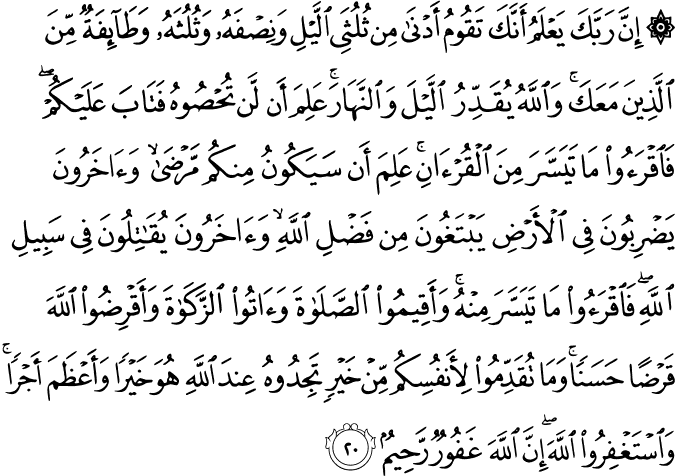
73.20 Indeed, your Lord knows, that you taqumu / establish adna / attachment (having intimate emotional, physical, mental and spiritual relationship without guidance) from a third of the layli / darkness (in obscuration) and nishfahu / part of it and a third of it, and tha'ifatun / a group (of thoughts with fantasy) from those with you. And Allah measures the layla / darkness (in obscuration) and the nahar / brightness (in clarity). He has known that you will not be able to tuhshuhu / comprehend it so fataba / retrospect (turn) over you, so iqra'u / read what is easy in the Qur'an / expression of truth. He knows that there will be among you mardho / (in) state of disorder (sick, tired, in pain and short of knowledge) and others yadhribu / set in the ardh / lower consciousness seeking from fadhli / given advantage of Allah and others fighting (good over evil) for the cause of Allah . So iqra'u / read what is easy from it and akimu salaat / establish the presence of the Rabb and aatu / accomplish zakah / mental development and aqridu / detach to Allah a goodly (full) detachment. And whatever good you put forward for your anfus / selves, you will find it better with Allah and a greater reward. And seek forgiveness of Allah . Indeed, Allah is ghafurun / forgiving and rahimun / merciful (in approving the knowledge from higher consciousness).
NOTES : This concluding verse of the surah brings together the inward discipline that has been unfolding throughout it. The Rabb knows the different capacities and circumstances of those who seek Him. Some are able to remain awake through much of the darkness, in obscuration, while others cannot. The precise measurement of brightness and darkness belongs to Allah, and consciousness cannot fully encompass His measure.
The important point is that the command is not an invitation to impose an impossible burden upon oneself. Allah knows what the insaan can and cannot sustain. When the limitation is recognized, He taaba ʿalaykum—turns toward you in restoration. The movement is therefore one of divine accommodation and mercy rather than rigid self-imposition.
The instruction to read what is accessible of the Qur'an follows naturally. The Qur'an is not something to be conquered through quantity. What matters is what can genuinely be received and assimilated. A small amount of living knowledge that penetrates consciousness can be more transformative than an enormous amount merely accumulated as information.
The verse then describes different movements through life: some are weakened by illness, some move through the ard seeking Allah's bounty, and some struggle in the way of Allah. The outward circumstances differ, but the essential direction remains the same—the movement of consciousness toward what Allah unveils.
Then comes wa-aqīmū aṣ-ṣalāh. Here the Qur'an does not say merely ṣallu; it commands to establish the ṣalaah / presence of the Rabb. After receiving and reading the Qur'an, insaan is invited to make that presence an established orientation rather than an occasional experience.
The zakaah follows as purification and growth. When the presence of the Rabb becomes established, what is unnecessary can fall away and what is beneficial can grow. The inner being is progressively purified of what obstructs recognition.
Then Allah asks for a qarḍ ḥasan—a good loan. This remarkable expression suggests that nothing truly given to Allah is lost. Whatever consciousness offers in sincerity—attention, understanding, effort, relinquishment, or goodness—is already known to Him. It is like placing something with the One who cannot lose or diminish what has been entrusted to Him.
The verse assures us that whatever good is put forward for the self will be found with Allah, better and greater. What is offered inwardly does not disappear; it returns as deeper recognition and greater capacity for truth.
Finally comes istighfar—seeking Allah's covering. Even after all this effort, consciousness recognizes its incompleteness. It does not claim purity or attainment. It remains open to being covered, protected, and restored by the Rabb.
The verse therefore closes with Ghafur and Raḥim. The One who continually covers and protects is also the One whose nurturing mercy restores. The journey is not completed by the effort of the separate self. It is completed through a continual movement between receiving, reading, establishing presence, purifying, offering, and allowing the Rabb to restore what remains incomplete.


No comments:
Post a Comment