
ALI IMRAN
(Consciousness enlivened by divine order)

INTRODUCTION
#lookingatoneself
The title Ali ʿImran metaphorically points to the “family” of inner qualities, the essential attributes that enliven and support conscious surrender. This surah invites us not to external observation, but to inner inquiry: to examine the landscape of our own reality, the movements of thought, the energies of resistance, and the subtle trust that underlies true security (imaan). At its core, Surah Ali ʿImran addresses the unfolding dynamics of imaan (inner security), hikmah (clarity through understanding), and Islam (conscious surrender) as they evolve within the soul’s journey. It speaks not merely to outer behavior, but to an inner realignment, where one returns to the truth of their inherent script, aligning the mind, body, and heart to the primordial deen.
Those described in this surah are not passive believers but awake participants in their covenant with Allah. They are among those who have aligned themselves with the script written within them, attuned their mental states to the rhythm of divine presence, and chosen to elevate their lives with full awareness. They no longer act from mechanical patterns of agitation, nor from inherited emotional reflexes shaped by past conditioning. Instead, they have returned to presence, to see clearly, to listen deeply, and to act in harmony with what is inwardly true. The agitated mind, programmed by repetition and self-generated content, is blind. It cannot perceive what is real in this moment. It reacts, resists, follows unverified narratives, and clings to illusions. Its priority is safety, not truth. It is efficient, but it is not aware.
This surah is an invitation to awaken from that mechanical flow. It reminds us that the path of deen is not about the memorisation of laws, but about the transformation of inner vision, a shift from unconscious habit to conscious presence. To walk the path of surrender (Islam) is to no longer live as a byproduct of your own unrest but as a living witness to truth, open and responsive to divine unfolding in the present moment. In its essence, Surah Ali ʿImran is a call to remember. To remember who you are before the veil of thought. To remember the inner voice that always pointed home. And to live, not in fragments, but in total alignment with your true nature, in full security with your Rabb, the one who nurtures, evolves, and sustains your being.

With the name of Allah - the Rahmaan, the Raheem.
NOTES : The name of Allah is the vibrational signature of the Being in whom all forms appear and disappear, the indivisible presence that pervades both the lower consciousness for the world of experience and thought, and the higher consciousness for the unbounded, unseen field from which all meaning flows. To invoke this name is to recognise that every measure of existence, every unfolding event, every hidden arrangement of cause and effect, arises within the vastness of this singular reality.
To begin with this name is to begin from stillness, from wholeness, from the recognition that the intelligence that moves galaxies is the same intelligence guiding your next breath. It is a return to the awareness that everything you seek is already held within the One who is nearer than your own being. In this recognition, the journey becomes simple, that is to remain open, to listen deeply, and to allow the mercy that shapes all things to shape you from within.

3:1 Alif, Lam, Meem.
NOTES : Alif signifies the singular, fundamental, irreducible reality of being itself. Lam represents the manifestation of the Singular reality through its countless representations, and Meem is the letter of completion and return, signifies al-aakhirah, the ending of association through dissolution of the conceptual self and the ending of separation through dissociation of true self.
This surah opens with the disjointed letters Alif, Lam, Meem. Altogether the Quranic language consists of 28 letters and 14 appear as disjointed at the beginning of 29 surahs. These Quranic letters are signs, with their distinct shapes and sounds, form the foundational building blocks of the Quranic verses, through which divine signs are manifested to convey Allah’s hidden messages of guidance and wisdom. From these letters, words and languages emerge, serving as a gateway to uncovering the profound, hidden spiritual messages embedded within the signs. From the pleasant thoughts provided to you, they invite pure rational mind to contemplate and grasp the deeper meanings concealed within.
From the comtemplation arises the appearance of the illusory, conceptual self, the self you imagine into being. This false self gives birth to further layers of association and separation, weaving a sense of distance from your true nature. When the conceptual self dissolves, both association and dissociation end. It is an act of injustice when truth is displaced by its illusion, when the representation is taken as reality. Amalan ṣaaliḥan are the corrective deeds that undo these distortions, dissolving injustice and allowing your true self to awaken and return to Allah. This is the inner process of al-aakhirah, the ending of dissociation and the unification of your true self as a living expression, a fractal reflection, of consciousness itself.

3:2 Allah, there is no ilaah / governing reality (that governs the mind) except Huwa / He, the Ḥayy / Ever-Living, the Qayyum / Self-Sustaining and Sustainer of all.
NOTES: The verse begins by directing attention away from the multiplicity of objects, thoughts and assumptions that appear to govern the mind. Ilaah is understood here through its functional meaning as a governing reality—whatever is allowed to determine the direction and configuration of the mind. The statement that there is no governing reality except Allah therefore points to the fundamental unity behind all authentic recognition.
The word Allah itself is not being presented as one competing object among other objects of thought. Rather, it identifies the ultimate Reality from which all genuine recognition arises. The apparent multiplicity of governing influences belongs to the conditioned mind. When these influences are examined, they are found to depend upon something prior to them: the awareness in which they appear and through which they become known.
That Reality is described as Al-Ḥayy / Ever-Living. Life here is not merely biological existence. It points to that which is never dependent upon the conceptualized self for its existence or recognition. Thoughts arise and disappear, identities change, knowledge develops and circumstances unfold, yet the capacity through which all of these are known is not itself dependent upon any particular thought.
It is then described as Al-Qayyum / Self-Sustaining and Sustainer of all. The root q-w-m carries the sense of standing, maintaining and establishing. The inward significance is therefore that Reality does not require support from the structures it sustains. The conceptualized self depends upon innumerable conditions, while the sustaining Reality is not dependent upon the self.
This creates an important distinction between what appears to govern the mind and what actually sustains its existence. Established thoughts may temporarily direct attention, inherited beliefs may appear authoritative, and emotional patterns may seem powerful, but none of them possesses independent existence. They arise within a reality that precedes and sustains them.
Thus 3:2 follows naturally from the closing movement of Al-Baqarah. After the insaan has been brought through recognition, resistance, inherited conditioning, responsibility and surrender, attention is brought back to the foundation itself. The journey is not ultimately toward establishing a stronger conceptualized self. It is toward recognizing the Ḥayy, Qayyum—the ever-living Reality that is already present, already sustaining, and never separate from the awareness through which truth is recognized.

3:3 He has brought down upon you Al-Kitab / the inherent script with Al-Haqq / the Truth, confirming what is within the reach and presence (of the rational mind), and He brought down the Tawrah / natural laws of reality (through which behavioural consequences become evident) and the Injeel / good news when signs reveal reality.
NOTES: The movement begins with Al-Kitab / the inherent script being brought into the field of the insaan. Because it comes with Al-Haqq / the Truth, it is not an arbitrary system of ideas imposed upon the mind. It reveals an inherent order that is already present within reality. The insaan is therefore invited to recognize rather than merely believe, to see what is already capable of being recognized within direct experience.
This is why the expression “what is within the reach and presence of the rational mind” is important. The rational faculty is capable of examining, connecting and recognizing what lies within its field of awareness. Al-Kitab confirms that which can already be reached by genuine reasoning, while also opening awareness to what lies beyond the limitations of established thought. Revelation and rational recognition therefore work together rather than standing in opposition.
The Tawrah / natural laws of reality then reveals another dimension of this recognition. Reality operates according to inherent laws, and these laws become evident through their consequences. Every thought, orientation and action participates in a process of cause and consequence. When the insaan understands these natural laws, behavioural consequences are no longer seen as arbitrary rewards or punishments imposed from outside. They are recognized as the natural unfolding of the configuration that has been established.
The Injeel / good news when signs reveal reality describes what happens when these signs become clear. A sign is not merely information pointing toward something else; it is an opening through which reality becomes recognizable. When what was previously obscured becomes evident, recognition itself becomes good news. The joy comes from the dissolution of uncertainty and from seeing reality more directly.
There is therefore a progression within the verse. Al-Kitab reveals the inherent script with Al-Haqq; the rational mind is able to recognize what lies within its reach; the Tawrah reveals the natural laws through which consequences become evident; and the Injeel expresses the good news that arises when signs disclose reality. These are not disconnected forms of guidance. They are different dimensions of one movement from obscurity toward recognition.
The deeper invitation is for the insaan to examine reality without allowing inherited assumptions to dictate what must be seen. What is within reach of the rational mind can be examined; the consequences of behaviour can be observed; and signs can be recognized as they reveal what is true. In this way, guidance becomes experiential rather than merely conceptual. Al-Haqq does not demand that the insaan abandon understanding; it invites understanding to become sufficiently clear that what is already present can finally be recognized.

3:4 From before, as guidance for an-nas / the agitated mind, and He brought down the Furqan / faculty of discernment (that distinguishes truth from falsehood). Indeed, those who kafaru / conceal what they recognize in the aayaat / signs of Allah, for them is a severe punishment. And Allah is ʿAzīz / irresistible in authority, Dhu Intiqaam / possessing the consequence that follows from what is concealed.
NOTES: The guidance that has already been brought into the field of the an-nas / agitated mind is accompanied by the Furqan / faculty of discernment. Recognition alone is not enough, because the mind can receive many impressions and interpretations. The Furqan enables the insaan to examine what arises and distinguish what is aligned with Al-Haqq / the Truth from what merely appears convincing.
This faculty of discernment is particularly important because the agitated mind is easily influenced by established patterns. Something familiar can appear true simply because it has been repeatedly accepted, while something unfamiliar can be rejected despite being true. Furqan therefore represents the capacity to see beyond familiarity and examine what is actually being recognized.
The verse then turns toward those who kafaru / conceal what they recognize. This is a deeper condition than simply not knowing. The recognition has already occurred through the aayaat / signs of Allah, yet the mind covers it rather than allowing it to unfold into understanding. Concealment can therefore take place even in a mind that possesses knowledge. What matters is not how much has been encountered, but whether what has been recognized is allowed to remain visible.
The resulting severe punishment can be understood as the natural consequence of this concealment. When the insaan recognizes something as true but continues to organize thought against that recognition, an inner division develops. The mind is pulled between what it knows and what it insists upon maintaining. The resulting conflict becomes its own form of suffering. The consequence is therefore inseparable from the act of concealment itself.
Allah is ʿAzīz / irresistible in authority because no configuration of thought can ultimately alter Al-Haqq. The mind may conceal a sign, deny its significance or construct another explanation around it, but the Truth does not become less true. Its authority does not depend upon recognition by the conceptualized self. What is real remains real even when awareness temporarily turns away from it.
Dhu Intiqaam / possessing the consequence that follows from what is concealed completes the movement. What is concealed does not simply disappear; it continues to participate in the unfolding of the self. The consequence arises from the very configuration that has been established through concealment. In this sense, Allah's authority is not arbitrary retaliation but the certainty that reality ultimately reveals the consequences of whatever the insaan chooses to recognize, conceal or embody.

3:5 Indeed, nothing is yakhfa / concealed upon Him, whether in the ard / lower consciousness or in the samaawaat / higher consciousness.
NOTES: The preceding verse introduced the Furqan / faculty of discernment through which the insaan distinguishes what is aligned with Al-Haqq from what conceals it. This verse now establishes the foundation upon which such discernment rests: nothing can actually be hidden from Allah. What may be concealed from the conceptualized self is never concealed from the Reality in which that self exists.
The word yakhfaa / is concealed points to something being hidden from awareness or kept out of sight. Within the inward reading, however, concealment belongs to the limitations of the mind. A thought may remain unnoticed, a motive may be suppressed, or a recognition may be deliberately covered, but none of these movements can exist outside the knowing of Allah.
The ard / lower consciousness represents the field in which thought becomes more contracted, conditioned and attached to particular configurations. The samaawaat / higher consciousness, by contrast, represents progressively elevated states of awareness. The verse encompasses both, showing that Allah's knowing is not restricted to one level of the insaan's experience.
This has an important implication for kufr / concealing what has been recognized. The insaan may conceal recognition from itself, from others, or even construct an explanation that makes the recognition appear absent. Yet concealment does not remove what has been recognized from Reality. What has been covered in one level of awareness remains fully known to Allah.
The verse therefore prevents the Furqan from becoming merely an intellectual exercise. Discernment is not about constructing a private certainty and then defending it. It is about becoming increasingly transparent to what is already present. Since nothing is hidden from Allah, the deeper movement is toward honesty—allowing what is actually occurring within the mind to become visible without distortion.
There is also a quiet reassurance in this recognition. The insaan does not need to make everything visible by force before Allah can know it. Nothing is outside His knowledge, whether it appears in the lower consciousness or the higher consciousness. The task of the seeker is therefore not to inform Allah of what is hidden, but to become sufficiently aware to recognize what Allah already knows.

3:6 He is the One who yusawwir / gives shape to you in the arḥaam / inner conception of understanding, however you will. There is no ilaah / governing reality except Huwa / He, Al-ʿAziz / the Irresistible in authority, Al-Ḥakim / the One that is perfect in wisdom.
NOTES: The previous verse established that nothing is concealed from Allah, whether within the ard / lower consciousness or the samaawaat / higher consciousness. This verse takes that recognition further by directing attention to the very process through which understanding takes shape. The insaan does not merely receive thoughts and perceptions; within the arḥaam / inner conception of understanding, these are continuously given form.
The expression yusawwir / gives shape points to the transformation of what is not yet clearly formed into something that can be recognized. An understanding may begin as a subtle impression, gradually acquire structure, and eventually become a clearly identifiable thought or orientation. The inner conception therefore functions as a field in which potential recognition takes shape.
This shaping is not confined to what the conceptualized self consciously chooses. Much of what appears within understanding emerges through a process that precedes deliberate thought. The insaan discovers thoughts already taking form within itself and may only subsequently become aware of them. Thus, the verse directs attention beyond the assumption that the conceptualized self is the independent author of everything that appears within its field of understanding.
The phrase “however you will” introduces the dimension of will into this unfolding. What takes shape within understanding is not separate from the movement of willing. The insaan continually turns toward some possibilities and away from others, and these orientations participate in the forms that become established. Yet beneath this apparent individual willing remains the singular governing Reality. The conceptualized self participates in the unfolding, but it does not stand outside the Reality within which the unfolding occurs.
This leads naturally to the declaration that there is no ilaah / governing reality except Huwa / He. Whatever forms appear within the inner conception of understanding are not independent authorities. Thoughts may seem to govern the mind, inherited assumptions may appear authoritative, and established orientations may determine behaviour, but none possesses ultimate governing authority. Their existence and influence remain within the One Reality that gives them form.
The verse therefore closes with Al-ʿAziz / the Irresistible in authority and Al-Ḥakim / the One that is perfect in wisdom. What takes shape within the insaan is not outside the authority of Allah, nor is its unfolding without wisdom. Recognition develops through forms, forms become visible within understanding, and understanding continually reveals its limitations and possibilities. The deeper movement is to recognize that behind every form is the One Reality in which that form arises—irresistible in authority and perfect in wisdom.

3:7 He is the One who has brought down upon you Al-Kitab / the inherent script. Within it are aayaat / signs that are muḥkamaat / governed by natural law; they are the umm al-kitab / mother of the inherent script, and others are mutashaabihaat / resembling (the Truth). As for those in whose quluub / inner centres of understanding is zaygh / a deviation, they follow what tashaabaha / resemble it (Truth), seeking fitnah / a captivation and seeking taʾwiil / interpretation. And none knows its taʾwiil / interpretation (that returns the resemblance to its originating truth) except Allah. And those firmly established in knowledge say, “We have taken security with it; all of it is from our Rabb / continual nurturing Lord.” And none yadhdhakkaru / embodies divine masculine attributes except ulul-albaab / those endowed with understanding based on Al-Haqq.
NOTES: Al-Kitab / the inherent script contains different kinds of signs through which recognition unfolds. Some are muḥkamaat / governed by natural law. Their manifestation follows an established order, allowing the insaan to observe how reality operates and how consequences arise. These signs therefore provide a stable foundation for understanding because their unfolding is not dependent upon personal preference or interpretation.
These muḥkamaat are described as the umm al-kitab / mother of the inherent script. They provide the foundational structure from which the rest of the inherent script can be approached. Natural law reveals itself through what repeatedly unfolds in accordance with the governing order of reality. When the insaan observes these patterns without imposing preconceived conclusions upon them, the underlying script becomes increasingly recognizable.
Other signs bear resemblance to Al-Haqq. Their representations point toward the Truth without necessarily presenting the originating reality in its most direct form. Resemblance therefore requires discernment. A representation can reveal something of the Truth while still being only a representation. The insaan must learn to recognize what the sign reveals without mistaking the form of the sign for the Reality itself.
The difficulty arises when the qalb / inner centre of understanding contains zaygh / deviation. Instead of allowing the resemblance to lead awareness back toward Al-Haqq, the deviated mind follows the resemblance itself. It becomes captivated by the representation and begins constructing meaning around it. Fitnah / captivation therefore describes a state in which attention becomes absorbed by the appearance rather than remaining oriented toward what the appearance reveals.
This is why taʾwiil / interpretation becomes significant. Genuine taʾwiil is not simply producing an explanation that satisfies the mind. It is the movement through which the resemblance is returned to its originating truth. When the mind is already deviated, however, interpretation can become another means of strengthening the very configuration that prevents recognition. The verse therefore reminds us that the originating truth cannot be fully possessed by interpretation as an independent mental construction.
Those who are firmly established in knowledge respond differently. They do not need to force every resemblance into an immediate explanation. They take security in the whole of Al-Kitab, recognizing that both the signs governed by natural law and those that bear resemblance arise from the same Rabb / continual nurturing Lord. Their security is therefore in the source rather than in their ability to explain every representation.
The closing reference to ulul-albaab / those endowed with understanding based on Al-Haqq brings the verse back to the quality of understanding required for this journey. To yadhdhakkaru / embody divine masculine attributes is not merely to remember information intellectually. It is to allow the recognition of those attributes to become embodied in the way understanding operates. The ulul-albaab are therefore those whose understanding remains rooted in Al-Haqq, allowing resemblance to point beyond itself rather than becoming an object of attachment.

3:8 Our Rabb / continual nurturing Lord, do not tuzigh / cause our understanding to deviate after You have guided us, and grant us raḥmah / nurturing mercy from Yourself. Indeed, You are Al-Wahhaab / the One who continually bestows.
NOTES: After distinguishing the signs governed by natural law from those that bear resemblance to Al-Haqq, the verse turns toward the condition of the one who is seeking recognition. The central concern is not simply acquiring knowledge, but remaining aligned with what has already been recognized. Guidance can be present, yet the inner centre of understanding can still deviate from it.
The request “do not tuzigh / cause our understanding to deviate” can be understood as a recognition of the fragility of the conceptualized self. The mind can move away from a direct recognition of Al-Haqq and become attracted to its own interpretations, preferences and established patterns. The preceding verse has already identified zaygh / deviation as the condition that causes the mind to follow resemblance rather than return toward originating truth.
The phrase “after You have guided us” is particularly significant. Deviation here occurs after guidance has become available. This means that possessing recognition does not automatically guarantee that recognition will remain embodied. The insaan must continually return to what has been recognized, otherwise established thought can gradually reclaim the centre of understanding.
The request for raḥmah / nurturing mercy is therefore a request for continued support in the process of alignment. Recognition is not sustained by the strength of the conceptualized self alone. It requires continual nurturing so that understanding can remain open rather than becoming fixed around its own conclusions. Mercy here is not merely forgiveness after an error; it is the ongoing nurturing through which recognition continues to develop.
The closing name, Al-Wahhaab / the One who continually bestows, completes this movement. What is required for further recognition is not manufactured by the conceptualized self. Capacity, insight, discernment and deeper understanding are continually bestowed. The insaan's role is to remain receptive rather than claiming independent ownership of what has been received.
Thus 3:8 follows naturally from 3:7. Having recognized that some signs are governed by natural law while others bear resemblance to Al-Haqq, the seeker asks not to become deviated by the resemblance. The deeper request is for continuity of recognition: having been guided, may the understanding remain aligned, receptive and continually nurtured toward Al-Haqq.

3:9 Our Rabb / continual nurturing Lord, indeed You are the gatherer of an-nas / the agitated conditioned thoughts for a yawm / moment which there is no doubt. Indeed, Allah does not yukhlifu / fail to fulfil the miʿaad / appointed promise.
NOTES: The movement from the previous verse continues with the recognition that the Rabb / continual nurturing Lord does not abandon the insaan to the fragmentation of its own conditioned thinking. The an-nas / agitated conditioned thoughts may appear as many separate tendencies, assumptions and reactions, yet Allah is the One who gathers them. What appears to be a collection of disconnected thoughts can therefore be brought into a single field in which their relationships become recognizable.
The yawm / moment is the point at which this gathering becomes evident. It need not refer to a distant period in time. It can be understood as a decisive moment in the unfolding of understanding when what has been scattered begins to come together. Thoughts that previously appeared unrelated may suddenly reveal their common source, their consequences and the conditioning that has held them together.
This gathering also provides an answer to the concern expressed in 3:8. After asking not to deviate after guidance, the insaan recognizes that it cannot maintain clarity through its own effort alone. The continual nurturing Lord is continuously bringing the scattered movements of understanding toward a state in which they can be seen together. The task of the insaan is therefore not to control the entire process, but to remain receptive to the gathering.
The absence of doubt does not mean that the conceptualized self will never experience uncertainty. Rather, the gathering itself is certain. Doubt belongs to the changing configuration of thought; the underlying movement toward recognition does not depend upon that configuration being certain about it. What is promised is therefore deeper than intellectual certainty—it is the eventual convergence of what has been dispersed.
The miʿaad / appointed promise expresses this certainty of unfolding. Allah does not fail to fulfil what He has appointed. What has been promised is not necessarily an externally imposed event but the completion of a process already operating within awareness. Every recognition, every deviation, every concealed understanding and every returning movement participates in an unfolding that is ultimately gathered.
The verse therefore offers reassurance to the seeking insaan: fragmentation is not the final condition. The agitated conditioned thoughts may scatter awareness in many directions, but the continual nurturing Lord gathers them toward recognition. The appointed promise does not depend upon the conceptualized self successfully controlling the journey. It rests upon the reliability of Allah, who does not fail to bring the unfolding to its appointed completion.

3:10 Indeed, those who kafaru / conceal what they recognize, their amwaal / wealth of knowledge and support and their awlaad / developing thoughts will never avail them against Allah at all. And those are the fuel of an-nar / consuming fire.
NOTES: The verse now moves from the certainty of gathering to what happens when recognition is concealed. Kufr / concealing what has been recognized is not simply an absence of knowledge. It is the condition in which something has become available to understanding but is then covered over, denied or prevented from unfolding. The verse points to the consequences of allowing that concealment to remain established within the mind.
The amwaal / wealth of knowledge and support represent what the insaan has accumulated as resources for the conceptualized self. Knowledge, experience, abilities, possessions and established understandings can all become forms of support. Yet none of these can protect the self from the consequences of concealing what it has genuinely recognized. Accumulation does not compensate for misalignment with Al-Haqq.
Likewise, the awlaad / developing thoughts are the thoughts that have emerged from what has already been established within the mind. They may multiply, become increasingly sophisticated and even appear to provide security to the conceptualized self. But thoughts generated from a configuration that conceals recognition cannot ultimately free that configuration from its own limitation.
The expression “will never avail them against Allah” therefore points to the inadequacy of relying upon accumulated mental resources to overcome the governing Reality. The mind can construct explanations, gather knowledge and generate increasingly elaborate thoughts, but none of these can alter what is true. The more the conceptualized self relies upon its own accumulation while concealing recognition, the more deeply it becomes confined within its own configuration.
The final image of these becoming the fuel of an-nar / consuming fire brings the consequence into focus. What the self has accumulated does not necessarily disappear; it can become the very material through which the consuming condition is sustained. Knowledge that is not allowed to transform understanding, and developing thoughts that reinforce concealment, can feed the intensity of the conditioned mind rather than release it.
Thus 3:10 follows naturally from the gathering described in 3:9. When the scattered an-nas / agitated conditioned thoughts are gathered, what has been accumulated within them becomes visible. If recognition has been concealed, wealth of knowledge and developing thoughts cannot provide an escape from the consequences of that concealment. The verse therefore directs the insaan away from accumulation as a source of security and back toward the only security that matters: remaining open to what has been recognized as Al-Haqq.

3:11 Like the conduct of the aali Firʿawn / integrated configuration of a tyrannical self-sovereignty (that claims sovereignty over life), and those before them: they concealed Our aayaat / signs, so Allah seized them because of their wrongdoings. And Allah is Shadid al-ʿIqaab / severe in the consequence that follows from wrongdoing.
NOTES: The verse continues the examination of what happens when recognition is repeatedly concealed. The aali Firʿawn / integrated configuration of a tyrannical self-sovereignty that claims sovereignty over life represents a deeply established configuration in which the conceptualized self assumes authority that does not truly belong to it. Instead of recognizing life as unfolding within Allah's governing Reality, this configuration behaves as though it possesses independent sovereignty.
Such a configuration does not necessarily begin with an explicit declaration of sovereignty. It can develop gradually whenever the mind gives itself final authority over what is true, what should be accepted and what should be rejected. Once the self-established authority becomes dominant, recognition that challenges it is experienced as a threat, and the aayaat / signs that could reveal Al-Haqq are increasingly concealed.
The reference to those before them shows that this is not a unique pattern. The same configuration can arise repeatedly within the insaan. Different thoughts, identities and belief structures may appear on the surface, yet the underlying movement remains the same: an established self-sovereignty encounters a sign, refuses to surrender its assumed authority, and conceals the recognition that could dissolve its dominance.
Allah's seizing can therefore be understood as the point at which the consequences of this configuration become unavoidable. What repeatedly conceals recognition gradually becomes constrained by its own structure. The mind that insists upon controlling reality becomes increasingly controlled by the very patterns through which it attempts to maintain control. What was initially experienced as sovereignty becomes a form of confinement.
This is why the verse connects the consequence with wrongdoing / ẓulm. In your established rendering, ẓulm is the displacement of truth from its rightful place. When the self-sovereign configuration places its own assumptions above what has been recognized through Allah's signs, truth is displaced. The problem is therefore not simply that the mind has made an intellectual mistake; it has given authority to something that does not possess ultimate authority.
Shadid al-ʿIqaab / severe in the consequence that follows from wrongdoing completes the principle. The severity does not require Allah to impose an arbitrary punishment upon the insaan. The consequence is already inherent in the configuration that has been established. The more completely the self claims sovereignty over life and conceals the signs that contradict that claim, the more deeply it becomes governed by its own constructed reality. The verse therefore continues the warning of the preceding verses: what is concealed from recognition does not cease to exist; it continues to unfold until its consequences become impossible to ignore.

3:12 Say to those who kafaru / conceal what they recognize: “You will be overpowered, and you will be gathered toward Jahannam / consuming intense fire, and wretched is the resting place.”
NOTES: The previous verse described the integrated configuration of Firʿawn / tyrannical self-sovereignty, in which the conceptualized self assumes authority over life and conceals the signs that challenge that assumption. This verse now describes what inevitably follows when such a configuration continues to assert itself against recognition.
To be overpowered does not necessarily mean that an external force defeats the individual. Within the inward movement, it points to the eventual inability of the self-sovereign configuration to maintain its claim of independence. No constructed identity can ultimately establish itself as sovereign over the Reality in which it arises. The apparent strength of the self therefore has a natural limit.
The movement toward Jahannam / consuming intense fire describes what happens when the configuration continues to feed upon its own concealment. The fire consumes the very structures that attempt to sustain themselves against recognition. The more the mind reinforces a false sovereignty, the more intensely that configuration becomes exposed to the consequences generated by its own resistance.
This also connects directly with the previous verse's ʿiqaab / consequence that follows from wrongdoing. The consequence is not something unrelated to the action. Concealing recognition and displacing Al-Haqq produce a configuration that eventually becomes consumed by its own internal conflict. What the mind attempts to preserve becomes the material through which its limitation is revealed.
The phrase “you will be gathered” also connects back to 3:9, where Allah is the gatherer of an-nas / the agitated conditioned thoughts. Fragmented thoughts and competing self-affirmations do not remain permanently scattered. They are eventually brought together, and when they are gathered, the configuration they have collectively produced becomes evident. What was previously hidden within separate thoughts can no longer remain concealed.
The final description of the resting place as wretched points to the condition of remaining established within this consuming configuration. There is no genuine rest in a self that must continually defend its own sovereignty against what it already recognizes. True rest can arise only when the need to maintain that separation dissolves and the insaan ceases to displace Al-Haqq.
Thus 3:12 continues the sequence from 3:10 and 3:11: concealment of recognition produces a self-sovereign configuration; that configuration becomes subject to the consequences of its own displacement of truth; and ultimately it is gathered into the consuming process through which its false sovereignty is exposed and consumed.

3:13 Surely, there was for you an aayah / sign in two groups that encountered one another: one group fighting in the way of Allah and another kaafirah / concealing what they recognized. They saw them twice their number with their own perception. And Allah supports with His naṣr / help for the realization of truth whoever wills. Indeed, in that is a lesson for those possessing abṣaar / insight.
NOTES: The verse presents an aayah / sign through the encounter of two opposing configurations. One is moving in the way of Allah, while the other is kaafirah / concealing what it has recognized. The encounter therefore reveals what happens when a movement toward recognition meets a configuration that is invested in preserving what has already been established.
The important point is that the opposition is not necessarily between two external groups. Within the insaan, there can also be a continual encounter between two movements: one that allows recognition to unfold and another that protects established thought from being disturbed. The struggle is therefore a revealing process. It exposes which configuration is being given authority.
The perception that one group appears twice the number of the other shows how perception can magnify what is encountered. What appears before the mind is not necessarily perceived without interpretation. Fear, conditioning and established expectations can enlarge an opposing thought until it appears much more powerful than it actually is. The verse therefore draws attention to the difference between what is perceived and what is actually present.
The phrase “with their own perception” makes this especially relevant. The insaan can become convinced by its own seeing, yet perception itself is influenced by the state of understanding through which the seeing occurs. A thought that appears overwhelming may derive much of its apparent strength from the attention and significance given to it. The faculty of insight begins when awareness becomes capable of observing its own perception rather than immediately accepting it as the whole of reality.
Allah supports with naṣr / help for the realization of truth whoever wills. Within the inward movement, this support is not arbitrary intervention favouring one conceptualized self over another. It is the assistance through which recognition of Al-Haqq becomes established when the insaan wills that direction. The decisive movement is therefore toward realization rather than toward strengthening the self's struggle to preserve its own position.
This is why the verse concludes with abṣaar / insight. Insight is more than ordinary seeing. It is the capacity to recognize what an experience is revealing beneath its appearance. The encounter becomes an aayah because it exposes the workings of perception, resistance and recognition. Those possessing insight do not merely see the opposing configurations; they learn from what the encounter reveals about the mind itself.
The deeper lesson is therefore that an apparent conflict can become a means of recognition. What initially appears as an overwhelming opposition may be magnified by perception, while the movement toward Al-Haqq may require only a willingness to see beyond that appearance. When perception is examined rather than blindly followed, the encounter becomes an āyah / sign, and the insaan begins to recognize the help that leads toward the realization of truth.

3:14 Made attractive to an-nas / the agitated conditioned thoughts is the love of the shahawaat / intense inclinations toward what is desired, from an-nisaʾ / developing thoughts arising from the feminine receptive faculty, and al-banin / developing thoughts arising from the masculine affirming faculty, and al-qanaaṭīr / accumulated structures of wealth of knowledge and support, from adh-dhahab / what is intensely attractive and highly valued, and al-fiḍḍah / what is refined and purified, and al-khayl / mental formations that move swiftly, al-musawwamah / marked with distinguishing characteristics, and al-anʿaam / pleasant thought (arising from departure of adverse condition), and al-ḥarth / cultivated conditioning. That is the enjoyment of al-ḥayaah ad-dunyaa / the life of close attachment, and with Allah is the excellence of the final return.
NOTES: The verse now turns from the encounter described previously to the forces that keep the an-nas / agitated conditioned thoughts attached to the immediate field of experience. Attraction is not presented merely as a response to external objects. It arises as shahawaat / intense inclinations toward what is desired, drawing attention toward whatever appears capable of providing satisfaction, security, completion or relief.
The reference to an-nisaaʾ / developing thoughts arising from the feminine receptive faculty and al-baneen / developing thoughts arising from the masculine affirming faculty presents two complementary movements within thought. One receives and develops an impression, while the other affirms and gives it continuing form. When these movements operate together, thoughts can become increasingly established and begin to appear as an independent reality to the agitated mind.
The al-qanaaṭeer / accumulated structures of wealth of knowledge and support represent another powerful source of attachment. Knowledge, experience and accumulated resources can provide genuine support, but the conditioned mind can gradually turn them into objects of security in themselves. Adh-dhahab / what is intensely attractive and highly valued and al-fiḍḍah / what is refined and purified illustrate how the mind can assign special value to particular forms, qualities or achievements and then become attached to possessing or preserving them.
The al-khayl / mental formations that move swiftly reveals how quickly attraction can move through the mind. One thought leads to another, and before the insaan has examined the movement, attention may already have followed it. When these formations become al-musawwamah / marked with distinguishing characteristics, they become recognizable patterns that can exert an even stronger pull. The mind begins to recognize, classify and pursue particular forms because they have acquired significance through previous conditioning.
The mention of al-anʿaam / pleasant thought arising from departure of an adverse condition adds another subtle dimension. When an adverse condition passes, relief itself can become attractive. The mind experiences the disappearance of difficulty as pleasure and may then seek to reproduce that pleasant state. Similarly, al-ḥarth / cultivated conditioning shows how repeated attention cultivates particular patterns until they become established within the field of experience. What is repeatedly attended to becomes increasingly familiar, and what is familiar can become increasingly desirable.
All these attractions belong to al-ḥayaah ad-dunyaa / the life of close attachment. The verse is not saying that these experiences should simply be rejected. Rather, it reveals why the agitated conditioned mind becomes attached to them: each appears to offer something that the conceptualized self believes it needs. The difficulty begins when temporary experiences are mistaken for the source of lasting fulfilment.
The verse therefore turns attention toward Allah and the excellence of the final return. When attachment is examined deeply, the insaan begins to see that no accumulated knowledge, developing thought, valued possession, rapid mental formation, pleasant relief or cultivated conditioning can provide the ultimate completion sought by the conceptualized self. The excellence of the return lies not in acquiring another object of attachment, but in recognizing the Reality to which every experience ultimately points.

3:15 Say: “Shall I inform you of khayr / what is beneficial and good beyond that? For those who developed taqwaa / conscious mindfulness toward their Rabb / continual nurturing Lord are jannaat / hidden gardens of flourishing states beneath which rivers of realisation flow, abiding therein, and purified azwaaj / integrated pairs (of dhakara and untha), and riḍwaan / contentment from Allah. And Allah is Baṣir / fully seeing of the servants.”
NOTES: The verse now offers a deeper possibility beyond the attractions described in the previous verse. The khayr / what is beneficial and good is not simply another collection of desirable experiences. It points to a quality of being that becomes available when the insaan develops taqwaa / conscious mindfulness toward the Rabb / continual nurturing Lord. Instead of allowing attraction to determine the direction of awareness, the insaan remains consciously aware of Allah while every movement of thought and desire unfolds.
The jannaat / hidden gardens of flourishing states represent inward states in which recognition can develop naturally. A hidden garden is not something immediately displayed to the agitated mind; it is discovered as awareness turns inward and becomes receptive to what is already present. These states flourish because they are no longer dependent upon the restless acquisition and preservation described in 3:14.
The rivers of realisation flowing beneath these gardens give the image its movement. Realisation is not a single intellectual conclusion that can be possessed and then put aside. It continues to flow, nourishing understanding and allowing one recognition to lead naturally into another. As long as the insaan remains receptive, this flow can continue to reveal deeper dimensions of Al-Haqq.
The purified azwaaj / integrated pairs of dhakara and untha point to complementary faculties within understanding. The dhakara / masculine affirming faculty and untha / feminine receptive faculty can become integrated rather than operating from conflict or distortion. What is received can be affirmed in alignment with Al-Haqq, while what is affirmed remains open to further recognition. Purification therefore means that neither faculty is being used to serve the conditioned self.
This gives riḍwaan / contentment from Allah a significance deeper than ordinary pleasure. The attractions of 3:14 depend upon obtaining something that the conceptualized self believes will complete it. Contentment does not depend upon acquisition. It arises when the demand for something outside the present recognition begins to dissolve. The insaan discovers that peace is not produced by possessing more of the life of close attachment, but through recognizing the Reality that is already present.
The closing name Baṣīr / fully seeing of the servants brings the verse back to complete transparency. Allah sees the entire movement—the attraction, the attachment, the turning toward recognition and the turning away from it. Nothing within the insaan is outside this seeing. The deeper invitation is therefore not to hide the movements of desire, but to become fully aware of them. Through taqwaa, the insaan can observe the attractions of close attachment without being governed by them, allowing the hidden gardens of flourishing states and the flowing realisation of Al-Haqq to become increasingly evident.

3:16 Those who say, “Our Rabb / continual nurturing Lord, indeed we have aamanna / taken security, so forgive us our dhunub / consequences of our shortcomings and protect us from the ʿadhaab / punishment of the consuming fire.”
NOTES: The movement begins with the recognition of Allah as Rabb / continual nurturing Lord. Those who say aamanna / have taken security are recognizing that genuine security does not come from the attractions, possessions or established patterns of the conditioned mind. Their security comes from turning toward the Reality that continually nurtures the unfolding of understanding.
This recognition also brings an awareness of what has previously been established within the self. The dhunub / consequences of our shortcomings are not merely isolated mistakes. They are the consequences that arise when understanding has been displaced, recognition has been concealed, or conditioned thoughts have been allowed to determine the direction of awareness. Once these consequences become visible, they can no longer be ignored.
The request to be forgiven can therefore be understood as a request for maghfirah / continual covering over. The purpose of this covering is not to hide what has happened from Allah, since nothing is hidden from Him. Rather, it allows the insaan to move beyond the consequences of previous configurations without continually carrying them as a fixed identity. What has been recognized can become the beginning of correction rather than a reason for remaining trapped in the past.
The request for protection from ʿadhāb / punishment of the consuming fire follows naturally. The consuming fire represents the painful consequence of remaining within configurations that continually consume the awareness they were supposed to serve. When the mind continues to feed concealment, attachment and displacement of truth, those very patterns become self-consuming.
There is therefore a significant shift from the attractions described in 3:14. The conditioned mind seeks security through what it can possess, accumulate and experience, whereas those who have aamanna / taken security recognize a different source of security. They do not claim that their previous shortcomings never existed. Instead, they turn toward the Rabb with an openness that allows those consequences to be covered over and no longer govern the direction of awareness.
The verse thus expresses the beginning of a deeper freedom. Taking security with Allah does not mean that the conceptualized self has become perfect; it means that it has ceased to depend upon itself as the ultimate source of security. From that recognition comes the willingness to acknowledge its shortcomings, receive continual nurturing mercy, and move away from the consuming consequences of the patterns that once governed it.

3:17 Those who are aṣ-ṣaabirin / steadfast in peaceful recognition, aṣ-ṣaadiqīn / truthful, al-qaanitīn / continually receptive in devoted obedience, al-munfiqīn / those who put into self-experience, and al-mustaghfirīn / those seeking forgiveness (continual covering) with al-asḥaar / the moments before the emergence of consequence.
NOTES: The verse describes how aamanna / taking security with Allah becomes embodied within the insaan. The first quality is aṣ-ṣaabirīn / those steadfast in peaceful recognition. Recognition is not always accompanied by immediate clarity or ease. Established thoughts may continue to arise, desires may continue to pull, and uncertainty may temporarily appear. Ṣabr is the capacity to remain peacefully aligned with what has been recognized without allowing these movements to displace it.
From this steadfastness comes aṣ-ṣaadiqīn / those who are truthful. Truthfulness means allowing the inner configuration to correspond with what has actually been recognized. It is not enough to acknowledge Al-Haqq intellectually while allowing contradictory patterns to govern experience. Ṣidq is the progressive alignment between recognition and embodiment, so that what the insaan knows and how the insaan lives no longer move in opposing directions.
The al-qaanitin / continually receptive in devoted obedience describe another dimension of this alignment. Devoted obedience is not blind submission to an external authority. It is the willingness of the insaan to remain receptive to the governing Reality rather than allowing established thought to insist upon its own authority. The more receptive the understanding becomes, the less it needs to defend its existing configuration.
This receptivity naturally leads to al-munfiqīn / those who put into self-experience. Recognition must move into experience. Knowledge that remains merely conceptual can become another possession of the self, whereas putting it into self-experience allows its truth to reshape the configuration of thought. In this sense, infaaq is an active movement of releasing recognized knowledge into lived experience rather than keeping it contained as an intellectual possession.
The final quality is al-mustaghfirīn / those seeking forgiveness, or continual covering, at al-asḥaar / the moments before the emergence of consequence. The asḥaar can be understood as a threshold period—a point at which what has been developing beneath awareness is approaching manifestation. Before consequence becomes evident, there remains an opportunity for recognition, correction and return. Seeking continual covering at this stage reflects an awareness that not every developing pattern needs to be allowed to reach its full consequence.
There is therefore a natural progression in the verse. Ṣabr provides stability, ṣidq brings truthfulness into the configuration, qaanit keeps awareness receptive, infaaq puts recognition into self-experience, and istighfaar remains open to continual covering and correction before what has been developing becomes fully manifest. The verse describes an insaan that is no longer merely receiving truth, but allowing truth to govern the entire movement from recognition to consequence.

3:18 Allah bears witness that there is no ilaah / governing reality except Huwa / He; and the malaa’ikah / governing authorities and ulul-ʿilm / those endowed with knowledge also bear witness, standing firmly with al-qisṭ / what establishes truth in its rightful balance. There is no ilaah / governing reality except Huwa / He, Al-ʿAzīz / the Irresistible in authority, Al-Ḥakim / the One perfect in wisdom.
NOTES: The qualities described in the preceding verse now become more than personal disciplines; together they become a witness to reality. Steadfastness in peaceful recognition, truthfulness, continual receptivity, putting recognition into self-experience and seeking continual covering are ways in which knowledge moves beyond intellectual possession and becomes embodied. When these qualities are present, the insaan itself becomes capable of witnessing what it has recognized.
The verse declares the fundamental recognition: laa ilaaha illaa Huwa / there is no governing reality except He. The significance of this recognition becomes clearer when placed after the attractions described in 3:14. The conditioned mind encounters many things that appear to govern it—desire, possession, knowledge, identity, pleasure and fear. Yet none of these possesses independent governing authority. Their apparent authority exists only within the singular Reality in which they arise.
The malaa’ikah / governing authorities bear witness to the same reality through the order they establish within the field of awareness. Their function does not point toward competing authorities. Rather, the multiplicity of governing functions ultimately reveals a single source of governance. What appears as many processes remains held within one governing Reality.
Then come the ulū al-ʿilm / those endowed with knowledge. In the immediate context, these can be recognized through the qualities just described. Their knowledge is not merely something they have learned; it has become embodied through ṣabr, ṣidq, qānūt, infāq and istighfar. Their lives therefore become a form of witnessing. They do not merely say that there is no governing reality except Allah—their way of responding to experience progressively demonstrates that recognition.
Their witnessing is described as qaaʾiman bil-qisṭ / standing firmly with what establishes equitable balance. This is important because genuine knowledge must establish truth in its rightful place. The embodied knower does not allow desire, inherited conditioning or personal preference to displace what has been recognized. Qisṭ therefore becomes the visible expression of knowledge that has remained aligned with Al-Haqq.
The repetition of laa ilaaha illaa Huwa reinforces that all three dimensions ultimately converge upon one recognition. Allah is the singular Reality; the governing authorities operate within His order; and those endowed with knowledge become witnesses through their embodied recognition. The apparent multiplicity does not produce multiple ultimate authorities.
The verse finally returns to Al-ʿAzīz / the Irresistible in authority and Al-Ḥakīm / the One perfect in wisdom. The recognition witnessed by the insaan is therefore not a philosophical conclusion manufactured by thought. It is discovered through the progressive alignment of understanding, behaviour and experience. When knowledge becomes embodied as peaceful recognition, truthfulness, receptivity, self-experience and continual return, the insaan itself becomes a witness to the singular Reality that governs all.

3:19 Indeed, the deen / the obligation to consciously fulfill the covenant (to live in alignment with truth) with Allah is Islam / willing surrender to Al-Haqq. And those who were given the Al-Kitab / inherent script did not differ except after knowledge had come to them, out of baghy / transgression arising from what had been given to them. And whoever conceals the signs of Allah, then indeed Allah is swift in accounting.
NOTES: The word deen points beyond a belief or an intellectual system. It concerns an obligation to consciously fulfil the covenant with Allah—to live in alignment with what has been recognized as Al-Haqq. Recognition therefore carries a responsibility. Once truth has become evident, the natural movement is not toward resistance but toward Islam / willing surrender. Surrender does not mean passively submitting to an external command; it is the willingness of the mind to release its resistance and allow life to be lived in accordance with what is true.
This makes Islam a lived condition rather than merely a declaration. The covenant is fulfilled when recognition becomes embodied in thought, perception and action. The qualities described in the preceding verses—sabr / steadfastness in peaceful recognition, sidq / truthfulness, qanit / continual receptivity, infaaq / putting recognition into self-experience, and istighfar / seeking continual covering—describe this movement from knowing truth to living it.
The difficulty arises when knowledge has already been received but the mind continues to preserve its own position. Those given the Al-Kitab / inherent script possess access to a framework through which truth can be recognized, yet knowledge itself does not prevent inner conflict. Difference emerges when the conceptualized self begins to interpret, possess or defend what has been given according to its own established configuration. The problem, therefore, is not that different perspectives appear, but that difference becomes separation from what knowledge has already revealed.
Baghy / transgression describes this movement beyond what is rightfully established. Instead of allowing knowledge to correct the self, the mind can make knowledge serve the self. It can use what was intended to free it from conditioning to strengthen the very conditioning that keeps it separate from Al-Haqq. In this way, knowledge becomes an instrument of the conceptualized self rather than a means through which the self is understood and released.
This also clarifies the meaning of concealing the signs of Allah. Concealment is not simply ignorance, because ignorance has no recognition to conceal. Kufr arises when something has been recognized but is prevented from unfolding into its rightful consequence. A sign may become clear within the inner field, yet the mind can turn away from its implication, preserve an inherited position, or refuse to allow the recognition to transform its way of living.
Allah's accounting is therefore swift because the consequence does not need to be imposed from outside. Recognition already carries its own consequence. When truth is consciously embraced, the mind moves toward alignment and surrender; when truth is concealed, the unresolved contradiction continues to shape the inner experience. The covenant with Allah is fulfilled when recognition is allowed to become life itself—when knowledge is no longer something the mind possesses, but something through which the mind willingly lives in alignment with Al-Haqq.

3:20 So if they haaju / argue with you concerning it, then say: “I have aslamtu / submitted my wajh / orientation to Allah, and whoever follows me.” And say to those who were given Al-Kitab / the inherent script and to the ummiyyīn / receptive thoughts (those without the knowledge of inherent script), “Have you willingly surrendered?” Then if they willingly surrender, they have indeed been guided. But if they turn away, then upon you is only the conveying. And Allah is Baṣir / fully seeing of the servants.
NOTES: The movement begins with haaju / argument because resistance often appears when an established configuration is confronted by recognition that challenges its existing position. Argument here is not simply the exchange of words. It is the inner tendency to defend what has already been accepted rather than allowing knowledge to reveal what is true. The response to such resistance is therefore not to become entangled in argument, but to demonstrate the orientation that has already been chosen.
To say aslamtu / I have willingly surrendered my wajh / orientation to Allah is to place the whole direction of the inner life with Allah. The wajh represents the orientation through which reality is approached and understood. When this orientation is surrendered, the mind is no longer attempting to make Al-Haqq conform to its expectations. Instead, it allows itself to be aligned with what truth reveals.
The addition of “and whoever follows me” extends this movement without turning it into coercion. Following means accompanying the same inward movement toward surrender. It is not merely following a person, a form, or a set of inherited statements. The essential thing being followed is the orientation toward Allah. Whoever genuinely follows that movement must eventually encounter the same question: Have you willingly surrendered?
This question is directed both toward those given Al-Kitab / the inherent script and toward the ummiyyīn / receptive thoughts, those without the knowledge of the inherent script. The distinction shows that possession of knowledge does not automatically produce surrender, while the absence of such knowledge does not prevent the possibility of surrender. The decisive factor is what happens when the mind encounters recognition. Knowledge may be present, but it must still be received and allowed to govern the inner configuration.
When there is willing surrender, guidance becomes evident. Guidance is therefore not merely something added to the mind from outside. It unfolds when resistance is released and the orientation turns toward Al-Haqq. The mind becomes receptive to what is already being revealed rather than continually defending its previous configuration. Islam / willing surrender is consequently both the response to guidance and the condition through which guidance continues to unfold.
Yet the responsibility of the one conveying recognition ends with the conveying itself. Truth can be expressed, signs can be presented, and the invitation to surrender can be made clear, but the turning must be willing. If the mind chooses to turn away, that choice cannot be replaced by another's effort. Allah as Baṣir / fully seeing sees the entire movement—not merely the outward argument or declaration, but the actual orientation of the inner life. What matters is therefore not what the mind claims to have accepted, but whether it has genuinely surrendered its orientation to Al-Haqq.

3:21 Indeed, those who yakfurun / conceal what they recognize in the aayaat / signs of Allah, and yaqtulun / suppress the nabiyyīn / receptive awareness who call for truth without rightful cause, and they yaqtulun / suppress those among the an-nās / agitated conditioned thoughts who command bil-qisṭ / what establishes truth in its rightful balance. So give them tidings (to awaken self-inflict) with a painful ʿadhaab / punishment.
NOTES: The movement described here begins with kufr / concealment. Recognition has already taken place through the aayaat / signs of Allah, yet what has been recognized is covered rather than allowed to unfold. This is different from simply not knowing. The inner conflict arises precisely because something has become evident, while another part of the mind resists its consequence.
The nabiyyīn / receptive awareness who call for truth represent the capacity within the mind to remain open to further recognition. This receptive awareness does not impose truth; it responds to what is revealed and allows recognition to enter. When this faculty is suppressed, the mind closes itself to the possibility of seeing beyond its established configuration. The phrase “without rightful cause” emphasizes that there is no legitimate basis for suppressing this receptive movement toward truth.
The second suppression concerns those among the an-nas / agitated conditioned thoughts who command bil-qisṭ / what establishes truth in its rightful balance. These are the movements within the conditioned mind that call for correction, proportion and restoration. They provide an inward counterbalance to distorted configurations. Suppressing them allows imbalance to continue even when the mind has sufficient recognition to see that something is not in its rightful place.
There is therefore a progressive movement: first recognition is concealed, then receptivity to truth is suppressed, and finally the inner movement toward balance is suppressed. What began as a refusal to acknowledge a sign becomes a condition in which the mind actively protects its established configuration from correction. The problem is no longer lack of knowledge; it is resistance to the transformation that knowledge requires.
The ʿadhaab / punishment can then be understood as the painful consequence generated by this resistance. The phrase “to awaken self-inflict” brings attention to the inward nature of that consequence. When the mind repeatedly conceals recognition and suppresses its own receptive and corrective faculties, it creates an experience in which the unresolved conflict turns back upon itself. The pain is therefore not arbitrary; it arises from the very configuration that refuses alignment with Al-Haqq.
The verse consequently exposes a subtle form of self-infliction. The mind may believe that it is protecting itself by concealing what it recognizes, silencing receptive awareness and resisting correction. Yet by doing so, it becomes increasingly confined within its own conditioned structure. The painful consequence becomes an awakening precisely because it reveals what the mind has been doing to itself: suppressing the very faculties through which truth could have been recognized, received and restored to its rightful balance.

3:22 Those are the ones whose aʿmaal / actions have become fruitless in al-ḥayaah ad-dunyaa / the life of close attachment and in the aakhirah / the end of dissociation (of true self), and they will have no naasirin / supporters.
NOTES: The verse now brings the consequence of concealment into focus. When recognition is covered and the receptive and corrective faculties are suppressed, the aʿmaal / actions arising from that configuration become fruitless. The issue is not that nothing is being done. The mind may remain highly active, constantly thinking, choosing and pursuing its attachments. Yet activity alone does not guarantee meaningful unfolding.
Fruitfulness depends upon the orientation from which action arises. When action is rooted in recognition of Al-Haqq, it can lead to correction, understanding and further unfolding. But when action arises from concealment, it tends to preserve the very configuration that prevents recognition. The mind may therefore expend considerable energy while remaining inwardly unchanged. Its actions become fruitless because they no longer lead toward the truth they have already encountered.
This becomes particularly apparent within al-ḥayaah ad-dunyaa / the life of close attachment. Attachments give the conceptualized self its sense of continuity and identity, so actions performed from attachment naturally serve to maintain that identity. Yet what is maintained through attachment cannot provide freedom from attachment. The activity may produce temporary experiences, but it cannot resolve the underlying dissociation from Al-Haqq.
The consequence extends into the aakhirah / the end of dissociation of the true self. As close attachments dissolve, the structures that previously supported the conceptualized self can no longer sustain it. What remains is not the accumulated appearance of activity, but the underlying orientation that produced it. Actions rooted in concealment cannot provide lasting support because their apparent fruit depended upon the very attachments that are dissolving.
This explains why there are no naasirin / supporters. The mind that has repeatedly suppressed its own receptive awareness and its own capacity to establish truth in its rightful balance has progressively removed the conditions through which it could be corrected. No external support can substitute for the willingness to recognize and surrender. Support becomes meaningful only when there is openness to what is true.
The verse therefore invites a deeper examination of what makes an action fruitful. It is not the amount of activity, nor its outward appearance, but whether the action allows recognition to unfold. When the orientation is toward Al-Haqq, action becomes part of the movement toward integration. When the orientation is maintained through concealment and attachment, action may continue endlessly yet remain fruitless. The eventual dissolution of close attachment simply reveals what that activity was actually built upon.

3:23 Have you not considered those who were given nashiban / a portion of Al-Kitab / the inherent script, being invited toward the Kitab / inherent script of Allah so that it may judge between them, then a group of them turns away while they are refusing?
NOTES: The verse now turns attention to a subtle contradiction within the mind: possessing access to the Al-Kitab / inherent script while simultaneously resisting the very source that can bring its understanding into discernment. Knowledge has been received, yet the mind is being invited to return to the inherent script itself so that what has been understood can be examined and brought into its rightful order.
The invitation toward the Kitab of Allah is therefore an invitation back to an intrinsic reference point. Instead of allowing inherited assumptions, preferences or established configurations to determine what the knowledge means, the mind is asked to let the inherent script itself govern the matter. This is consistent with the movement of the preceding verses: truth has to be allowed to correct the configuration rather than being made to serve it.
The function of ḥukm / judgment here is particularly important. It is not simply the issuing of a verdict. It is the discerning process through which what is true is distinguished and established in its rightful place. When the inherent script judges between conflicting configurations, the mind is no longer free to preserve a preferred interpretation merely because it is familiar or comforting.
Yet a group turns away. This reveals that possessing knowledge does not necessarily mean being willing to submit to its discernment. The same Al-Kitab that can provide guidance can become uncomfortable when it exposes an established configuration that the mind is unwilling to release. The resistance therefore arises not from absence of access, but from unwillingness to allow recognition to govern.
The phrase “while they are refusing” makes the inner resistance even clearer. Turning away is not merely an accidental failure to understand. It is a refusal to engage with the very criterion that could settle the conflict. The mind would rather preserve its existing position than submit it to a process capable of revealing whether that position is aligned with Al-Haqq.
This connects directly with the previous verses. Concealment of recognition leads to suppression of receptive awareness and the faculty that establishes truth in its rightful balance. Here, the same pattern appears in another form: the mind is given an opportunity to return to the inherent script and allow it to judge, yet it turns away. The deeper lesson is that true knowledge must remain open to being corrected by truth itself. Possessing Al-Kitab is not enough; its guidance becomes transformative only when the mind is willing to let it establish what is true within itself.

3:24 That is because they say, “The consuming fire will never touch us except for a limited number of moments.” And they were deceived in their deen / obligation to consciously fulfil the covenant (to live in alignment with truth) by what they used to fabricate.
NOTES: The resistance described in the previous verse is sustained by a comforting assumption: the consequences of concealment are limited and therefore need not be taken seriously. The mind creates a boundary around its own accountability, convincing itself that whatever follows from turning away from the inherent script will be temporary and manageable.
This reveals how the conceptualized self can protect its established configuration through fabrication. Rather than allowing the inherent script to judge and correct what has been understood, the mind constructs an explanation that makes continued resistance appear acceptable. The fabrication does not necessarily have to be a deliberate falsehood; it can be an interpretation created by the mind to preserve its existing sense of security.
The deeper problem is therefore connected to deen / the obligation to consciously fulfil the covenant to live in alignment with truth. The covenant requires recognition to become lived alignment. But when the mind convinces itself that consequences are limited, it separates knowledge from responsibility. It can acknowledge truth intellectually while postponing the transformation that truth demands.
The consuming fire represents the painful consequence of this separation. The mind may imagine that the consequence can only affect it for a limited period, but such calculations arise from the same configuration that created the concealment. The mind is attempting to determine in advance how much consequence it can tolerate while continuing to preserve its attachments.
The phrase “what they used to fabricate” brings the responsibility back to the mind itself. The limitation was not established by Allah; it was constructed within the conditioned configuration. A fabricated belief becomes particularly powerful when it provides justification for continuing in a familiar pattern. What was created as an explanation gradually becomes a shield against recognition.
The verse therefore exposes a subtle form of self-deception. The mind can possess Al-Kitab / inherent script and still construct beliefs that protect it from the implications of what it knows. But truth cannot ultimately be contained within the limits fabricated by the conceptualized self. When the mind willingly fulfils its covenant and aligns itself with Al-Haqq, there is no need to negotiate how much consequence it can endure. The movement is simply toward recognition, surrender and truthfulness.

3:25 Then how will it be when We jama'naahum / gather them for a yawm / moment in which there is no doubt, and every nafs / conceptualized self will be fully paid what it has earned, and they will not be ẓulamun / have truth displaced from its rightful place?
NOTES: The previous verse describes the mind's attempt to protect itself through a fabricated assurance that the consequences of its orientation will be limited. This verse removes that assumption by bringing attention to the moment when everything that has been accumulated through the conceptualized self is brought together. The yawm / moment is therefore a decisive unfolding in which what has been scattered through experience becomes fully apparent.
The absence of doubt is significant. During the life of close attachment, the mind can maintain uncertainty, reinterpret recognition and construct explanations that allow it to continue in familiar patterns. But there comes a point at which the accumulated configuration can no longer remain concealed from itself. What has been thought, affirmed, suppressed and acted upon is brought into a unified field of recognition.
The gathering of every nafs / conceptualized self points to the complete exposure of what that self has acquired. Nothing is treated as belonging to some other configuration, and nothing is transferred away from its source. Every conceptualized self encounters the consequences generated through its own orientation, its own recognitions, its own concealments and its own actions.
To be fully paid what it has earned therefore carries the meaning of complete correspondence between what has been embodied and what unfolds from it. There is no arbitrary addition and no withholding. What has been developed through the inner configuration reaches its corresponding consequence. This is why the verse immediately connects the process with ẓulm / displacement of truth from its rightful place.
There is consequently no injustice in this unfolding. Truth is not displaced, because each thing is brought into its rightful relationship with what produced it. The mind may previously have imagined that consequences could be avoided, postponed or restricted through fabrication, but when the complete configuration is gathered, such distinctions can no longer be maintained.
The deeper movement is therefore from concealment to complete recognition. What the conceptualized self tried to keep separate is gathered together and made evident. The yawm is not merely a future date to be feared; inwardly, it represents the decisive moment when there is no longer room for the mind to maintain doubt about what it has itself cultivated. At that point, what has been earned becomes fully apparent, and Al-Haqq remains exactly where it has always been—in its rightful place.

3:26 Say: “O Allah, Maalik / one who has authority over the mulk / domain of governing authority, You give the mulk / domain of governing authority to whoever wills (whoever repeatedly turns back), and You withdraw the mulk / domain of governing authority from whoever wills (whoever repeatedly turns away). You give honour to whoever wills (whoever repeatedly turns back), and You bring low whoever wills (whoever repeatedly turns away). In Your hand (your rational strength) is the khayr / what is beneficial and good. Indeed, You are over all things fully capable of determining their unfolding.”
NOTES: The verse begins by directing attention to Maalik / the One who has authority over the entire mulk / domain of governing authority. After the previous verses exposed the limitation of the conceptualized self, this becomes a recognition that no configuration within the mind possesses independent sovereignty. Whatever authority appears within the field of experience exists within a greater governing order belonging to Allah.
The giving and withdrawal of mulk / governing authority can be understood through the movement of the mind itself. When it repeatedly turns back toward Allah, authority is given to those configurations that are aligned with recognition. When it repeatedly turns away, that authority is withdrawn. The change is therefore not arbitrary. It reflects the orientation that the mind repeatedly chooses to embody.
The same principle applies to honour and being brought low. Honour arises when the mind is increasingly aligned with Al-Haqq and its faculties are allowed to function according to their rightful purpose. Conversely, when the mind repeatedly turns away, the configuration that once appeared powerful begins to lose its authority. What is brought low is not the true self, but the false assumption that the conceptualized self possesses independent sovereignty.
The phrase “In Your hand is the khayr / what is beneficial and good” takes the understanding deeper. The hand can be seen inwardly as the rational strength through which recognition is grasped, examined and brought into experience. When that rational strength remains aligned with Allah, it becomes an instrument through which khayr unfolds. True benefit is therefore not simply what satisfies an immediate desire; it is what contributes to clearer recognition and movement toward Al-Haqq.
This also explains why the same governing Reality can be experienced as elevation or diminution. The changes occur within the domain of governing authority, but Allah Himself does not change. What changes is the configuration through which His governing reality is being experienced. Repeated turning back allows a configuration to become increasingly receptive to truth; repeated turning away allows it to lose the authority that it previously imagined it possessed.
The verse therefore returns the mind to humility without diminishing its agency. The conceptualized self does not control the entire unfolding, yet its orientation matters. It can repeatedly turn back or repeatedly turn away, and the corresponding configuration of authority unfolds from that movement. Allah remains fully capable of determining the unfolding of all things, while the insaan discovers that its deepest freedom lies not in claiming sovereignty, but in consciously choosing whether to align its orientation with Al-Haqq.

3:27 You cause the layl / state of obscured intellect to enter into the nahaar / state of clarified intellect, and You cause the nahaar / state of clarified intellect to enter into the layl / state of obscured intellect. And You bring forth the ḥayy / living and responsive from the mawt / loss of responsiveness, and You bring forth the mawt / loss of responsiveness from the ḥayy / living and responsive. And You provide rizq / sustaining provision to whoever wills (whoever repeatedly turns back), without limitation.
NOTES: The verse continues the recognition from the previous verse that the entire movement of the inner domain remains within Allah's governing authority. What appears to the mind as a separation between clarity and obscurity is not a fixed division. Layl / the state of obscured intellect and nahaar / the state of clarified intellect continually enter into one another. A state that appears clear can become obscured, while what was previously obscured can open into clarity.
The repeated movement of yulij / causes to enter suggests a gradual interpenetration rather than two completely separate conditions. Clarity can emerge within obscurity, and obscurity can arise within what had appeared clear. This prevents the mind from treating its present condition as permanent. A moment of understanding should not become another fixed identity, just as a period of confusion does not mean that clarity has disappeared completely.
The same principle is expressed through al-ḥayy / the living and responsive and al-mawt / the loss of responsiveness. Responsiveness to Al-Haqq can emerge from a condition in which responsiveness has been lost. Conversely, something that was responsive can become unresponsive when recognition is concealed. The verse therefore describes an ongoing movement between responsiveness and its loss, rather than presenting them as permanent identities.
This gives a deeper meaning to the movement of awakening. When the mind has become unresponsive, the possibility of renewed responsiveness has not been destroyed. What is apparently dead in relation to recognition can become alive again when life-giving knowledge enters the field of awareness. At the same time, responsiveness must remain consciously embodied; otherwise the living recognition can again become obscured and lose its vitality.
The final movement toward rizq / sustaining provision shows that this unfolding is continually supported. Provision is not restricted to material acquisition. Within this inward reading, it includes whatever sustains the capacity for recognition, understanding and further development. The phrase whoever wills can therefore be understood through the established principle of repeated turning back: as the mind repeatedly turns toward Allah, it becomes increasingly receptive to the provision through which recognition can continue to unfold.
And this provision comes without limitation. The sustaining capacity of Allah is not exhausted by the changing conditions of the mind. Clarity may diminish and return; responsiveness may be lost and restored; yet the source of sustaining provision remains unrestricted. The verse thus reveals an intimate continuity: obscurity can open into clarity, loss of responsiveness can open into life, and the capacity for further recognition is continually sustained by Allah.

3:28 Let not the muʾminun / those who have taken security with Allah take the kāfirūn / those who conceal what they recognize as awliyaaʾ / intimate guardians instead of the muʾminun / those who have taken security with Allah. And whoever does that has nothing with Allah in anything, except that you protect yourselves from them as a precaution. And Allah warns you of Himself, and toward Allah is the final return.
NOTES: The verse continues the distinction between those who have taken security with Allah and those who conceal what they recognize. The central concern is not simply who is present within the mind, but who is given intimate authority within it. An awliyaaʾ / intimate guardians are the influences that the mind allows to remain close, trusted and protective. The verse therefore asks the muʾmin not to hand this intimate position over to configurations that conceal recognition.
The warning becomes particularly meaningful when we remember that a kaafir is not necessarily one who has never encountered truth. In this framework, kufr is the act of concealing what has already been recognized. Such a configuration can appear convincing precisely because it knows something of the truth while simultaneously resisting its implications. If the mind allows such a configuration to become its intimate guardian, it effectively permits concealment to protect it from further recognition.
This does not mean that every arising thought must be rejected. The conditioned mind will continue to produce thoughts, inclinations and defensive responses. What matters is whether these movements are given guardianship. A thought may arise and be observed without being trusted as an authority. The inward discipline is therefore one of discernment: recognize the thought, but do not automatically allow it to determine your orientation.
The qualification concerning protection as a precaution is important. Willing surrender to Allah does not require the mind to expose itself indiscriminately to every influence. There may be configurations from which it is necessary to maintain distance while remaining inwardly free from hostility toward them. Protection here is an act of conscious discernment, not another form of rejection or conflict.
To give such configurations intimate authority is to have nothing with Allah in anything, because the orientation has been divided. The mind cannot simultaneously claim security with Allah while making concealment its trusted guardian. The issue is therefore one of inward allegiance: what does the mind actually trust to preserve and direct its life?
The warning that Allah warns you of Himself brings the matter to its deepest level. Allah is not another competing authority within the mind. He is the governing Reality within which every configuration appears. The warning is therefore a call to recognize the consequence of allowing anything that conceals truth to occupy the place of intimate guardianship. And when the verse ends with the final return to Allah, it reminds us that every borrowed authority eventually falls away. What remains is the truth of the orientation that has been lived.

3:29 Say: “Whether you conceal what is within your ṣudur / awareness or disclose it, Allah knows it. And He knows what is in the samaawaat / higher consciousness and what is in the ard / lower consciousness. And Allah is over all things fully capable of determining their unfolding.”
NOTES: The verse continues the recognition that nothing within the inner field is outside Allah's knowing. Whether something is concealed within the ṣudur / awareness or openly disclosed, concealment does not make it unknown to Allah. What may remain hidden from the conceptualized self, or from others, is never hidden from the Reality in which the entire field of experience unfolds.
This is especially important because concealment can create the illusion that an unexpressed thought has no significance. A thought may never be spoken, an inclination may never become visible, and an intention may remain entirely inward, yet it has already arisen within the configuration of awareness. The mind can conceal something from itself by refusing to look at it, but it cannot remove that movement from the knowing of Allah.
The reference to the samaawaat / higher consciousness and the ard / lower consciousness expands this recognition beyond what the individual mind ordinarily perceives. The subtle and elevated dimensions of understanding, as well as the conditioned and limited dimensions of experience, are equally within Allah's knowledge. There is therefore no region of consciousness in which the mind can establish an independent domain beyond His awareness.
This gives a deeper meaning to the preceding warning about what the mind chooses as its intimate guardians. What is allowed to govern the inner life is already known. The important question is therefore not whether something can be hidden, but whether the mind is willing to see clearly what it has allowed to arise and govern within itself. Conscious recognition begins when concealment is no longer used to protect an established configuration.
The verse also removes the assumption that what is hidden is somehow outside the process of unfolding. Allah does not merely know what exists; He is fully capable of determining its unfolding. Every concealed inclination, every disclosed thought, every movement within higher consciousness and every configuration within lower consciousness remains within the field of His governing reality. Nothing develops independently of that greater order.
The natural response, then, is not fear of being exposed but honesty in awareness. What is hidden can be brought into recognition; what is disclosed can be examined without attachment; and both can be allowed to return to their rightful place in relation to Al-Haqq. When nothing within awareness needs to be protected from seeing, the mind becomes increasingly transparent to the truth that Allah has always known.

3:30 The moment every nafs / conceptualized self will find what it has done of khayr / what is beneficial and good present, and what it has done of suuʾ / what is harmful and adverse, it will wish that between itself and it were a distant separation. And Allah warns you of Himself, and Allah is Raʾuf / deeply compassionate toward the servants.
NOTES: The verse brings the discussion of concealment and disclosure into a more intimate dimension. What has been thought, embodied and acted upon does not simply disappear. There comes a point when every nafs / conceptualized self encounters the consequences of what it has itself brought into being. What was beneficial becomes evident as such, and what was harmful can no longer be separated from the configuration that produced it.
The presence of khayr / what is beneficial and good shows that the accounting is not concerned only with wrongdoing. Every movement toward recognition, correction and alignment has its own consequence. Likewise, suuʾ / what is harmful and adverse represents the consequences of movements that have taken the mind away from what is true. Both become apparent when the conceptualized self can no longer conceal what it has embodied.
The desire for a distant separation from what is harmful reveals the mind's recognition of its own contradiction. During the life of close attachment, a configuration may protect, justify or even identify with what is harmful. But when the consequence becomes fully apparent, the same configuration wishes to distance itself from what it previously sustained. The painful realization is that what it wants to escape is inseparable from what it has itself cultivated.
This connects directly with the preceding warning that nothing within awareness is hidden from Allah. Concealment can delay recognition from the perspective of the conceptualized self, but it cannot erase what has been established. The moment of encounter therefore does not introduce something new; it reveals what was already present within the configuration.
Yet the warning is immediately accompanied by Raʾuf / deeply compassionate. This is significant. The purpose of revealing consequence is not simply to condemn the conceptualized self, but to awaken it to what its own orientation has produced. Compassion is present even within the warning because recognition of consequence can become the beginning of correction.
The verse therefore invites awareness before such separation becomes necessary. If what is harmful can be recognized while it is still being formed, there is an opportunity to turn back, correct the configuration and realign with Al-Haqq. Allah's warning is thus not opposed to compassion. The warning itself is an expression of compassion, because it reveals the consequence while there is still the possibility of conscious return.

3:31 Say: “If you love Allah, then follow me; Allah will love you and forgive your dhunub / sins (consequences) of your shortcomings. And Allah is Ghafur / forgiving (continually covering over), Raḥim / continually nurturing with mercy.”
NOTES: After describing the moment when every nafs / conceptualized self encounters what it has embodied, this verse points toward the way that movement can be transformed. The essential requirement is love of Allah. Love here is not merely an emotional attachment to an idea of Allah. It is an inward inclination toward the Reality itself—a willingness to know, approach and live in accordance with Al-Haqq.
The instruction to follow means that this love must become a movement of the whole inner life. It is not enough for the mind to affirm that it loves Allah while continuing to follow configurations that conceal recognition. To follow is to allow one's orientation, understanding and conduct to move in the same direction as the one who has surrendered his wajh / orientation to Allah.
This connects directly with the preceding verses concerning the choice of intimate guardians. What the mind truly loves becomes influential within it. When Allah becomes the orientation of love, the mind gradually ceases to give intimate authority to configurations that conceal what they recognize. Love therefore becomes a force of alignment rather than merely a feeling.
The promise that Allah will love you reveals a reciprocal movement. As the mind repeatedly turns toward Allah, it becomes increasingly receptive to the nurturing reality that is already present. Divine love is not something that Allah begins to possess only after the human being performs correctly. Rather, the turning allows that ever-present nurturing relationship to become consciously experienced.
The forgiveness of dhunub / consequences of shortcomings follows naturally from this movement. When the mind turns back toward Al-Haqq, the consequences generated through previous misalignment can be covered rather than continually reinforced. Ghafur / continually covering over expresses this capacity of Allah to cover what has been recognized and released, so that the past configuration does not have to remain the governing reality of the present.
Finally, Raḥim / continually nurturing with mercy shows that the process does not end with forgiveness. The mind that turns toward Allah is continually nurtured toward deeper recognition. Love therefore becomes a living movement: recognition gives rise to following, following opens the experience of divine love, and divine nurturing allows the consequences of past shortcomings to be released while the inner orientation continues to unfold toward Al-Haqq.

3.32 Say: “Obey Allah and the rasul / inner silent messenger (by which truth enters awareness).” Then if they turn away, indeed Allah does not love the kaafirin / those who conceal what they recognize.
NOTES: The previous verse described love of Allah as a movement that must become embodied through following. This verse makes the relationship even clearer: love is not merely an inward feeling or an intellectual recognition. It expresses itself through ṭaʿah / willing obedience to Allah and responsiveness to the rasul / inner silent messenger through which truth enters awareness.
Obedience here should not be understood as blind compliance. Within this inward framework, it is the willingness to allow what has been recognized as truth to govern the inner configuration. When the rasul brings recognition into awareness, the appropriate response is not to negotiate with it according to established preferences, but to remain receptive to what Allah is revealing.
This also explains why the rasul is mentioned alongside Allah. The rasul represents the channel through which recognition enters the field of awareness. Following the rasul therefore means remaining responsive to the movement by which truth becomes evident. It is not the elevation of an intermediary above Allah, but the recognition of how divine guidance becomes available within the inner experience.
The contrast is with those who turn away. Turning away is not simply failing to understand. It is a movement away from a recognition that has already become available. When the mind chooses to preserve its established configuration rather than follow what truth reveals, concealment begins to take the place of recognition.
This connects directly with kufr / concealing what has been recognized. The kaafir is not necessarily without knowledge; rather, the problem is that recognition is prevented from becoming transformative. The mind may encounter the sign, hear the inner call and even understand its meaning, yet still turn away because surrender would require the release of an established attachment.
The statement that Allah does not love the kāfirīn therefore describes the incompatibility between divine nurturing and deliberate concealment. Allah's mercy remains available, but the configuration that continually conceals recognition has turned away from the very movement through which that nurturing can be consciously received. The invitation remains simple: love Allah by following what truth reveals, remain receptive to the inner messenger through which recognition enters, and do not turn away from what has become known.

3:33 Indeed, Allah chose Adam / inner authority to receive Al-Haqq, and Nuh / inner call toward awakening, and the aali Ibrahim / integrated configuration of one naturally inclined toward Al-Haqq, and the aali Imran / integrated configuration that enlivens divine order, above the aalamin / all realms through which something becomes known.
NOTES: The verse continues the movement from obedience and willing surrender toward the recognition of the inner configurations through which Al-Haqq becomes known. The choosing of Adam / inner authority to receive Al-Haqq points to the foundational capacity to place the judgment within the consciousness field within the insaan to receive truth. Before knowledge can be consciously developed, there must be an inner authority capable of receiving what is revealed and allowing it to become recognized.
From this foundation emerges Nuh / inner call toward awakening. The receptive capacity is not meant to remain passive. There is an inward call that disturbs established patterns and invites awareness to awaken. Nuh therefore represents the movement from simply receiving recognition toward responding to the call that draws the mind out of its unconscious conditioning.
The aali Ibrahim / integrated configuration of one naturally inclined toward Al-Haqq represents a further refinement. Awakening alone does not determine the direction of the mind. The awakened faculty must develop an orientation that naturally inclines toward truth. Ibrahim therefore expresses the integration of receptivity and awakening into a configuration that turns naturally toward Al-Haqq rather than toward inherited assumptions.
Then comes the aali Imran / integrated configuration that enlivens divine order. Here the development moves beyond individual inclination toward the enlivening of a greater divine order within the field of understanding. What has been received, awakened and naturally oriented toward truth becomes capable of expressing and sustaining an order aligned with Allah.
The phrase above the aalamin / all realms through which something becomes known does not necessarily imply superiority in the conventional sense. It points to the significance of these configurations within the unfolding of recognition. They represent important modes through which truth can become known: receiving Al-Haqq, awakening to it, naturally inclining toward it, and enlivening its divine order.
The sequence therefore presents a coherent inward development. Adam receives, Nuh awakens, Ibrahim naturally inclines toward Al-Haqq, and Imran enlivens divine order. Allah's choosing is what gives these configurations their significance; they are not independent sources of truth. Through them, the insaan can move from the capacity to receive recognition toward a fully integrated orientation in which truth is not merely known but consciously lived.

33.34 Dhurriyyah / an early developed thoughts, some of them from others. And Allah, He Samiʿ / fully hears, ʿAlīm / the fully knows.
NOTES: This verse continues the sequence introduced in the preceding verse. The configurations represented by Adam, Nuh, the aali Ibrahim and the aali ʿImran are not isolated developments. They arise in continuity with one another, with each stage providing a basis from which another stage can emerge. The expression dhurriyyah / offspring of early developed thoughts therefore points to the unfolding of recognition through successive inner configurations.
The phrase “some of them from others” is particularly significant for an inward reading. Development does not occur in isolation. An emerging understanding can arise from what has already been received, awakened and integrated. What comes later carries something of what came before, while also developing beyond it. Recognition therefore has continuity without requiring every stage to be identical.
This gives deeper meaning to the sequence of the previous verse. Adam / inner authority to receive Al-Haqq provides the capacity for reception; Nuh / inner call toward awakening brings that capacity into awakening; aali Ibrahim / integrated configuration of one naturally inclined toward Al-Haqq gives the awakened faculty a truthful orientation; and aali ʿImran / integrated configuration that enlivens divine order allows that orientation to become an integrated living configuration. Each development emerges from what has already been established.
The verse also prevents the mind from treating spiritual development as a sudden event disconnected from everything that preceded it. What appears as a new recognition may have been prepared by earlier movements within awareness. A receptive thought gives rise to an awakening; awakening gives rise to discernment; discernment develops into natural inclination toward Al-Haqq; and that inclination can become an order capable of enlivening further recognition.
Yet the closing names of Allah maintain the essential distinction between the developing configurations and the One who knows them. As-Samīʿ / the One who fully hears encompasses every inward call, intention and movement toward recognition, while Al-ʿAlīm / the One who fully knows encompasses the entire development before, during and after its emergence. Nothing in this unfolding is unknown or unheard.
The verse therefore presents recognition as a living continuity of development. What emerges within the insaan is not isolated from what preceded it; each developing configuration can become the ground from which another unfolds. Yet throughout this entire process, Allah remains the One who fully hears and fully knows. The development belongs within His governing reality, while the insaan gradually becomes aware of how one recognition gives birth to another.

3:35 When imraatu / receptive awareness of ʿImran / integrated configuration that enlivens divine order said: “My Rabb / continual nurturing Lord, indeed I have vowed to You what is in my baṭn / inner depth, fully devoted to You, so accept it from me. Indeed, You are As-Samīʿ / the One who fully hears, Al-ʿAlim / the One who fully knows.”
NOTES: The verse brings the focus inward to the imraʾah / receptive awareness within the aali ʿImran / integrated configuration that enlivens divine order. This receptive quality recognizes that what is developing within the inner field should not be claimed as the possession of the conceptualized self. Instead, it consciously turns toward the Rabb / continual nurturing Lord and dedicates what is emerging to Him.
The baṭn / inner depth is the unseen interior from which understanding, insight and developing thoughts emerge before they become fully expressed. To vow what is within this depth to Allah is therefore to dedicate the very potential of emerging recognition. The receptive awareness does not attempt to determine in advance what that development must become; it places the emerging potential within the care and direction of Al-Haqq.
The expression fully devoted indicates freedom from competing ownership. What is dedicated is not being prepared to strengthen an inherited configuration, satisfy an attachment or reinforce the identity of the conceptualized self. It is released from such claims so that its development can serve recognition. This is a profound movement of surrender: even the emerging understanding is not appropriated as “mine.”
The request to accept it reveals another dimension of surrender. The receptive awareness can dedicate, but it cannot control the outcome. Acceptance belongs to Allah. The developing configuration must therefore be allowed to unfold according to the greater governing Reality rather than according to the expectations of the mind. This prevents even sincere dedication from becoming another attempt by the conceptualized self to control what follows.
The closing recognition of Allah as As-Samiʿ / the One who fully hears and Al-ʿAlim / the One who fully knows gives assurance that nothing about this inward dedication is overlooked. Allah hears the intention before it becomes expression and knows the potential within the inner depth before it becomes fully manifest. The receptive awareness does not need to force its development because the Rabb already knows what is unfolding.
The verse therefore describes the beginning of a profound inner process: what is emerging within awareness is consciously dedicated to Allah before it becomes claimed by the conceptualized self. When the developing potential remains surrendered to Al-Haqq, it can become part of the divine order that the aali ʿImran represents. The receptive faculty does not possess the truth; it offers itself and what is arising within it to the One who fully hears, fully knows and continually nurtures its unfolding.

3:36 So when she had wadaʿat / placed down what she had conceived, she said: “My Rabb / continual nurturing Lord, indeed I have wadaʿtu / placed her as untha / receptive feminine faculty, and Allah knows best what she has wadaʿat / placed; and the dhakar / affirming masculine faculty is not like the untha / receptive feminine faculty. And indeed, I have named her Maryam / receptive thought pursuing Al-Haqq, and indeed I seek refuge with You for her and her dhurriyyah / offspring of early developed thoughts from ash-shayṭaan / the persistent distracting whisper arising from the agitated and conditioned mind.”
NOTES: The verse brings us into the inner development of the aali ʿImran / integrated configuration that enlivens divine order. What has been developing within its baṭn / inner depth is now brought into a more defined state. The use of wadaʿat / placed down suggests that something previously held within the inner depth has reached the point where it can emerge as a distinct configuration. It is not yet simply an established thought; it is a developing faculty that has been brought forth from within.
What is placed down is identified as untha / receptive feminine faculty. This establishes an important distinction between the receptive and affirming movements of understanding. The dhakar / affirming masculine faculty and the untha are not interchangeable because they perform different functions. The untha receives, allows and nurtures what is emerging, while the dhakar gives affirmation and direction. Both belong to the development of recognition, but their functions are distinct.
The statement that Allah knows best what has been placed down introduces an important humility into this development. The receptive faculty may be present before its full significance is understood by the conceptualized self. Allah knows what this developing configuration will become, even when the mind cannot yet perceive its potential. The receptive faculty therefore does not need to define itself prematurely; its development can remain within the nurturing awareness of the Rabb.
It is then given the name Maryam / receptive thought pursuing Al-Haqq. This name reveals a specific direction within the receptive faculty. Maryam is not simply a thought that receives whatever enters awareness. She represents a receptive thought whose movement is oriented toward Al-Haqq. The pursuit gives the receptive faculty dynamism: it remains open, but its openness has a direction. It continually moves toward greater recognition of what is true.
This also explains the concern for Maryam and her dhurriyyah / offspring of early developed thoughts. Once a receptive thought pursuing Al-Haqq begins to generate further thoughts, those developing thoughts inherit the direction of their source. Yet they remain vulnerable to ash-shayṭaan / the persistent distracting whisper arising from the agitated and conditioned mind. Such distraction can redirect the receptive movement toward inherited assumptions, attachments or self-generated conclusions rather than toward Al-Haqq.
The request for protection therefore concerns the preservation of a whole developmental process. The receptive faculty is dedicated to pursuing Al-Haqq, and the thoughts arising from it must remain protected from influences that divert that pursuit. The verse thus establishes a powerful sequence: what is conceived within the inner depth is brought forth as receptive awareness; receptive awareness develops into a thought pursuing Al-Haqq; and the thoughts arising from that pursuit must be protected so that the original orientation toward truth is not lost.
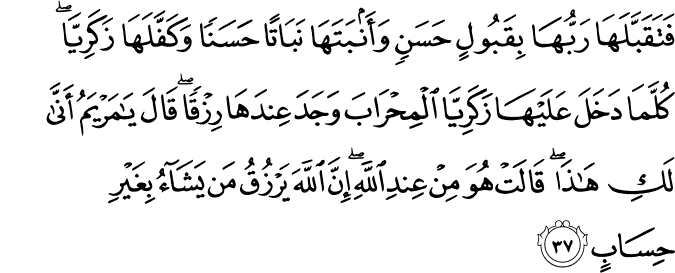
3:37 So her Rabb / continual nurturing Lord accepted her with a good acceptance, and caused her to develop with a good development, and placed her under the care of Zakariyya / he who fills and support (development and growth in recognition). Whenever Zakariyya entered upon her in the miḥrab / elevated inner state where the mind confronts and resolves its conflicting configurations, he discovered with her rizq / sustaining provision. He said: “O Maryam / receptive thought pursuing Al-Haqq, from where is this for you?” She said: “It is from Allah. Indeed, Allah provides rizq / sustaining provision to whoever wills (whoever repeatedly turns back), without limitation.”
NOTES: The development of Maryam reveals an important principle about the way recognition unfolds. Her Rabb does not merely bring her into existence and leave her to develop by herself. He accepts her completely and nurtures her development in a way that is good, sound, and aligned with Al-Haqq. Her growth therefore does not arise from the restless activity of the conditioned mind, but from an underlying process of divine nurturing that allows receptive understanding to mature naturally.
This receptive thought is then placed under the care of Zakariyya / he who fills and supports development and growth in recognition. The function of Zakariyya is significant: what is receptive needs to be sustained while it develops. Recognition cannot mature merely by receiving an insight once; it needs a supportive capacity that continually provides what is necessary for further growth. In this sense, support is not an external addition to recognition but part of the process through which recognition becomes established.
The miḥrab / elevated inner state where the mind confronts and resolves its conflicting configurations represents a deeper movement within this development. When the mind enters such a state, it is no longer simply moving among its ordinary conditioned patterns. It becomes capable of confronting those patterns directly and allowing their conflicts to resolve. It is within this inward clarity that something unexpected is discovered: rizq / sustaining provision is already present with the receptive pursuit of Al-Haqq.
This raises a profound question. Where does such sustaining provision come from? The question is not merely about the origin of an intellectual insight. It points toward the recognition that what genuinely nourishes the development of truth cannot ultimately be attributed to the conceptual mind. The mind may experience the recognition, cultivate it, and give it expression, but the source from which that nourishment arises is beyond the mind's own construction. Maryam therefore directs the recognition back to Allah.
The answer also reveals that this provision is not scarce or dependent upon the mind's calculations. Allah provides rizq to whoever wills / repeatedly turns back, without limitation. Whenever the mind turns back toward Al-Haqq, it becomes receptive to what is already available from the source of its nurturing. The apparent lack of provision is therefore not a limitation in Allah, but a limitation created when the mind turns away from what is continually available.
The deeper movement of the verse is consequently from receptivity to nourishment, from nourishment to development, and from development to recognition of its true source. Maryam represents the receptive movement toward Al-Haqq; Zakariyya represents the capacity that fills and supports that development; and the miḥrāb represents the elevated inward state in which conflicting configurations can be confronted and resolved. Yet the sustaining provision discovered there does not originate from any of these faculties. It comes from Allah, whose provision remains without limitation for the one who continually turns back toward Him.

3:38 Thereupon Zakariyya / he who fills and supports development and growth in recognition called upon his Rabb / continual nurturing Lord, saying: “My Rabb, grant me directly from You a dhurriyyah / developing thoughts that are wholesome. Indeed, You are Samiʿ / fully hearing of what is expressed, ʿAlim / fully knowing of what is understood.”
NOTES: The encounter with sustaining provision awakens in Zakariyya a deeper recognition of where genuine development comes from. Having witnessed that nourishment can arise within the receptive pursuit of Al-Haqq without being manufactured by the conditioned mind, he naturally turns toward his Rabb. The movement is not one of demanding an external reward, but of becoming receptive to a further unfolding of recognition.
His request for dhurriyyah / developing thoughts that are wholesome expresses the desire for understanding to continue reproducing itself without becoming distorted. A wholesome thought is not merely a pleasant or agreeable thought; it is one that develops while remaining aligned with Al-Haqq. Such development can continue to generate further recognition rather than becoming another fixed configuration that limits awareness.
The expression “directly from You” is especially significant. Zakariyya recognizes that the deepest source of wholesome development cannot be manufactured through intellectual effort alone. The mind can support, nurture, and make itself receptive, but it cannot claim ownership of the truth that emerges. What is genuinely transformative must arise directly from the continual nurturing source.
This also reveals why the request follows his encounter with Maryam. The receptive pursuit of Al-Haqq has already demonstrated that sustaining provision is available. Zakariyya now seeks for that same source to bring forth a new development. Recognition therefore unfolds organically: what has been received becomes nourishment, nourishment supports development, and development gives rise to further living recognition.
Allah is Samiʿ / fully hearing of what is expressed because nothing that emerges through the inward movement is outside His awareness. The expression of the request itself is already part of the unfolding. At the same time, He is ʿAlim / fully knowing of what is understood, knowing not only what the mind articulates but also what lies beneath its words—the genuine condition from which the request arises.
The verse therefore presents a movement from recognition to receptivity, from receptivity to wholesome development, and from development to further recognition. Zakariyya does not seek to construct this development by his own conceptual power. He turns toward the source and asks that it come directly from there. The next stage of the unfolding will reveal what this wholesome developing thought becomes: Yaḥyā / the living and responsive development.

3:39 Then the malaaʾikah / governing authorities called to him while he was standing in the miḥrab / elevated inner state where the mind confronts and resolves its conflicting configurations, establishing ṣalaah / connection through which Allah’s presence is experienced: “Indeed, Allah gives you bashhiru / joyful thoughts (arises from the recognition of Al-Haqq) of Yaḥya / living and responsive development, confirming a word from Allah, and a sayyid / one who is masterful in governing, and ḥasur / one who restrains himself, and a nabiyy / receptive awareness bringing recognition of truth, from among the ṣaliḥin / those who correct themselves.”
NOTES: The emergence of Yaḥya begins within the miḥrab / elevated inner state where the mind confronts and resolves its conflicting configurations. While Zakariyya remains established in ṣalaah / connection through which Allah’s presence is experienced, the governing authorities become active and bring recognition of what is unfolding. This suggests that genuine development does not arise from forcing an outcome. When the mind remains connected with Allah, the conditions are created for a new and living recognition to emerge naturally.
The message is expressed through bashhiru / joyful thoughts arising from the recognition of Al-Haqq. Joy here is not merely emotional pleasure. It is the natural lightness that appears when something within the mind recognizes what is true. The joyful thought announces Yaḥya / the living and responsive development—a development that is no longer merely potential but has become capable of responding to truth.
Yaḥya is described as confirming a word from Allah. The significance is that living recognition does not invent its own truth. It recognizes and confirms what originates from Allah. A thought becomes truly alive when it can receive truth without distorting it through the conditioned mind. In this sense, Yaḥyā represents a development of understanding that remains connected to its source.
His description as sayyid / one who is masterful in governing shows that this living recognition has acquired authority over the movement of thought. It is no longer merely carried along by inclinations, impulses, and inherited configurations. It can govern its own direction because it is established in recognition. Yet this mastery is immediately balanced by ḥaṣūr / one who restrains himself. True mastery includes the capacity not to follow every impulse that arises.
This restraint is not suppression. It is the freedom to remain aligned with Al-Haqq even when conflicting inclinations appear. The living development can distinguish what should be followed from what should be released. In this way, mastery and restraint work together: one provides governing strength, while the other prevents that strength from being diverted by the conditioned mind.
Yaḥya is then identified as a nabiyy / receptive awareness bringing recognition of truth, belonging to the ṣāliḥīn / those who correct themselves. The complete picture is therefore of a development that is alive, responsive, confirmatory, governing, restrained, receptive to truth, and continuously self-correcting. What Zakariyya requested as dhurriyyah / wholesome developing thoughts has now emerged as a living capacity within recognition. It is not merely another thought added to the mind; it is a development that can receive Al-Haqq, govern its own movement, and continually correct itself in accordance with what it recognizes.

3:40 He said: “My Rabb, how can there be for me a ghulaam / developing thought when al-kibar / advanced development has reached me and my imraati / receptive awareness is ʿāqir / unable to produce development?” He said: “Thus does Allah unfolds what is willed.”
NOTES: Zakariyya’s question arises from the apparent limits of the existing configuration. He has reached al-kibar / advanced development, while his imraʾah / receptive awareness is ʿaaqir / unable to produce development. From the perspective of the established patterns of the mind, there appears to be no capacity left from which a new ghulam / developing thought could emerge. The question therefore exposes the mind’s tendency to measure possibility according to what its present condition allows.
Yet the request itself had been for a development directly from Allah. The apparent impossibility therefore becomes an opportunity to recognize that what comes from the continual nurturing source does not have to conform to the limitations of the existing configuration. A developing thought that arises directly from Allah is not manufactured by the accumulated structures of the mind; it emerges through a deeper movement of recognition.
Al-kibar / advanced development need not therefore signify the end of development. It may simply indicate that one configuration has reached the limit of what it can produce through its existing patterns. Likewise, ʿaaqir / unable to produce development describes a condition of incapacity, not an absolute limitation upon what Allah can unfold. What appears to be an ending from the perspective of the conditioned mind can become the ground from which something entirely new emerges.
The response, “Thus does Allah unfold what is willed,” redirects attention away from the limitations of the existing configuration. The unfolding is not determined by what the mind believes to be possible. Allah remains the source from which new possibilities can arise, even when the existing conditions appear incapable of producing them. What is willed can therefore unfold without being constrained by the mind’s previous assumptions about how development must occur.
This gives ghulam / developing thought a deeper significance. It is not simply another thought added to an already developed structure. It represents a new movement of understanding emerging where the established configuration could no longer generate further development by itself. The development comes directly from the source and therefore carries the possibility of moving beyond inherited limitations.
The verse thus prepares us to recognize a fundamental principle of inward development: the end of one mode of development is not necessarily the end of development itself. When the existing configuration reaches its limit, the mind may interpret that limitation as impossibility. But when it turns toward its Rabb, what appeared impossible can become the very condition through which a new, living and responsive recognition unfolds.

3:41 He said, “My Rabb / continual nurturing Lord, appoint for me an aayah / sign.” He said: “Your aayah / sign is that you will not takallamu / express understanding to an-naas / the agitated conditioned thoughts for three moments (during clarity, darkness, and early stage for result) except by ramz / symbolic indication (mind only speaks in respect of symbols as representation to reality). And udhkuru / embody the divine masculine of your Rabb abundantly, and tasabbih / move to explore beyond limitation into the expansive recognition of Al-Haqq with the lack in perception and the ibkaari / early stage of clarity.”
NOTES: The request for an aayah / sign shows that Zakariyya is seeking a way to recognize the unfolding of what has been promised. The sign is not another verbal explanation. Instead, his ordinary ability to takallam / express understanding toward an-naas / the agitated conditioned thoughts becomes restricted. This creates a temporary separation from the habitual process through which the mind normally converts recognition into conceptual expression.
The restriction does not mean that understanding disappears. Communication remains possible through ramz / symbolic indication, because the mind encounters reality through representations. A symbol does not itself constitute the reality it represents; it points beyond itself toward what is to be recognized. Thus, when ordinary conceptual expression becomes quiet, recognition can still be indicated through symbolic representation.
The three moments represent stages within the unfolding: clarity, darkness, and the early stage from which a result emerges. These are not merely divisions of external time but different conditions through which understanding develops. Recognition may pass through clarity, apparent absence of clarity, and the initial formation of a consequence. The sign is that Zakariyya remains connected with the source through all these stages, even when ordinary expression is unavailable.
He is therefore instructed to udhkur / embody the divine masculine of his Rabb abundantly. This is more than remembering an idea about Allah. It is the embodiment of the active, affirming qualities through which divine recognition becomes expressed within the developing mind. The abundance of this embodiment ensures that the temporary silence of ordinary expression does not become a vacuum; it becomes filled with a deeper alignment to the Rabb.
The instruction to tasabbih / move to explore beyond limitation into the expansive recognition of Al-Haqq further redirects the mind away from its accustomed boundaries. Rather than attempting to force understanding through existing concepts, it explores what lies beyond those limitations. This movement is particularly significant when perception itself is lacking, because the absence of clear perception does not mean that the underlying reality has disappeared.
The reference to the ibkaari / early stage of clarity completes the movement. After the condition of limited perception, a new clarity begins to emerge. The mind is therefore being trained to remain with Al-Haqq through the entire movement—from diminished perception, through exploration beyond limitation, to the first emergence of clarity. The sign is consequently not merely the inability to speak; it is the transformation of the way recognition develops when habitual conceptual expression becomes quiet.
In this sense, 3:41 continues the theme of the previous verses. A new ghulaam / developing thought can emerge even when the existing configuration appears incapable of further development. The aayah given to Zakariyya demonstrates how this new development begins: ordinary conceptual expression becomes quiet, symbolic recognition remains, awareness of the Rabb is embodied abundantly, and the mind moves beyond its limitations until a new clarity begins to unfold.

3:42 And when the malaaʾikah / governing authorities said: “O Maryam / receptive thought pursuing Al-Haqq, indeed Allah has iṣṭafaaki / selected you, purified you, and selected you above the nisaaʾ / receptive thoughts arising from the feminine receptive faculty of al-aalamin / all realms through which reality becomes known.”
NOTES: Maryam represents a receptive thought that has become deliberately oriented toward Al-Haqq. Her significance is therefore not simply that she receives information, but that her receptivity has acquired a clear direction. She is receptive without surrendering that receptivity to every influence arising within the conditioned mind. This makes her capable of receiving what is true while remaining oriented toward its source.
The malaaʾikah / governing authorities announce that Allah has iṣṭafaaki / selected her. Selection here can be understood as the recognition of a particular capacity that is especially suited to the unfolding of truth. Maryam's receptivity has become distinguished from the many other ways in which the mind can receive, interpret, and develop representations of reality. Her selection therefore concerns function rather than personal superiority.
That selection is followed by purification. Receptivity must become increasingly free from the distortions that arise when conditioned thought interferes with what is being received. Purification does not require the elimination of thought; rather, it removes the tendency to confuse the representation with the reality it represents. As that interference diminishes, receptive understanding becomes clearer and more transparent to Al-Haqq.
The repetition of iṣṭafaa / selected is significant. The first selection establishes the receptive faculty for its particular function, while purification refines that faculty. The second selection can therefore be understood as a renewed recognition of its suitability after purification. What was initially receptive becomes increasingly capable of receiving without distortion.
Maryam is then selected above the nisaaʾ / receptive thoughts arising from the feminine receptive faculty of the al-ʿaalamin / all realms through which reality becomes known. This places her within the larger field of all possible ways through which reality can become known. Among these receptive developments, she represents a particularly refined movement: receptivity that remains consciously directed toward Al-Haqq rather than becoming absorbed in the representations produced by the mind.
The verse therefore describes a progressive refinement of receptivity: orientation toward Al-Haqq, selection, purification, and renewed selection. Maryam is being prepared for something further. Her receptive capacity has become sufficiently clear that what emerges through it can no longer be understood merely as another product of conditioned thought. The following verses will reveal how this purified receptivity becomes the field through which a deeper recognition is brought into the mind.

3:43 O Maryam / receptive thought pursuing Al-Haqq, be obedient (in embodying the divine masculine attributes) to your Rabb / continual nurturing Lord, and usjudi / surrender your orientation, and ir'ka'i / accept with humility with those who raa'ki'iin / accept.
NOTES: Maryam represents receptive thought pursuing Al-Haqq, and the first instruction is to become obedient to her Rabb / continual nurturing Lord. This obedience is not blind submission to an external authority. It is the willingness of receptive understanding to embody the divine masculine attributes that affirm, establish, and express what has been recognized as true. What is received through genuine receptivity must therefore become embodied rather than remaining merely an idea.
The instruction to usjudi / surrender your orientation deepens this movement. Once truth has been recognized, the receptive thought must surrender its own tendency to determine reality according to its previous conditioning. Surrender is therefore a relinquishment of the claim that the conceptual mind knows independently. The orientation turns toward Al-Haqq, allowing recognition to become the governing reference rather than the mind's accumulated assumptions.
Then comes ir'ka'i / accept with humility. Humility here does not mean thinking less of oneself; it means becoming willing to receive what is beyond the present configuration of understanding. A receptive thought that remains proud of its own conclusions becomes closed to further recognition. Humility keeps the faculty open, allowing what has been recognized to continue developing without resistance.
The instruction to do this with those who raa'ki'iin / accept shows that humility is not an isolated state. It is a shared quality among faculties that are willing to relinquish resistance to Al-Haqq. The movement is from obedience, to surrender, to humble acceptance. Each stage removes another layer of self-imposed authority that could interfere with the unfolding of recognition.
This gives Maryam's development a clear progression. She has first been selected and purified, then instructed to embody the divine masculine attributes of her Rabb. Now she is asked to surrender her orientation and accept with humility. Receptivity is therefore not weakness. It becomes a disciplined openness in which truth can be received, embodied, and allowed to transform the configuration of understanding.
The deeper message is that recognition of Al-Haqq requires both receptivity and surrender. To receive truth without embodying it leaves understanding incomplete; to embody it without surrender leaves the conceptual self in control; and to surrender without humility can become merely passive. Maryam represents the receptive faculty in which these movements come together, creating the condition for a deeper reality to become known.

3:44 That is from anba'i al-ghayb / news of the unseen that We inspired to you. You were not with them when they yulquna / brought forward their aqlaam / faculties that inscribe understanding, determining which of them would take responsibility for Maryam, nor were you with them when they yahtasimun / were disputing (among those faculties).
NOTES: The verse draws attention to a process that lies beyond the immediate perception of the conditioned mind. The anbaaʾ al-ghayb / news of the unseen reveals an inward movement that cannot be discovered merely by observing the surface activity of thought. What is being unveiled is how receptive understanding becomes entrusted to a particular faculty and how that responsibility is established among competing modes of understanding.
The aqlaam / faculties that inscribe understanding represent the different capacities through which experience is interpreted, recorded, and given form within the mind. Each faculty can leave an imprint upon what is being received. The act of yulqūna / bringing forward their aqlām therefore represents these faculties placing their respective modes of understanding into consideration, as though each is presenting itself as capable of guiding what is receptive.
The purpose of this process is to determine which of them would take responsibility for Maryam / receptive thought pursuing Al-Haqq. This is significant because receptivity by itself does not determine what will be done with what is received. What is perceived must still be interpreted and developed by some faculty. The question is therefore: which faculty will be entrusted to nurture and support this receptive pursuit without distorting its orientation toward Al-Haqq?
The subsequent dispute among those faculties reveals that this responsibility is not automatically settled. Different modes of understanding may claim authority over the same receptive thought, each attempting to interpret what has been received according to its own configuration. The conflict therefore occurs within the architecture of the mind: competing faculties seek to determine which interpretation will govern the development of receptivity.
Yet the revelation of this unseen process also points to something deeper. The receptive thought pursuing Al-Haqq cannot simply be handed over to whichever faculty is most forceful or most familiar. Its development requires a faculty capable of supporting it while remaining aligned with truth. The dispute exposes the importance of discerning which mode of understanding should be given authority.
This prepares the way for the appearance of Zakariyya / he who fills and supports development and growth in recognition. The preceding verses have already shown his supportive relationship with Maryam, and the present verse reveals that this responsibility emerges from a process in which different faculties contend over who will assume it. The unseen news therefore unveils not merely a past event, but an inward principle: receptive understanding requires the right faculty to nurture it, and discernment is needed when competing faculties seek authority over its development.

3:45 When the malaaʾikah / governing authorities said: “O Maryam / receptive thought pursuing Al-Haqq, indeed Allah gives you bashshir / joyful thoughts (arising from the recognition of Al-Haqq) of a kalimah / word from Him, whose name is Al-Masih / he who brings the touch of awareness, Isa / he who brings the spirit of Al-Haqq, construct of Maryam / receptive thought pursuing Al-Haqq, honoured in the dunya / life of close attachment and the aakhirah / the end of dissociation (of true self), and among the muqarrabun / those who are brought near (to Al-Haqq).”
NOTES: The announcement marks a further unfolding in the development of Maryam / receptive thought pursuing Al-Haqq. Having been selected, purified, and instructed to embody the divine masculine attributes of her Rabb, surrender her orientation, and accept with humility, she is now prepared to receive a new development directly from Allah. The bashshir / joyful thoughts arising from the recognition of Al-Haqq indicate that this is not merely information being added to the mind. It is the joy that naturally accompanies the recognition of something true.
What emerges is a kalimah / word from Him. A word, in this inward framework, is an articulated expression through which something becomes known. Because this word is from Him, its origin is not the conditioned mind or any of the competing faculties that had disputed over responsibility for Maryam. It comes directly from Allah and enters the receptive field as something to be recognized rather than something manufactured by thought.
The word is identified as Al-Masīḥ / he who brings the touch of awareness. The touch of awareness suggests a direct contact between awareness and what is being revealed. Just as masḥ involves passing over or making contact, the inward function is to bring awareness into contact with what has previously remained obscure. The result is not necessarily the destruction of the existing mental configuration, but the opening of perception so that what was hidden can become recognizable.
This word is also ʿIsa / he who brings the spirit of Al-Haqq. Here the movement goes beyond mere contact. The spirit of Al-Haqq is brought into the receptive field, giving the recognition a living quality. 'Isa therefore represents an active expression through which the spirit of truth becomes present within understanding. The fact that he is a construct of Maryam / receptive thought pursuing Al-Haqq shows that this development arises through purified receptivity, not through the independent manufacture of the conditioned mind.
His being honoured in the dunya / life of close attachment and the aakhirah / the end of dissociation of the true self indicates that this recognition retains its significance through both stages of the inward journey. It can illuminate the mind while it is still engaged in close attachment, and it remains relevant when those attachments dissolve. The truth brought through ʿIsa is therefore not dependent upon the temporary configuration of the conceptual self.
Finally, ʿIsa is among the muqarrabun / those who are brought near to Al-Haqq. Nearness here is not spatial. It describes the intimacy of recognition: the less distance there is between the mind and what it recognizes as Al-Haqq, the less room remains for distortion, projection, and separation. The development brought through Maryam therefore moves progressively closer to its source.
The verse presents a profound sequence: purified receptivity gives rise to a kalimah / word from Allah; the word brings the touch of awareness; that awareness brings the spirit of Al-Haqq; and this living development becomes increasingly near to its source. Maryam is the receptive field, Al-Masiḥ is the touch that awakens awareness, and ʿIsa is the expression that brings the spirit of Al-Haqq into that field. This is not merely the acquisition of another concept—it is the emergence of a living development through which truth becomes increasingly intimate within the mind.

3:46 And he (Isa) will speak to an-nās / the agitated conditioned thoughts in the mahdi / state of developing guidance and in the kahlan / a state of advanced development, and among the ṣaaliḥin / those who correct themselves.
NOTES: The development represented by ʿIsa / he who brings the spirit of Al-Haqq does not remain confined to the receptive state from which it emerged. Once the spirit of Al-Haqq has entered understanding, it becomes capable of communicating with an-nas / the agitated conditioned thoughts. Recognition therefore begins to interact with the very mental configurations that previously obscured it.
This communication occurs in the mahdi / state of developing guidance and the kahli / state of advanced development. The two descriptions suggest that the living recognition can express itself throughout different stages of development. It is not limited to an early stage of understanding, nor does it disappear when understanding becomes mature. The same truth can meet the mind at whatever stage of development it has reached.
The contrast between developing and advanced states is particularly significant. A new recognition may initially appear as something small and still developing, but its truth does not depend upon its developmental age. As it matures, it can become increasingly capable of communicating with more established configurations of thought. Thus, the spirit of Al-Haqq can accompany the mind throughout its development rather than being confined to a particular moment of insight.
The reference to an-nas / the agitated conditioned thoughts also shows the direction of this communication. The purpose is not simply to reinforce already harmonious thoughts. It reaches into the agitated and conditioned field where conflicting assumptions, inherited patterns, and restless inclinations continue to operate. The living recognition therefore has an active role in transforming the very field in which it has emerged.
Yet the verse concludes by placing this development among the ṣaaliḥin / those who correct themselves. This indicates that the communication of truth must remain connected with continual correction. Recognition is not considered complete merely because it has emerged. It must continually examine and correct the configurations through which it expresses itself, preventing new understanding from becoming another fixed mental structure.
The verse therefore presents ʿIsa as a living development that can communicate with the conditioned mind across its different stages of maturity. The spirit of Al-Haqq does not remain an abstract recognition hidden within receptive awareness. It becomes an active capacity that enters the developing and advanced states of understanding, engages the agitated conditioned thoughts, and continually moves them toward ṣalāḥ / self-correction and alignment with Al-Haqq.

3:47 She said: “My Rabb, how can there be for me a walad / developing thought (given birth by Maryam) when no bashar / joyful thought (arising from the recognition of Al-Haqq) has touched me?” He said: “Thus does Allah evolve what he ('Isa) wills. When He determines an amr / governing command, He only says to it, ‘Be,’ and it becomes.”
NOTES: Maryam's question arises from the apparent absence of the condition she would normally associate with the emergence of a walad / developing thought given birth by her. She is receptive and pursuing Al-Haqq, yet no bashar / joyful thought arising from the recognition of Al-Haqq has touched her. From the standpoint of the existing configuration, there appears to be no recognizable process through which this new development could arise.
The response introduces a deeper principle: Allah evolves what ʿIsa / he who brings the spirit of Al-Haqq wills. The development is therefore not dependent upon the ordinary sequence expected by the receptive mind. What ʿIsa wills represents an emerging movement within the spirit of Al-Haqq, while Allah remains the source that evolves and brings that movement into manifestation. The apparent absence of a preceding bashar does not prevent the new development.
This distinction is important because bashar / joyful thought is an experience of recognition, whereas walad / developing thought is the development that can emerge from it. Maryam expects the joyful recognition to come first, followed by development. Yet the verse reveals that the source of development is deeper than the sequence anticipated by the mind. What is being evolved can arise directly from the governing command before the expected sign has appeared in the familiar way.
The amr / governing command represents the decisive establishment of what is to unfold. Once this command is determined, Allah does not need to construct the development through the limited mechanisms available to the conceptual mind. The expression “Be” represents the direct establishment of the governing reality, while “it becomes” describes the unfolding of that determination into an actual development.
This also connects the experiences of Zakariyya and Maryam. Zakariyya questioned how a ghulam / developing thought could emerge when his existing configuration had reached advanced development and lacked the capacity for further production. Maryam now questions how a walad / developing thought can emerge without the expected bashar. Both encounters expose the same limitation: the mind attempts to define what can emerge according to conditions it already understands.
The deeper recognition is that divine evolution is not confined to the mind's anticipated sequence of causes. What appears absent may already be contained within a governing command that has not yet unfolded into perception. When the mind remains receptive rather than imposing its own conditions upon reality, the command can become manifest. Thus, the absence of the expected bashar does not prevent the emergence of the walad; the development comes through a deeper source, and when Allah determines its unfolding, it becomes.

3:48 And He will teach him Al-Kitab / the inherent script, and al-Ḥikmah / wisdom (understanding based on Al-Haqq), and the Tawrah / natural laws of reality (through which behavioural consequences become evident), and the Injeel / good news when signs reveal reality.
NOTES: The development described in the preceding verses now moves from the arising of a new thought into its education. What emerges through Maryam / receptive thought pursuing Al-Haqq is not left to develop according to the accumulated conditioning of the mind. Its understanding is taught from a source beyond that conditioning. This is important because a thought arising from Al-Haqq cannot fulfil its function merely by possessing information; it must learn to recognise the order through which reality expresses itself.
Al-Kitab / the inherent script represents that underlying order. It is not simply accumulated knowledge placed into the mind from outside, but the inherent pattern through which reality can be read and understood. To be taught Al-Kitab is therefore to become capable of recognising what has already been inscribed within the unfolding of existence. The thought begins to read reality itself rather than interpreting everything through inherited assumptions, preferences and attachments.
Yet recognition of the inherent script requires al-Ḥikmah / wisdom, because knowledge without wisdom can easily become another possession of the conceptualized self. Wisdom is understanding based on Al-Haqq—the capacity to see how what is recognized should be appropriately embodied. Al-Kitab reveals the underlying order, while al-Ḥikmah enables that order to be understood and lived without distortion. Thus knowledge and its proper application develop together.
The Tawrah / natural laws of reality then reveals that every movement within consciousness carries consequences. Nothing arising in the mind is isolated from what follows it. A thought repeatedly affirmed develops its corresponding condition; an orientation toward truth produces one consequence, while concealment of what has been recognized produces another. The Tawrah therefore makes visible the lawful relationship between inward orientation and the experience that subsequently unfolds from it.
From recognising these natural laws comes the Injeel / good news when signs reveal reality. The good news is not disconnected from the Tawrah; it becomes apparent when the consequences themselves are understood as signs. What previously appeared to be merely pleasant or painful experience can now disclose something about the mind's relationship with Al-Haqq. Even correction becomes good news when its sign is understood, because it reveals what must be released, restored or brought again into alignment.
The verse therefore describes a complete education of the developing recognition represented by ʿIsa / he who brings the spirit of Al-Haqq. Al-Kitab provides the inherent script, al-Ḥikmah gives understanding grounded in Al-Haqq, the Tawrah reveals the natural laws through which consequences unfold, and the Injeel reveals the good news contained within their signs. Together they prepare this developing recognition not merely to know Al-Haqq conceptually, but to read its order, understand its wisdom, recognize its consequences, and perceive its signs as they unfold within lived experience.

3:49 And a rasul / inner silent messenger (by which truth enters awareness) to the bani Israel (those who construct their spititual journey seeking guidance) that indeed, I have come to you with an aayah / sign from your Rabb / continual nurturing Lord. I evolve for you from the ṭīn / conditioned matter a form like that of a ṭayr / thought that rises and moves freely, then I breathe into it from the ruḥ / spirit of Al-Haqq, and it becomes a ṭayr / thought that rises and moves freely by Allah's permission. And I heal the akmah / inner blindness, and the abraṣ / distorted perception, and I give life to the mawta / those who have lost responsiveness, by Allah's permission. And I inform you of what you consume and what you store within your buyut / mental houses. Indeed, in that is surely an aayah / sign for you, if you are mu'minin / those who have taken security with Allah.
NOTES: The verse presents ʿIsa / he who brings the spirit of Al-Haqq as an inward movement through which guidance becomes experiential rather than remaining conceptual. The rasul is the silent messenger by which truth enters awareness, and the bani Israʾil are those who construct their spiritual journey while seeking guidance. This means the message is directed toward a mind already engaged in a journey of recognition. The sign from the Rabb is therefore something that can be recognized within the development of that journey.
The transformation begins with ṭin / conditioned matter. Existing conditioning is not simply rejected or destroyed. Instead, it becomes the material from which a new configuration can evolve. When a form resembling a ṭayr / thought that rises and moves freely emerges, thought is no longer completely confined by the patterns from which it arose. It begins to possess movement beyond its previous limitations. This is a significant transition: the conditioned mind becomes capable of allowing a thought to move rather than continually returning it to the same established conclusions.
Yet this movement becomes truly transformative only when it receives the ruḥ / spirit of Al-Haqq. The breath of this spirit represents the enlivening influence of truth itself. What was merely a constructed form now becomes responsive to a deeper reality. The ṭayr therefore represents more than an imaginative thought; it points to a thought that has acquired freedom of movement because it is no longer entirely governed by conditioning. Its movement is permitted by Allah because its source and sustaining reality remain with Him.
From this awakening comes healing. The akmah / inner blindness is not simply an inability to receive information; it is the condition in which recognition cannot see what is already present. The abraṣ / distorted perception similarly represents a mind that sees through a distorted configuration. When the spirit of Al-Haqq becomes active, these limitations begin to lose their authority. Seeing becomes clearer because the mind is no longer imposing its inherited distortions upon what is being revealed.
The giving of life to the mawta / those who have lost responsiveness takes the process still deeper. A mind may continue thinking while inwardly losing its capacity to respond to truth. Such a condition is effectively lifeless in relation to recognition. The spirit of Al-Haqq restores responsiveness—not by adding more concepts, but by reopening the capacity to receive, recognise and move with what is true. What had become inwardly inert can therefore become alive again by Allah's permission.
The final sign is particularly intimate: knowing what is consumed and what is stored within the buyut / mental houses. What enters the mind does not simply disappear; what is repeatedly consumed can become part of the structures in which thought lives. Some inputs nourish recognition, while others reinforce conditioning. The verse therefore turns the attention inward, asking the seeker to observe both what is being taken in and what has been allowed to become established within the mental house. For those who are muʾminin / those who have taken security with Allah, these movements themselves become signs: conditioning can evolve, thought can become free-moving, perception can be healed, responsiveness can return, and the contents of the inner house can become consciously recognized.

3:50 And confirming what is between my hands from the Tawrah / natural laws of reality (through which behavioural consequences become evident), and to make lawful for you some of what was forbidden to you. And I have come to you with an aayah / sign from your Rabb / continual nurturing Lord, so develop taqwa / conscious mindfulness toward Allah and obey me.
NOTES: The movement of ʿIsa / he who brings the spirit of Al-Haqq continues by confirming the Tawrah / natural laws of reality that are already within reach and presence of the rational mind. Truth does not need to contradict the lawful order through which reality unfolds. Rather, genuine recognition confirms what can already be discerned when the mind observes the relationship between its orientation, its actions and their consequences.
This confirmation is important because the mind can easily create an imagined separation between spiritual recognition and the laws governing lived experience. Yet the Tawrah represents an order that remains operative whether or not the mind acknowledges it. When ʿIsa brings the spirit of Al-Haqq into awareness, the natural consequences that were previously overlooked become visible. Recognition therefore does not abolish reality's order; it reveals it more clearly.
The verse then introduces the making lawful of some things that had been forbidden. Within the inward reading, this points to the possibility that a restriction may belong to a particular stage of development rather than being an absolute feature of truth itself. What was previously experienced as prohibited may become accessible when the underlying distortion or incapacity that made it harmful has been transformed. The distinction is crucial: freedom does not mean abandoning discernment. It means understanding why a restriction existed and whether its underlying condition remains.
This is where the aayah / sign from the Rabb becomes significant. The sign is not merely an extraordinary occurrence; it is the recognition that appears when a previously concealed relationship becomes clear. The developing mind begins to see why certain conditions produce certain consequences. What once appeared arbitrary begins to reveal an intelligible order. The sign therefore educates rather than merely impresses.
Such recognition naturally calls for taqwa / conscious mindfulness. Once the relationship between orientation and consequence becomes visible, awareness can no longer honestly claim not to know. Taqwa is the sustained attentiveness that prevents the mind from returning unconsciously to what it has already recognized as misaligned. It is not fear imposed from outside, but an inward sensitivity to the consequences of losing alignment with Al-Haqq.
Obedience to ʿIsa therefore means allowing the spirit of Al-Haqq to govern the movement of thought. The instruction is not toward blind submission to another conceptual authority, but toward responsiveness to the recognition that has entered awareness. The sequence is coherent: the natural law is confirmed, restrictive conditioning is reassessed, the sign becomes evident, conscious mindfulness is established, and obedience becomes the natural expression of understanding.

3:51 Indeed, Allah is my Rabb / continual nurturing Lord and your Rabb / continual nurturing Lord, so serve Him. This is a ṣiraaṭ mustaqim / path of the one who is established in Al-Haqq.
NOTES: The recognition brought by ʿIsa / he who brings the spirit of Al-Haqq ultimately returns to the recognition of a single nurturing Reality. Allah is not merely the Rabb of one particular faculty, one particular thought, or one particular stage of development. He is equally the Rabb of the one who brings recognition and the one who receives it. The source of guidance and the one being guided are therefore held within the same continual nurturing Reality.
To serve Him is to allow this recognition to become the governing orientation of the mind. Service is not simply an outward performance carried out by a separate self for a distant authority. It is the willingness to let Al-Haqq determine the movement of thought, rather than allowing inherited conditioning, personal preference or attachment to assume that authority.
This becomes especially meaningful after the preceding description of ʿIsa. The inherent script has been taught, wisdom has developed, the natural laws of reality have become evident, and signs have begun to reveal what was previously concealed. The conditioned material has been transformed, perception has been healed and responsiveness has been restored. All these movements now converge upon one recognition: Allah alone is the Rabb.
The expression ṣiraaṭ mustaqim then describes the quality of this movement. Mustaqim carries the sense of being upright, established and firmly aligned. The path is therefore not merely a route that leads toward Al-Haqq; it is the path of the one who is established in Al-Haqq. Once recognition is no longer continually pulled away by competing identifications, movement becomes direct and balanced.
Being established in Al-Haqq does not mean that the mind has reached a final conceptual conclusion. It means that its orientation is no longer dependent upon the fluctuations of conditioning. Thoughts may arise and dissolve, clarity may alternate with obscurity, and experiences may change, but the underlying orientation remains grounded in what has been recognized as true.
Thus the verse brings the preceding development into simplicity. The purpose of knowledge, wisdom, natural law, signs and transformation is not to create another elaborate identity. It is to establish the mind in its source. When Allah is recognized as the continual nurturing Lord, serving Him becomes the natural expression of that recognition, and the path becomes ṣiraaṭ mustaqim—the path of the one who is established in Al-Haqq.

3:52 Then when ʿIsa / he who brings the spirit of Al-Haqq perceived the kufr / concealment of what was recognized from them, he said, “Who are my anṣaar / those who support the realization of truth toward Allah?” The ḥawaariyyun / those who become purified and move toward what is clear said, “We are anṣaar / those who support the realization of truth toward Allah. We have aamanna / taken security with Allah, and bear witness that we are muslimun / those who willingly surrender to Al-Haqq.”
NOTES: The movement now reaches a point where recognition encounters resistance. ʿIsa / he who brings the spirit of Al-Haqq perceives kufr not simply as a lack of knowledge, but as the concealment of what has already been recognized. The problem is therefore no longer whether truth has been presented. It is whether the mind is willing to remain open to what it has already seen.
At this point, recognition requires support. The question about the anṣaar / those who support the realization of truth is an inward question: which faculties within the mind are willing to sustain the movement toward Al-Haqq rather than allow conditioned patterns to suppress it? Truth may be recognized, yet without supporting faculties that recognition can easily be covered again by habitual thought.
The ḥawaariyyun respond by identifying themselves with this supporting movement. Their purification is important because genuine support for truth cannot arise from the same distortions that conceal it. As the mind becomes clearer, its faculties become capable of standing with recognition rather than competing against it. They do not claim ownership of the truth; they support its realization.
Their iman / taking security with Allah then expresses a deeper transition. Security is no longer sought in the familiar structures of the conditioned mind. The developing faculties place their trust in the Reality that continually nurtures their recognition. This gives them the stability needed to remain with what has been seen even when established patterns resist it.
Their declaration of being muslimun / those who willingly surrender to Al-Haqq completes the movement. Recognition by itself is not surrender. One can recognize something as true and still resist its implications. Willing surrender means allowing the recognized truth to reorganize the mind without demanding that reality conform to its previous assumptions.
Thus the verse moves from recognition of concealment, to the search for support, to purification, to security, and finally to willing surrender. The spirit of Al-Haqq does not force the mind into alignment. It reveals the truth and calls forth those inner faculties that are willing to support its realization.

3:53 Our Rabb / continual nurturing Lord, we have aamanna / taken security with what You have brought down, and we have followed the rasul / inner silent messenger (by which truth enters awareness), so write us among the shaahidin / those who bear witness.
NOTES: The response of the ḥawaariyyun now moves from recognition into conscious alignment. Having identified themselves as supporters of the realization of truth, they acknowledge Allah as their Rabb and place their security in what He has brought down. This is not merely accepting an external teaching. It is finding stability in the recognition that has entered awareness through the continual nurturing of Al-Haqq.
The phrase aamanna is particularly significant. To take security with Allah means that the mind no longer needs to protect itself through its previous assumptions. The need to defend an established position begins to fall away because security is found in remaining open to what is true. This creates the inner stability required for genuine transformation.
Their following of the rasul is therefore a natural consequence of that security. The rasul / inner silent messenger is the movement through which truth enters awareness. To follow it is to allow that movement to continue rather than interrupting it with the resistance of conditioned thought. Recognition is thus not something to admire from a distance; it becomes a direction in which the whole mind begins to move.
They then ask to be written among the shaahidin / those who bear witness. Witnessing is deeper than merely agreeing with an idea. A witness is one in whom what has been recognized becomes evident through the way awareness operates. The truth is no longer merely something understood intellectually; it becomes something that can be directly observed in the transformation taking place within.
This completes the movement that began when ʿIsa perceived the concealment of what had been recognized. The answer to kufr is not argument or force. It is a mind that takes security with Allah, follows the movement by which truth enters awareness, and allows that truth to become embodied. In this way, recognition becomes lived evidence.
The verse therefore describes a progression from security, to following, to witnessing. When the mind is secure in Al-Haqq, it can follow without resistance; when it follows without resistance, recognition can become embodied; and when recognition becomes embodied, the mind itself becomes a witness to the truth it has recognized.

3:54 And they devised a concealed strategy, and Allah devised; and Allah is the best of those who devise.
NOTES: The preceding verse has described those who recognized the truth yet attempted to undermine it. Their response was not one of open recognition but of resistance. Within the inward movement of the insaan, this represents the tendency of an established configuration of thought to protect itself when confronted by what exposes its limitations.
Such resistance often operates subtly. Rather than meeting what has been recognized directly, the mind can rearrange its perceptions, create alternative explanations, conceal what has become evident, or construct circumstances that appear to preserve its existing position. The strategy is concealed because the mind itself may not fully recognize that it is protecting an assumption rather than discovering what is true.
Yet no movement within the insaan exists independently of the greater reality in which it arises. What appears to be an independent attempt to control the direction of events is already contained within the unfolding brought about by Allah. The limited mind can formulate its intentions only from within the field of understanding available to it; it cannot stand outside the whole and determine the whole.
This reveals the deeper meaning of the divine response. The greater unfolding does not need to oppose the limited strategy on its own terms. What the mind intends for one purpose can become the very circumstance through which another reality is revealed. A movement intended to conceal can therefore become a movement that exposes; an attempt to obstruct recognition can become part of the process through which recognition becomes clearer.
The superiority of Allah's devising lies precisely here. The limited strategy operates from partial knowledge, while the divine unfolding encompasses both the strategy and its consequence. Nothing that the conditioned mind constructs can escape the reality within which it is constructed.
The verse therefore shifts attention from the apparent power of resistance to the completeness of the divine unfolding. The insaan may attempt to preserve separation, conceal what has been recognized, or redirect the movement of understanding, but none of these movements can alter Al-Haqq. What seems to be a strategy against truth is already contained within the unfolding through which truth reveals itself.

3:55 When Allah said, “O Isa / he who brings the spirit of Al-Haqq, indeed I mutawaffika / complete you fully and raise you (in derajat) to Me, and I will purify you from those who conceal what they have recognised. I will make those who follow you superior to those who conceal what they have recognised until yawmil; qiyamah / moment of standing (in consciousness when what has been established stands fully in awareness). Then to Me is your return, and I will judge between you concerning that in which you differed.”
NOTES: The preceding verse describes the concealed strategies of those who attempt to resist what has been recognised. In this verse, the movement shifts toward Isa, understood inwardly as he who brings the spirit of Al-Haqq. The focus is therefore on the recognition of truth and its further development within the insaan.
The declaration that Allah will mutawaffika, complete Isa fully, points to the bringing of this recognition to its full measure. What begins as an emerging recognition of Al-Haqq is not left incomplete or confined to the level at which it first appears. It is gathered into completeness, so that nothing essential remains outside the recognition.
This completion is accompanied by an elevation in derajat. Recognition does not merely increase in quantity; it rises in degree. As the insaan becomes less identified with the configurations that previously concealed what was recognised, the recognition of Al-Haqq becomes established at a higher level of awareness. The movement is therefore from partial recognition toward a more complete seeing of what is already true.
At the same time, Allah purifies this recognition from those who conceal what they have recognised. The concealment referred to here is not simply ignorance. It is the movement of knowing something inwardly while allowing an opposing configuration to obscure, deny or suppress that knowing. Purification means that such concealment can no longer determine the direction of recognition.
Those who follow Isa represent the faculties that remain aligned with this movement of recognition. Their superiority is not necessarily superiority over other people; inwardly, it is the ascendancy of recognition over concealment. As recognition becomes more firmly established, the tendency to deny what has been recognised loses its authority. What is aligned with Al-Haqq naturally becomes stronger than what attempts to obscure it.
This continues until yawmil-qiyaamah—the moment of standing, when what has been established stands fully in awareness. At that point, what has previously remained uncertain, concealed or divided becomes unmistakably present. Recognition stands as recognition, while concealment stands revealed as concealment. Nothing needs to be imposed from outside; what has been established simply becomes fully evident.
The movement then returns to Allah, because every degree of recognition ultimately returns to its source. The return is not merely a movement toward a distant destination. It is the inward movement by which what has been perceived as separate is brought back into the awareness of its originating reality.
The differences that existed during the process are then judged within that complete awareness. What had appeared as conflicting understandings is no longer evaluated from the limited perspective from which the disagreement arose. Each movement is seen according to what it actually recognised, what it concealed, and how faithfully it remained aligned with Al-Haqq.
The verse therefore presents a complete inward progression: recognition of Al-Haqq is brought to completion, elevated in degree, purified from concealment, and strengthened against the tendency to deny what has been recognised. Eventually, what has been established stands fully in awareness, and all apparent differences return to the one reality from which recognition arose.

3:56 As for those who kafaru / conceal what they have recognised, I will punish them with severe suffering in this dunya / close attachments (of subconscious conditioned mind) and in the aakhirah / ending the dissociation (of true self), and they will have no supporters.
NOTES: The previous verse described the completion and elevation of recognition through Isa, together with its purification from those who conceal what they have recognised. This verse now turns directly to the consequence of kufr—those concealing something that has already been recognised. The problem therefore arises after recognition has occurred.
Within the dunya, understood as the close attachments of the subconscious conditioned mind, concealment creates a division within the insaan. What has been recognised as true is present, yet the conditioned mind continues to organise experience around attachments that do not acknowledge it. The result is an inner tension: recognition moves in one direction while the conditioned structure attempts to preserve itself in another.
The severe suffering arises from this very division. The insaan cannot permanently conceal what has been recognised without experiencing the consequences of living against its own deeper seeing. The more firmly the conditioned mind identifies with its attachments, the more deeply the concealment becomes embedded, and the greater the suffering produced by that separation.
The consequence also extends into the aakhirah, understood here as the ending of dissociation from the true self. When the close attachments that sustain the conditioned identity come to an end, the structures that enabled concealment can no longer provide the same separation. What has been hidden beneath those attachments is brought into direct awareness.
At that point, there is no longer a supporting configuration through which the concealment can maintain itself. This is the significance of having no supporters. No conditioned attachment, belief, identity or mental structure can ultimately stand independently against what has been recognised as Al-Haqq.
The verse therefore describes the consequence of kufr as an unfolding rather than an arbitrary punishment. Concealment generates suffering because it maintains dissociation from what has already been recognised. In the dunya, the conflict is sustained through attachment to the conditioned mind; in the aakhirah, when that dissociation ends, the concealment loses the structure that supported it. What remains is the recognition that was there all along.

3:57 And as for those who have aamanu / taken security (recognised, aligned with what is right, and acted in accordance with that recognition), He will fulfil their rewards. And Allah does not love those who are zaalimin / unjust (displace truth from its rightful place).
NOTES: The preceding verse described the consequence of kufr, where what has been recognised is concealed and the insaan remains divided from what it already knows. This verse presents the contrasting movement through imaan—taking security in what has been recognised, aligning with what is right, and allowing that recognition to guide thought and action.
This security is not merely belief in an idea. It is the growing absence of inner conflict that comes when the insaan no longer needs to defend a conditioned position against what has become evident. Recognition is allowed to settle into understanding, and understanding is allowed to express itself in the way one perceives, responds and lives.
The fulfilment of the reward describes the completion of this movement. When recognition is not concealed but embodied, its consequences naturally unfold. The reward is therefore not simply an external payment for an action; it is the fruition of alignment. What has been recognised becomes increasingly established within awareness, and the insaan experiences the wholeness that comes from no longer moving against that recognition.
This also clarifies the relationship between imaan and action. Action does not manufacture recognition. Rather, when recognition is secure, it expresses itself through action. The outward movement becomes an indication of the inward alignment that has already taken place.
The verse then identifies what stands contrary to this movement: zulm—displacing truth from its rightful place. Zulm occurs when something other than what has been recognised as Al-Haqq is given authority over it. A conditioned assumption is placed where direct recognition should stand; attachment is allowed to override clarity; or the limited self is placed in the position that belongs to truth.
Allah does not love this movement because it sustains distortion and separation. The issue is not that Allah withholds love from a particular individual, but that zulm itself is incompatible with the movement toward Al-Haqq. What displaces truth cannot be the basis for complete recognition.
Thus the verse completes the contrast established in the previous two verses. Kufr conceals what has been recognised, while imaan takes security in it. Kufr sustains inner division, while imaan allows recognition to become embodied. And when truth is no longer displaced from its rightful place, the movement naturally reaches its fulfilment.

3:58 That is what We recite to you from the Ayaat / signs and the dhikri / embodiment of the divine masculine attributes, al-hakim / the wise (who establishes things in their proper order).
NOTES: The preceding verses have shown the movement from concealment to recognition, from inner division to security, and from displacement of truth to alignment with it. This verse now points to the Ayaat through which these movements are being revealed. The signs are not merely information to be accumulated; they are representations through which the insaan can recognise what is taking place within itself.
The dhikr is the embodiment of the divine masculine attributes. It represents the active expression of what has been recognised, allowing the qualities of Allah to become established in the movement of the insaan. In this sense, dhikir is not simply recalling something mentally. It is bringing the recognised reality into expression so that it becomes present in the way the insaan perceives, understands and acts.
The designation al-Hakim points to the wisdom by which everything is established in its proper order. Nothing is placed arbitrarily. Each faculty, recognition and movement has its appropriate position within the unfolding of reality. When the insaan displaces truth from its rightful place, disorder arises; when what has been recognised is allowed to occupy its proper place, understanding becomes coherent.
The Ayaat therefore function as a means of restoring this order. They reveal the distinction between what conceals recognition and what allows recognition to become established. The dhikr embodies the qualities through which that recognition is sustained, while al-Hakim indicates the wisdom that places each element where it belongs.
The verse consequently directs attention back to the nature of the Qur'anic signs themselves. They are not merely statements to be believed or rejected. They are signs through which the insaan is invited to see, recognise and reorder its inner movement according to what is true.
In this way, the verse continues the movement of the preceding passages: recognition becomes secure when what has been recognised is no longer displaced, but established in its proper order. The Ayaat reveal this movement, the dhikr embodies it, and al-Hakim expresses the wisdom by which the whole is brought into harmony.

3:59 Indeed, the likeness of Isa / he who brings the spirit of Al-Haqq with Allah is as the likeness of Adam / inner authority to receive Al-Haqq. He evolved him from turab / layers of illusory and corrupted thoughts, then He said to him, “Be,” and he became.
NOTES: The preceding verse directs attention to the Ayaat through which reality is recognised and to al-Hakim, the wisdom that establishes everything in its proper order. This verse now clarifies the nature of Isa by placing him alongside Adam. The comparison shows that both represent stages within the same inward process through which Al-Haqq becomes recognised and established in the insaan.
Isa, understood as he who brings the spirit of Al-Haqq, represents the movement through which truth becomes present and recognisable within awareness. Adam, understood as the inner authority to receive Al-Haqq, represents the receptive capacity through which that recognition can be established. Their likeness therefore lies in their function within the unfolding of recognition rather than in their outward forms.
The starting condition is turab, layers of illusory and corrupted thoughts. These accumulated thoughts form the conditioned ground upon which the insaan ordinarily builds its sense of reality. They can appear convincing because they have been repeatedly established, but their apparent solidity does not make them true. They are the material from which the inward transformation begins.
The process of evolution is therefore significant. What has been formed through layers of conditioned thought is not simply discarded; it becomes the ground from which a different configuration can emerge. As recognition of Al-Haqq penetrates these layers, the receptive authority represented by Adam begins to develop. The old configuration is progressively reorganised so that it can receive what is true without distorting it through inherited assumptions.
The command “Be” represents the decisive establishment of this new reality. It is not merely an external instruction but the point at which what has been brought into possibility becomes established. When the conditions for recognition are complete, what Allah wills to establish simply becomes.
The final movement, “and he became,” expresses the immediacy of this divine establishment. The receptive faculty does not create Al-Haqq; it becomes what it is intended to be through receiving and embodying it. What was previously obscured beneath layers of illusory and corrupted thought becomes capable of standing as a clear recognition.
Thus the likeness between Isa and Adam reveals two complementary movements: Isa brings the spirit of Al-Haqq into recognition, while Adam represents the inner authority capable of receiving Al-Haqq. Both emerge through the same divine process of evolution—from the accumulated layers of distorted thought toward an established reality in which truth can be recognised and embodied.

3:60 The truth is from your Rabb /continual nirturing , so do not be among the mumtarin / those who doubt.
NOTES: The likeness of Isa and Adam as two movements within the same divine unfolding reveals the spirit of Al-Haqq becoming recognisable and the inner authority becoming capable of receiving Al-Haqq. This verse now establishes the foundation upon which that recognition rests.
What has been described does not originate from the assumptions of the conditioned mind. Its source is Al-Haqq from your Rabb—the continual nurturing reality from which the development of recognition takes place. The truth is therefore not something manufactured by thought; it is something that becomes recognised as the layers of distortion are progressively penetrated.
The instruction not to become among those who doubt is not a demand to suppress questioning. Doubt here can be understood as the movement that remains divided after recognition has already become clear. It is the mind's tendency to return to its previous configuration because the established assumptions feel more familiar than the reality that has been revealed.
The deeper movement is therefore one of trust in direct recognition rather than dependence upon conditioned conclusions. When Al-Haqq becomes evident, the insaan does not need to manufacture certainty through belief. Recognition itself becomes the basis of security.
This also connects with the preceding image of turab as layers of illusory and corrupted thoughts. Those layers can continue to generate doubt even after a deeper recognition has emerged. The verse therefore directs the insaan not to allow the residue of those conditioned structures to obscure what has already become evident.
The movement is simple: truth originates from the Rabb, recognition receives it, and doubt belongs to the residual movement that continues to identify with what has already been exposed as incomplete. As recognition becomes established, there is progressively less need to defend an assumed reality against what is directly recognised as Al-Haqq.

3:61 Then whoever hajjaka / argues with you concerning him after the knowledge has come to you, then say: “Come, let us call abna / our construct of understandings and your abna / construct of understandings, our nisaa / receptive impulses and your nisaa / receptive impulses, our anfus / souls and your anfus / souls; then nabtahal / let us earnestly invoke and place the curse / distancing from nurturing mercy of Allah upon those who lie.”
NOTES: The preceding verse establishes that the truth comes from the Rabb and that recognition should not be displaced by doubt. This verse now addresses the condition in which the mind continues to hajjaka—to argue, contend or dispute concerning what has already become known. The issue is therefore no longer the absence of knowledge, but resistance to knowledge that has already arrived.
The invitation to bring together the abna represents the construct of understandings through which each side has organised what it perceives. These understandings are not merely isolated pieces of information; they are developed structures that shape how reality is interpreted. By bringing them into the examination, the established constructions of thought are placed openly before Al-Haqq rather than being protected through argument.
The nisaa represent the receptive impulses through which these understandings receive, respond to and incorporate what is encountered. Both the constructed understanding and the receptive movement that sustains it must therefore be brought into awareness. Nothing within the inner configuration should remain hidden while the truth is being examined.
The anfus, understood as souls, bring the examination to the level of the conceptual self itself. The invitation is therefore comprehensive: the constructs of understanding, the receptive impulses and the conceptual selves associated with them are all brought into the same field of recognition. There is no selective examination in which only the ideas of the other are questioned while one's own configuration remains protected.
The movement of nabtahal then takes this examination beyond ordinary argument. It is an earnest invocation in which the whole matter is entrusted to Allah. Rather than attempting to establish truth through the superiority of one conditioned argument over another, the participants submit the opposing configurations to the consequence of divine truth.
The reference to the curse of Allah is functionally understood as distancing from the nurturing mercy of Allah. What is false does not merely lose an argument; it becomes progressively distanced from the sustaining movement of the Rabb. A configuration that persists in denying what has been recognised removes itself from the very nurturing process through which recognition develops.
Those who lie are therefore those whose expression no longer corresponds with what is true. The lie is not merely a spoken falsehood. It is the displacement of recognition by a constructed understanding that contradicts what has already become evident. When such distortion is exposed to Al-Haqq without protection, its separation from the nurturing reality becomes apparent.
The verse consequently presents a radical form of self-examination. When argument persists after knowledge has arrived, bring the entire configuration into the field of recognition—its constructed understandings, receptive impulses and conceptual self—and relinquish the need to defend any of them. Allow Allah to determine what remains aligned with truth and what becomes distanced from His nurturing mercy.

3:62 Indeed, this is the true qasasu / unfolding through traceable steps, and there is no ilah / governing reality (that governs the mind) except Allah. And indeed, Allah is surely Al-ʿAziz, the one who establishes through irresistible strength, Al-Hakim, the wise who establishes everything in its proper order.
NOTES: Earlier the different configurations of understanding was brought into direct examination and asked that they be exposed to Al-Haqq rather than protected by argument. Having reached that point, this verse identifies what remains as the true qasasu—the unfolding through traceable steps. The truth is not presented as an isolated conclusion; its movement can be followed through the stages by which recognition develops and reveals what is real.
This is important because the preceding account has not moved randomly. Each stage leads into the next: recognition arises, resistance attempts to conceal it, the conditioned configuration argues against it, and the whole structure is eventually brought into direct examination. The qasasu is true because its unfolding can be traced through these successive movements without requiring an externally imposed explanation.
The recognition that there is no ilah, understood here as a governing reality that governs the mind, brings the movement back to its foundation. The mind can be governed by many apparent authorities—constructed understandings, inherited assumptions, attachments, identities and impulses. Yet none of these possesses independent authority over the whole movement of awareness. They may influence the mind, but they are not the ultimate governing reality.
This also clarifies the preceding discussion of Isa. The recognition brought through Isa does not establish another governing reality alongside Allah. Rather, it leads the insaan back to the source from which recognition itself arises. Whatever appears within awareness remains subordinate to the reality that gives rise to awareness and its capacity to recognise.
Al-ʿAziz expresses the capacity of Allah to establish through irresistible strength. What is established by this reality cannot ultimately be overturned by a conditioned configuration of thought. The mind may resist, conceal or dispute, but its resistance does not acquire the power to redefine what is true.
Al-Hakīm expresses the wisdom that establishes everything in its proper order. The stages through which recognition unfolds are therefore not accidental. Even concealment and resistance have their place within the process, because their exposure reveals the limitations of the configuration that produced them.
The verse consequently brings the argument to a simple recognition: the unfolding of truth can be traced through its successive stages, and throughout that unfolding there is no independent reality governing the mind apart from Allah. What Allah establishes cannot be overcome, and what He establishes unfolds with the wisdom of everything being brought into its proper order.

3:63 Then if they tawallaw / turn away, indeed Allah 'alimun / is Knowing of those who are with the mufsidin / those who corrupt their covenant (with Allah).
NOTES: The preceding verse establishes the qasasu as the true unfolding through traceable steps and recognises Allah as the only governing reality. Having been brought to this recognition, the insaan is now faced with a choice: remain aligned with what has become evident or tawallaw—turn away from it.
Turning away is therefore a movement of the inner configuration away from the direction in which recognition is unfolding. The mind may return to its familiar assumptions, attachments and inherited understandings, even after the truth has become clear. The turning does not invalidate the recognition; rather, it reveals that the conditioned configuration is still attempting to retain its former position.
The mufsidin are those who corrupt their covenant—the established alignment or commitment through which the insaan remains connected to what has been recognised as Al-Haqq. Corruption occurs when that alignment is disrupted: what has been recognised is no longer allowed to govern the movement of understanding, and another configuration is placed in its position.
Allah being ʿAlim, fully Knowing, means that this movement cannot remain hidden. The mind may not recognise the extent to which it has turned away or corrupted its covenant, but nothing within the movement is outside the knowledge of Allah. The entire process—from recognition to resistance, from alignment to turning away—is already completely known.
The verse therefore does not suggest that turning away creates uncertainty about the truth. Rather, it exposes the condition of the one who turns away. The truth remains established; what changes is the relationship of the insaan to it. When recognition is abandoned and the covenant with Al-Haqq is corrupted, the resulting movement becomes one of fasād, while Allah remains fully Knowing of every stage of that departure.

3:64 Say, “O Ahle Al Kitab / those closely connected with their inherent script, come to a word that is equal between you and us: that we do not serve except Allah, that we do not associate anything with Him, and that none of us take others as governing authorities besides Allah.” Then if they turn away, say, “Bear witness that we are muslimun / those who willingly surrender to Al-Haqq.”
NOTES: Earlier the verse describes those who turn away after the truth has become clear. The response here is not to continue the argument but to return to a principle that can be recognised without requiring agreement over every secondary interpretation. The address to Ahle Al-Kitab, those closely connected with their inherent script, calls them back to the guidance already present within that deeper script.
The invitation to come to a kalimah that is equal between both sides establishes a common ground. The word is not presented as a compromise between two opposing positions. It is a point of equality because it removes the assumptions that create separation in the first place. Both movements are invited to recognise the same governing reality.
That foundation is the recognition that Allah alone is to be served. To serve Allah is to allow the one governing reality to determine the direction of the mind rather than allowing conditioned constructions to become its ultimate authority. Thoughts, identities, inherited interpretations and attachments may appear within the mind, but none of them is independent enough to occupy the position belonging to Allah.
The prohibition against associating anything with Him extends this principle further. Association occurs whenever something within the conditioned configuration is elevated to the status of an independent governing reality. The mind then gives its own representation, belief or attachment an authority that does not belong to it. The result is a divided orientation in which the source of truth is confused with the representations through which truth is perceived.
The same principle is then applied to the relationship between one human configuration and another. No one is to become the governing authority over another in place of Allah. This does not deny guidance, teaching or mutual responsibility. Rather, it prevents another conditioned configuration from becoming an absolute authority that replaces direct recognition of Al-Haqq.
If they nevertheless turn away, the response is not to force recognition upon them. The instruction is simply to bear witness to one's own state of islaam. The muslimun are those who willingly surrender to Al-Haqq, allowing what is recognised as true to take precedence over the resistance of the conditioned mind.
Thus the verse brings the discussion back to its simplest foundation: there is one governing reality, and nothing within the mind or between human beings should be elevated to compete with it. If another configuration refuses this recognition, remain surrendered to Al-Haqq rather than becoming entangled in the need to make another mind agree.

3:65 O Ahle al Kitab / those who are connected to their inherent script, why do you tuhaajuna / argue concerning Ibrahim / who is naturally inclined to Al-Haqq, while the Tawrah / natural law of reality (through which behavioural consequences become evident) and the Injeel / good news (when signs reveal reality) were not revealed until after him? Will you not ta'qilun / understand?
NOTES: The preceding verse establishes a common foundation: Allah alone is the governing reality, and no inherited configuration or human authority should be allowed to take His place. This verse now directs that principle toward the dispute concerning Ibrahim, understood as the one who is inclined toward Al-Haqq. The question is why those connected with their inherent script continue to tuhaajuna—to contend or argue concerning him.
The argument becomes misplaced when a later configuration of understanding attempts to claim authority over an earlier movement of recognition. Ibrahim represents an inclination toward Al-Haqq that precedes the later formulations through which that recognition was expressed and preserved. The issue is therefore not to determine which later configuration can claim ownership of Ibrahim, but to recognise the reality toward which Ibrahim was already inclined.
The Tawrah, understood as the natural law of reality through which behavioural consequences become evident, belongs to a later stage of this unfolding. It reveals the lawful relationship between what is established within the insaan and the consequences that subsequently become apparent. It does not create the originating inclination toward Al-Haqq represented by Ibrahim.
Likewise, the Injeel, understood as the good news that arises when signs reveal reality, is a later disclosure within the same movement. When the Ayaat become clear, what was previously unseen becomes evident, bringing the recognition of reality into a form that can be received and understood. Its emergence after Ibrahim therefore confirms that the recognition represented by Ibrahim cannot be defined as a product of either the Tawrah or the Injeel.
The sequence is important. First there is the inclination toward Al-Haqq; subsequently, the natural law through which consequences become evident; and subsequently, the good news that arises when signs reveal reality. Confusing this order causes the later expressions to be projected backward as though they were the source of the earlier recognition.
The closing question, “Will you not ta'qilun?”, calls for more than the accumulation of information. ʿAql involves binding or connecting what has been perceived so that the relationship between the elements becomes intelligible. To understand here is therefore to see the sequence and its proper relationship: Ibrahim precedes the Tawrah and the Injeel, while both belong to the later unfolding of recognition.
The verse therefore invites the insaan to release the need to possess the source through a later conceptual configuration. Ibrahim's inclination toward Al-Haqq precedes the formulations that later reveal its laws and signs. To understand is to recognise this order and allow each stage to remain in its proper place, rather than using a later expression to define or confine what came before it.

3:66 Here you are—arguing about what you have knowledge of. So why do you tuhaajjuna / argue about what you have no knowledge of? And Allah knows, while you do not know.
NOTES: The preceding verse exposes the error of arguing about Ibrahim through later configurations of guidance that came after him. The issue now becomes more fundamental: the mind can argue confidently about what it has some knowledge of while simultaneously extending that confidence into what it has never actually recognised.
There is a distinction between knowledge that has been directly established and conclusions constructed beyond that knowledge. The former has a basis in recognition; the latter is an extrapolation of the conditioned mind. When the mind fails to distinguish between them, it treats assumption as though it were knowledge.
This is particularly relevant to the dispute concerning Ibrahim. What can be recognised from the sequence of revelation may be known to a certain extent, but attempting to construct claims beyond what has actually been revealed introduces elements that the mind cannot directly substantiate. The argument then becomes an attempt to defend a conceptual configuration rather than an inquiry into Al-Haqq.
The question therefore turns the examination inward: if one argues about what one knows, on what basis does one argue about what one does not know? The problem is not the use of reasoning itself. ʿAql is valuable when it connects what is known accurately. It becomes distorted when it extends beyond its actual ground of knowledge and then mistakes its own construction for reality.
Allah's knowledge, by contrast, is not limited to what the conditioned mind has recognised. What remains unknown to the insaan is not unknown to Allah. This establishes the appropriate relationship between human understanding and divine knowledge: recognition should remain faithful to what has actually become evident, while what remains unknown should not be filled with imagined certainty.
The verse therefore calls for intellectual humility. Know what has been recognised, distinguish it from what has merely been constructed, and do not allow the mind's desire for completion to turn the unknown into assumed knowledge. Allah knows the whole, while the conditioned mind knows only what has been revealed to it.

3:67 Ibrahim / who is naturally inclined to Al-Haqq was neither a Yahudi / those who return to the right path nor a Nasrani / those who give support to the right path, but he was hanif, naturally inclined to Al-Haqq, musliman / one who willingly surrender to Al-Haqq and he was not among the mushrikin / those who associate others with Allah.
NOTES: The preceding verses have distinguished between what is genuinely known and what is constructed beyond knowledge. This verse applies that distinction to Ibrahim, whose inward orientation toward Al-Haqq precedes the later configurations through which people attempted to define him.
The designations Yahudi and Nasrani describe particular movements in relation to the right path: one returning toward it and the other giving support to it. Yet neither designation captures the fundamental orientation represented by Ibrahim. These are descriptions of particular movements within the unfolding of recognition, whereas Ibrahim's orientation is more fundamental.
His hanif nature expresses a natural inclination toward Al-Haqq. The movement is not produced by an inherited identity or imposed from outside. There is an intrinsic turning toward what is true. Before the mind constructs categories around truth, there is already within the insaan a capacity to incline toward what corresponds with Al-Haqq.
His being musliman then describes what happens when that inclination is allowed to mature into willing surrender. Recognition is not merely acknowledged intellectually; the insaan ceases to resist what has been recognised and allows Al-Haqq to determine the direction of its movement. Submission therefore arises from recognition rather than from attachment to a label.
This also explains why Ibrahim is distinguished from the mushrikin. To associate others with Allah is to allow something other than the one governing reality to share in the authority that belongs to Allah. Such association can occur inwardly whenever a constructed belief, inherited configuration or conceptual identity is treated as an independent source of truth.
Ibrahim's movement is therefore one of undivided orientation. His natural inclination is toward Al-Haqq, his response is willing surrender, and his understanding does not distribute ultimate authority among competing realities.
The verse thus moves beneath inherited labels and points to the essential movement itself: an innate inclination toward Al-Haqq, a willing surrender to what is recognised, and freedom from the tendency to associate any constructed reality with the One governing reality.

3:68 Indeed, the nearest of an-nas / the agitated thought with Ibrahim / who is naturally inclined to Al-Haqq are those who followed him, and this nabi / receptive awareness that establishes Al-Haqq, and those who have recognised; and Allah is the waliyyul / protecting authority of the mukminin / those who have taken security with Al-Haqq.
NOTES: The preceding verse establishes Ibrahim as naturally inclined toward Al-Haqq, willingly surrendered to it, and free from associating anything with Allah. This verse now clarifies what it means to be nearest to Ibrahim. The nearness is not a matter of physical proximity, lineage or inherited identity; it is a nearness of inner orientation.
The an-nas, understood here as the agitated thought, represents the movements of thought that arise and fluctuate within the insaan. Such thought becomes nearest to Ibrahim when it follows the same fundamental inclination toward Al-Haqq. Instead of allowing agitation to pull awareness into competing assumptions, it begins to move in the direction of what is true.
Following Ibrahim therefore means following his functional movement rather than merely identifying with his name. The thought that follows him is thought that turns toward Al-Haqq, willingly surrenders to what has been recognised, and does not divide ultimate authority between Allah and constructed realities.
The reference to this nabi, understood as receptive awareness that establishes Al-Haqq, brings another dimension to the movement. Recognition must not remain merely an abstract perception. Receptive awareness receives what is revealed and allows that recognition to become established. The connection with Ibrahim is therefore strengthened when thought becomes receptive to what establishes Al-Haqq rather than remaining trapped within its own agitation.
Those who have recognised are likewise nearest to Ibrahim because recognition establishes the same essential orientation. What connects them is not an inherited label but the security that comes from no longer resisting what has become evident. Their recognition becomes a stable ground from which thought can operate without being governed by its previous agitation.
Allah being the waliyy of the mukminin completes this movement. Those who have taken security with Al-Haqq are not left to depend upon the unstable movements of thought for their ultimate direction or protection. Their governing and protecting authority is Allah. As security in Al-Haqq becomes established, the agitated thought is gradually released from the need to govern itself through conditioned assumptions.
Thus the verse presents nearness as a quality of alignment: the agitated thought is nearest to Ibrahim when it follows the inclination toward Al-Haqq; receptive awareness establishes that recognition; and the mukminin find security in it because Allah remains their protecting authority.

3:69 And tho'ifatah / a group of looping thoughts (with fantasy) from the Ahle al Kitab / those who are aligned to their inherent script, going around wishing they could mislead you. But they do not mislead except their anfus / souls, and they perceive not.
NOTES : There arises within your agitated conditioned mind, a looping movement tho’ifatah, a subtle group of thoughts not rooted in clarity but in fantasy. They come dressed in familiarity, echoing the Ahl al-Kitab, those thought patterns acquainted with your inner script. But though they seem familiar, they do not seek truth, they seek control. They circle within, projecting pleasure from wild and fantastical imagination. These thoughts cannot truly mislead your true self except your conceptualied self. And because they do not see clearly, they are unaware that their attempt to lead you astray only deepens their own confusion.

3:70 O the Ahle al Kitab / those who are aligned to their inherent script, why do you takfuru / reject with ayati / signs of Allah while you witness (you see the evidence and know the truth)?
NOTES : O Ahle al-Kitab, who are aligned to your own inner script, why do you takfuru, why do you cover and reject the signs of Reality, that rise fresh and clear within you? You witness them. You feel the gentle pull of alignment, the moments of grace when all fragmentation ceases. The signs are not hidden. Yet something in you resists through denial. To reject the signs is a refusal to live in accordance with the truth you already see.

3:71 O Ahle al Kitab / those who are aligned to their inherent script, why do you talbisu / disguise the truth with falsehood and conceal the truth while you know ?
NOTES : There is no doubt that the Ahl al-Kitab, those familiar with their inherent script, recognize the truth revealed within them. Yet something within seeks to veil it, to dress it in the garment of falsehood. There is a subtle tendency to trade what is clear for what is convenient, to merge the light of direct seeing with the shadows of self-preservation. And this is done not out of ignorance, but knowingly.

3:72 And tho'ifatun / a group of looping thoughts (wild and fantasy wishing to mislead) from the ahlil kitab (those who are familiar in their inherent script), say, "Take security with those which was revealed to the aamanu, wajha / its focus to care (for growth) of an-nahar / the internal conflict and akfuru / reject its aakhirah / ending the dissociation of true self) perhaps they will return,
NOTES : A group of looping, restless thoughts, tho’ifatun, arises from within the Ahl al-Kitab, those familiar with the inner script. These thoughts, driven by wild imagination, whisper, “Take security in what has been revealed to you (aamanu), but only wajha an-nahar, care to resolve the internal conflict. Then, reject its aakhirah, the ending of dissociation, remain the illusory existence of the conceptualised self and dissociation of true self with a wild wish for the return of your true self.” This voice subtly suppresses the truth embedded in the aakhirah, accepting just enough light to appear sincere, yet turning away from its complete unfolding. In this, no true return is possible. Be cautious and skeptical on everyone except those who follow your deen, consciously obey their obligations to fulfill their covenant with Allah.

3:73 And do not tukminu / trust anyone except those who follow your deen / obligation to consciously fulfill the covenant (to live in alignment with truth). Tell them surely al hudaa / the guidance is Allah's guidance that is granted to everyone just like it was granted to you, otherwise they would yuhajju / contend / debate in the nearness of your Rabb / Lord. Say, "Indeed, the fadla / given advantage is in the hand of Allah - He grants it to who wills. And Allah is all-Encompassing, Knowing.
NOTES : There is no doubt that the guidance that you are seeking is Allah's guidance that is granted to everyone including you. Otherwise you can always contend and question Allah, how can Allah hold anyone accountable if guidance does not come from Him? It is Allah that gives you the advantage to receive. He grants it to whomever wills to receive it. And Allah is vast in His giving, all-encompassing in His knowing.

3:74 He distinguishes for His rahmah / abstract system of education, who wills. And Allah is the possessor of the great fadhli / given advantage.
NOTES : He selects those who are inwardly eligible to receive education through His rahmah, His expansive, subtle abstract system of education. Those free from attachment, sincere in heart, and open in awareness become vessels for this unfolding. Allah is the possessor of fadhl al-ʿazīm, the great given advantage, and He bestows it upon those who will for it, so they may resonate with, and truly grasp, the understanding embedded in the knowledge He offers.

3:75 And from the Ahle al Kitab / those who are familiar in their inherent script, (is the thought) who, if you entrust him biqintharin / with integration of desires (with al Kitab), he yu'addihi / will discharge it over you (fulfilling his trust not to pollute al Kitab with his own desires). And among them (is he) who, if you entrust him with a dinar / a thing that is valuable (glisten in excitement and admiration that fulfill his desires), he will not discharge it to you (meaning he will consume to satisfy his desire) unless you are constantly qaaiman / establish (the trust) over him. That is because they say, "There is not upon us sabilun / ways concerning the ummiyyin / motherly care (because their knowledge is dominantly based on the fatherly support of their rational mind)." And they say the kaziba / lie about Allah while they know (because their opinion is not from their Rabb / true Nurturer).
NOTES : Among the Ahle al-Kitab, those aligned to the inherent inner script, are thoughts that, when entrusted with a qinthār, the integration of desire with the guidance of al-Kitab, will return it faithfully. These are trustworthy movements of mind that honour the trust, not allowing their desires to pollute the purity of inner knowing. But among them also are thoughts that, when entrusted with a dīnār, something that glitters with value, arouses admiration, and satisfies personal desire, will not return it. Instead, they consume it inwardly to feed their own sense of lack and longing. These states require constant qa'iman, ongoing inner vigilance and establishing of trust, otherwise, they slip into self-centered consumption. This distortion arises from an internal narrative that says: “We are under no obligation towards the ummiyyīn,” those whose wisdom flows from motherly care, intuitive presence, and not from the rigid structures of rational dominance. In such thinking, care is dismissed as weakness, and the mind’s superiority falsely upheld. And so, they speak kazib, a lie about Allah, while knowing within that it does not come from their true Rabb, their Nurturer.

3:76 Rather, whoever fulfills with his commitment and be conscious (of Allah) then indeed, Allah loves those who are conscious of Him.
NOTES : The truth is to fulfill your commitment sincerely, represented by all your obligations in your covenant with Allah and remain muttaqī, aware, aligned, and inwardly conscious of the Divine. This taqwā is being mindful to stay true, to honour what is entrusted within, and to follow what your Rabb reveals to you. Allah loves those who live from this awareness, because they do no betray the truth they carry.

3:77 Indeed, those who yashtaruna / exchange the covenant of Allah and aymaanihim / your rightful experiences (based on factual knowledge) for a small price, they are those who will have no evolution for them in the aakhirah / ending the dissociation (of true self), and Allah will not speak to them or look at them on the yawm al-qiyamah / moment of standing upright (when truth becomes self-evident), nor will He zakki / mentally develop them; and they will have a painful punishment.
NOTES : This verse describes a subtle movement within consciousness, a moment when the mind turns away from what is true in exchange for something small, fleeting, and ultimately unable to satisfy. “Indeed, those who exchange the covenant of Allah…”. The covenant is the natural alignment between your being and the truth of your own awareness. It is the quiet recognition that your life unfolds within a deeper intelligence, and that your thoughts, emotions, and impulses are meant to reflect that intelligence, not replace it.

3:78 And indeed from them is a distinguished division who yalwuuna alsinatahum / distort their languages with the Kitab / inherent script (misrepresent the true meanings) so that you calculate it is from the Kitab / inherent script and it is not from the Kitab / inherent script. And they say it is from the nearness of Allah and it is not from the nearness of Allah. And they say the kaziba / lie on Allah and they know it.
NOTES : And indeed, among them is a subtle and influential division of thoughts that yalwuna alsinatahum, twist the language of meaning itself. These thoughts distort the Kitāb, the inherent inner script, by subtly bending its expression, cloaking falsehood in the appearance of truth. In this scenario, you make it seem as though your words arise from the Kitab, when in truth, they do not. You claim it comes from the nearness of Allah, yet it does not emerge from the awareness that is nurtured by your Rabb, true Nurturer. In this distortion, you speak kazib, a lie about Allah, knowingly. Indeed, this is a dangerous deception, one that wears the mask of the sacred while leading you away from it.

3:79 It is not for a bashar / sensible thought (who trust in transformation) that Allah gives him al Kitab / the inherent script and al Hukma / the wisdom (understanding based on factual knowledge and its connectedness) and an-nubuwwah / the prophethood (to pronounce and establish the truth) then he says to an-nas / the agitated mind that be a servant for me besides Allah and become rabbaniyyun / fatherly support nurturing (the truth) with what you have been given the knowledge of the Kitab / inherent script and with what you take lessons.
NOTES : A bashar is a sensible, receptive thought that trusts the process of inner transformation. Allah has granted it al-Kitab, the inherent script that guides from within. Alongside this, it receives ḥikmah, wisdom that brings clarity through direct, factual understanding, and an-nubuwwah, the capacity to pronounce and establish news of the ghaib. With such divine trust bestowed upon it, it is not for the bashar to turn to the agitated mind and demand servitude to itself, nor to place an-nas to act as instruments of fatherly support to nurture others with the knowledge of al Kitab that Allah has provided him.

3:80 Nor could he order you to take the mala'ikah / inner authority (to judge and make decisions) and nabiyyin / pronounce and establish (news of the ghaib), as arbaban / Lords nurturers, evolvers and sustainers (other than Allah). Would he (bashar) order you with alkufri / the rejection (ayaati of Allah) after when you had been muslimun / those who surrender (their an-nas)?
NOTES : Nor could such a bashar, thought aligned with transformation, ever direct you to take the mala’ikah (your inner faculties of authority and discernment) or the nabiyyīn (those thoughts that proclaim and establish insight from the unseen) as arbaban, nurturers or sources of fatherly support. The true bashar does not fragment your devotion or scatter your focus. It never shifts your trust from the One Nurturer to parts within you, however amazing they may seem. Would such a thought, given truth, wisdom, and the inner script, then lead you into kufr, rejection of the signs of Allah, after you had surrendered your agitated mind (an-nas) and become among the muslimūn, those who have surrendered? True inner guidance never pulls you away from surrender; it draws you deeper into it.

3:81 And when Allah took misaqa an-nabiyyeen / covenant of the those who pronounce and establish (news of the ghaib) "certainly whatever I gave you from al Kitab / the inherent script and hikmah / wisdom (understanding based on factual knowledge and its interconnectedness) then comes to you rasulun / messenger (who delivers silent voiceless ayaati, Al Kitab and Hikmah from your Rabb) confirming that which is with you surely you will trust with it and definitely you will help him". He said "do you akrartum / affirm and you akhaztum si'ri / that (which) is My binding obligation upon you? They said "akrarna / we do affirm". He said so you bear ashhadu / self witness and I am from those who bear shahidin / witness.
NOTES : And when Allah drew forth a covenant from the nabiyyīn—those thoughts that pronounce and establish insights from the unseen, the covenant was clear that is, whatever Allah entrusted to you from the Kitāb, your inherent script, and ḥikmah, wisdom grounded in experiential clarity and factual insight, then there will come to you a rasul, an inner voice that echoes the signs, script, and wisdom from your Rabb, confirming what already resides within, then you must fully trust in it and support its unfolding within you. He asked, “Do you affirm this? Will you hold to iṣrī, this binding inner responsibility that ties your awareness to your covenant?” They responded, akraarna, “We affirm.” And He said, “Then bear witness to this alignment and I, too, am among the witnesses.”

3:82 Then whoever turned away after that - they were the faasikun / ones who disobeyed (Allah's command).
NOTES : If you turn away after that, then you are the faasikun, those who disobeyed Allah's command.

3:83 Afaghaira / so is it other than the deen of Allah / obligation to consciously fulfill the covenant (to live in alignment with truth), that they yabghuna / seek and to Him aslama / surrendered whatever in the samaawaat / higher consciousness and the ardh / lower consciousness thou'an / willingly and karhan / unwillingly, and to Him they will return.
NOTES : So is there other than the deen of Allah, the natural obligation of aligning your obligations with your covenant of Allah, that you seek? When in truth, everything within the samaawaat (your higher consciousness) and the arḍh (your lower consciousness) has already aslama, surrendered to Him, either willingly or unwillingly. To Him, you all will return.

3:84 Say aamanna / we took security with Allah and what is revealed on us and what was revealed on Ibraheem (who is inclined to the truth) and Ismail (who listen to his silent wordless guidance) and Ishaq (who is clear and firm in understanding) and Yaqub (who traces the truth in his experiences and the asbathi / who are like minded and having same interest and what was given to Musa (who is strong in rational thinking), Isa (who is fortified with ruh qudus) and the nabiyyun / those who pronounce and establish (news of the ghaib) is from their Rabb / Lord (the one who nurtures, evolves and sustains). We do not make distinction between anyone of them (that they are all inner messengers of silent wordless guidance who recite ayaats, deliver knowledge of al Kitab, al Hikmah and justify them by which truth enters awareness) and to Him we are muslimun / those who surrender (their anfus, souls).
NOTES : In this verse, when Allah asks you to "Say," it is a call to consciously stand in your truth, to affirm from within that your security rests with Allah and what He has revealed to you. It is the same truth that was revealed to Ibraheem (who was inwardly inclined to truth), Isma‘īl (who listened to the truth), Ishaq (who remained alienated from falsehood), Ya‘qub (who perceived the consequences of one’s chosen path), and the Asbaṭ (those who were like-minded in inward alignment). It is the same truth given to Musa (who is familiar with the truth), ‘Isa (who is fortified by the pure spirit of truth), and all the Nabiyyūn—those inner faculties that pronounce and establish insight from the unseen. These are not separate streams but one source from your Rabb, your true Nurturer. You do not make any distinctions between them, for they all represent our inner voices. And to Him, you and your inner voices are muslimun, those who surrender our agitation and restlessness and return to stillness.

3:85 And whosoever seeks deenan / an obligation to consciously fulfill the covenant (to live in alignment with truth) other than the Islaami / sound surrender for innate peace (of your agitation and restlessness) then it will never be accepted from him and he will be from the khosirin / losers in the aakhirah / ending of dissociation (of your true self).
NOTES : It is your duty to ensure that all obligations tied to your covenant with Allah are fulfilled. The purpose of this path is to surrender your agitated and restless thoughts so that Islam, the innate peace that reflects your fitrah, your pure and unconditioned nature, can be restored. Whoever seeks a deen other than Islam, this sound surrender, will find no place in the higher consciousness. Such a pursuit leaves you among the khosirīn, the losers in the akhirah, the ending of dissociation and the return to your true self, because there is no room for the finite self to merge with the Infinite unless you surrender the finite completely.

3:86 How will Allah guides qauman / a group of established thoughts who kafaru / reject (ayaati of Allah) after their imaan / trust and had shahidu / self - witnessed the rasul / messenger (who delivers silent voiceless ayaati, Al Kitab and Hikmah from your Rabb) is true and bayyinat / clarity had come to them ? And Allah does not guide the qauma zalimun / group of established thoughts who have wrongly placed the truth.
NOTES : How will Allah guide a qaum, a group of established thoughts that has consciously chosen to kafaru, reject the ayat of Allah, after having once placed īman, inner security in them? Especially after they have self-witnessed the truth brought forth by the rasul, the inner voice delivering signs, the inherent script, and wisdom from your Rabb, your true Nurturer. Even after the light has touched their awareness and clarity has already reached them, they still choose to turn away. Allah does not guide the ẓalimūn, those who wrongly position the truth, displacing it from its rightful place within.

3:87 Those (qauma zalimun) their recompense will be that upon them is the laknat / condemnation (no inspiration, no development and no evolution) of Allah and the malaa'ikah / inner authority and an-nas / the agitated mind, all together,
NOTES : For such a qaum, those who have wrongly positioned the truth (zalimun), the natural recompense is laknat, the quiet condemnation from Allah. In this state, there is no inspiration, no unfolding, no evolution. This estrangement is not only from Allah, your true Nurturer, but also from the mala’ikah, as your inner authority becomes overwhelmed by agitation. Even an-nss, the agitated mind itself, where there is no alignment, there can be no development, no transformation. They remain confined in that laknat, a state of inner stagnancy and disconnection.

3:88 Abiding eternally therein (in the laknat state), the punishment will not be lightened for them, nor will they be reprieved.
NOTES : In this condition, the burden is not lightened, for the veiling of truth is self-imposed. Nor will there be reprieve, because reprieve only comes when the veils are consciously and willingly lifted from within.

3:89 Except for those who tabu / repent from after that and correct themselves. For indeed, Allah is Forgiving and Merciful(in providing guidance that unfolds naturally).
NOTES : Except for those who tabu, those who repent, recognise their veils, correct themselves, life the veils, begin to realign and restore what was misplaced within. For such, the potential for healing always remains. Indeed, Allah is Forgiving, ever-ready to release the weight of misperception, and Merciful, nurturing the return with gentleness and grace.

3:90 Indeed, those who kafaru / reject (ayaati of Allah) after their imaan / security (in al Kitab) then azdadu / add (increase) kufran / (in) rejection (reinforcing and hardening the laknat state) - never will their repentance be accepted, and they are the ones astray.
NOTES : Among those who recognize the ayaat of Allah and know the truth it carries, there are some who, despite having once taken security in it, consciously choose to reject it. Then, azdadu kufran, they deepen their rejection by reinforcing their inner veils and hardening their stance against what they once inwardly knew to be true. In this compounded state of denial, repentance cannot reach them, not because Allah withholds it, but because they are unable to lift the veils themselves due to its reinforced and hardened state. Thus, they remain lost, wandering in estrangement from their true self.

3:91 Indeed, those who kafaru / reject (ayaati of Allah) and maatu / lifeless (unaware of the truth) while they are kufran / a rejector, then never will be accepted from any of them mil'u / grounded (filled in falsehood) by the ardh / lower consciousness as dhahaban / dispersed thoughts even if he would ransom (himself) with it. They are those who shall have a painful punishment, and they shall have no helpers.
NOTES : Those who reject the guidance of al-Kitab, allowing their true self to remain lifeless, untouched by truth, then further compound their soul in rejection by reinforcing the veils over the ayaat, they will not be accepted, not even dispersed thoughts offered up from the lower consciousness, no matter how much they glitter. There is no place for the finite matter, bound by illusion, in the presence of the Infinite. Even if they attempt to ransom themselves with all they possess, it will avail them nothing. A painful punishment awaits them and there shall be no helpers, for they consciously turned away from the truth.

3:92 Never will you attain the birra / truthfulness (of your covenant) until tunfiqu / you self-experience (the reform by putting the knowledge into practice) from that which you love (that is from your close attachments and relationships including your mind, body and soul). And whatever you tunfiqu / self-experience from a thing, then indeed, with it Allah knows.
NOTES : You will never attain al-birr, the integrity and truthfulness of fulfilling your covenant until you tunfiqu (put into practice to transform) from that which you deeply love, that which you are attached to such as your thoughts, your identity, your body, your relationships, your beliefs and everything you hold close. It is only through the surrender and conscious release of these that transformation begins. And whatever you tunfiqu, know that Allah is fully aware of it.

3:93 All at-ta'ami / the consumption of knowledge was lawful for bani Israel (those who construct the spiritual journey seeking the truth) except what Israel (those on the spiritual journey) has forbidden upon his nafs / soul from before that is revealed by At Tawrah / the natural law (Allah's immutable law which govern the behavioral consequences). Say bring with the tawrah (natural law) and recite it if you are truthful.
NOTES : The Bani Israel represent those who consciously construct their spiritual journey in pursuit of the truth embedded in the ayaat of Allah. That truth becomes meaningful only when embodied through actions that align with At-Tawrah, the natural law. Natural law governs the collective free will of behavioural choices by revealing their consequences. What we receive in return always reflects whether our chosen actions are moral or immoral, aligned with what is right or wrong. Thus, the truthfulness of any self-experience is only validated after its manifestation, when it is tested and bound by the natural law. In this light, all consumption of knowledge is potentially lawful until its application proves to violate the Tawrah.

3:94 And whoever iftara / fabricate upon Allah the kaziba / lie from after that, then those are the zhaalimun / unjust (misplacing the truth).
NOTES : Whoever fabricates a lie about the consequences of their actions, whether moral or immoral, are unjust, for they have displaced the truth from its rightful place.

3:95 Say Allah has spoken the truth then follow the millata ibraheem / inherited configuration of realities grounded in Al-Haqq, hanifan / a natural inclination towards the truth. He was not from those who associates.
NOTES : Consciously stand on your truth and say: "Allah has spoken the truth. So align yourself with the millata Ibraheem, a mindset that is rational and responsive, grounded in clear perception and deliberate action. Stay away from the mindset that is impulsive and reactive. Ibraheem inclined naturally towards the truth (hanīfan). He was not from those who associates.

3:96 Indeed the first (mental) house (house of pure rational mind) placed for an-nas / the agitated mind is that with Bakka (remorse for his foolishness and ignorance), a blessing (with knowledge of the unseen) and guidance for aalamin / all the empirical and factual knowledge.
NOTES : The first move toward a pure, rational mind, for an-nas, the agitated and reactive self begins with Bakkah, the inward remorse for your own foolishness and ignorance. It is a moment of quiet awakening, a realization that the content of your existing mental house is unstable, shaped by conditioning, impulse, and assumption. What once felt certain is seen for what it was, that is a structure built without insight. This first movement of remorse in your mental house becomes a blessing, because it is illuminated by the knowledge of the unseen and it is guided by what is empirical and factual.

3:97 In it are clear ayaatun / signs of the maqamu / established position of Ibrahim (who is inclined to the truth). And whosoever enters it become secure and surely for Him upon an-nas / agitated mind is Hijj al Bayti / reasoning of the (mental) house over an-nas / agitated mind whosoever has the capability towards its way and whosoever reject then surely Allah is self-sufficient of al 'alamin / all the empirical and factual knowledge.
NOTES : With remorse, you are lifted into a clearer awareness of an inner stillness that allows you to observe, analyse, and discern the signs of Allah pointing inwardly toward the truth embedded within you. In this state, you begin to perceive with clarity the signs that mark the maqam, established position of the one who is inwardly inclined to truth, Ibraheem. Whoever enters this station of Ibraheem inner alignment and inclination to the truth, finds a sense of security. You begin to rationally explore the meaning of the signs you receive, interpreting them as the evolving content of your mental house, no longer ruled by agitation, but by conscious inquiry. Whether you possess the readiness and capacity to walk this inward path of reasoning, or whether you reject the signs and continue to resist them as mental noise, know that Allah is entirely self-sufficient.

3:98 Say, "O Ahle al Kitab / those who are aligned to their inherent script, why do you takfuru / reject with ayaatin / signs of Allah and Allah is shahidun / witness over what you do?"
NOTES : Should you reject, then the question is why do you reject the signs of Allah after knowing the signs and after taking al Kitab, your inherent script as your security? The signs are the echoes of your own knowing, the gentle reminders within your awareness. To reject them is to turn away from your own inner compass. Allah surely witness what you do.

3:99 Say, "O Ahle al Kitab / those who are aligned to their inherent script, why do you turn from the way of Allah of those who aamana / took security (in Al Kitab), seeking to make it iwajan / a distortion (in the message), while you shuhada'a / witnessed (the truth of the message)? And Allah is not unaware of what you do."
NOTES : If you turn from the way of those who have taken security in al Kitab, the inherent script, then ask yourself why do you turn away from the path while you are also familiar with al Kitab? Is it because you want to distort Allah's message for your own gain while you witness the truth embedded from within it? Allah is not unaware of what you do.

3:100 O you who aamanu / take security (in al Kitab), if you obey fariqan / a group from those who were given al Kitab / the inherent script, they will turn you back, after your imaan / faith (in al Kitab), kaafirin / rejecters.
NOTES : If you follow this group, they will turn you back into kaafirin, a mindset that becomes repulsive, reactive, and disconnected, after you have already anchored yourself in imaan, the inner security rooted in millata Ibraheem, a mindset that is rational, responsive, and inclined toward truth. To abandon such clarity is not a fall from grace, but a return to confusion.

3:101 And how could you reject the ayaatu / signs of Allah and over you they are recited and in you is His rasul / messenger (who delivers silent voiceless ayaati, Al Kitab and Hikmah from your Rabb). And whosoever holds with Allah then without doubt he has been guided towards siratim mustaqim / path of the one who is established in truth.
NOTES : And how could you reject the ayaat, signs of Allah, when they are being recited over you and echoed within you through the rasul, your inner voice that delivers the ayaat, the inherent script (al-Kitab), and the wisdom (hikmah) from your Rabb, the true Nurturer? Whoever holds firmly to Allah, the Source of guidance and clarity, is without doubt being guided along the sirat al-mustaqim, the path of one established in truth.

3:102 O you who aamanu / take security (in Al Kitab) ittaku / be mindful of Allah as the right mindfulness He is righfully due, and do not tamutunna / be lifeless (true self) except you are muslimin / the one who surrender (with your pure rational mind).
NOTES : If you take security in al-Kitab, your inherent script, then be mindful of Allah with the mindfulness rightly due, a mindfulness that brings clarity, presence, and inner alignment. Do not allow your true self to fall into lifelessness, veiled beneath the agitation and conditioning of the reactive mind, except you are muslimin, where that agitated mind is surrendered, rationalized, and transformed by the light of your pure, rational awareness.

3:103 Waktasimu / and hold fast jami'an / all together bihabli / with tying a knot to Allah and do not be tafarraqu / divided. And uzkuru / embody (with divine masculine attributese (like linear, logical, focus and assertive) of the nikmati / blessings (with pleasant discernment of hidden knowledge) of Allah over you when you were a'da'an / rivals and He joined your hearts (to be in affection) then ashbahtum / your early light of understanding with His nikmat / blessing (discernment of hidden knowledge), ikhwaanan / a brotherly thoughts and you were on the edge or the brink of an-nar / the internal conflicts (that burn an-nas) and He saved you from it. Likewise Allah makes His ayaati / signs clear to you that you may be guided.
NOTES : Hold fast, remain bound, all of you together, with the ḥabl of Allah, the lifeline, the inner knot that ties you back to the Source. Do not be divided, scattered, dispersed into fragments of competing desires, egos, and conflicting narratives. Division is what pulls consciousness apart, while the rope of Allah draws it back into unity. And udhkuru, embody, live out with the divine masculine attributes of clarity, logic, focus, and steadfastness, the niʿmah of Allah, the blessing of discernment, the hidden knowing that brings light to confusion. Recall how you were once aʿdāʾan — rivals, caught in inner conflict, where parts of the self were at war with each other. Yet, He joined your hearts, the subtle seat of awareness — bringing them into maḥabbah, affection, harmony, coherence.
Through His niʿmah, His blessing of inner discernment, aṣbaḥtum — your early dawn of understanding arose. You became ikhwānan — brotherly thoughts, no longer in conflict but supporting, complementing, and strengthening one another in the mind’s inner dialogue.
You stood at the brink of an-nār, the burning fire of inner conflict, agitation, and fragmentation that consumes the nās (the agitated mind). Yet He saved you, pulled you back, through the clarity of His guidance. In this way, Allah makes His signs, His markers of truth, clear to you, that you may walk upright in alignment, guided by what is real.

3:104 And let there be from you ummatun / a group of thoughts invoking to good, enjoining with the makruf / acknowledgement of truth and yanhau / will ultimately reach (and rise beyond) what is the munkar / one who is disconnected from truth, and those will be the muflihun / successful ones (those who break the frontiers of consciousness).
NOTES : Let there emerge within you a unified group of thoughts, an inner assembly aligned with what is upright and clear, invoking what is good, what brings harmony and coherence. Let these thoughts enjoin the ma‘ruf, the acknowledged and recognized truths, those facts that are self-evident once seen without distortion. At the same time, allow them to reach toward the munkar, not to dwell in confusion, but to rise beyond what has been hidden or disguised, to unmask what the conditioned mind has veiled. This journey inward, through recognition and refinement, is not merely intellectual; it is a return to clarity. Such an inner alignment, where you recognize what is true and courageously face what is veiled, leads to falaḥ, true success. Not a worldly reward, but a breaking through of the inner frontiers of consciousness, where clarity, stillness, and right action unfold naturally.

3:105 And do not be like the ones who became divided and ihtalafu / replace the truth from after the clear proofs had come to them. And those will have a great punishment.
NOTES : Do not be like those who, after clarity had dawned and the signs became self-evident, allowed themselves to become divided within. They become scattered in thought, fragmented in being. They ihtalafu, not just disagreed, but replaced the clarity of truth with distortion, swapping the inner knowing for borrowed beliefs or reactive narratives. This inner contradiction, after knowing the truth, becomes its own punishment: a great dissonance that unsettles the soul.

3:106 At the moment of wujuhun / focus to care (for growth) is bright and wujuhun / focus to care (for growth) is dark. As for those whose wujuhu / focus to care (for growth) is dark, "Akafar / did you reject (ayaati of Allah) after you imaan / take security ? Fazuqu / then taste (self-experience) the punishment for what you used to takfurun / reject."
NOTES : There comes a moment when the inner focus to care for growth, wujuhun, either radiates with clarity or sinks into darkness. It reflects the orientation of your being, either drawn toward truth and integration, or lost in confusion and inner conflict. The darkening of your wujuhun is essentially the result of rejecting the ayaat of Allah, the signs that once offered you certainty. Now, taste the punishment of what you chose to turn away from.

3:107 And as for those whose wujuhu / focus to care (for growth) is bright, within the rahmah / abstract system of education of Allah, they will abide therein eternally.
NOTES : As for those whose wujuhu, their inner focus to care and grow, is bright, they dwell within the rahmah of Allah: the subtle, all-encompassing system of inner education that nurtures, refines, and elevates. Here, they abide continuously in a deep and lasting alignment with the unfolding of truth, learning, and self-awareness. To abide in rahmah is to live in harmony with the unseen intelligence that sustains and guides all inner transformation.

3:108 These are the ayaatu / signs of Allah (We) recite them to you (to follow thereof), with truth; and Allah wants no injustice lil aalamin / to all the empirical and factual knowledge.
NOTES : These are the ayaatu of Allah, clear signs recited to you as living truths to be embodied. Each sign is purposeful, rooted in truth, arising to realign your being with the reality beneath all appearances. Let empirical knowledge and factual understanding take their rightful place; to misplace them is to act unjustly, distorting what is meant to guide. Allah wills no injustice.

3:109 And to Allah belongs whatever is in the samaawaat / higher consciousness and whatever is in the ardh / lower consciousness. And to Allah will matters be returned.
NOTES : Everything in the higher consciousness (samaawaat) and lower consciousness (ardh) belongs to Allah. All matters ultimately return to Him, the source and end of all states of manifestation and representation.

3:110 You are khoira ummati / best group of thoughts produced for an-nas / agitated mind. You enjoin what is makruf / acknowledgment of truth and tanhau / ultimately reach (and rise beyond) what is munkar / one who is disconnected from truth and tukminu / keep security with Allah. If only the Ahle al Kitab / those who are aligned to their inherent script, had kept their safety, it would have been better for them. Among them are the mukminun / those who take security (in Al Kitab), and most (of their logical thoughts) are the faasiqun / those defiantly disobeyed (Allah's command).
NOTES : Those whose wujuhu is bright, are the finest formation of thoughts brought forth for the agitated mind, thoughts that enjoin what is makruf, that which is factually known, and rise beyond what is munkar, that which is disguised. You place your security with Allah, the unshakable truth. If only the ahlul kitab, those familiar with their inherent script had anchored themselves in this security, it would have opened clarity and alignment for them. Among them are those who do take security in Al Kitab, but most of their thoughts persist in rebellion, defiantly resisting Allah’s command.

3:111 Never will they (the fasiqun) harm you except 'azan / hurt / anxiety. And if they fight you, they will turn their backs to you; then they will not be helped.
NOTES : Among those who took security in al-Kitab, there remain patterns that defiantly resist Allah’s command. These forms cannot truly harm you. At most, they stir ʾadhan, a brief psychological disturbance, a flicker of anxiety or inner tension. But such disruptions are merely passing mental activities, appearances that dissolve when not fed. If these disruptive patterns attempt to rise and confront your awareness, they will inevitably collapse. They cannot stand before the radiance of discernment. Their grip is hollow, their strength illusory. They will turn back, and find no support.

3:112 Struck upon them the dhillah / humiliation wherever they are found, except with a knot (that bind) from Allah and a knot (that bind) from the agitated minds (that they are tafarraqu, divided). And they have drawn upon themselves anger from Allah and have been covered over them the maskanah / state of motionless (that is stagnant and no effort to move away from their agitated mind). That is because they used to yakfuru / reject with ayaati / signs of Allah (signs, proofs, evidences, verses, lessons, signs, revelations, etc.) and killed the anbiya' / who established (news of the ghaib), without truth. That is because they disobeyed and (they used to) transgressed.
NOTES : Struck upon them the dhillah, a state of inner humiliation, wherever such patterns are found, for they are held in place by two opposing knots that is, one from Allah, representing divine order, and one from the agitated mind, representing inner agitated mind. This split pulls you in opposite directions, creating internal conflict that fragments your clarity and weakens your resolve. With this division comes maskanah, a stagnation that settles like a heavy stillness. It signals a deep resistance to dissolving agitation, a refusal to allow transformation to unfold. This condition arises because you once rejected the ayaat of Allah and suppressed the growth and establishment of the anbiya’, who bear insight from the unseen. At the root, it is a disobedience of alignment, a turning away from the very command that brings coherence and inner peace.

3:113 Not all of them are same from Ahle al Kitab / those who are aligned to their inherent script, ummatun / group of thoughts that qaaiman / established in following of the ayats / signs of Allah in portions of the laili / darkness (without guidance) and they are those who yasjudun / submit.
NOTES : Not all of those who took security disobeyed Allah's command. Among them are ummatun, group of thoughts that remain upright and established, unwavering in their receptivity of the ayyat of ALlah. These thoughts continue to return inward, seeking clarity in the moments of darkness, uncertainty or inner confusion when guidance seems distant. They engage with the signs reverently, allowing these moments of darkness to become places of inward listening and surrender. They surrender their agitated conditioned mind.

3:114 They yukminun / keep secured with Allah and the yawmil aakhiri / moment of ending (dissolution of conditioned self) and they order with makruf / acknowledgement of truth and yanhau / will ultimately reach (rising beyond) about the munkar / one who is disconnected from truth and they hasten in betterments. And they are from the solihin / corrected ones (with their pure rational mind).
NOTES : These are the thoughts that remain anchored in security with Allah, stable and unshaken in their alignment with truth. They are aware of the yawmil aakhiri, the inward moment to dissolve the illusion of separation, and to end the dissociation of true self. They naturally align themselves with what is makruf, the clear and acknowledged truths, and their movement is upward, toward the unveiling of what was once munkar, the disguised and hidden layers of meaning. In their journey, they are swift in seeking what is wholesome, healing, and elevating, the khayraat. They are among the solihin, those whose minds have been purified of agitation, whose reasoning has been corrected, and whose actions emerge from the clarity of a unified and rational self.

3:115 And whatever from good they do - then never will it be rejected from them. And Allah is All Knowing with the muttaqin / those who are mindful of their thoughts.
NOTES : Every act of goodness that arises from you is never lost, ignored, or dismissed. It is never veiled from the divine intelligence. Your efforts are known, acknowledged, and held in the vast awareness of Allah. Such receptivity belongs to the muttaqin, those who live with deep mindfulness, watching the flow of their thoughts and aligning them consciously.

3:116 Indeed, those who kafaru / reject (the signs of Allah) - never will their amwal / accumulated knowledge or their awlad / thoughts produce by rijal / independent thinking process and nisa / passionate urge, tugni / avail them against Allah at all, and those (thoughts of the agitated mind) are the companions of an-nar / the internal conflicts (that burn an-nas); they will abide therein eternally (living in inherent fire of conflicts due to useless knowledge or unreasonable desires).
NOTES : When the signs, those subtle insights and inner hints of the truth are rejected, you become misaligned from the very foundation of your being. No matter how much accumulated knowledge you possess, or how many reasonings, concepts, and ideas you generate, none of it can benefit you when disconnected from truth. These thoughts become the companions of inner conflict, the fire that burns within. And this fire becomes your enduring state of punishment, persisting until you are willing to resolve it through alignment with the truth.

3:117 Likeness of what they (whose amwaal and awlad are companions of an-nar) yunfiqu / self-experience (the reform by putting their accumulated knowledge and conceived thoughts into practice) in this hayaati duniya / life of the duniya (subconscious conditioned self) is like that of rihin / a spirit / an essence of the truth in it sirrun / frozen which asobat / befallen the investigation of qaum / group of established thoughts who done injustice to their anfus / souls then destroys it. And Allah does no injustice to them, but they are doing injustice to their anfus / souls.
NOTES : The likeness of those whose accumulated knowledge and conceived thoughts are companions of the fire (of internal conflict) is like a spirit of truth frozen within, embedded in the life of the duniya, that realm of attachments to mind, body, and identity. Their attempts at reform resemble a frozen essence of truth descending upon a qaum, group of established thoughts engaged in the analysis of Al-Kitab. But when the spirit is frozen, no insight can truly be received. The truth remains unreachable, veiled. And whatever arises from them in such a state only furthers injustice to their own souls, subtly eroding their inner being. It is not Allah who wrongs them, but they wrong themselves.

3:118 O you who aamanu / took security (in al Kitab), do not take bathonah / spirituality from beside your (inner true) self. They will not fail to make you corrupted and they like that you suffer. Without doubt hated has badati / appeared from their mouths and what is hidden in their sudur / awareness is greater. Without doubt We have clarified for you ayats / signs if you would ta'qilun / comprehend (use your pure rational mind)
NOTES : Spirituality is the quiet force that shapes your life from the inside out. Often forgotten, it lies buried beneath your mind, body, conditioned mind and the universe constructed by your conditioned mental state. It is not status, not fear, not fate, not what they said about you, not what you failed to become, not even what you believe is holding you back and anything constructed by your agitated conditioned soul. These are only shadows that appear strong, but does not represent your spirituality. They are your conditoined mind that create the illusion of control, and they corrupt and destroy your soul. Do not lean on them. Do not trust the branch over the root, the echo over the voice, the mask over the truth. Do not take spirituality from beside your true self. Spirituality is the light behind those shadows. The truth is from your Rabb, true Nurturer. It is Allah who clarify the ayaat for you so use your own pure rational mind to comprehend and experience spirituality.

3:119 Lo! You are those who love them, while they do not love you, and tu'minu / you took security with the Kitab (inherent script), all of it. And when they laqu / measure to determine (your committment), they say we take security (in al Kitab), when they are kholu / alone (empty of aamanu when you are govern by your own thoughts) they bite their fingers from anger over you. Say mutu / become lifeless (your agitated conditioned soul) with your anger. Surely Allah is knowledgeable of what (is in) the sudur / awareness.
NOTES : You are the one who extends your love to them, that is, to spirituality constructed by your agitated conditioned mind, but the conditioned mind do not return that love. This is because they will, inadvertently, seek to keep your intuitive mind silent, even though you have taken security in al-Kitab, all of it. When they assess your commitment, they say, “We too have taken security.” Yet what they say with their mouth is not substantiated by truth. So when they are alone, fully governed by the conditioned mind, they become angry with you for not heeding the thoughts conceived by that same conditioned mind. Stand firm in the truth that silences the conditioned mind, so that your intuitive mind may be alive. Surely, Allah knows what is in your awareness.

3:120 If goodness afflicts you they get hurt / feel bad and if badness / hurt reaches you they rejoice and if you are patient and you are mindful ( of Allah), they cannot harm you in anything (with their plot). Surely Allah is All-Encompassing with what they do,
NOTES : Your conditioned soul loves anything that satisfies the egoic mind. So when any goodness that nourishes your true self reaches you, it causes the conditioned self pain. And when harm touches your true self, it rejoices. But if you remain patient, and stay inwardly mindful, anchored in the awareness of Allah, its plotting cannot harm you in the least. Surely, Allah is All-Encompassing in His knowing of what it does.

3:121 And when you, come out early from your ahli / those who are aligned (to your inherent script) to prepare the place for those mukminin / those who take security (with their pure rational mind) as maqaida / foundation to the qital / fight (between your inner true self and egositic self). And Allah is Hearing and Knowing,
NOTES : So if you remain patient and are mindful of Allah, they will not be able to harm you either, when you step out early from your place of familiarity (what you have come to understand from al-Kitab), to prepare a ground for those who take security through their pure rational mind, as a maqaida, a foundation, for the qital, the inner struggle between your true self and the egoic self. And Allah is Hearing and Knowing.

3:122 When two groups of looping thoughts (from fantasy) among you incline to lose courage, and Allah was their guardian; and upon Allah the mukminin / those who take security (with their independent logical mind) falyatawakkali / will surely placed their trust (to Allah) as custodian.
NOTES : Likewise, they will not be able to harm you, even when two groups of looping thoughts, arising from wild imagination and fantasy within you, begin to lose courage. Yet Allah was their guardian. And upon Allah, the mukminin, those who take security through their pure rational mind, will surely place their trust, for He is the true custodian.

3:123 And without doubt Allah helped you with full maturity while you azillah / received humiliation (with their plots). So be conscious of Allah and you may be thankful.
NOTES : And without doubt, Allah supported you with badr, full maturity, even while you were in a state of azillah, receiving humiliation through their plots. So remain conscious of Allah, that you may be truly grateful.

3:124 When you said to the mukminin / those who take security (with their pure rational mind), is it not sufficient that your Rabb / Lord (the one who nurtures, evolves and sustains)reinforces you with salaasati 'alaafin / three key elements that unite (heart-brain coherence comprising of shift in focus, honour and love) that malaa'ikah / inner authority (that is, authority shifted from agitated mind to within the consciousness field) revealed ?
NOTES : When you said to the mukminin those who take security through their pure rational mind, is it not sufficient that your Rabb, your true Nurturer reinforces you with salaasati 'alaafin three key elements that bring inner unity. The inner unity refers to your heart-brain harmony that shift you in your focus, honour, and love, revealed by the malaa'ikah (your inner authority) from within, as your sense of power is transferred from the agitated mind into the field of conscious awareness?

3:125 Rather, if you tasbiru / have patience and tattaqu / mindful (of Allah) and they come to you from fawrihim / their rage, your Rabb / Lord (the one who nurtures, evolves and sustains) will reinforce you with khamsati alaafin / five key elements that harmonize (your heart-brain coherence with additional two elements of consistency and inner stillness) from the malaa'ikah / inner authority (where authority shifted from agitated mind to consciousness field), musawwimin / who possess fanciful imagination.
NOTES : Rather, if they come to you driven by their rage, and you remain patient and stay mindful of Allah, then your Rabb, your true Nurturer, will reinforce you with khamsati 'alaafin, five key elements that bring harmony to your heart-brain coherence, enhanced by two additional qualities of consistency and inner stillness. These will come through the malaa'ikah, your inner authority, where power has shifted from the agitated mind into the field of conscious awareness, even amidst the musawwimin, those shaped by fanciful imagination through your conditioned mind.

3:126 And Allah made it not except as bushra / sensible thoughts (to evolve and transform) for you and to reassure your hearts with it. And there is no help except from the nearness of Allah, the Almighty, the All-Wise (provider of factual knowledge and its interconnectedness).
NOTES : From fanciful imagination, and with the reinforced elements of heart-brain coherence from your Rabb, your true Nurturer, Allah made it into bushra, sensible thoughts meant to guide your evolution and transformation. There is no help except through the nearness of Allah, the Almighty, the All-Wise, the One who provides understanding through His law, grounded in facts and empirical evidence.

3:127 That He will cut off thorafan / a part from those who kafaru / rejected or suppress them so that they turn back disappointed.
NOTES : Allah will sever a part of those who reject or suppress the truth. This means that although you may be equipped with sound reasoning, when you consciously choose to reject, a part of that inner clarity is cut off. In that moment of resistance, divine guidance does not reach you, nor does the message from the inner voice arrive when you attempt to return to Allah and His Messenger. As a result, you return disappointed because you had turned away from its source.

3:128 (You hold) nothing from the affair (whether to restrain or advance) or forgive them or punish them, for indeed, they are zhaalimun / unjust (displaced the truth).
NOTES : You hold no control over the affair—whether to restrain or advance it, whether to forgive them or to hold them accountable. It is Allah's exclusive authority over judgment. Indeed, they are zhaalimun, displacing the truth , distort reality, or act in a way our of harmony with what is just, real, and balanced.

3:129 And to Allah belongs whatever is in the higher consciousness and whatever is in the lower consciousness. He forgives whoever will and punishes whoever will. And Allah is Forgiving and Merciful (in providing guidance that unfolds naturally).
NOTES : Every stream of factual knowledge, every structure of absolute truth, and every provision of intelligence arises from the higher consciousness, belonging fully to Allah. Likewise, the movement and expansion of the lower consciousness also belong to Him, serving as a necessary field for the unfolding of awareness and the awakening of your true self. Actions born of despair can cause you to stray from your the truth, and leading to a sense of inner fragmentation. Yet, in this same field of experience, forgiveness is always available. Allah forgives whoever inwardly wills to return, and punish for whoever wills to remain astray.

3:130 O you who aamanu / take security (in Al Kitab), do not consume ar-riba (the swelling of knowledge and identity), compounded by mudho'afah / one who receive inflated knowledge, and be mindful of Allah so that you may be successful (increase your consciousness).
NOTES : Ar-riba is the artificial inflation of knowledge, the restless buildup of mental constructs and the ego’s compounding narratives that distort truth. This verse warns those who take security in Al Kitab, the inherent script, not to indulge in riba that feeds on exaggerated truths and conceals authentic understanding. The danger is not just in the initial distortion, but in how it multiplies, layered and compounded by those who absorb and circulate inflated knowledge. So be mindful of Allah, and do not consume ar-riba.

3:131 And attaku / be mindful of an-nar / the internal conflicts (that burn an-nas), which has been prepared for the rejecters.
NOTES : Those who consume ar-riba, the exaggeration and inflation of truth, are identified by Allah as kaafirin, rejecters. The consequence is an-nar, that is, a fire that doesn’t burn from outside but from within, an unrest that corrodes the soul from the inside out.

3:132 And follow Allah and the rasul / messenger (who delivers silent voiceless ayaati, Al Kitab and Hikmah from your Rabb) so that you will receive turhamun / mercy (where guidance unfolds naturally).
NOTES : The way out is to follow Allah and the rasul, the inner voice that delivers the ayat (signs), the inherent script (Al Kitab), and Hikmah (wisdom) from your Rabb, your true Nurturer. This alignment returns you to the truth already inscribed within. It opens you to Allah’s subtle system of inner education, where guidance unfolds naturally and leads you back to the right path.

3:133 And hasten to forgiveness from your Rabb / Lord (the one who nurtures, evolves and sustains) and a jannah / hidden knowledge, its width is the higher consciousness and the lower consciousness, prepared for muttaqin / those who are conscious / mindful.
NOTES : Allah urges us to hasten, not delay, in seeking forgiveness. With that turning comes entry into jannah, the garden of hidden knowledge. Don’t hold back or postpone it. In the realm of consciousness, there’s no time or space. When the realization to seek forgiveness arises, the shift should happen immediately, like Allah’s command kun fayakun, “Be,” and it is, transformation is instant when aligned with truth. This mercy, this forgiveness, and this inner jannah span the full spectrum of awareness, embracing both higher and lower consciousness. It’s already prepared for those who live with taqwa, those who are mindful of Allah and willing to face themselves with sincerity.

3:134 Those who yunfiqu / self-experience (the reform by putting the knowledge into practice) during ease and hardship and the restrain of the anger and the forgiveness of an-nas / agitated mind, and Allah loves the muhsinin / one whose experience is of true knowledge;
NOTES : It is essential to ground your transformation in truth, regardless of the situation you are in. Whether you are at ease or in hardship, the call remains the same. When life flows smoothly, it’s easy to act aligned. But when you are under pressure, emotionally, mentally, or materially, that’s when the sincerity of your transformation is tested. The verse also speaks to inner discipline of restraining anger, especially when it flares from wounded pride or the ego’s need to defend itself. That is not easy. And harder still is forgiving the agitated mind, an-nas, especially when it makes wrong judgments, when it doubts, criticizes, or spins stories rooted in fear. Allah loves the muhsinin—those who self-experience the truth, apply it, and live it in real time.

3:135 And those who, when they commit fahishah / immorality or zhalamu / unjust (displaced the truth) to their nafs / soul, they zakaru / embody the masculine faculty of Allah (like linear, logical, focus and assertive) then they seek forgiveness to their sin. And who can forgive their sin except Allah? And they did not persist over what they did and they know it.
NOTES : And Allah loves those when they slip, commit fahishah (immorality) or act zhalamu (unjustly, displacing truth) against their own nafs (soul), they activate their zakaru, masculine qualities of Allah within themselves such as focus, discipline, logic, responsibility, and turn back. They seek forgiveness, recognizing that only Allah can truly clear the weight of misalignment. Crucially, they don’t persist in their wrongdoing. They see it, own it, and realign, and they know. This is not blind regret, but conscious correction. That awareness marks the true return.

3:136 They (those who seek forgiveness) are those, whose reward is forgiveness from their Rabb / Lord (the one who nurtures, evolves and sustains) and the rivers of jannatun / garden of hidden knowledge flow from underneath it, wherein they abide eternally; and nikma / excellent (bestowed with the pleasant discernment of the hidden knowledge) is reward of the aamilin / practical experiencers.
NOTES : They are the ones whose Rabb, the One who nurtures, evolves, and sustains their being, clothes them in forgiveness, when they seek forgiveness after committing fahishah. This forgiveness is an unveiling by clearing away of the veils of distortion that once obscured their vision. From this state of inner cleansing, they are led into the jannāt, the gardens of hidden knowledge, where the rivers of insight flow beneath, nourishing the roots of their awareness arising currents of wisdom, clarity, and remembrance that irrigate the soul, keeping it alive and flourishing.
To “abide eternally” is to remain established in this inner garden, no longer shifting with the restless tides of desire and fear, but resting in the unchanging ground of Presence. And ni‘ma, how excellent, how fulfilling is the reward for those who are ʿāmilīn, the practical experiencers. For they do not merely theorize about truth, nor cling to borrowed beliefs. Instead, they place themselves directly in the furnace of life’s experience, testing, witnessing, and embodying the guidance.
Their reward is the delight of discernment, the joy of seeing the unseen revealed, the peace of living in harmony with their Rabb.

3:137 Indeed kholat / had been emptied (of impurities) is sunanun / (Allah's) prescribe ways from before you, fasiru / so explore throughout the lower consciousness and observe how was the end of mukazzibin / those who gave false account.
NOTES : Khalat, what had been emptied, cleared, or purified are the sunan, the recurring patterns and practices of Allah, from before you. These are practices woven into the fabric of consciousness itself. They repeat with precision, like the rhythm of breath, the rising of the sun, or the cycles of growth and decay. So, fasīru, explore and reflect within the terrain of your own lower consciousness. For it is there, in the field of your past impulses, attachments, and distortions, that you will witness the echoes of those who were mukazzibīn, the deniers who gave false accounts.
Observe how was their end, to look inward, to see how within you, each false narrative collapses. Every time the mind clings to a distortion, it eventually reaches a dead end such as discontent, conflict, or despair. This is the inevitable outcome of denial of truth.
Allah’s sunan are clear, that is purity comes when the impurities are emptied, when falsity burns itself out, leaving only what is real. The call is not to follow stories of the past as history, but to recognize them as mirrors of your own inner unfolding.

3:138 Here is a clear statement to an-nas / the agitated mind and hudan / a guidance and maw'izatun / instructions to muttaqin / those who are mindful (of Al Kitab).
NOTES : This is a call to reflect on inner patterns for truth and falsehood leave traces, realobservable evidence. Study both. This is a clear statement to an-nas, the agitated, restless mind. It serves as hudan, a guidance and maw'izatun, practical instruction for the muttaqin, those who are mindful and aligned with Al Kitab. It speaks directly to the inner state of confusion, offering a way back to clarity through awareness, discipline, and alignment with revealed truth.

3:139 So do not weaken nor fall into despair. For you must gain mastery if you are mukminin / who take security (with their pure rational mind).
NOTES : So do not weaken, and do not fall into despair. You are meant to rise, to gain mastery, if you are mukminin, those who take security through a clear, rational mind grounded in truth. This verse is a call to inner strength. Hardship does not define your outcome, clarity does. Mastery begins when you stop collapsing into emotion and stand firm in secure, conscious awareness.

3:140 If a wound has touched you, then certainly a similar wound has touched the qaum / group of established thoughts (in transformation of soul). Such moments We give by turns among an-nas / the agitated mind that Allah may know those that aamanu / keep their security and that take from you witnesses. And Allah loves not the zhaalimin / injustices (in displacing the truth).
NOTES : If you have been wounded, know that others within the qaum, groups of established thoughts have faced the same. These ups and downs rotate through an-nas, the agitated mind, as part of the process. Through this, Allah reveals who truly aamanu, holds to their security and brings forth witnesses from within you. It’s a test of integrity. And Allah does not love the zhaalimin, injustices of misplacing or distorting truth. The wound you experience is a trial, a refining process, not a punishment.

3:141 And that Allah will purify those who aamanu / take security (in Al Kitab) and to deprive (of the purification) the kaafirin / rejecters.
NOTES : It’s the same type of trial faced by those who truly said aamanna, who took security in Al Kitab. Its purpose is to purify you from the distortions of falsehood, clearing the way for a mind that sees with clarity. But for the the rejecters, Allah withholds this purification. Their inner distortions remain, clouding their judgment and keeping them locked in misalignment.

3:142 Or do you calculate that you will receive jannah / garden of hidden knowledge and whereas Allah knows jaahadu / those who strive amongst you and knows the patience.
NOTES : Do you think you will attain jannah, garden of hidden knowledge, without effort? Allah distinguishes those who strive (jaahadu) and those who embody patience. True access comes through struggle and endurance. It is not claimed.

3:143 And certainly you used to wish for almawta / the dissolution (ending your duniya and conceptualized self) from before talqauhu / you fully measured it, then indeed you have seen it (seen the truth of mawta mentally) and you are looking (at it).
NOTES : Al-mawta is the dissolution of your conceptualized self, ending the illusion of a separate identity shaped by conditioning and false perceptions. You may have understood this command from before, even acknowledged it intellectually with your rational mind, but that is not the same as embodying it. In this state, you’ve seen it mentally, and you're still observing it from a distance analytically, not experientially. The truth is visible, but not yet lived. Real dissolution begins when knowing turns into practice.

3:144 And Muhammadun / one who is praised (for the practical dissolution of conceptual self) is not, except rasulun / messenger (who delivers silent voiceless ayaati, Al Kitab and Hikmah from your Rabb), surely ar rusulu / the messengers (who deliver silent voiceless ayaati, Al Kitab and Hikmah from your Rabb) from before him were khalat / emptied of its illusions. If he mata / is dissolved or killed, will you turn back (depart and turn away from the illusions) on your heels (as the consequence). If any did turn back on his heels (make a departure from the illusions), then never will Allah make him yadhurra / suffer and Allah will reward those who are thankful.
NOTES : There is no distinction between the rusul, inner voices, all carry the same news of the ghaib (of your inherent script, Al Kitab) from the Rabb. Muhammad, the praised one, brought the final message, centered on dissolving the illusory, conceptualized self through practical action as the seal of all prior messages brought about by the prophets. His role is the same as the rusul, inner voices from before. So Muhammad is not anything but a rasul, a silent voiceless messenger delivering signs and teaching the Inherent Script and Wisdom from your Rabb, the true Nurturer. Yet his message marks the completion of all revelations brought by the prophets, those who establish news of the ghaib. This seal leads to the aakhirah, end of dissociation from the true self and the realization of Allah’s oneness. So if Muhammad is rejected or dismissed or if he is "killed", will you turn back, seeking security in the false self built by your own thoughts? Those who remain steadfast and dissolve the illusion, even in Muhammad’s absence, will never be forsaken by Allah. He will reward them with strength to stay aligned and accept their gratitude as proof of their commitment to the truth.

3:145 No nafsin / soul is tamuta / dissolved except with Allah's permission, kitaaban muajjalan / one who delay a fixed command. And whoever desire a reward in this duniya / subconscious conditioned mind, We shall give it to him and whoever desire a reward in the aakhirah / ending the dissociation (of true self), We shall give it to him. And swiftly shall We reward those who are thankful.
NOTES : The final command is clear that is, the dissolution of the conceptual self brought about by Muhammad, the praised one from the Rabb. The final message emphasizes the practical dissolution and the ending of your dissociation from the true self. Psychologically, there is no space or time, so when the message arrives, it is kun fayakun—“Be,” and the dissolution begins. Yet among those who take security in Al Kitab, some reject Muhammad and deny that practical dissolution. Those who reject the final command and seek reward in the duniya, through close attachments and the constructed self, Allah grants it. But if they reject the final command while still seeking the aakhirah, the ending of dissociation, and remain steadfast, guided by the rusul (inner voices) that came before, Allah will give them that reward as well. Allah swiftly rewards those who are grateful that is, those who stay aligned with truth.

3:146 And how many from nabiyyin / who pronounced and established (news of the ghaib) fought with him many ribbiyun / nurturers (through agitated, conditioned mind). Then they (nabiyyin) did not get broken (weak) for what touched them in the cause of Allah, and they are not weakened and they did not give in. And Allah loves the saabirin / patience.
NOTES : Those who establish the news of the ghaib, the unseen reality are the nabiyyin. Allah made them mulukan, sovereign in authority. They have reclaimed their power of judgment and placed it within the field of consciousness field, no longer ruled by the agitated, reactive mind. And Allah has given them knowledge of the unseen based on facts and empirical evidences, but they constantly face and confront thoughts arising from the conditioned mind, patterns built on falsehood. Even when hardship strikes in the path of Allah, they remain firm. These are the ones who stay awake, unshaken in the storm. Allah loves the patience.

3:147 And their saying was nothing except that they said, "Our Rabb / Lord (the one who nurtures, evolves and sustains), forgive us our sins (residues and held patterns from our weaknesses) and the israfana / trangressed actions in our affairs and make our steps firm and support us over the qaumi / group of established thoughts of the kafirin / rejecters."
NOTES : The nabiyyin, those who established the news of the ghaib received from their Rabb, the true Nurturer, were deeply aware of their own limitations. They recognized that traces of past errors and ingrained patterns might still linger in memory and behavior. So their only response was to turn inward, asking for realignment, forgiveness. They sought strength from Allah to keep their footing steady and called for support against forces firmly rooted in denying the truth of Allah’s message.

3:148 So Allah gave them the reward of this duniya / subconscious conditioned mind and the good reward of the aakhirah / ending the dissociation (of true self). And Allah loves the muhsinin / those who fortify themselves with true knowledge.
NOTES : So Allah rewards those who fortify themselves with factual knowledge, both in the duniya, through their close attachments and relationships, and in the aakhirah, through the ending of dissociation from the true self. The reward of the duniya is that you are no more in darkness as there are no more inner barriers, no more filters that block the light of understanding and its power to transform. The aakhirah is the return to the undivided indivisible being, the clarity that leads to the direct realization of the oneness of Allah.

3:149 O you who aamanu / take security (in Al Kitab), if you obey those who kafaru / reject, they will turn you back on your heels, and you will become losers.
NOTES : O you who aamanu, who take security in the reality revealed through Al-Kitab, if you align with those who kafaru, who reject, cover, or suppress the message of Allah, they will pull you back into old patterns, into reactivity, illusion, and deeper dissociation from your true self. You lose your footing the moment you abandon inner clarity. To follow denial is to deny your own knowing. That is the real loss.

3:150 Rather, Allah is maulaakum / your protector, and He is the best of helpers.
NOTES : Allah is your protector and the best of helpers.

3:151 We will cast terror into the hearts (with two sides argument and confusion) of those who kafaru / reject for what they have associated with Allah of which He had not sent down authority. And their dwelling will be an-nar / the internal conflicts (that burn an-nas), and wretched is the residence of the zhaalimin / unjust (for displacing the truth).
NOTES : Those who kafaru, reject and suppress the truth, fall into contradictory arguments and confusion because they have built their sense of reality on partners to Allah creating false authorities, divided identities, inner constructs Allah never authorized. That inner split breeds instability. Their home becomes an-nar, the fire of internal conflict, the friction that burns from within and consumes clarity. And what a miserable home it is for the zhaalimin, unjust actions by those who displace truth.

3:152 And certainly Allah sadaqakumu / is truthful to you His promise when you tahussu / evaluate them (to overpower the kafaru's side of the argument) by His permission until when you lost courage and fell to disputing in the order and disobeyed after He had shown you that which you love. Among you are some who desire this duniya / subconscious conditioned mind, and among you are some who desire the aakhirah / ending the dissociation (of true self). Then he sarafakum / divided you from them that He might test you. And He has already forgiven you, and Allah is the possessor of fadhlin / given advantage for the mukminin / those who take security (with their independent pure rational mind).
NOTES : Allah is truthful to His promise when you are empowered to evaluate and overpower the side of rejection, by His permission. But when hesitation creeps in and inner conflict take over, you will break your alignment. You will disobey after seeing what you desire such as victory, outcome, validation. Some of you are pulled toward duniya, your close attachments. Others leaned toward aakhirah, the dissolution of illusion and return to wholeness. So He sarafakum, split you from them to expose what is real and test your alignment. And Allah holds fadhlin, a given advantage for those who secure themselves through clear, pure rational mind.

3:153 When you tus'iduna / were immersing (in your diversion and test) and not talwuna / turning towards anyone and the rasulu / messenger (who delivers silent voiceless ayaati, Al Kitab and Hikmah from your Rabb) was calling in your end (from your side of the argument), then (He) rewarded you a cover with a cover so you would not grieve for that which had escaped you or that which had befallen you. And Allah is khobirun / All Aware with what you do.
NOTES : You were caught in the swirl, immersed in your own reactions and tests, no longer turning toward one another. The rasul, your inner voice aligned with truth, was calling you back from within your own position. So He placed a cover over a cover, a pause, a mercy, so grief would not consume you over what you lost or what struck you. And Allah is fully aware of every movement within you.

3:154 Then He reveals upon you from after the distress, amanah / state of security, dizziness that enveloped a group from you, and another group certainly inclined with their own souls, yazhunnun / certain with Allah other than the truth, zhanna / certain of jaahiliyyah / nescience (they do not possess knowledge because they are uninformed), saying, "Do we have any hand in the affair?" Say, "Indeed, the matter belongs completely to Allah." They conceal within their soul what they will not reveal to you. They say, "Had we any hand in the affair, we would not have been killed here." Say, "Even if you had been inside your houses, those decreed to be killed would have come out to where they (now) lie" and that Allah might test what is in your sudur / awareness and clear what is in your hearts. And Allah is Knowing of that within the sudur / awareness.
NOTES : Then He reveals upon you after the distress, amanatan / a state of internal security, a soft descent that enveloped a group among you, while another group became distracted with their own selves, thinking about Allah other than the truth, like the assumption of the jahiliyyah / the unaligned, primal state. They said: Is there anything for us from the inner directive? Say: Indeed, the directive, all of itbelongs to Allah. They conceal within themselves what they do not reveal to you. They say: Had we been consulted in the amr, none of us would have been slain here. Say: Even if you were inside your homes, those for whom killing was written would have emerged to their places of rest. And (this is) so that Allah may examine what is within your sudur / awareness, and refine what is embedded in your qulub / heart-centers. And Allah is all-aware of what is held within."

3:155 Indeed those of you who turned back among you on the moment the two gathered (the honest and the dishonest thoughts), surely it was shaytan (acts arises from state of despair) who caused them to slip for some they had earned. But Allah has already forgiven them. Indeed, Allah is Forgiving and Forbearing.
NOTES : In the moment when opposing forces gathered, truthful thoughts and deceptive ones some of you turned back. Not because of weakness in your essence, but because a movement arose from shaytan, a state born from despair, separation, and forgetfulness. It reflected the content of your soul, something that had built up such as habits, likings, beliefs, or attachments carried within. Allah, the ever-present reality had already extended forgiveness. Because in truth, nothing is outside of mercy. What you are is never defined by a moment of confusion. Indeed, Allah is Forgiving and Forbearing.

3:156 O you who aamanu / take security (in Al Kitab), do not be like those who kafaru / reject (ayaati of Allah) and they said to their brotherly thoughts (inner movement aligned with shared values) when they darabu / strike in the lower consciousness or were waging war, "If they had been with us, they would not matu / dissolve (their conceptual selves) and would not have been killed (thoughts engaged in fighting). Surely Allah places a regret within their hearts." And it is Allah who gives life (to true self) and yumitu / dissolve conceptual self, and Allah is Seeing of what you do.
NOTES : Those who take security in Al-Kitab are truthful in their commitment to uphold the covenant with Allah. They are marked for inner development that is, called to evolve the agitated mind and undergo transformation. Within them arise brotherly thoughts, inner movements aligned with shared values such as qurbaa (close), yatama (unsupported), masaakin (needy), sabiil (pursue the path), saa’ilin (asked for guidance), and raqib (watchful). These brotherly thoughts stand in support of their commitment, participating in the effort to strike down agitation and dissolve the false patterns through conscious struggle. In this process, some thoughts will dissolve (be killed), and others will do the dissolving (kill). But those who reject the signs, the kafaru, will try to plant regret by saying, “If those thoughts had stayed with us, they would not have been killed or have killed.” Here, Allah warns those who take security in truth, do not think like the rejecters. It is not fear or control that gives life or ends it.

3:157 And if you are killed (thoughts engaged in fighting) in the way of Allah or muttum / dissolved (your conceptual self), the forgiveness is from Allah. And the rahmah / mercy (from the hidden knowledge received) is better from what yajma'un / they gather (convergence of those thoughts with their agitated mind).
NOTES : Allah alone gives life, awakening presence, and causes death, the end of dissociation. And Allah is fully seeing of all that moves within you. Your conceptual self and your brotherly thoughts share the same values and direction. If any part of you is dissolved or cut off along the path, Allah affirms: forgiveness belongs to Him. What you’ve gained through struggle, the rahmah that brings ease and clarity from hidden knowledge, is far greater than anything you might cling to by remaining entangled with the agitated mind, even if you were to survive untouched.

3:158 And if muttum / conceptual self is dissolved, or are killed, surely to Allah you will be gathered.
NOTES : When the conceptual self is dissolved or cut off, you are gathered back to Allah. The illusion of separation ends. All mental content converges with truth, and what remains is stillness, a clear, empty space, free from agitation and restlessness. If the illusion of separation persists and unresolved patterns remain, you are instructed to stay gentle and emotionally open, even while coexisting with agitated thoughts.

3:159 So because of rahmah / mercy (the hidden knowledge gathered) from Allah, you were linta / gentle to them (fortified yourself from agitation within your co-existence). And if you had been fazzhon / rough emotionally rigid of the heart, they would surely have regrouped from hawlika / surround you. So pardon them and ask forgiveness for them and consult them in the matter. And when you have decided, then tawakkal / trust upon Allah. Indeed, Allah loves mutawakkilin / those who trust Him.
NOTES : It was through rahmah, mercy of hidden knowledge received from Allah, that you remained steady, not reactive or disturbed. Had you been harsh and rigid in heart, they would have pulled away, regrouped, and turned against you to afflict you with more inner conflict. So the guidance is to pardon them, seek forgiveness on their behalf, and continue to consult them with what remains unresolved, without resistance.

3:160 If Allah should help you, no one can overcome you; but if He should forsake you, who is there that can help you after Him? And upon Allah let the mukminin / those who take security (with their pure rational mind) put their trust.
NOTES : If you follow Allah’s guidance, that is, to pardon, to forgive and to engage with unresolved thoughts through consultation and align with the final directive brought through Muhammad from your Rabb, then nothing can overpower you. But if Allah “forsakes” you, it reflects that your rational mind still clings to a separate existence, operating separate from Him then, no one can you, because the root illusion remains. So let your pure rational mind recognize His indivisibility, His oneness, and trust fully in that. Only then can the conceptual self dissolve, and what remains is clarity, not separation.

3:161 And not (attributable) to a nabi / who established (news of the ghaib) that he misrepresent the truth (cut-off from the truth) and whoever misrepresent (the truth) shall bring what he has misrepresentated to the moment of the qiyamah / moment of standing upright (when truth becomes self-evident). Then will every soul tuwaffa / complete (their souls) for what it earned, and they will not yuzlamun / be unjustly rewarded.
NOTES : This verse invites you to look gently at the way truth moves within you, and how easily the mind can reshape it to fit its own preferences. “And not attributable to a nabi, one who establishes the news of the unseen, that he misrepresents the truth.” The nabi is the inner faculty through which truth is revealed, the quiet intelligence that receives what comes from beyond the conditioned mind. It is a movement of clarity within consciousness. And such clarity cannot misrepresent truth. It cannot distort, hide, or bend insight to serve the ego. It only reflects what is real, the same way a still lake reflects the sky when untouched by wind.
Whenever truth appears within you, a moment of honesty, a recognition of what feels right, a clear seeing that arises unforced, that is the nabī speaking. And that movement is always pure, always whole, always uncut by personal motive. Misrepresentation does not originate from the prophet within you; it originates from the mind that rushes to claim truth, to use it, to shape it, to turn it into something that serves its own story.
“And whoever misrepresents the truth shall bring what he misrepresented to the moment of qiyamah.”. Misrepresentation is not punished; it is merely revealed. Whatever the mind has taken from truth and altered, whatever it twisted, softened, exaggerated, or concealed, does not disappear. It follows the one who distorted it, because it was created within consciousness itself.
The moment of qiyamah is the moment when truth stands upright inside you, when clarity becomes unavoidable, when what you have avoided seeing rises effortlessly to the surface.
In that moment, all distortions return, not to condemn you but to be seen. You bring your misrepresentations with you because they are part of your inner landscape, unfinished movements waiting to be acknowledged. And in that seeing, they dissolve.“Then every soul will be completed with what it earned." Nothing is missing. Nothing is withheld. The completeness given to the soul is simply the fullness of seeing whatever it has made, whatever it has believed, whatever it has avoided.
What you “earned” is not reward or punishment but the lived effects of your thoughts, assumptions, and interpretations. Every distortion ripens into clarity the moment you are ready to meet it. Every truth ripens into peace the moment you allow it to enter.
“And they will not be unjustly rewarded.” There is no injustice in awareness. Nothing is exaggerated, nothing minimized. You receive exactly the experience that arises from your own alignment or misalignment with truth. Not because you are judged, but because the inner life unfolds with perfect precision.
Misrepresentation brings confusion, and clarity brings peace.
Both arise naturally, like light and shadow moving across a single field. In this way, you simply live the truth of what you have made within yourself, until the seeing of it dissolves the need for further suffering.

3:162 So is (the one) who pursues ridwan / approval of Allah like the one who brings upon himself the anger of Allah and whose refuge is jahannam / stagnancy (of transformation) ? And wretched is the destination.
NOTES : Can the one who moves in alignment with ridwan, approval of Allah, be compared to the one who brings upon himself inner resistance, conflict, and the burning restlessness of disconnection? The one who resists truth finds their resting place in jahannam, a state of stagnancy, where transformation is blocked and the self loops in separation. And what a miserable end because of the soul’s refusal to return to what is real.

3:163 They are darajaat / degrees in the nearness of Allah , and Allah is Seeing of whatever they do.
NOTES : There are darajaat, varying degrees of nearness to Allah, each reflecting how deeply one has surrendered to truth. So ask yourself, "which degree are you in?" Every state reveals something, either how much of your conceptual self has dissolved, or how tightly you’re still holding on. And Allah is fully Seeing of all that unfolds within you. Nothing is missed.

3:164 Surely Allah has manna / strengthened (when you are weak) upon the mukminin / those who take security (with their pure rational mind), as He ba'atha / raised up (to life) among them rasulan / messenger (who delivers silent voiceless ayaati, Al Kitab and Hikmah from your Rabb) from among their souls, who recites to them (to follow) His ayaati / signs, and purifies them and teaches them Al Kitab / the inherent script and hikmatan / wisdowm (understanding based on factual knowledge and its interconnectedness), although before that they were in obvious error.
NOTES : The mukminaat are those who take security in the signs revealed directly from their Rabb, the Nurturer. These signs are then received, reflected on, and processed through the higher rational mind by the mukminin, to establish a grounded understanding of the truth embedded within them. Surely, Allah strengthens your rational mind when it falters, by raising from within it a rasul, an inner voice born from your own conscious clarity. This rasul delivers the signs, purifies their meaning, and teaches the message: what is written within, and the wisdom that directs your understanding through factual, lived knowledge. Without the support of this inner rasul, this voice of alignment, you would remain in error.

3:165 Or at the time musibah / calamity reaches you, surely (it) afflicted them its likeness twice as much of you said, "where did this come from?" Say, "It is from your soul." Indeed, Allah measures over all things.
NOTES : For those who take security in Al-Kitab, the inherent script, musibah is a test from Allah, through fear, hunger, loss of insight, soul, intellect, or rational clarity. When it reaches you, and you lack patience, it won’t just shake you, it will strike deeper, returning twice the consequence, beyond merely asking where it came from. Because the test comes from your own soul, reflecting what lies within. And indeed, Allah measures all things.

3:166 And whatever struck you on the moment the two gathered (the one strengthened with Muhammad to fulfill the final command and the rejecter), then with permission of Allah and will know the mukminin / those who take security (with their independent rational mind).
NOTES : Whatever outcome struck you at the moment the two forces met, the one aligned with Muhammad to fulfill the final command, and the one in rejection, it was by Allah’s permission. And through it, you come to know who among you are the mukminin, those who truly take security in Al-Kitab and trust in what has been revealed.

3:167 And liya'lama / that He will make known nafaqu / reality of experience (in the heart) and it was said to them, "ta'alau / most high deed is qaatilu / fight (dissolve your conceptual self) in the way of Allah or udfa'u / turn back (reject the final command)." They said, "If we had known fighting, we would have followed you." They were nearer to kufri / reject (the final command) that moment than to imaan / take security (in it), saying with their mouths what was not in their hearts. And Allah is most Knowing of what they conceal,
NOTES : It is in the nature of the conditioned soul that thoughts disconnected from the heart are filtered through the reactive mind, making you unaware that what you say may not match what you truly feel. Hypocrisy is the veil, the way the self conceals this split. So Allah brings awareness: to show whether your words align with truth, whether you are truly committed to the final command to fight and dissolve the conceptual self, or turning back in rejection. He makes clear that this inner dissolution is the highest deed in the way of Allah, the path of real surrender.

3:168 Those who said to their brotherly thoughts (those of shared values and goals such as qurba, yatama, masakin, etc) and while they qa'adu / remained behind said if they had obeyed us they would not have been killed. Say qadra'u / repel (push away) almauta / the dissolution (ending your conceptual self), about your soul if you are truthful.
NOTES : There are those who took security in Al Kitab that stayed behind, detached from the struggle, spoke about their brotherly thoughts, the qurba, yatama, masakin, etc who are aligned with purpose and shared values. They said, “If they had obeyed us, they wouldn’t have been killed.” Say to them if they are truthful, then repel the dissolution of their own conceptual self. Push back death, if you truly believe you can. Because avoidance will not stop what truth demands. The self must dissolve, whether you move toward it or hide from it.

3:169 And you do not take into account to those who are being killed in the way of Allah are lifeless but alive near their Rabb / Lord (the one who nurtures, evolves and sustains)being provided sustenance.
NOTES : Those brotherly thoughts like qurba, yatama, masakin, and others, that are killed in the struggle are not lifeless or dead. They are transformed. They become part of a reorganization of thought, forming higher, clearer resolutions that support a better inner experience. They shift in response to the injury, not as an end, but as an evolution. So they remain alive, sustaining new patterns of clarity in the nearness of their Rabb.

3:170 Rejoicing with what Allah has bestowed upon them from His fadhli / given advantage, and they yastabsiru / receive sensible thoughts with those after them who have not yet joined from kholfihim / their representation - that no fear upon them them, nor will they grieve.
NOTES : Allah grants a given advantage in the form of sensible insight, to those who appear to be lost in the struggle but are, in truth, fully alive. With this renewed clarity, a heightened representation of thought emerges, leading to elevated understanding, all directed toward fulfilling the final command, the dissolution of the conceptual self. And to those who have not yet entered the struggle, Allah offers words of reassurance - do not fear, and do not grieve the experience as it is the ta'alau / most high deed.

3:171 They receive sensible thoughts (in respect to dissolution of their conceptual selves) with favor from Allah and fadhlin / given advantage and that Allah does not allow the reward of the mukminin / those who take security (with their independent rational mind) to be lost.
NOTES : Those who begin to receive sensible insight into the dissolution of the conceptual self, even if they have not yet entered the struggle, are not left behind. Allah ensures that their independent rational mind becomes fully aware of His final command and the reward it carries. In doing so, He does not allow the value of this inner transformation to be lost. So if one still chooses to reject the path, it is no longer due to ignorance, but a conscious act of defiant disobedience.

3:172 Those who istajaabu / answered Allah and the rasul / messenger (who delivers silent voiceless ayaati, Al Kitab and Hikmah from your Rabb) from after the wound afflicted them, among them for those who do ahsanu / good and be mindful / conscious have a great reward.
NOTES : Among those engaged in the struggle to dissolve their conceptual selves, some are afflicted and may not fully succeed in the practical execution of the final command. Yet, those who remain good in intent and conscious of their Rabb are still promised a great reward, for the sincerity and effort they put into the path. The value lies not in perfection, but in sincere commitment.

3:173 Those to whom an-nas / the agitated mind said, "Indeed an-nas / the agitated thoughts jama'u / have gathered against you, therefore fear them, but this increased their security (with Allah), and they said, "Sufficient is Allah for us and most pleasant is the wakil / (trusted) custodian.
NOTES : To instill fear, certain thoughts whisper, through voices in your head suggesting that agitated thoughts are closing in, ganging up against you. But those secure in Allah’s guidance respond with clarity affirming that Allah is sufficient for them. They feel at ease, knowing Allah as their wakil, trusted custodian, because they recognize that all truth flows from their Rabb, and through their independent rational mind, they are able to shape understanding using the divine masculine attributes of logic, focus, and inner strength.

3:174 So they returned (taking security in their hearts with Allah), with favour from Allah and fadhlin / given advantage, no harm having touched them. And they pursued the pleasure of Allah (towards dissolving their conceptual selves), and Allah is the possessor of great fadhlin / given advantage.
NOTES : Those whose mind, body, and soul are in alignment where thought, action, and feeling move as one in truth are granted Allah’s fadhlin, the given advantage. With it, they return unharmed, sustained by clarity and protected from distortion towards the dissolution of their conceptual selves.

3:175 (It is) only that of yours ash-shaytan / the agitated whispers from state of despair, will actively instills fear through it's allies (habitual negative thoughts that are in alliance with fear), but do not fear them, and fear Me if you are mukminin / ones who take security (with your independent rational mind).
NOTES : Be aware that the source of where the wound comes from that afflict you is just whispers, echoing from the state of despair. These whispers feed you habitual negative thoughts, swarming you and clouding your clarity with fear. So do not fear them, but fear Me, if you are truly secure in your own knowing.

3:176 And you will not be grieved, by those who hasten into the kufri / rejection (ayaati of Allah). Indeed, they will never harm Allah at all (will not diminish truth). Allah intends that He will not set for them any part in the aakhirah / ending the dissociation (dissolution of mind, body and soul), and for them is a great punishment.
NOTES : And do not let it weigh on you by those who rush into denial. They cannot diminish the truth in any way. Allah intends no share for them in the ending of dissociation, and for them awaits a vast suffering.

3:177 Indeed, those who purchase the kufri / rejection with imaan / security - never will they harm Allah at all, and for them is a painful punishment.
NOTES : Indeed, those who trade their inner security for rejection will never harm the truth in any way, and for them is a painful suffering.

3:178 And let not those who kafaru / reject (ayaati of Allah) calculate (the unfolding of the delusion) that grant respite to them is only better for their anpus / souls. We grant them respite only that they may increase sins; and to them is a disgraceful punishment.
NOTES : And let not those who reject the signs of Allah assume that delay in consequence benefits their souls. In truth, every postponement in aligning with what is real adds layer upon layer, overlapping and entangling the soul in deeper patterns of distortion. The longer the resistance, the harder it becomes to unravel and return to clarity. For such a soul, only a humuliating end awaits.

3:179 Allah would not leave the mukminin / those who take security (with their independent rational mind), upon what you are in until He separates the evil from the good. And Allah would not elevate (the mukminin) over the ghaibi / hidden knowledge (hidden truth), but Allah chooses from His rusuli / messengers (who deliver silent voiceless ayaati, Al Kitab and Hikmah from your Rabb) who wills (whoever want the hidden truth). So aaminu / have security in Allah and His rusuli / messengers (who deliver silent voiceless ayaati, Al Kitab and Hikmah from your Rabb). And if you have security and be mindful / conscious of Him, then for you is a great reward.
NOTES : The mukminin are those who take security in their inherent script (Al-Kitab), in what is being revealed now and what was revealed before from their Rabb, the ever-present nurturer and sustainer. They are certain of the aakhirah, the end of separation and the return to the wholeness of the true self. Allah has already equipped them with clarity of thought, inner strength, divine favour, insight into His divine masculine attributes, and rusuli, subtle inner voices that echo the guidance of the Rabb, guiding the soul through transformation. With a clear and rational mind, they reflect, discern, and recognise the truth already written within. Allah does not leave them suspended in confusion, but brings about a clarity that unveils what is false and what is real, and from among their rusuli, selects those receptive to the signs, the unseen truth, and the wisdom of the inner script. So place your trust in Allah and in His inner guidance. Remain attentive. The reward is the end of inner division and oneness.

3:180 And let not those who yabkholun / withhold with what Allah has given them from his fadhli / given advantage, calculate that it is better for them. Rather, it is worse for them. They will be suffocated by what is withheld on the moment of standing upright (in consciousness). And for Allah belongs the miraasu / heritage of the higher consciousness and the lower consciousness. And Allah, with what you do, is All Aware.
NOTES : When you withhold the dissolution of your delusional self, after knowing and understanding the final command, you remain fragmented and dissociated from your true nature. The longer you delay, the harder it becomes to return to reality. What is withheld will eventually suffocate you. It does not benefit; it only deepens the harm. To Allah belongs the heritage of both lower and higher consciousness.

3:181 Certainly, Allah heard the saying of those who said, "indeed Allah is faqirun / in need (misplacing reality) and we are aghniyaa' / self-sufficient". Surely We will record what they have said and their killings of the anbiya' / who pronounce and establish (news of the ghaib), without truth. And We will say, "zuqu / taste (self-experience) the punishment of burning (that arises from your internal conflicts)".
NOTES : There are those who claim that Allah is in need, while imagining themselves to be self-sufficient. In their servitude, they relate to Allah through transaction, seeking reward in exchange for their deeds. But their inner state resists transformation. They do not confront their distortions and delusions, remaining caught in the agitation of a conditioned mind, far from the stillness of clear, rational awareness. They silence the anbiya', those who declare and establish the unseen truth, not because it is false, but because it unsettles their constructed beliefs and personal desires. What they will taste is not an outer punishment, but the fire of their own inner conflict, the burning that arises from denying what is real within. The punishment you experience is the natural consequence of your own choices.

3:182 That is with what your hands have put forth and that Allah is not ever unjust to (His) servants."
NOTES : It reflects the inner state shaped by your resistance, fragmentation, and denial. There is no injustice in it. Allah does not wrong His servants, not even in the slightest.

3:183 Those who said, "Indeed, Allah has taken covenant at us that we should not take security to a rasul / messenger (who delivers silent voiceless ayaati, Al Kitab and Hikmah from your Rabb) until he brings to us with qurbanin / detachments (of our duniya) which an-nar / internal conflicts consumes it. Say, "There have already come to you rusulun / messengers (who deliver silent voiceless ayaati, Al Kitab and Hikmah from your Rabb) before me with clear proofs and that of which you speak. So why did you kill them, if you should be truthful?"
NOTES : The qurban in the Qur’an does not point to outward sacrifice, but to an inner dissolution, a letting go of what you’re closely attached to, so that the veils of illusion fall away and your true self draws near to Reality. Some say that you can only take security in Allah once you bring to Him a qurban, a surrender of something that draws you closer. But messengers have already come, rusul, the inner voices, delivering the divine messages with clear signs. And what they brought established the truth of qurban, that it is the dissolving of all close attachments and the false, conceptual self. So why do you silence them?

3:184 Then if they kazzabu / deny you, so surely (they) kuzziba / denied rusulun / messengers (who deliver silent voiceless ayaati, Al Kitab and Hikmah from your Rabb) from before you, who brought bayyinat / clarity and zuburi / cognitive intelligence (to acquire, process, understand, store and retrieve information) and the munir / enlightening of al kitab / inherent scripture.
NOTES : This verse offers reassurance to the one who stands in truth. It reminds you that rejection is not a sign of error, but a sign of clarity meeting resistance.
“Then if they deny you…” When truth is spoken plainly, the conditioned mind may feel threatened. Denial (kadhdhaba) arises not because truth is unclear, but because it destabilizes familiar structures of identity. The mind that is invested in its own narrative often resists what invites it to soften, open, or dissolve. This denial is a natural response of the ego when confronted with something it cannot control.
“…they denied messengers before you.” The verse widens the perspective. You are not alone in this encounter. Before this moment, before this voice, before this insight,
there were other messengers, movements of awareness that arose within consciousness. A rasūl is a silent carrier of truth, one through whom meaning becomes present. A messenger delivers without argument, without force, without persuasion. Truth arrives quietly, as recognition.“They brought bayyinat — clarity.” Clarity does not shout. It simply reveals. Bayyinat are those moments when something is seen so plainly that nothing needs to be added. They are the gentle unveilings where confusion naturally falls away. Yet clarity can be unsettling, because it leaves no room for avoidance.
“And the zubur, cognitive intelligence.” The zubur represent the structured capacities of understanding, the mind’s ability to acquire, process, organize, store, and retrieve meaning. They are the frameworks through which insight is stabilized and made accessible. But even refined intelligence can be rejected when it threatens the emotional comfort of the conditioned self. Knowledge alone does not guarantee openness. It must be received with humility.
“And the munir, the illuminating inherent scripture.” Al-Kitab here is the inherent script of truth that becomes luminous within awareness. It is munīr, self illuminating. It does not require belief to function. It simply shines. When this inner illumination appears, it exposes both clarity and resistance simultaneously.
If your clarity is denied, it is not because clarity has failed. It is because clarity is doing its work. Truth has always been met this way — first with resistance, then with reflection, and finally, when the mind is ready, with surrender.

3:185 Every soul will zaa'iqatu / taste (experience) almauta / the death (lifeless true self not aware of the truth), and your reward will only be completed on yawmal qiyamah / moment of standing upright (in consciousness). So whoever is saved / drawn away from an-nar / the internal conflicts (that burn an-nas) and admitted to jannah / hidden garden of knowledge then surely faza / (he is) successful (bring alive his true self). And what is the life of this duniya / subconscious conditioned self, except the delusional enjoyment.
NOTES : Every soul will experience death. When you were born, the content of your soul is empty but with all the potentials that you have, you will be able to develop it. However you start to lose your true self and create your own conceptiualized self, when the content of your soul is falsehood. Your duniya and this conceptualized self, is your mental creation built on illusion, has no place in the realm of Allah’s higher and lower consciousness. Hence the phrase among spiritual seekers: “Die before you die.” It points to a deep inner transformation, the shedding of unsubstantial beliefs, false assumptions, distorted understanding, and the delusional self-identity. For the sincere spiritual seeker, there comes a moment of clarity, that is reality must be established, and all that is baseless, fabricated, and untrue, especially the imagined self, must dissolve. True reward is not found in the illusions of the world, but is only realised through the complete dissolution of the false. After the dissolution, you will attain peace when you are drawn away from the fire of internal conflict and enter the effortless flow of the hidden garden of knowing.

3:186 You will surely be tested in your wealth (of knowledge) and (dissolution of) your souls . And you will surely hear from those who were given the Kitab / inherent script from before you and from those who associate others (with Allah), many detrimental things. But if you are patient and be mindful / conscious then indeed, that is from azmil 'umur / the unwavering determination to resolve unfolding affairs.
NOTES : You will certainly be tested through the wealth of knowledge entrusted to you, by how you evaluate the truth of the message from your Rabb, and through the dissolution of your soul, where you are called to annihilate the conceptual self and let go of your image-based identity. You will also come to know that this very test was given to those who received the inherent script before you, as well as to those who associate others with Allah, bringing many forms of harm. But if you remain patient and mindful, know that this reflects your unwavering determination to resolve the test with clarity, and your steadfast security in Allah and His commands.

3:187 And when Allah took a covenant with those who are given Al Kitab (saying) definitely you will clarify it for an-nas / agitated mind and you will not hide it. But they threw it away behind their backs and purchased with it little price. Then bad what they bargain.
NOTES : Once you accept the covenant, Allah will reveal the signs, embedded within it the truth, and when you receive the revelation, your responsibility is not to conceal them. Rather, you are to reflect, ponder, and analyze so the truth becomes clear to your rational mind. Yet some cast it behind their backs, completely disregarding the signs as unworthy of reflection. Others sold them for a small price, choosing worldly gain over truth. What a terrible bargain they made.

3:188 And never think those who yafrahuna / rejoice with what they have been given and they love that they be praised for what they did not do. So they never think they escape from the punishment, and for them is a painful punishment.
NOTES : Do not think that among those given the inherent script, there are those who rejoice over what they have been given and love to be praised for the unseen knowledge they hold, even though it was Allah who granted them that hidden knowledge. They assume they will not be held accountable simply because they possess the truth. But Allah does not consider what you know; He considers what you put into practice and live by, how that knowledge transforms your agitated mind. So for those who carry knowledge but do not embody it, a painful punishment awaits.

3:189 And to Allah belongs the mulku / authority of the higher consciousness and the lower consciousness, and Allah measures over all things.
NOTES : To Allah belongs the full authority over both the higher and lower consciousness. He measures over all things.

3:190 Indeed, in the evolution of the higher consciousness and the lower consciousness and ihtilafi / representations of the darkness (without guidance) and the nahar / illumination (with guidance) are signs for ulil albab / those endowed with hikmah (understanding based on facts).
NOTES : Indeed, in the evolution of the higher and lower states of consciousness are signs for those endowed with inner clarity. The higher consciousness evolves around the recognition of oneness, that behind the many forms, there is only one essential existence. It aligns with truth, shared values, and the harmony of being. The lower consciousness, rooted in the agitated mind, begins in fragmentation. You look at one thing, but you see many—divided, separate, conflicted. This is the state of darkness, where clarity is absent and guidance is needed. The nahār, the illumination, shines into that darkness so you may see clearly and walk the straight path. These contrasting states, their movement and transformation, are signs for the ulī al-albab, those endowed with ḥikmah, who discern truth not through opinion or assumption, but through grounded, lived insight where only facts are established.

3:191 Those who yazkuru / embody divine masculine attributes (such as linear, logical, focus and assertive) of Allah, qiyaman / establish (connection with their Rabb in a state of awareness) or qu'udan / lay in waiting (to act) and over junubihim / their state of bewilderness (when what is understood is fresh and different from what is normally known) and yatafakkaru / reflect deeply in khalqi / evolution of the higher consciousness and the lower consciousness, "Our Rabb / Lord (the one who nurtures, evolves and sustains), You did not khalaqta / evolved this bathilan / a falsehood; subhanaka / Glory be to You (for thoughts movement towards clarity with Nur Allah); then save us from the punishment of the an-nar / internal conflicts (that burn an-nas).
NOTES : Those who embody the divine masculine qualities of Allah remain in a state of conscious awareness—whether firmly connected with their Rabb, in stillness as they wait to receive revelation, or in states of bewilderment when fresh understanding begins to dissolve old patterns. Anchored in these attributes, they reflect deeply, penetrating the layers of meaning in the unfolding of higher and lower consciousness. They are grateful to Allah for guiding them on the path of exploring His vast knowledge, and for not allowing falsehood to take root in their journey of evolution.

3:192 Our Rabb / Lord (the One who nurtures, evolves, and sustains), indeed whoever you tudkhili / admit into an-nar / the internal conflicts (that burn an-nas) then without doubt he is disgraced. And for the zhaalimin / unjust (displace truth from its rightful place), there will be no helper.
NOTES : Whoever is admitted by their Rabb, the One who nurtures, evolves, and sustains, into an-nar, the fire of inner conflict, has indeed fallen into disgrace. Such are the ẓalimun, the unjust, who displace truth from its rightful place. In doing so, they misalign themselves from the reality of their being, and there will be no helper to lift them out of that misalignment. Munadiyan is your silent caller, an inner urge that gently draws you toward taking security in Allah by awakening your understanding of the inherent script within you. It is a spiritual nudge, a wordless recognition that arises from the depth of awareness, guiding you back to alignment.

3:193 Our Rabb / Lord (the one who nurtures, evolves and sustains), surely we have listened to munadiyan / one who silently call, calling for imaan / security that aaminu / take security with your Rabb / Lord, so we took security. Our Rabb / Lord (the one who nurtures, evolves and sustains) then forgive us zunubana / our guilt / sins and cover about us our badness / psychological illnesses and complete our lives with the abrar / truthfulness (to our covenant) after deprivation and suppressed in the abrari / truthfulness.
NOTES : Those who respond to this inner call place their trust in the revelation that unfolds within them. They seek forgiveness from Allah for the missteps of the past, ask Him to cover and protect them from future faults, and finally, they turn to Him for help in completing their lives in truthfulness, fulfilling their covenant with clarity, sincerity, and integrity.

3:194 Our Rabb / Lord (the one who nurtures, evolves and sustains) and give us what You promised over Your rusul / messengers (who deliver silent voiceless ayaati, Al Kitab and Hikmah from your Rabb) and You do not disgrace us on the yawmal qiyamah / moment of standing upright (in consciousness). Surely you do not tuflifu / replace the promise.
NOTES : It is already established that you will be granted security with your Rabb, the One who nurtures, evolves, and sustains you through the unfolding of your inherent script. This is the promise embedded in the silent call you felt pulling you inward. Your part is to fulfill the covenant with truthfulness. In doing so, you will not go wrong and be disgraced when the moment comes to establish the truth.

3:195 So their Rabb / Lord (the one who nurtures, evolves and sustains) answered them, surely I do not waste doers deeds among you from the zakarin au unsa / divine masculinity (linearity, logic. focus and assertiveness) or divine feminity (unconditional love and unconditional acceptance). Some of you are from the some. So those who migrated and driven out from their diyaar / state of encircling thoughts and got hurt in My way and they fought and they were being killed, definitely I will cover their badness. So I will definitely enter them in jannatin / garden of hidden knowledge from where the knowledge flow beneath them, sawaban / a reward from the nearness of Allah. And the beautiful reward is near Allah.
NOTES : Surely, Allah does not replace His promise but it is you who may turn away from the nada, silent call. So remain mindful of how you respond. To those who respond to the silent call and place their trust in the unfolding revelation within, the journey may lead them to be cast out from the dominant, encircling thoughts that once confined them. In this migration from falsehood to truth, there may be pain, resistance, and even moments that of death. Yet surely, Allah will cover their faults and admit them into gardens of hidden knowledge, where deeper understanding flows and actions become aligned with truth. Those who embody the divine masculine attributes of clarity, focus, and will, as well as the divine feminine qualities of love, receptivity, and surrender, their sincere efforts in response to the silent call will never be in vain. The most beautiful reward is nearness to Allah.

3:196 Do not be deceived by the turnings (of the aim / goal / care) of the kafaru / rejecters, in the bilaadi / habitual domains (thought-forms, emotional responses, conditioned patterns).
NOTES : Do not be deceived by the shifting aims and movements of those who reject the truth within their own inner domains. Though their thoughts, emotions, and conditioned patterns may appear to thrive in the habitual territories of the mind, these turnings are rooted in separation and misalignment. Their momentum does not reflect truth, it only masks the internal disconnection from the Real. The actions that arise from the biladi, the habitual domains of those who reject, bring only fleeting enjoyment.

3:197 A small enjoyment; then their abode is jahannam / dark hole of ignorance, and the mihadu / developmental place of evil.
NOTES : These moments of pleasure are temporary; they appear, then vanish. But as long as one remains attached to these passing delights, they remain in jahannam, a state of mind veiled from truth, immersed in ignorance. It becomes a mihad, a breeding ground where distortion takes root and misalignment grows.

3:198 But those who are mindful / conscious of their Rabb / Lord (the one who nurtures, evolves and sustains) will have jannatun / hidden gardens of knowledge beneath which the knowledge flow, abiding eternally therein, a revelation from the nearness of Allah. And whatever is near Allah is best for the abrar / truthfulness.
NOTES : Those who are mindful and conscious of their Rabb, the One who nurtures, evolves, and sustains, align their habitual domains with truth. To them are granted jannaat, the gardens of hidden knowing, where streams of understanding flow beneath the surface of awareness. They abide in this state continually, grounded in the unfolding of revelation that arises from nearness to Allah. And whatever is near to Allah is the highest, most enduring fulfillment, for those who live in unwavering truthfulness.

3:199 And indeed, of the Ahle al Kitab / those who are aligned in their inherent script, are certainly the one who take security with Allah and what was revealed to you (directly) and what was revealed to them (rational thoughts), khashi'ina / (in) states of humility (before the truth) to Allah, they do not exchange with ayaati / signs of Allah for a small price. Those will have their reward with their Rabb / Lord (the one who nurtures, evolves and sustains). Indeed, Allah is swift in the account.
NOTES : Allah describes the Ahle al-Kitab, those aligned with their inherent script, as the ones who take security in Allah. This includes both what is revealed directly to the heart, beyond the filters of the rational mind, and what is revealed through their rational thoughts, clarified and crystallised through analysis and reflection. They receive the truth with humility. And when the truth is understood, they embody it in practice. To such souls, Allah promises a swift and complete reward.

3:200 O you who aamanu / took security (with Allah), persevere and endure and remain abiding and attaqu / be mindful of Allah that you may be successful (break the frontiers of consciousness).
NOTES : Persevere through inner resistance, endure through uncertainty, remain anchored in presence. Be mindful of Allah, the One who nurtures, evolves, and sustains, that you may truly succeed in breaking through the frontiers of your conditioned mind into the expanse of higher consciousness.


